






RFID Field Detector Review: 125kHz & 13.56MHz Tester
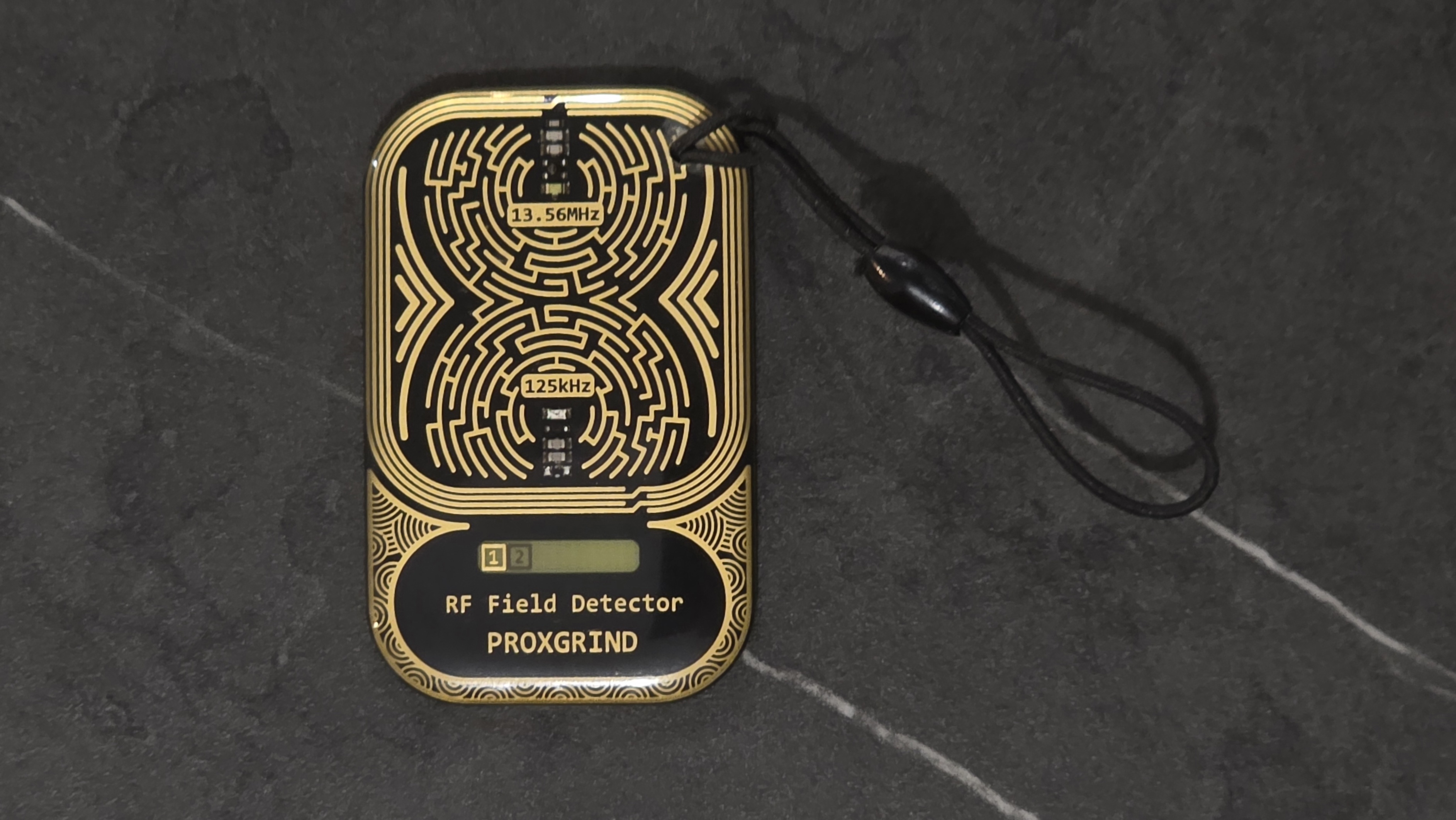
What is an RFID Field Detector?
The RFID Field Detector is a handheld device that instantly detects the presence of RF energy at 125 kHz (LF) and 13.56 MHz (HF) frequencies. Unlike complex spectrum analyzers or software-defined radio setups requiring PC connection, the field detector provides immediate visual and audible feedback when RF fields are present. It's purpose-built for quickly verifying RFID reader installations, detecting unauthorized readers, testing card reader functionality, and performing site surveys without technical complexity.
Primary Use Cases
- Reader Installation Verification: Confirm that newly installed badge readers are transmitting RF fields correctly
- Security Testing: Detect rogue or unauthorized RFID reader installations during penetration tests
- Card Reader Troubleshooting: Quickly diagnose whether a malfunctioning reader is transmitting (hardware failure vs. software issue)
- Site Surveys: Map RF field coverage and identify dead zones or interference areas
- Badge Cloning Detection: Identify suspicious RFID reader activity during facility walkthroughs
- Antenna Testing: Verify proper antenna operation and RF output without expensive test equipment
Hardware Specifications
| Specification | Typical RFID Field Detector | Notes |
|---|---|---|
| Frequency Detection | 125 kHz (LF) and 13.56 MHz (HF) | Covers both standard RFID frequency bands |
| Detection Range | 0.5 – 2 meters (varies by field strength) | Portable; hand-held operation |
| Sensitivity | Adjustable (typical 3-level or continuous dial) | Allows detection of weak fields or blockage detection |
| Field Strength Display | LED bargraph or LCD screen | Visual indication of relative field intensity |
| Audio Feedback | Audible beep (adjustable volume or pulsing) | Tone intensity increases with field strength |
| Frequency Band Switch | Manual toggle (125 kHz / 13.56 MHz) | Switch between bands as needed |
| Modulation Detection | Basic (on/off detection) | Detects presence; doesn't decode modulation |
| Power Supply | 2-4 AA batteries (typical) | Portable; no external charging required |
| Battery Life | 40-80 hours continuous use | Weeks of periodic field testing |
| Dimensions | ~150mm × 80mm × 40mm (pocket-sized) | Portable EDC tool |
| Operating Temperature | -10°C to +50°C | Stable operation in typical field conditions |
| Antenna Type | Internal dual-resonant coils (125 kHz and 13.56 MHz) | Automatic frequency selection or manual switching |
| Enclosure Rating | IP54 (typical) | Dust and splash resistant |
Key Features
- Dual-Frequency Detection: Switch between 125 kHz and 13.56 MHz instantly; covers all standard RFID bands
- Visual Field Strength Indicator: LED bargraph or LCD display shows relative RF field intensity
- Audible Alert: Beep tone increases in frequency as field strength increases; useful when monitoring hands-free
- Sensitivity Adjustment: Multiple sensitivity levels allow detection of weak fields or near-field vs. far-field assessment
- Instant Activation: Power on and immediately begin detecting; no software, no setup required
- Compact Pocket Size: EDC tool; fits in shirt pocket or equipment bag
- Long Battery Life: Weeks of periodic use on standard AA batteries
- Durable Construction: IP54 rating provides dust and moisture protection for field operations
How It Works
- Power on the detector and select desired frequency (125 kHz or 13.56 MHz)
- Hold the device near the location being tested (typically within 0.5-2 meters of an active reader)
- Visual LED indicator and audible beep respond to RF field presence
- Adjust sensitivity dial to detect stronger or weaker fields
- Move around the area to map field coverage and identify dead zones
Real-World Applications
Application 1: Badge Reader Verification After Installation
A facility installs new access control readers at entry points. Use the field detector to verify:
- RF field is present at the expected location (reader is functioning)
- Field strength is adequate (within 30-50cm of door frame)
- No dead zones exist that could prevent card detection
- Field is contained (not bleeding into unintended areas)
Time Required: 2-3 minutes per door vs. 30-45 minutes with spectrum analyzer + analysis software
Application 2: Rogue Reader Detection During Penetration Test
Security team sweeps facility for unauthorized RFID readers during red team operation:
- Detect hidden or concealed reader installations in suspicious locations
- Confirm presence of RF fields that shouldn't exist (skimming attempts)
- Identify active readers during badge cloning assessment
- Document field strength and coverage of suspicious installations
Advantage: Much faster than RF survey software; no need to open laptops in hallways
Application 3: Troubleshooting Malfunctioning Readers
An access control reader stops responding to valid badges:
- Place field detector near reader; if RF field present → likely firmware/software issue
- No RF field present → likely power supply failure, antenna disconnection, or hardware damage
- Immediately distinguish hardware failure (requires technician) from software issue (requires IT support)
ROI: Saves hours of troubleshooting by quickly identifying problem category
Application 4: Site Survey and Coverage Mapping
Customer wants to understand actual RF field coverage of existing reader network:
- Walk through facility with detector in hand
- Physically map field coverage by marking locations with strong/weak/no signal
- Create quick site coverage diagram without expensive RF survey equipment
- Identify blind spots where visitors can pass undetected by RFID
Strengths
- Instant Results: No software, no setup, no configuration; power on and immediate feedback
- Affordable: Costs less than a single spectrum analyzer; accessible to any technician
- Portable and Discrete: Pocket-sized; won't draw attention like large RF test equipment
- No Training Required: Intuitive operation; anyone can use after 30-second explanation
- Dual-Frequency Coverage: Handles both 125 kHz and 13.56 MHz in single device
- Field Strength Visualization: LED bargraph provides immediate understanding of RF intensity
- Long Battery Life: Weeks of periodic testing on standard batteries
- Hands-Free Operation: Audible beep allows monitoring while performing other tasks
Limitations
- No Modulation Analysis: Detects field presence only; cannot analyze modulation type or protocol
- No Frequency Precision: Detects presence at 125 kHz or 13.56 MHz bands; cannot precisely measure exact frequency
- No Signal Recording: Data cannot be logged or exported for later analysis
- Range Limited: Typically 0.5-2 meters; cannot detect distant installations without moving physically closer
- No Phase/Polarization Info: Detects field strength only; antenna orientation not directly measured
- Simple LED/Audio Feedback: Lacks precision of spectrum analyzer displays for RF professionals
- Environmental Sensitivity: RF interference from other sources can cause false positives in noisy areas
Comparison to Alternative Approaches
| Method | Time Required | Cost | Expertise Needed | Data Recording |
|---|---|---|---|---|
| RFID Field Detector | 2-3 minutes/location | Affordable | None (intuitive) | Manual notes only |
| Spectrum Analyzer | 15-30 minutes/location | Expensive | High (RF expertise) | Yes (frequency data) |
| SDR (RTL-SDR V4) | 10-20 minutes/location | Moderate | Moderate (software setup) | Yes (IQ data) |
| Simple Card Test | 1-2 minutes/location | None (card already exists) | None | No |
Ideal Users
- Access Control Technicians: Quick field verification during reader installation and maintenance
- Security Professionals: Penetration testers assessing RFID security posture
- Facility Managers: Troubleshooting badge reader failures or coverage issues
- IT Support Staff: Quickly diagnosing access control hardware problems
- Red Team Operators: Detecting rogue readers during authorized security assessments
- RFID System Integrators: Verifying proper reader operation after installation
Not Ideal For
- Deep RF analysis requiring frequency precision or modulation details
- Automated frequency surveys requiring data logging and analysis
- Characterizing complex RF environments with multiple signal sources
- Research requiring waveform capture or spectroscopy
Practical Field Tips
- Start at maximum sensitivity and decrease if getting false positives from nearby RF sources
- Move slowly through area to detect field edges and boundaries
- Test at multiple heights (ankle, waist, chest, head) to understand vertical field coverage
- Note dead spots that could allow badge-equipped personnel to bypass readers undetected
- Compare field strength before and after shielding changes to verify effectiveness
Verdict: Essential Quick-Check Tool
The RFID Field Detector is not a replacement for professional spectrum analyzers or SDR-based RF analysis. However, it's an indispensable quick-check tool for anyone working with RFID access control systems. The combination of instant feedback, zero setup complexity, and affordable pricing makes it the obvious choice for field technicians and security professionals who need rapid field verification without lugging spectrum analyzers or setting up PC-based equipment.
Think of it as the digital equivalent of a non-contact voltage detector for electricians—simple, fast, and solves 90% of field problems without requiring advanced test equipment. Every access control technician and penetration tester should carry one.
Best Practices for Maximum Value
- Keep in EDC kit for quick field diagnosis during site visits
- Use as first-line troubleshooting tool before involving spectrum analyzer
- Combine with basic card tests for comprehensive reader verification
- Document field coverage maps for site reference documentation
- Use sensitivity adjustment to detect field boundaries precisely
Final Score
- Ease of Use: 10/10
- Portability: 10/10
- Detection Accuracy: 8/10
- Field Applicability: 9/10
- Value for Money: 10/10
- Overall Rating: 9.4/10
Get Your RFID Field Detector Today!
Add the essential tool to your access control troubleshooting kit. Instant 125kHz and 13.56MHz reader field detection for every technician and security professional.
Get your RFID Field Detector today!
Nici o postare găsită
Scrie un comentariu






We support all major card and digital payment options. More local methods are available and shown during checkout.
You enter into a binding sales contract once you have received an 'order confirmation and sales receipt' email from us, in line with our Sales & Delivery conditions. Therefore, sdrstore.eu has the right to cancel your order in the event of technical problems, delivery failure, Fair use policy and other similar situations.






Your payments are protected by advanced encryption and 3-D Secure authentication for safe online shopping.