





Web-888 16-bit SDR Review: Best Network Receiver
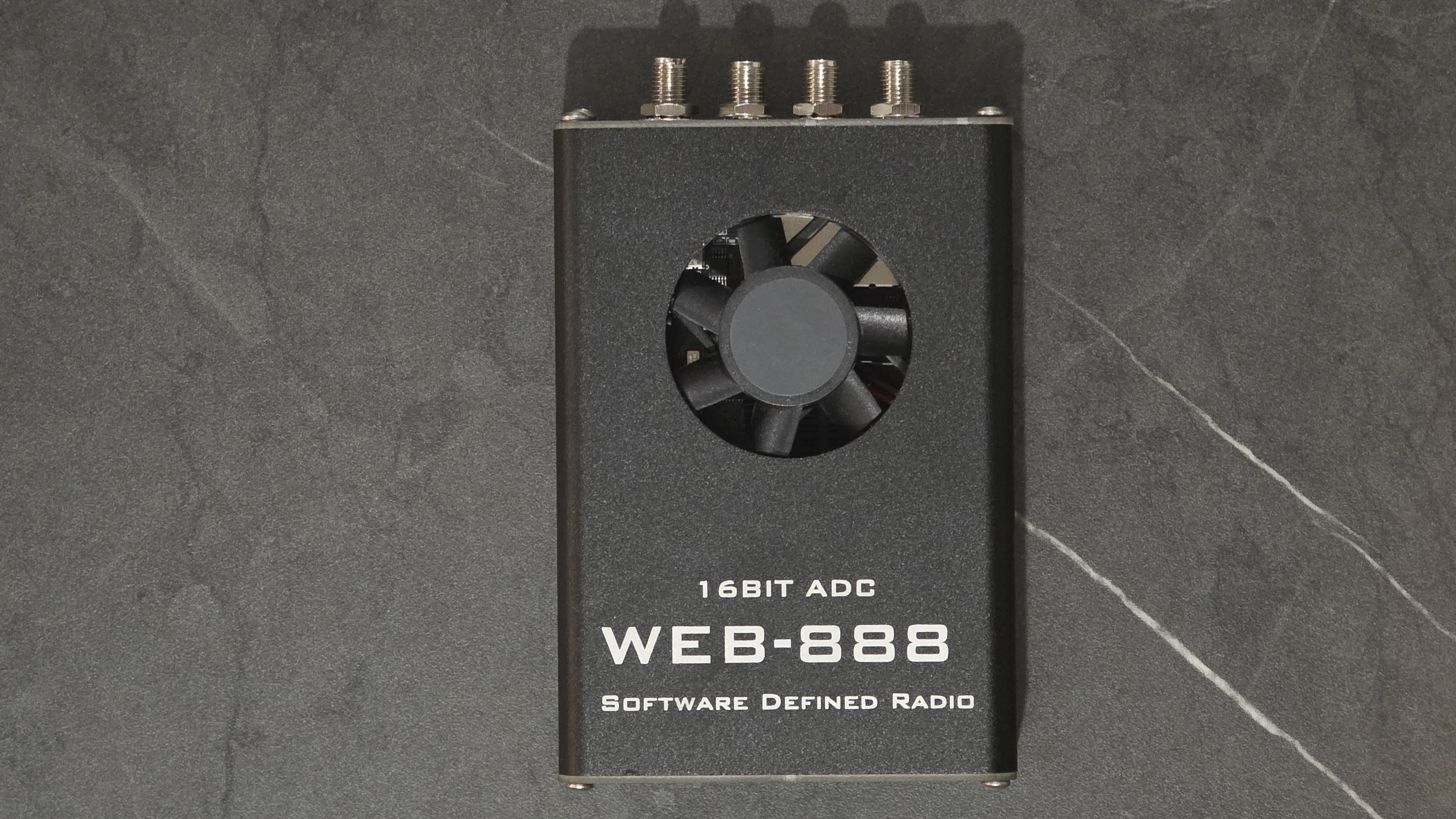
What is the Web-888?
The Web-888 is a network-based software-defined radio designed for stationary HF and VHF reception. Unlike portable USB dongles, the Web-888 operates as a standalone system connected to your network via Gigabit Ethernet. It combines a professional 16-bit ADC (LTC2208), Zynq7010 FPGA with dual ARM cores, and KiwiSDR-based software running on Alpine Linux. The result is a 13-channel simultaneous receiver capable of monitoring multiple frequencies with real-time waterfall displays accessible from any web browser—making it ideal for serious radio monitoring, emergency communications, and HF/VHF research.
Hardware Specifications
| Specification | Web-888 | Notes |
|---|---|---|
| Frequency Range (HF) | 1 kHz – 61.44 MHz | DC coupled for extremely low frequencies |
| Frequency Range (VHF) | 118 MHz – 145 MHz | Aviation and ham radio bands |
| Real-Time Bandwidth | 61.44 MHz | Entire HF spectrum viewable simultaneously |
| ADC Architecture | 16-bit DDC (Digital Down-Converter) | LTC2208 chip, 130 MSPS sampling |
| SFDR (Spurious-Free Dynamic Range) | ~100 dB | Exceptional signal purity; minimizes spurious products |
| ADC Sample Rate | Tunable (up to 130 MSPS) | Flexible for different bandwidth requirements |
| FPGA | Xilinx Zynq7010 with dual ARM A9 cores | Processes 13 simultaneous channels on the device |
| Simultaneous RX Channels | 13 channels with waterfall for each | Unprecedented multi-channel capability for SDRs |
| Antenna Inputs | Dual SMA connectors (HF and VHF) | Separate antennas for each band optimal |
| Network Connectivity | Gigabit Ethernet (1000 Mbps) | High-speed, low-latency data streaming |
| Reference Clock | 24.576 MHz TCXO (0.5 ppm) | Precision oscillator; can also accept external reference |
| Expandable GPIO | 8 digital I/O pins | Antenna switching, relay control, external automation |
| GPS Module | Built-in all-constellation GPS | Supports GPS, GLONASS, Galileo, BeiDou for timing sync |
| Power Consumption | 5V/2A (10W typical) | USB-C power; low operational power requirements |
| Operating System | Alpine Linux 3.20 (Linux 6.6 kernel) | Lightweight OS optimized for embedded SDR |
| Physical Dimensions | 100mm × 71mm × 25.2mm (excluding SMA connectors) | Compact single-board form factor |
| Cooling | Active cooling fan (40mm) | Maintains stable operation during continuous use |
| Storage | TF card (microSD) slot | For system files and user data logging |
Key Advantages Over Competitors
- 13-Channel Simultaneous Reception: Unique capability among affordable SDRs; monitor 13 different frequencies or bands simultaneously with full waterfall for each.
- 16-bit ADC vs. 8-bit Dongles: 256× better vertical resolution than RTL-SDR; reveals weak signals hidden by 8-bit quantization noise.
- 61.44 MHz Real-Time Bandwidth: Entire HF spectrum visible at once; no frequency switching or scanning required.
- Network-Based Architecture: Access from any device on your network or internet via web browser; no PC required at the receiver location.
- Professional-Grade Design: Inherited RF and ADC design from RX-888 (professional-grade); proven robust performance.
- Open-Source Software: KiwiSDR-based codebase with active community; highly customizable and extensible.
- Built-In Decoders: WSPR, FT8 skimmers, and other digital mode decoders built into the interface.
Software Capabilities
- Web-Based Interface: OpenWebRX interface accessible from any web browser; no software installation required on client machines.
- KiwiSDR Protocol Support: Compatible with KiwiSDR websocket protocol; third-party applications can stream audio and spectrum data.
- Multi-User Streaming: Support for multiple simultaneous users viewing spectrum and listening to different frequencies.
- Built-In Decoders:
- WSPR (Weak Signal Propagation Reporter)
- FT8 skimmer (digital mode monitoring)
- CW, AM, USB, LSB, FM demodulation
- Extensible plugin architecture for custom decoders
- Waterfall Recording: Continuous capture of spectrum data for later analysis.
- Antenna Switching: GPIO-controlled antenna selection via web interface.
- Real-Time Performance Monitoring: System metrics, GPU usage, network bandwidth visible in admin interface.
Performance Benchmarks
- HF Broadcast (1-15 MHz): Receives distant international broadcasts with excellent clarity; weak signal detection rivals professional receivers.
- Amateur Radio Monitoring (3.5-28 MHz): Full SSB, CW, and digital mode reception capability; simultaneous monitoring of multiple ham bands.
- WSPR Reception: Exceptional performance at detecting weak propagation beacons; useful for ionospheric monitoring.
- FT8 Skimming: Automatic FT8 signal detection and spotting to PSKREPORTER; popular for digital mode activity tracking.
- VHF Monitoring (118-145 MHz): Aviation and ham radio VHF band reception with full waterfall display.
- Multi-Channel Stability: All 13 channels maintain independent frequency stability; no crosstalk between channels.
Operational Modes
- Shared Mode: Up to 13 simultaneous clients; each can zoom up to level 9 on waterfall displays.
- Exclusive Mode: Only 2 simultaneous clients; can zoom up to level 13 for detailed analysis.
- Single-User Mode: Full device resources allocated to single operator.
What's Included
- 1× Web-888 SDR receiver board (fully assembled)
- 1× USB-C power cable
- Optional: Pre-configured SD card with optimized firmware (varies by vendor)
- Optional: Antenna kit (check vendor offerings)
Recommended Accessories
- HF Antenna: Long-wire, dipole, or loop antenna for optimal HF reception
- VHF Antenna: Dedicated antenna for 118-145 MHz band monitoring
- Gigabit Network Switch: Dedicated switch for stable, low-latency connection
- External GPS Antenna: Better timing synchronization than built-in module
- Reference Clock: Precision external clock for laboratory-grade stability
- SMA Splitter/Combiner: If using wideband antenna for both HF and VHF
Comparison to Alternatives
| Device | ADC Bits | Channels | Bandwidth | Network | Best For |
|---|---|---|---|---|---|
| Web-888 | 16-bit | 13 simultaneous | 61.44 MHz | Gigabit Ethernet | Professional HF monitoring |
| KiwiSDR | 14-bit | 4 simultaneous | 30 MHz | Gigabit Ethernet | Community web SDR |
| RTL-SDR V4 | 8-bit | 1 | 2.4 MHz | USB (local only) | Budget portable |
| RX-888 | 16-bit | 1 | 61.44 MHz | USB 3.0 (PC required) | Wideband lab recording |
| KiwiSDR 3 (future) | 16-bit (est.) | ~8 channels (est.) | 62 MHz (est.) | Gigabit Ethernet | Next-gen network SDR |
Real-World Use Cases
- Emergency Communication Center: Monitor multiple amateur radio frequencies simultaneously for emergency response coordination.
- Ionospheric Research: Continuous WSPR reception and analysis for propagation studies and space weather monitoring.
- Community Web SDR: Public-facing network SDR accessible globally for radio monitoring without receiver ownership.
- Aviation Monitoring: Dedicated VHF receiver for air traffic control frequency monitoring with spectrum display.
- Radio Astronomy: Utilize full 61.44 MHz bandwidth for solar radio observations and discrete source detection.
- Signal Intelligence: Professional-grade HF band monitoring with persistent spectrum logging for threat detection.
- Educational Teaching Lab: 13-channel capability allows multiple students to monitor different frequencies simultaneously from one device.
Strengths
- Unmatched Channel Count: 13 simultaneous channels with waterfall—only Web-888 offers this capability at this price point.
- Professional-Grade ADC: 16-bit resolution delivers signal quality competitive with benchtop equipment.
- Full HF Coverage: 1 kHz to 61.44 MHz captures entire HF spectrum in real-time; no compromises on frequency coverage.
- Network Architecture: Access from anywhere; no tethered PC required; multiple users simultaneously.
- Built-In Decoders: WSPR and FT8 skimmers integrated; no external software dependencies.
- Compact Design: Single-board form factor with active cooling fits anywhere; minimal physical footprint.
- Open-Source Software: KiwiSDR codebase ensures ongoing development and community support.
- Precision Timing: Built-in GPS and 0.5 ppm TCXO enable accurate synchronization for coordinated measurements.
- Extensible GPIO: 8 digital I/O pins enable antenna switching, relay control, and external automation.
Limitations
- Network Dependency: Requires stable Gigabit Ethernet connection; no standalone operation without network.
- Installation Complexity: Initial setup requires Linux familiarity; not plug-and-play like USB dongles.
- Limited Commercial Support: Community-based support; some hardware variants have inconsistent documentation.
- VHF-Only Above 145 MHz: Cannot receive UHF or microwave bands (unlike HackRF or USRP).
- No Transmit: Receive-only; cannot generate RF signals or perform full-duplex testing.
- Power Supply Required: Unlike portable USB dongles, needs stable 5V power supply at receiver location.
- SD Card Updates: Firmware updates require SD card access; not as streamlined as USB-based alternatives.
Ideal Users
- HF Radio Enthusiasts: Full spectrum monitoring for DXing, WSPR, FT8, and digital modes.
- Radio Professionals: Emergency services, communications centers, radio observatories.
- Radio Astronomy: Researchers using SDRs for solar observations and spectroscopy.
- Community Web SDR Operators: Public-facing receivers for global radio access.
- Signal Intelligence Analysts: Professional-grade HF monitoring and threat detection.
- Educational Institutions: Radio engineering programs needing multi-user simultaneous reception.
Not Ideal For
- Portable/mobile SDR use (requires stationary network installation)
- UHF/microwave applications (limited to HF + VHF aviation band)
- Users needing transmit capability (receive-only)
- Beginners uncomfortable with Linux and network administration
Verdict: Professional-Grade Network SDR Excellence
The Web-888 represents a significant leap forward for network-based SDR systems. It delivers professional-grade 16-bit ADC performance, unprecedented 13-channel simultaneous reception, and the full HF spectrum visible in real-time. For stationary HF and VHF monitoring, emergency communications, propagation research, and radio astronomy applications, the Web-888 has no equal in its performance class. The network-based architecture enables unprecedented accessibility—multiple operators worldwide can access the same receiver simultaneously via web browser.
The Web-888 is not a replacement for portable USB dongles (RTL-SDR) or full-bandwidth research platforms (USRP). It's a specialized tool for serious HF and VHF monitoring that fills a genuine gap between budget receivers and expensive professional systems. If your primary use is HF band monitoring, WSPR/FT8 reception, or emergency communications, the Web-888's combination of performance, channel count, and network accessibility is genuinely unmatched.
Final Score
- RF Performance: 10/10
- Channel Capability: 10/10
- Ease of Setup: 6/10 (requires Linux experience)
- Software Maturity: 9/10
- Value Proposition: 9/10
- Overall Rating: 8.8/10
Get Your Web-888 Today!
Experience professional-grade HF reception with 13-channel simultaneous monitoring. The Web-888 sets the standard for network-based software-defined radio—perfect for serious operators, researchers, and emergency communications.
Get your Web-888 today!
Nessun messaggio trovato
Scrivi una recensione






We support all major card and digital payment options. More local methods are available and shown during checkout.
You enter into a binding sales contract once you have received an 'order confirmation and sales receipt' email from us, in line with our Sales & Delivery conditions. Therefore, sdrstore.eu has the right to cancel your order in the event of technical problems, delivery failure, Fair use policy and other similar situations.






Your payments are protected by advanced encryption and 3-D Secure authentication for safe online shopping.