



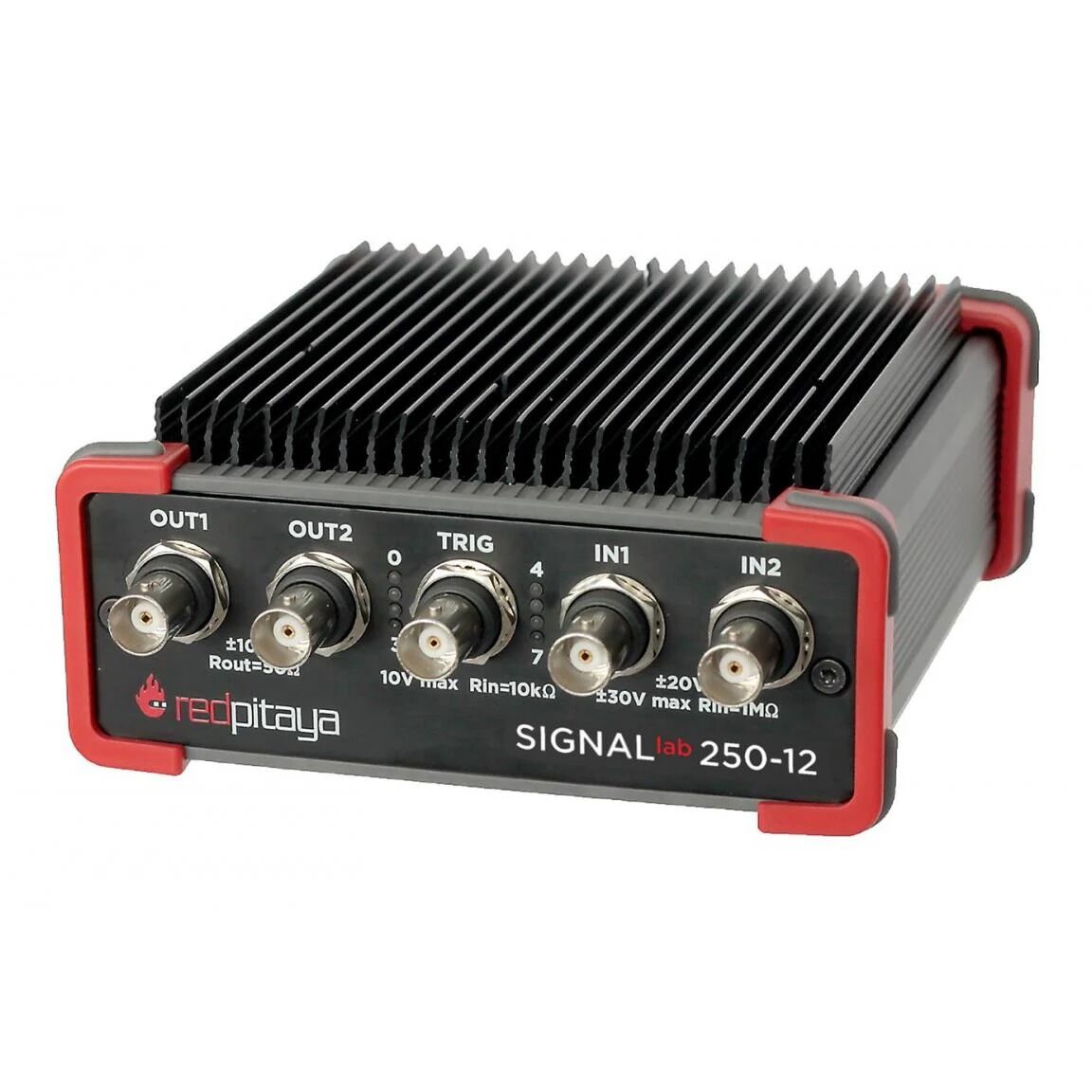
Red Pitaya SIGNALlab 250-12 Standard Kit IZD0024 250MS/s



We offer free shipping for orders over 415 EUR. Free shipping also applies to products marked with the Free Shipping sticker, even if the order total is below this amount. Availability and delivery times may vary depending on your country.


- Order Protection: If your order is lost, we guarantee a replacement or a refund. Terms apply.
- Easy Returns: Enjoy a simple and hassle-free return process.
- Flexible Payments: Choose from multiple secure payment options that fit your needs.
- Best Prices: Get the best value on all our products.
The Red Pitaya SIGNALlab 250-12 Standard Kit IZD0024 is a high-performance programmable measurement and signal-generation platform designed for demanding electronics development, industrial testing, research, and laboratory automation. It combines a dual-channel 250MS/s digitizer, dual high-speed signal outputs, Xilinx Zynq-7020 FPGA processing, dual-core ARM computing, Gigabit Ethernet, and a robust aluminium enclosure in one compact instrument.
With a DC to 60MHz analog bandwidth and full software control over its analog front end, SIGNALlab 250-12 can replace several traditional laboratory instruments, including an oscilloscope, function generator, spectrum analyzer, Bode analyzer, and data acquisition platform.
High-Speed 250MS/s Signal Acquisition
The SIGNALlab 250-12 provides two simultaneous analog input channels capable of sampling at up to 250MS/s. Its 12-bit ADC architecture provides significantly more detail than basic 8-bit oscilloscopes while retaining the high sampling speed required for RF, embedded, power-electronics, and general signal-analysis applications.
- 2 simultaneous analog input channels
- 250MS/s sampling rate per channel
- 12-bit ADC resolution
- DC to 60MHz analog bandwidth
- 1MΩ input impedance
- AC and DC input coupling
- Selectable ±1V and ±20V full-scale input ranges
Dual High-Speed Signal Generator Outputs
Two integrated DAC channels allow the SIGNALlab 250-12 to generate sine waves, square waves, arbitrary waveforms, sweeps, and custom test signals directly from the same platform.
- 2 analog output channels
- 250MS/s output sampling rate
- 14-bit DAC resolution
- DC to 60MHz output bandwidth
- 50Ω output load support
- Short-circuit protection
- Software-controlled output amplitude and waveform generation
Xilinx Zynq-7020 FPGA and Dual-Core ARM Processor
The SIGNALlab 250-12 is built around the AMD Xilinx Zynq-7020 SoC, combining FPGA logic with a dual-core ARM Cortex-A9 processor. This hybrid architecture allows time-critical signal processing to run directly in programmable logic while Linux applications, networking, automation, and user software run on the ARM processor.
The larger Zynq-7020 FPGA provides substantially more real-time processing resources than entry-level Red Pitaya boards, making the SIGNALlab platform suitable for advanced custom DSP, triggering, streaming, and instrumentation applications.
Programmable Oscilloscope and Function Generator
The included oscilloscope and signal-generator application allows users to observe electrical signals and generate test waveforms from the same browser-based interface. This makes the platform useful for electronics development, debugging, component testing, and automated measurements.
Spectrum Analyzer
Frequency-domain analysis allows users to inspect the spectral components of captured signals and identify harmonics, noise, interference, oscillations, and unwanted frequency content up to the supported analog bandwidth.
Bode Analyzer
The included Bode Analyzer application can measure the frequency response of amplifiers, filters, control systems, and other devices under test. Gain and phase measurements can be performed over a configurable frequency range using the integrated signal generator and ADC channels.
PoE Power and Gigabit Ethernet
Current SIGNALlab 250-12 units support Power over Ethernet, allowing compatible installations to provide network communication and power through a single Ethernet cable. This can simplify remote laboratory, rack, production, and industrial deployments.
Gigabit Ethernet also provides high-speed remote connectivity for browser applications, automated measurement systems, and data streaming.
External Trigger and Reference Clock
Dedicated BNC connections are provided for external triggering and reference clock input. These interfaces make it easier to integrate the SIGNALlab 250-12 with external laboratory equipment and synchronized measurement setups.
Remote Control and Automation
The SIGNALlab 250-12 can be controlled remotely through Red Pitaya software interfaces and SCPI commands, making it suitable for automated test systems and remotely operated laboratories.
- Python
- MATLAB
- LabVIEW
- C
- Scilab
- SCPI-based automation
Browser-Based Instrument Interface
Red Pitaya applications can be accessed through a standard web browser over Ethernet or a compatible Wi-Fi dongle. This allows the instrument to be operated from Windows, Linux, macOS, tablets, and other devices with a modern browser.
Key Features
- Red Pitaya SIGNALlab 250-12 Standard Kit
- Manufacturer part number: IZD0024
- AMD Xilinx Zynq-7020 SoC
- Dual-core ARM Cortex-A9 processor
- 1GB RAM
- 2 × 12-bit analog input channels
- 250MS/s ADC sampling rate
- DC to 60MHz input bandwidth
- 2 × high-speed analog output channels
- 250MS/s DAC sampling rate
- 14-bit DAC resolution
- DC to 60MHz output bandwidth
- Selectable analog input ranges
- AC/DC input coupling
- Gigabit Ethernet
- Power over Ethernet support
- USB connectivity
- Optional Wi-Fi using a compatible dongle
- External trigger input
- External reference clock input
- SATA daisy-chain synchronization support
- Open-source and programmable architecture
- Aluminium enclosure included
Expansion Interfaces
- 16 digital I/O lines
- 4 × 12-bit analog inputs, 0–3.5V
- 4 × 12-bit analog outputs, 0–1.8V
- I2C
- SPI
- UART
- Available extension voltages including 3.3V and 5V
Included Red Pitaya Applications
- Oscilloscope
- Signal generator
- Spectrum analyzer
- Bode analyzer
- Streaming
- SCPI server for remote control
- Python/Jupyter development support
Typical Applications
- Electronic circuit development
- High-speed oscilloscope measurements
- Function and arbitrary waveform generation
- Spectrum analysis
- Filter and amplifier characterization
- Automated test equipment
- Production-line testing
- Industrial measurement systems
- Control-system development
- FPGA and DSP development
- University and research laboratories
- Remote laboratory instrumentation
Technical Specifications
- Manufacturer: Red Pitaya
- Manufacturer part number: IZD0024
- Platform: SIGNALlab 250-12
- FPGA/SoC: AMD Xilinx Zynq-7020
- Processor: dual-core ARM Cortex-A9
- RAM: 1GB
- System storage: microSD up to 32GB
- Analog inputs: 2 channels
- ADC resolution: 12-bit
- ADC sampling rate: 250MS/s
- Input bandwidth: DC–60MHz
- Input impedance: 1MΩ
- Input coupling: AC/DC
- Input range: ±1V / ±20V
- Analog outputs: 2 channels
- DAC resolution: 14-bit
- DAC sampling rate: 250MS/s
- Output bandwidth: DC–60MHz
- Output load: 50Ω
- Ethernet: 1Gbit
- USB: 2 × USB 2.0
- Wi-Fi: supported with compatible USB dongle
- Trigger input: dedicated BNC
- Reference clock input: dedicated BNC
What’s in the Box?
- 1 × Red Pitaya SIGNALlab 250-12 digitizer in aluminium housing
- Oscilloscope probes
- microSD card
- Power supply
- USB-A to USB-C cable
- Ethernet cable
Optional Accessories
Logic analyzer probes, the Logic Analyzer Extension Module, LCR accessories, and other Red Pitaya expansion hardware are available separately unless explicitly included in the selected bundle.
Professional Programmable Test Instrument
The Red Pitaya SIGNALlab 250-12 is an excellent choice for engineers, researchers, universities, and industrial users who need high-speed acquisition, programmable signal generation, FPGA processing, remote control, and flexible test automation in a compact instrument.
No questions yet
No reviews found
Find the right RF tool
Tell us what you want to build, test, receive, or analyze. Our AI assistant will match your use case with products from our catalog.
Do not include personal, confidential, or sensitive information in your request.