


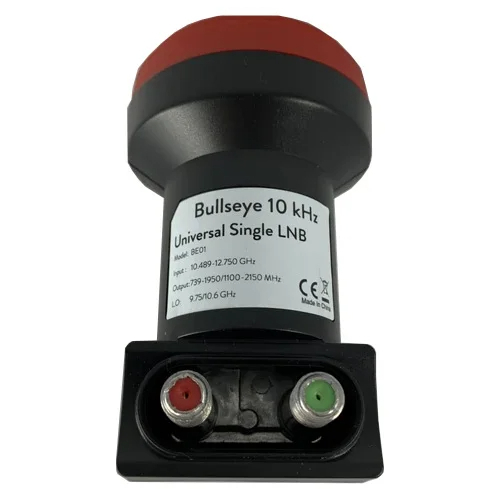


Hallo, ich hätte ein paar Fragen zum
Bullseye:
1.Gibt es eine Begrenzung beim 10ghz Eingang bzw. der ZF?
Benötige 10.200Ghz Eingang würde rechnerisch bei 9750/ 450Mhz ZF bedeuten.
2.Wieweit lässt sich die 25Mhz Injektions Frequenz ziehen?
3.Ist das Oberband / 10.500 / 22Khz noch funktionsfähig und ließe sich dieser auf 11.000 ziehen bzw. erweitern.
Vielen Dank für die Bemühungen
73 de Dg7naj
Hans
Hello Hans,
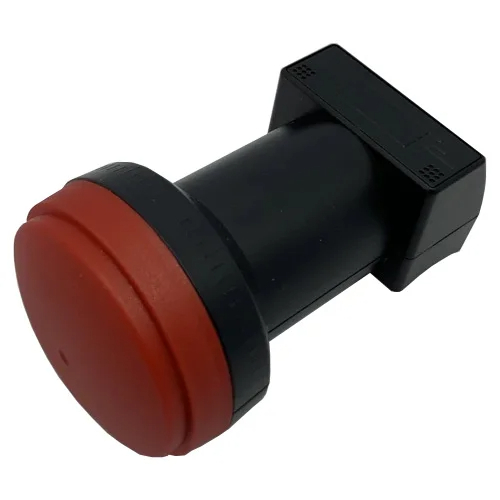
Thank you for your questions about the Bullseye TCXO LNB. Here are the answers based on the product’s specifications:
1. Is there a limitation at 10 GHz input or the IF? I need 10.200 GHz input, which would mathematically mean 9750/450 MHz IF.
The Bullseye LNB input frequency range covers 10489 MHz up to 12750 MHz. A 10.200 GHz signal is below the specified input range, so the LNB cannot properly downconvert that frequency.
• Output IF ranges are approximately 739–1950 MHz (low band) and 1100–2150 MHz (high band) based on the L.O. being 9750/10600 MHz, respectively.
2. How far can the 25 MHz injection/reference frequency be pulled?
The 25 MHz output is a reference signal taken from the internal TCXO. This output is provided so you can monitor or use that stable reference to lock external equipment, but its frequency is fixed at 25 MHz. It is not a variable injection frequency you can sweep.
3. Is the upper band / 10.500 / 22 kHz still functional and could it be extended to 11.000 GHz?
The LNB does receive signals around 10.489 GHz (the QO-100 narrowband downlink) within its input range. Its upper input range goes up to ~12.75 GHz, so in principle frequencies near 11.000 GHz are within the supported input.
However, just tuning the internal LO by tens of MHz (e.g., adjusting 10.500 to 11.000) is not something supported as a user control. The LO options are at the factory-set 9750 MHz (low) and 10600 MHz (high) modes for correct downconversion within the specified IF bands.
Also, the ±22 kHz figure you mention likely refers to frequency stability tolerance, not a tunable range. The TCXO’s stability is typically within about ±10 kHz at 23 °C and variations up to ±30 kHz over wider temperatures.
Summary:
• The Bullseye LNB *does not support a 10.200 GHz input frequency — it starts at ~10.489 GHz.
• The 25 MHz reference is fixed and not user-tunable.
• The LO frequencies are fixed. You can receive up to ~12.75 GHz signals, but you cannot shift the internal LO freely to push a 10.2 GHz signal into the IF.
If you want to receive frequencies outside the Bullseye’s specified input range, you might need an LNB with a suitable LO or an external conversion scheme.
Best regards,
The SDRstore Team