




Robert
Verified purchase


We offer free shipping for orders over 415 EUR. Free shipping also applies to products marked with the Free Shipping sticker, even if the order total is below this amount. Availability and delivery times may vary depending on your country.


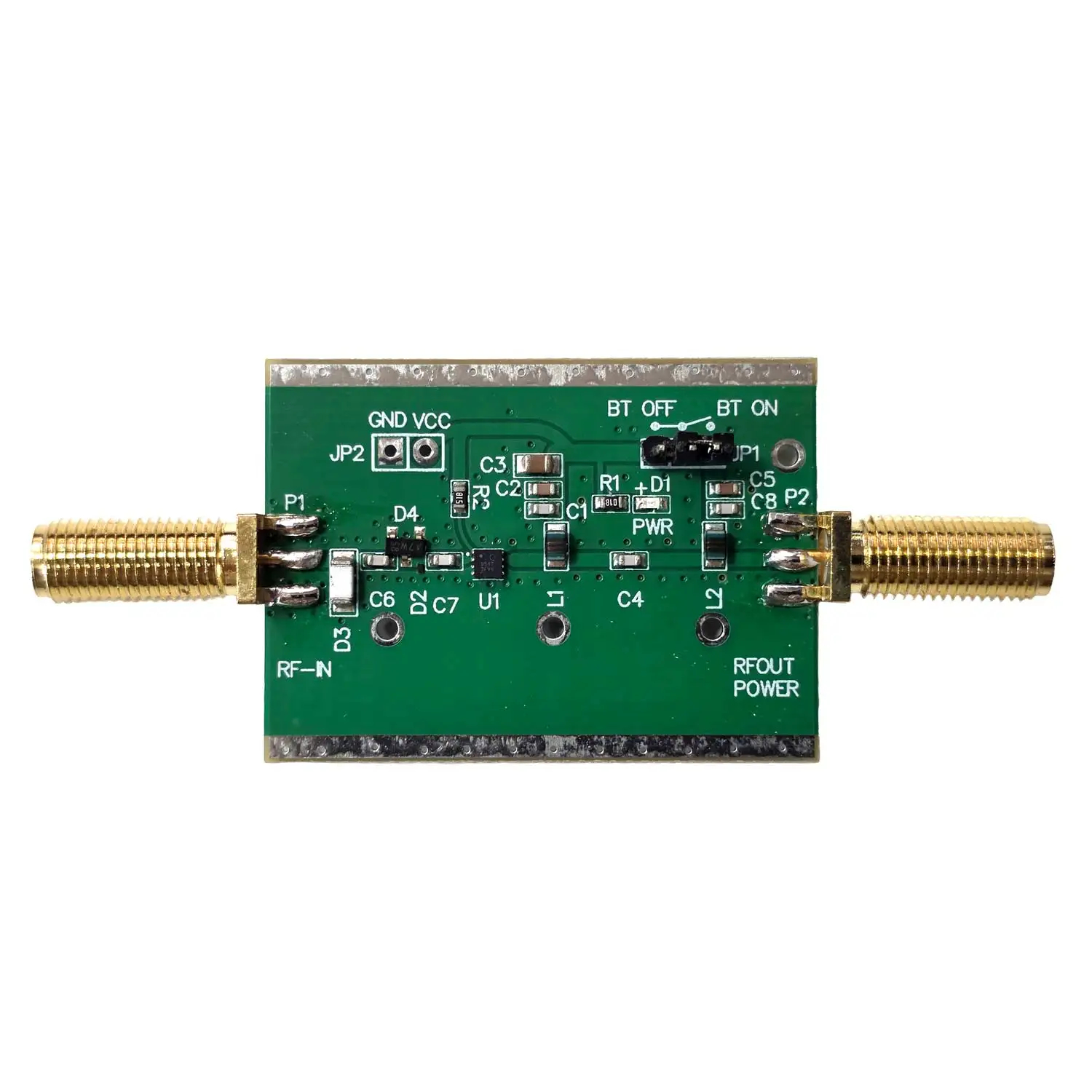
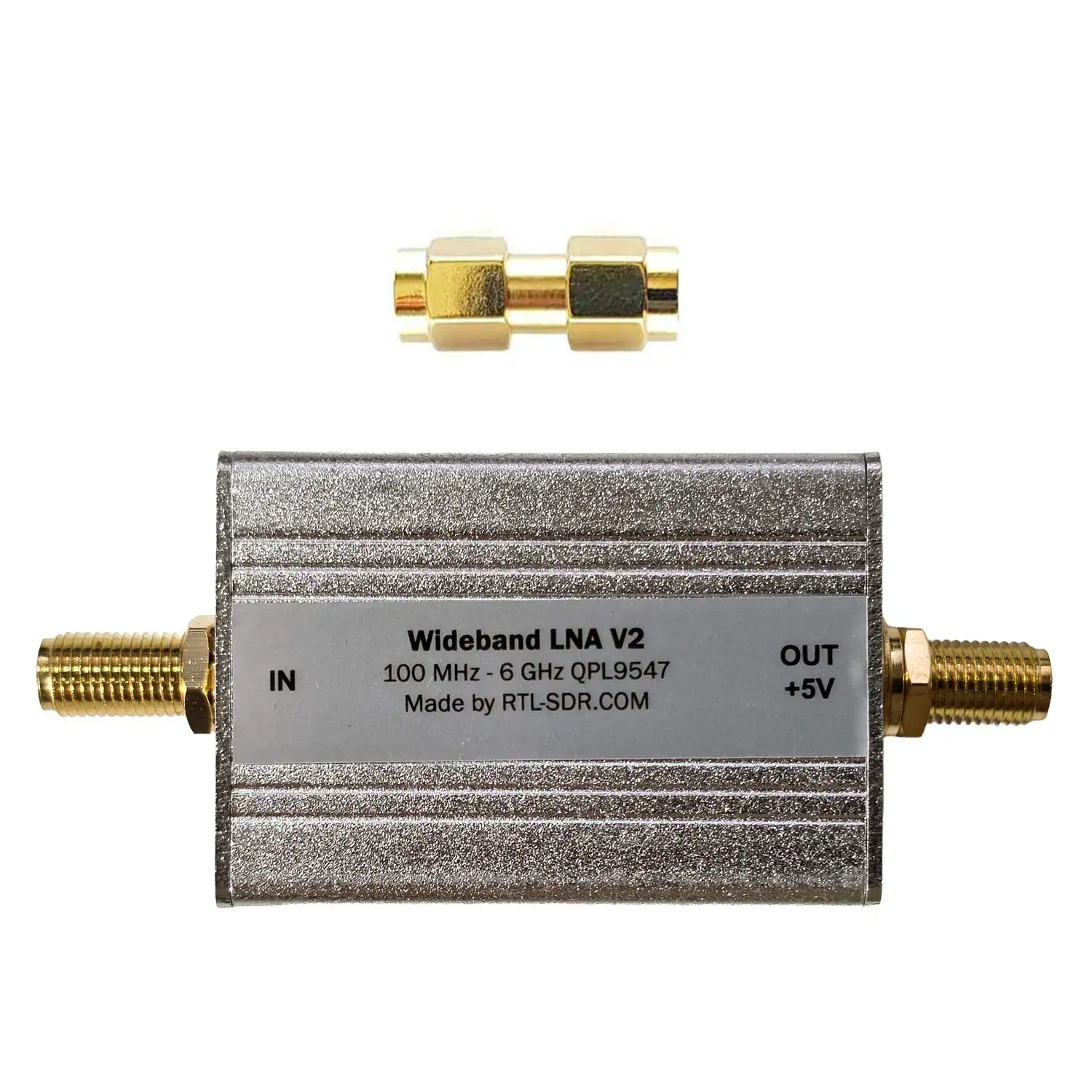
The RTL-SDR Blog Wideband LNA V2 is a general-purpose low-noise RF amplifier designed to improve reception of weak signals across a wide frequency range from approximately 100MHz to 4GHz. Built around the modern Qorvo QPL9547 ultra-low-noise amplifier, it is ideal for software-defined radio receivers, scanners, satellite reception, VHF/UHF monitoring, L-band experiments, and other receive-only RF applications.
With a noise figure below 1dB across its intended operating range, the Wideband LNA V2 can improve overall receiver sensitivity when installed correctly, particularly when used close to the antenna to compensate for coaxial cable and system losses.
The V2 design replaces the older-generation amplifier used in the original RTL-SDR Blog Wideband LNA with the newer Qorvo QPL9547.
The QPL9547 is a high-performance pHEMT low-noise amplifier designed for applications that require low noise and strong linearity across a broad RF range. This makes it well suited to general-purpose SDR receiving systems where a single amplifier may be used across multiple frequency bands.
The RTL-SDR Blog Wideband LNA V2 is designed for reception from approximately 100MHz to 4GHz, covering a large portion of the frequency range used by popular SDR receivers.
This wide frequency response makes one amplifier useful for many different receiving projects rather than being restricted to a single frequency such as 1090MHz ADS-B.
The LNA provides a noise figure of less than 1dB, helping reduce the contribution of receiver noise to the overall RF system.
An LNA is particularly useful when the wanted signal is weak and losses exist between the antenna and SDR. Placing the amplifier near the antenna allows the signal to be amplified before it passes through lossy coaxial cable, connectors, splitters, or other components.
The Wideband LNA V2 requires 3V to 5V DC bias-tee power to operate. Power is supplied through the RF coaxial cable, so a separate power cable is normally unnecessary.
RTL-SDR Blog receivers with an integrated 4.5V software-controlled bias tee are suitable for powering the LNA. This includes compatible RTL-SDR Blog V3, V4, and V4L receivers when their bias tee is enabled.
The LNA will not operate unless a suitable bias tee or external power configuration is used.
An internal header allows the amplifier to be changed from bias-tee power to an external power source if required.
Because the standard aluminium enclosure does not provide an opening for external power wiring, users choosing this configuration will need to modify the enclosure to route the required wires.
For most SDR installations, powering the LNA directly through a compatible bias tee is the simpler and cleaner solution.
For the best receiver performance, the LNA should normally be installed as close to the antenna as practical.
A recommended signal path is:
Antenna → Wideband LNA V2 → Coaxial Cable → SDR Receiver
Installing the amplifier at the receiver end of a long coaxial cable can still provide gain, but it cannot recover signal-to-noise ratio that has already been lost in the feed line.
The Wideband LNA V2 can be paired with RTL-SDR receivers and many other SDRs that use standard 50-ohm RF interfaces. A suitable external bias tee can also be used with receivers that do not provide bias power internally.
Typical receiving applications include:
The Wideband LNA V2 intentionally amplifies a broad range of frequencies. This provides excellent flexibility, but it also means that strong unwanted signals can be amplified together with the desired signal.
In RF environments with powerful FM broadcast, television, cellular, paging, or other nearby transmitters, the LNA may overload itself or the connected SDR receiver. A suitable band-pass, high-pass, low-pass, or notch filter can be added when strong out-of-band interference is present.
For a fixed-frequency application, a dedicated filtered LNA may offer better performance than a general-purpose wideband amplifier.
The Wideband LNA V2 can amplify signals around 1090MHz, but users building a dedicated ADS-B receiving station may benefit more from an ADS-B-specific filtered LNA.
A filtered ADS-B amplifier suppresses strong signals outside the 1090MHz band before they can overload the amplifier or receiver, making it better suited to permanent aircraft-tracking installations in RF-dense environments.
| Manufacturer | RTL-SDR Blog |
|---|---|
| Model | Wideband LNA V2 |
| Amplifier IC | Qorvo QPL9547 |
| Operating Frequency | Approximately 100MHz–4GHz |
| Noise Figure | Less than 1dB |
| Supply Voltage | 3V–5V DC |
| Default Power Method | Bias tee through RF coaxial cable |
| Optional Power Method | External power through internal header |
| RF Connectors | SMA |
| Application | Receive-only RF amplification |
An LNA is most useful when receiving genuinely weak signals or when significant feed-line loss exists between the antenna and receiver. It is not simply a universal signal booster.
If the SDR is already bei
Tell us what you want to build, test, receive, or analyze. Our AI assistant will match your use case with products from our catalog.
Do not include personal, confidential, or sensitive information in your request.
We deliver products internationally.
We offer only those goods, in which quality we are sure
You have 14 days to test your purchase