





LTE Cat 1 vs LTE-M vs NB-IoT: Which Should Your IoT Project Use?
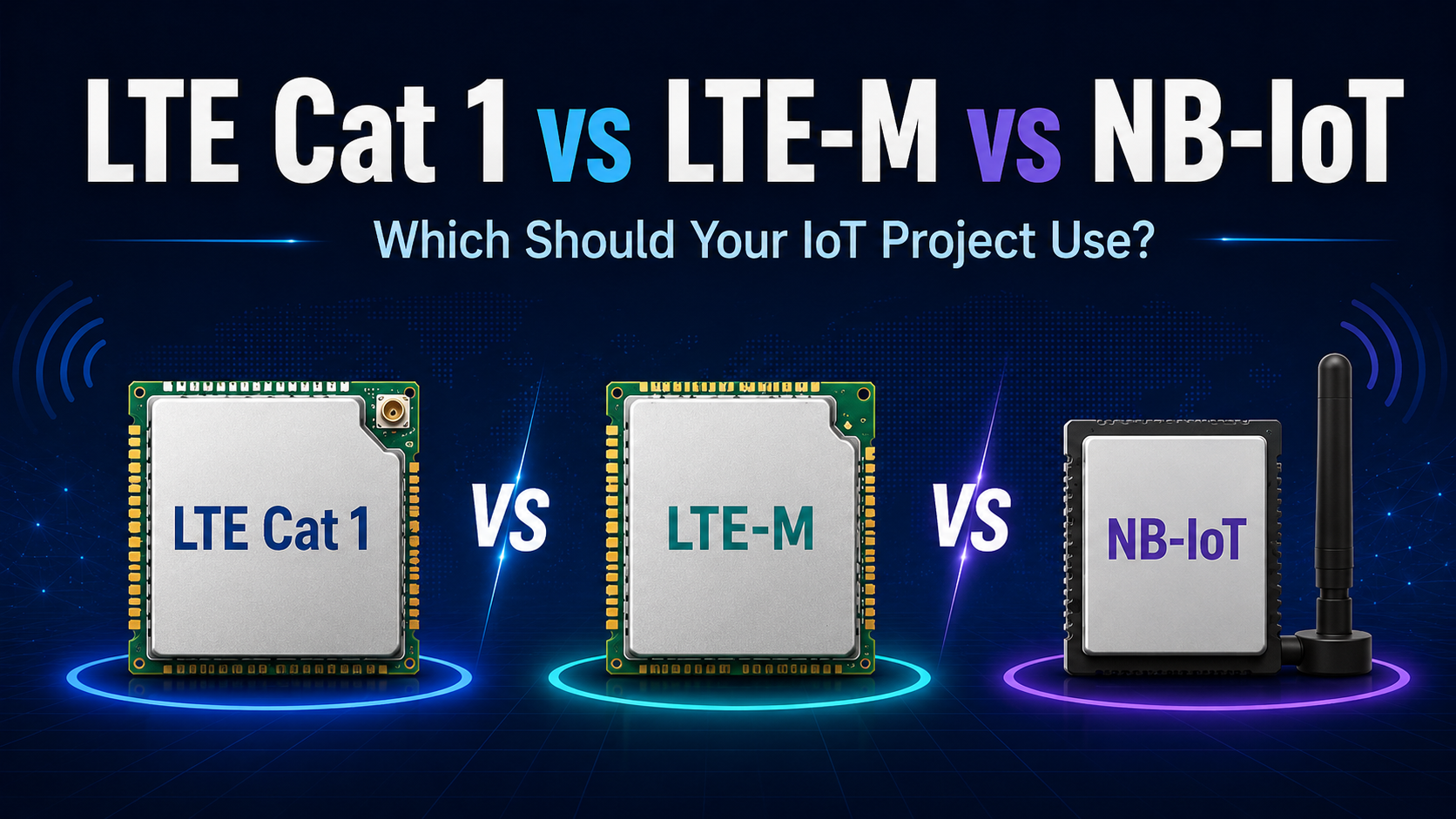
Choosing cellular connectivity for an IoT device is no longer as simple as selecting “4G.”
A product designer can choose between LTE Cat 1, LTE Cat 1 bis, LTE-M and NB-IoT, and all four can connect an IoT device to a cellular network. However, they are optimized for very different combinations of data rate, mobility, battery life, coverage and cost.
The wrong choice can create problems that are difficult to fix after deployment:
- a tracker may lose connectivity while moving;
- a battery-powered sensor may consume far more energy than expected;
- a firmware update may take too long over a narrow connection;
- a device may work in one country but fail to roam in another;
- an underground meter may have inadequate LTE coverage;
- an IoT gateway may simply need far more throughput than NB-IoT can provide.
The practical recommendation is:
- Choose LTE Cat 1 or Cat 1 bis when you need several Mbps, low latency, mobility, frequent firmware updates or conventional LTE coverage.
- Choose LTE-M when battery life matters but the device still moves, needs responsive two-way communication or sends moderate amounts of data.
- Choose NB-IoT when the device is mostly static, transmits small amounts of data infrequently and needs excellent coverage in difficult locations.
This guide explains where each technology fits and how to choose the right cellular module before building the PCB, selecting a SIM or deploying hundreds of devices.
LTE Cat 1 vs LTE-M vs NB-IoT: Quick Comparison
| Feature | LTE Cat 1 / Cat 1 bis | LTE-M | NB-IoT |
|---|---|---|---|
| Typical positioning | Medium-rate cellular IoT | Low-power mobile IoT | Ultra-low-power static IoT |
| Peak data-rate class | About 10 Mbps DL / 5 Mbps UL | Hundreds of kbps to roughly 1 Mbps depending on module/network | Usually tens to low hundreds of kbps depending on release/module/network |
| Channel width direction | Normal LTE carrier operation | Approximately 1.4 MHz LTE allocation / 1.08 MHz occupied radio bandwidth | Approximately 180 kHz |
| Mobility | Excellent | Good; designed for mobility and handover | Primarily static/nomadic; not designed for seamless connected-mode handover |
| Latency | Lowest of the three | Moderate | Highest and most variable |
| Battery optimization | Good on modern IoT modules | Excellent | Excellent |
| PSM/eDRX | Available on many modern IoT implementations | Core IoT feature | Core IoT feature |
| Deep indoor coverage | Normal LTE-class coverage | Improved coverage | Strongest coverage-extension focus |
| Voice | Possible with VoLTE-capable module/operator | Can support VoLTE where implemented | No normal voice service |
| Large FOTA updates | Best | Practical | Possible but often slow and power expensive |
| Video / images | Possible for modest applications | Limited | Poor fit |
| Asset tracking | Excellent | Excellent | Only for low-update or mostly stationary cases |
| Smart metering | Possible | Excellent | Excellent |
| Underground / deep-building sensor | Possible but not ideal | Good | Excellent when network support exists |
| Global simplicity | Often strongest because normal LTE coverage is widespread | Good, but operator support must be checked | Good in supported markets, but roaming/deployment varies |
The Simplest Decision Rule
If your device:
- moves frequently;
- uploads images;
- downloads large firmware updates;
- needs responsive remote control;
- streams audio;
- functions as a gateway;
start your evaluation with LTE Cat 1 or Cat 1 bis.
If it:
- runs on a small battery;
- moves regularly;
- needs GPS tracking;
- sends telemetry every few minutes;
- needs reasonable downlink responsiveness;
start with LTE-M.
If it:
- stays installed in one place;
- wakes a few times per day;
- sends only a few bytes or kilobytes;
- needs years of battery life;
- sits inside a meter cabinet, basement or underground installation;
start with NB-IoT.
What Is LTE Cat 1?
LTE Category 1 was introduced much earlier than LTE-M and NB-IoT.
It is a lower-complexity LTE user-equipment category designed to provide normal LTE mobility and networking without the very high throughput of Cat 4, Cat 6 or modern smartphone modems.
The standard Cat 1 throughput class is approximately:
- 10 Mbps downlink;
- 5 Mbps uplink.
That is far more than most sensors require, but extremely useful for IoT products that exchange larger amounts of data.
Typical LTE Cat 1 applications
- GPS trackers;
- fleet telematics;
- payment terminals;
- industrial gateways;
- security panels;
- remote diagnostic systems;
- digital signage;
- smart vending equipment;
- portable terminals;
- small cameras sending snapshots;
- voice-capable devices;
- products migrating from 2G/3G.
What Is LTE Cat 1 bis?
Cat 1 bis is especially important for new IoT products in 2026.
Standard LTE Cat 1 uses receiver diversity and traditionally requires two receive paths.
Cat 1 bis removes the second receive path and allows a single receiving antenna while maintaining the same basic Cat 1 throughput class.
This can reduce:
- module complexity;
- PCB area;
- RF front-end complexity;
- antenna count;
- BOM cost;
- integration effort.
That is why many modern cellular IoT modules now use Cat 1 bis.
Cat 1 vs Cat 1 bis
| Feature | Cat 1 | Cat 1 bis |
|---|---|---|
| Peak DL | 10 Mbps | 10 Mbps |
| Peak UL | 5 Mbps | 5 Mbps |
| Mobility | Yes | Yes |
| LTE handover | Yes | Yes |
| Receive diversity | Yes | Removed |
| Receive antennas | Normally two paths | One |
| Hardware complexity | Higher | Lower |
| Cell-edge reception | Potential advantage from diversity | Can be somewhat weaker because diversity is removed |
For many new IoT designs, Cat 1 bis is the more relevant technology to compare against LTE-M.
What Is LTE-M?
LTE-M is the common industry name for LTE-MTC, including Cat-M1 devices introduced for cellular low-power wide-area applications.
It was specifically designed to reduce:
- modem complexity;
- radio bandwidth;
- power consumption;
- device cost;
while retaining important LTE features such as mobility.
LTE-M occupies a much narrower LTE allocation than ordinary LTE equipment.
3GPP specifications commonly describe approximately:
1.08 MHz occupied radio bandwidth within a 1.4 MHz LTE allocation.
This narrower architecture allows a simpler modem while still providing significantly more data capability and responsiveness than NB-IoT.
Typical LTE-M applications
- asset trackers;
- fleet telemetry;
- wearables;
- alarm systems;
- medical telemetry;
- portable sensors;
- pet trackers;
- industrial monitoring;
- cold-chain monitoring;
- smart-city equipment;
- battery-powered GPS devices.
What Is NB-IoT?
Narrowband Internet of Things takes the low-power cellular concept even further.
NB-IoT uses approximately:
180 kHz of radio bandwidth.
Its design prioritizes:
- very low data requirements;
- low device complexity;
- coverage extension;
- deep indoor penetration;
- massive numbers of endpoints;
- long sleep periods.
NB-IoT is excellent when the device spends almost all of its life asleep and occasionally reports a small measurement.
Typical NB-IoT applications
- water meters;
- gas meters;
- electricity meters;
- parking sensors;
- environmental sensors;
- agricultural telemetry;
- tank-level monitoring;
- basement sensors;
- industrial status sensors;
- smart-city infrastructure;
- utility monitoring.
LTE Cat 1 Is Much Faster
Throughput is one of the easiest differences to understand.
| Technology | Data-rate direction |
|---|---|
| LTE Cat 1 | Up to approximately 10 Mbps DL / 5 Mbps UL |
| LTE-M | Hundreds of kbps to around 1 Mbps depending on modem and implementation |
| NB-IoT | Tens to low hundreds of kbps depending on modem, release and network conditions |
Actual network throughput is usually lower than modem headline figures.
Coverage-extension modes, congestion, RF conditions, operator configuration, protocol overhead and power-saving behavior all reduce practical speed.
Real Hardware Example: SIMCom A7670 Cat 1
The LILYGO T-Call A7670 provides a useful Cat 1 development platform.
Its A7670E-family modem is officially specified around:
- LTE Cat 1;
- up to 10 Mbps downlink;
- up to 5 Mbps uplink;
- LTE mobility;
- TCP/IP-based networking;
- FOTA support;
- GNSS options depending on implementation;
- regional LTE-band variants.
Combined with an ESP32, the board is suitable for prototypes such as:
- vehicle trackers;
- industrial controllers;
- remote data loggers;
- payment-style terminals;
- cellular gateways;
- portable telemetry devices.
Real Hardware Example: SIM7080G LTE-M + NB-IoT
The LILYGO T-SIM7080G-S3 is useful when evaluating LTE-M and NB-IoT on the same board.
Its SIMCom SIM7080G supports both modes.
SIMCom currently specifies:
| SIM7080G mode | Downlink | Uplink |
|---|---|---|
| Cat-M | Up to 589 kbps | Up to 1119 kbps |
| Cat-NB | Up to 127 kbps | Up to 158.5 kbps |
The module also supports protocols including:
- TCP;
- UDP;
- HTTP/HTTPS;
- MQTT;
- CoAP;
- LwM2M;
- TLS/DTLS;
- FOTA.
SIMCom lists module-level PSM current around 3.2 µA under its specified conditions.
That number should not be confused with complete-board consumption. The ESP32, voltage regulator, sensors, LEDs, GNSS and other circuitry also consume power.
LTE-M vs NB-IoT: The Most Important Difference Is Mobility
LTE-M was designed to support moving IoT devices.
NB-IoT was primarily optimized around stationary or slowly changing deployments.
LTE-M supports connected mobility
A tracker travelling through multiple LTE cells can maintain connectivity using LTE mobility procedures.
This makes LTE-M suitable for:
- vehicles;
- shipping containers;
- portable medical devices;
- wearables;
- high-value assets;
- mobile industrial equipment.
NB-IoT behaves differently
NB-IoT devices can move and perform cell reselection, but the technology is not designed around the same seamless connected-mode handover experience as normal LTE or LTE-M.
That makes it less attractive for continuously moving devices.
Which Is Better for GPS Tracking?
LTE-M or Cat 1.
Choose LTE-M when:
- the tracker is battery powered;
- position updates are small;
- updates occur every few seconds/minutes rather than continuously;
- target operators provide reliable LTE-M coverage.
Choose Cat 1 / Cat 1 bis when:
- you need frequent updates;
- the tracker downloads significant data;
- you need faster FOTA;
- the product may require voice;
- maximum conventional LTE roaming availability matters.
NB-IoT can be used for location-style applications, but it is usually better suited to assets that move rarely and report infrequently.
Which Is Best for Battery Life?
For a tiny sensor sending only small packets, the general ranking is:
NB-IoT / LTE-M → Cat 1
But real battery life is not determined by the technology name alone.
Important variables include:
- PSM configuration;
- eDRX configuration;
- network signal strength;
- coverage repetitions;
- reconnection frequency;
- payload size;
- reporting interval;
- TCP/TLS overhead;
- GNSS operation;
- microcontroller sleep current;
- battery chemistry;
- temperature.
What Is PSM?
Power Saving Mode allows a cellular device to enter an extremely low-power state while remaining registered with the network.
During PSM:
- the modem stops actively monitoring paging;
- the network remembers the registration state;
- the application can sleep for long periods;
- the device wakes later to transmit or perform a scheduled network update.
This avoids performing a complete network attach every time the sensor wakes.
The trade-off is that the server generally cannot immediately contact a modem that is sleeping in PSM.
What Is eDRX?
Extended Discontinuous Reception lets the modem check for network paging less frequently.
This creates a compromise between:
- battery life;
- downlink responsiveness.
A device that needs instant remote commands cannot sleep as aggressively as a water meter that only needs to wake once per day.
PSM and eDRX Depend on the Network
One of the most important deployment lessons is that the modem does not control every timer independently.
The device requests PSM/eDRX parameters, but the network can provide different accepted values.
That means the same firmware can consume different amounts of power on different operators.
For large deployments, test actual SIMs and operators instead of calculating battery life entirely from modem datasheets.
Which Has the Best Coverage?
NB-IoT was explicitly optimized for extended coverage.
LTE-M also improves link budget compared with ordinary LTE devices.
Cat 1 relies more heavily on conventional LTE coverage.
In a normal strong-signal outdoor environment, all three may work perfectly.
The difference becomes more important for:
- basements;
- underground meters;
- parking garages;
- utility cabinets;
- industrial plant rooms;
- remote rural sensors;
- devices embedded inside machinery.
For a fixed sensor in one of these environments, NB-IoT can be extremely attractive—if the intended operator actually provides NB-IoT service on the relevant bands at that site.
Coverage on a Map Is Not Enough
A network operator showing ordinary LTE coverage does not automatically mean the site supports:
- LTE-M;
- NB-IoT;
- the specific band your modem uses;
- roaming for that IoT technology;
- the PSM/eDRX options your design expects.
Before production:
- choose target countries;
- choose target operators;
- identify deployed LTE-M/NB-IoT bands;
- confirm module band support;
- confirm SIM roaming support;
- test the real hardware at representative locations.
LTE-M and NB-IoT Are Still Growing Globally
The GSMA's February 2026 Mobile IoT Deployment Guide states that, as of October 2025, more than:
- 140 NB-IoT networks;
- 129 LTE-M networks;
had been deployed globally.
That is substantial coverage, but availability is still not as uniform as ordinary LTE.
This is one reason Cat 1 bis has become increasingly popular for products that need a straightforward migration from 2G/3G while retaining broad LTE coverage.
Latency: Cat 1 Wins
If your product must react quickly to cloud commands, the general ranking is:
Cat 1 → LTE-M → NB-IoT
Cat 1 behaves like conventional LTE and is best for responsive applications.
LTE-M typically provides enough responsiveness for:
- alarm acknowledgement;
- remote control;
- asset tracking;
- interactive telemetry.
NB-IoT can involve longer delays, particularly when:
- coverage-extension repetitions are active;
- the modem is sleeping;
- PSM is configured aggressively;
- the device needs to reconnect;
- network conditions are poor.
If your specification says “remote command must reach the device in under one second,” NB-IoT should not be selected without extensive real-network validation.
Which Is Best for Firmware Updates?
Firmware-over-the-air capability deserves more attention than it usually receives during modem selection.
Cat 1
Best for large updates.
A multi-megabyte firmware package is straightforward at Mbps-class speeds.
LTE-M
Generally practical for normal embedded-device FOTA.
Transfers take longer but remain manageable.
NB-IoT
Possible, but large firmware files can create challenges:
- long radio-on time;
- higher energy use;
- greater sensitivity to unstable coverage;
- longer maintenance windows.
A sensor that sends only 100 bytes per day may still eventually need a 2 MB security update.
Plan for that before choosing the narrowest possible radio technology.
Which Is Best for MQTT?
All three technologies can support MQTT using suitable modem firmware.
The better question is:
How much MQTT traffic will your application create?
NB-IoT works well for:
- small telemetry messages;
- infrequent publishing;
- simple cloud reporting.
LTE-M is better when:
- messages are more frequent;
- two-way communication matters;
- the server needs reasonable responsiveness.
Cat 1 is better when:
- large payloads are transmitted;
- many topics/messages are exchanged;
- TLS sessions are frequent;
- the product performs other network tasks simultaneously.
MQTT vs CoAP for Low-Power IoT
MQTT is extremely popular, but TCP and TLS introduce overhead.
Very small NB-IoT applications may benefit from protocols such as:
- CoAP;
- LwM2M;
- UDP-based custom protocols;
- non-IP data delivery where supported.
That does not automatically make MQTT a bad choice. It simply means protocol overhead becomes more important when radio bandwidth and battery energy are extremely constrained.
Which Is Better for TLS?
All three can run secure IP communication using capable modules.
However, TLS handshakes involve:
- multiple packets;
- cryptography;
- latency;
- certificate data;
- additional radio-on time.
On Cat 1 this overhead is usually relatively minor.
On NB-IoT, repeatedly establishing new TLS sessions can represent a significant portion of the transmitted data and energy use.
Use persistent sessions or protocol strategies appropriate to the device's power model where practical.
Which Is Best for Voice?
NB-IoT is not designed for conventional voice.
LTE-M can support VoLTE-type voice services where:
- the modem supports it;
- the operator enables it;
- the SIM/service supports it.
Cat 1 modules can also support VoLTE and are generally the safer choice for products where voice is a major requirement.
Always check the exact modem. “Cat 1” does not automatically mean every module SKU includes voice support.
Which Is Best for Video?
Of these three:
Cat 1.
Its 10 Mbps downlink / 5 Mbps uplink class can support modest image and video applications.
LTE-M is not intended for normal continuous video streaming.
NB-IoT is completely unsuitable for conventional video streaming.
For high-quality cameras, Cat 4 or faster LTE/5G technology may be more appropriate than Cat 1.
Which Is Best for Images?
Images create a more nuanced decision.
A remote device sending:
- a 20 kB compressed thumbnail;
- once per hour;
could potentially operate over LTE-M.
A security device sending:
- 500 kB–2 MB images;
- many times per hour;
is much better suited to Cat 1 or higher.
NB-IoT should normally be avoided for image-heavy applications.
Which Is Best for Smart Meters?
NB-IoT is one of the strongest candidates.
A smart meter is often:
- stationary;
- installed for many years;
- sending small readings;
- located in a difficult RF environment;
- not latency sensitive.
This matches the design goals of NB-IoT extremely well.
LTE-M is also an excellent alternative, particularly when:
- operator support is stronger;
- firmware updates are larger;
- faster interaction is required.
Which Is Best for Parking Sensors?
NB-IoT is a strong fit for embedded parking sensors because:
- they are static;
- payloads are tiny;
- they may be installed near or below ground level;
- battery replacement is expensive;
- latency requirements are usually modest.
Which Is Best for Asset Tracking?
LTE-M is usually the most technically balanced option.
It combines:
- mobility;
- low power;
- GNSS-friendly application design;
- reasonable throughput;
- good coverage extension.
Cat 1 may be better for:
- vehicles with permanent power;
- high-frequency location updates;
- driver terminals;
- camera-equipped trackers;
- larger FOTA packages.
Which Is Best for Fleet Telematics?
For a vehicle drawing power from its electrical system:
Cat 1 or Cat 1 bis is usually the safest choice.
Vehicle systems may send:
- GNSS position;
- CAN data;
- diagnostic data;
- driver behavior;
- route information;
- firmware updates.
The additional Cat 1 bandwidth is valuable, while power consumption is less important than in a coin-cell sensor.
Which Is Best for Wearables?
LTE-M was designed with wearable and mobile low-power applications in mind.
It offers a useful combination of:
- mobility;
- lower modem complexity;
- coverage extension;
- low-power modes;
- reasonable data rate.
Cat 1 bis can also work well where:
- the data requirement is higher;
- LTE-M coverage is poor;
- voice is important;
- global conventional LTE availability is the priority.
Which Is Best for Alarms and Security Devices?
It depends on responsiveness.
LTE-M
Excellent for battery-backed alarm sensors and low-power security devices that need two-way communication.
Cat 1
Better for:
- security control panels;
- voice;
- image transmission;
- frequent cloud interaction;
- large updates.
NB-IoT
Can work for slow status monitoring, but long/unpredictable latency can make it unsuitable for time-critical alarm products unless thoroughly validated.
Which Is Best for Agriculture?
For static environmental sensors:
NB-IoT or LTE-M.
Example measurements include:
- soil moisture;
- temperature;
- humidity;
- tank level;
- rainfall;
- irrigation status.
If a sensor sends only a few readings every hour, Cat 1 bandwidth provides little benefit.
However, local operator coverage should decide the final technology.
Which Is Best for Industrial IoT?
Industrial IoT spans too many applications for one answer.
| Industrial application | Best starting point |
|---|---|
| Remote equipment gateway | Cat 1 |
| Mobile equipment telemetry | LTE-M / Cat 1 |
| Static temperature sensor | NB-IoT / LTE-M |
| Machine alarm | LTE-M |
| Camera / images | Cat 1 or faster |
| Remote meter | NB-IoT |
| Firmware-heavy controller | Cat 1 |
Network Availability Can Override the Technical Winner
You can design the perfect LTE-M tracker and still have a failed deployment if the target operator does not provide reliable LTE-M coverage.
This means technology selection should happen in this order:
- Define deployment countries.
- Identify candidate operators and IoT SIM providers.
- Check LTE-M/NB-IoT availability.
- Check roaming.
- Check modem band support.
- Then compare power and throughput.
Do not select the module first and investigate network support afterward.
Global Deployment: Why Cat 1 bis Is Becoming So Popular
One reason Cat 1 bis has attracted significant IoT interest is that it uses the normal LTE network rather than requiring a special NB-IoT or LTE-M deployment.
This can simplify products deployed across:
- multiple countries;
- multiple operators;
- complex roaming arrangements.
For a mains-powered industrial product, the simplicity of ordinary LTE availability may outweigh the theoretical battery advantage of LPWA.
But Cat 1 Is Not Automatically More Future-Proof
Cat 1 and Cat 1 bis depend on conventional 4G LTE operation.
LTE-M and NB-IoT were specifically incorporated into the wider 3GPP cellular IoT evolution and continue to receive long-term industry support.
That does not mean one will last forever and another will suddenly disappear.
Network longevity is ultimately an operator decision.
For deployments expected to remain installed for 10–15 years, obtain written roadmap information from the intended connectivity provider rather than relying solely on generic statements about “4G” or “5G.”
What About 5G RedCap?
5G RedCap is becoming increasingly relevant for higher-performance IoT products, but it occupies a different cost/performance tier.
RedCap becomes interesting for applications requiring:
- more bandwidth than Cat 1;
- 5G-native deployment;
- industrial devices;
- video;
- wearables with higher data requirements;
- future 5G SA integration.
For a sensor sending a few bytes every hour, RedCap is usually unnecessary.
For a low-cost tracker, Cat 1 bis or LTE-M may still be a much more practical design choice in 2026.
Cat 1 vs LTE-M Power Consumption
It is tempting to say LTE-M always uses less battery.
For small infrequent payloads, this is generally true.
However, a faster Cat 1 link can complete a large transfer much faster.
For example:
A device uploading a multi-megabyte file may spend far less time with the radio active using Cat 1.
Therefore:
- small, infrequent packets favor LTE-M;
- large frequent transfers can make Cat 1 more efficient than expected;
- mains-powered devices rarely need to optimize solely for modem sleep current.
NB-IoT vs LTE-M Power Consumption
NB-IoT often appears to be the obvious lowest-power choice, but coverage conditions matter.
In extremely poor signal conditions, coverage-extension repetitions can require the transmitter to remain active longer.
Battery life therefore depends on:
- signal level;
- coverage enhancement;
- network timers;
- message frequency;
- payload;
- protocol overhead.
Do not promise “10-year battery life” simply because the modem supports NB-IoT.
Module Power Numbers vs Complete Device Power
A module datasheet may claim microamp-level PSM consumption.
Your complete board may still consume milliamps because of:
- MCU sleep leakage;
- voltage regulators;
- USB-UART chips;
- LEDs;
- GNSS;
- sensors;
- pull-up resistors;
- SD cards;
- poor PCB power design.
This is especially important when evaluating development boards.
A modem capable of 3 µA PSM does not guarantee that the complete ESP32 development board also consumes 3 µA.
SIM Cards and IoT Connectivity
The physical SIM is only one part of the connectivity decision.
You also need to verify:
- operator technology support;
- APN;
- LTE-M/NB-IoT roaming;
- private APN requirements;
- public/static IP requirements;
- SMS support;
- PSM support;
- data limits;
- country restrictions;
- eSIM/eUICC requirements.
An ordinary consumer smartphone SIM may work during prototyping but can be unsuitable for a commercial IoT fleet.
Which Technology Is Best for Global Roaming?
There is no universal answer.
Cat 1 generally benefits from widespread conventional LTE availability.
LTE-M and NB-IoT have substantial global deployment, but roaming still requires compatible:
- bands;
- operators;
- SIM agreements;
- network features;
- device certification.
For a global product, consider:
- multi-band modem;
- global or regional modem variants;
- eSIM/eUICC;
- multi-operator IoT connectivity;
- dual-mode LTE-M/NB-IoT hardware where appropriate.
Why Dual-Mode LTE-M + NB-IoT Modules Are Useful
A module such as SIM7080G supports both technologies.
This gives the designer more flexibility because the same hardware platform can potentially use:
- LTE-M where mobility and responsiveness are important;
- NB-IoT where coverage or operator availability favors it.
However, dual-mode hardware does not automatically switch successfully on every network.
The SIM, modem firmware, band configuration, network and roaming profile must all support the selected technology.
Choosing Antennas
The modem is only half the cellular system.
An LTE antenna must cover the bands used by your target network.
Do not simply buy an antenna labeled “4G” and assume it performs equally across every LTE band.
Check:
- frequency range;
- efficiency;
- return loss;
- ground-plane requirements;
- antenna clearance;
- cable loss;
- connector type.
This becomes especially important for small trackers where the battery, enclosure and PCB sit close to the antenna.
Why Low LTE Bands Matter for IoT
Lower cellular frequencies generally propagate better through buildings and over distance than high-frequency LTE bands.
Bands around 700–900 MHz are therefore important for many IoT deployments.
When comparing module variants such as:
- A7670E;
- A7670G;
- A7670SA;
choose the version based on the actual bands used in the target region.
Do not assume a European modem SKU will support every North American operator or vice versa.
Cellular IoT Development Boards at SDRstore.eu
LILYGO T-Call A7670
The LILYGO T-Call A7670 combines:
- ESP32-WROVER-E;
- A7670E LTE Cat 1 modem;
- Wi-Fi;
- Bluetooth;
- SIM support;
- GNSS capability depending on configuration;
- Arduino-friendly development.
Best fit: trackers, mobile telemetry, gateways and projects where Mbps-class cellular connectivity is valuable.
LILYGO T-A7670
The LILYGO T-A7670 R2 is another Cat 1 development option with regional A7670 modem variants.
Best fit: embedded cellular prototyping, GNSS telemetry and ESP32-connected equipment.
LILYGO T-SIM7080G-S3
The LILYGO T-SIM7080G-S3 combines:
- ESP32-S3;
- SIM7080G;
- LTE-M;
- NB-IoT;
- GNSS;
- Wi-Fi;
- Bluetooth 5.0;
- TF card;
- MQTT/HTTP/CoAP/LwM2M-capable modem functions.
Best fit: low-power telemetry, smart-city prototypes, asset tracking and applications where LTE-M/NB-IoT evaluation is required.
Browse the LILYGO development boards and IoT hardware category for additional options.
Which Board Should You Buy?
| Project | Recommended starting hardware |
|---|---|
| Vehicle GPS tracker | LILYGO A7670 Cat 1 |
| Battery asset tracker | LILYGO T-SIM7080G-S3 in LTE-M mode |
| Smart meter prototype | LILYGO T-SIM7080G-S3 in NB-IoT mode |
| Remote environmental sensor | T-SIM7080G-S3 |
| Cellular gateway | A7670 Cat 1 |
| Frequent cloud uploads | A7670 Cat 1 |
| Very infrequent telemetry | SIM7080G NB-IoT |
| Moving low-power equipment | SIM7080G LTE-M |
| Testing which LPWA technology your operator supports | Dual-mode SIM7080G platform |
Development Checklist Before Ordering Hardware
- List every country where the product will operate.
- List the operators or IoT SIM providers.
- Check Cat 1, LTE-M and NB-IoT availability.
- Check required LTE bands.
- Decide whether the device moves.
- Calculate daily data volume.
- Determine maximum acceptable latency.
- Estimate FOTA image size.
- Define battery-life requirement.
- Check PSM/eDRX network support.
- Select the modem family.
- Select the regional modem variant.
- Select and validate the antenna.
- Test real network performance before production.
Common Cellular IoT Design Mistakes
1. Choosing NB-IoT only because it sounds low power
A moving or interactive product may perform much better on LTE-M.
2. Choosing Cat 1 only because it is faster
A battery meter sending 50 bytes per day gains almost nothing from 10 Mbps throughput.
3. Ignoring firmware updates
The device may send tiny telemetry packets but still require multi-megabyte security updates.
4. Assuming all LTE operators support LTE-M
LTE-M requires operator deployment.
5. Assuming all LTE operators support NB-IoT
The same is true for NB-IoT.
6. Ignoring roaming
Domestic connectivity does not guarantee international LPWA roaming.
7. Selecting the wrong regional modem
Cellular band support varies between modem SKUs.
8. Trusting development-board sleep current as modem PSM current
The complete board includes far more circuitry than the modem alone.
9. Using a poor antenna
Bad antenna efficiency causes longer transmissions, retries and higher power consumption.
10. Testing only beside the office window
Test representative basements, vehicles, factories and remote deployment locations before production.
Decision Matrix
| Your requirement | Best starting technology |
|---|---|
| 10 Mbps-class data | Cat 1 / Cat 1 bis |
| Lowest latency | Cat 1 / Cat 1 bis |
| Continuous mobility | Cat 1 / LTE-M |
| Low-power moving tracker | LTE-M |
| Battery wearable | LTE-M |
| Static smart meter | NB-IoT |
| Underground sensor | NB-IoT, subject to operator coverage |
| Tiny telemetry packets | NB-IoT |
| Frequent FOTA | Cat 1 |
| Moderate FOTA + long battery life | LTE-M |
| Images / audio | Cat 1 |
| Voice | Cat 1 or LTE-M with supported VoLTE configuration |
| Conventional LTE availability across many markets | Cat 1 / Cat 1 bis |
| Need both LPWA options on one modem | Dual-mode LTE-M + NB-IoT module |
Our Recommendation by Project Type
Choose LTE Cat 1 / Cat 1 bis for:
- vehicle telematics;
- industrial routers;
- payment terminals;
- high-update-rate trackers;
- voice devices;
- image transmission;
- large FOTA;
- mains-powered cellular devices;
- products requiring broad conventional LTE compatibility.
Choose LTE-M for:
- mobile battery-powered sensors;
- asset tracking;
- wearables;
- alarm systems;
- medical telemetry;
- cold-chain tracking;
- moderate-rate cloud telemetry;
- low-power devices needing reliable two-way communication.
Choose NB-IoT for:
- smart meters;
- parking sensors;
- fixed environmental sensors;
- utility infrastructure;
- deep-indoor sensors;
- very infrequent telemetry;
- devices where data volume and latency are extremely low priorities.
For Businesses, IoT Teams and Universities
Companies, engineering teams, universities, smart-city developers and research laboratories can request formal quotations for multiple IoT development boards and cellular hardware directly through SDRstore.eu.
Use the Add to Quote option on individual product pages or the document icon on product cards.
A cellular IoT development quote can include:
- LILYGO Cat 1 development boards;
- SIM7080G LTE-M/NB-IoT boards;
- multiple regional modem variants;
- LTE antennas;
- GNSS antennas;
- RF cables and adapters;
- RF measurement equipment;
- development boards for multiple engineers or students.
See Request a Quote Online at SDRstore.eu for the purchasing workflow.
Official Technical References
- GSMA — Mobile IoT Deployment Guide
- GSMA — Improving Energy Efficiency for Mobile IoT
- GSMA — LTE-M and NB-IoT Data Throughput
- u-blox — LTE Cat 1
- u-blox — LTE Cat 1 bis Explained
- SIMCom — SIM7080G LTE-M / NB-IoT Module
Final Verdict: LTE Cat 1, LTE-M or NB-IoT?
There is no single best cellular technology for every IoT project.
LTE Cat 1 / Cat 1 bis is the strongest choice when performance and widespread conventional LTE connectivity matter more than extreme power optimization.
Its 10 Mbps downlink and 5 Mbps uplink class, mobility and relatively low latency make it ideal for trackers, gateways, telematics, larger firmware downloads and richer applications.
LTE-M is the best middle ground for many battery-powered mobile IoT products.
It combines low-power features with mobility, reasonable throughput and better responsiveness than NB-IoT. For asset trackers, wearables, alarms and mobile sensors, LTE-M should often be the first LPWA technology evaluated.
NB-IoT is the strongest specialist choice for static, low-data devices in difficult RF locations.
If a meter wakes occasionally, sends a tiny packet and then sleeps again, extra Cat 1 bandwidth provides almost no benefit.
The final selection process should therefore be:
- check operator availability;
- check bands and roaming;
- define mobility;
- define payload and update frequency;
- define latency;
- calculate firmware-update requirements;
- calculate energy use;
- test real coverage;
- then choose the modem.
For prototyping, the SDRstore.eu catalog makes the comparison straightforward: use an A7670-based LILYGO board for Cat 1 development or a SIM7080G-based board when you want to experiment with both LTE-M and NB-IoT.
FAQ
What is the difference between LTE Cat 1, LTE-M and NB-IoT?
LTE Cat 1 provides Mbps-class data rates, normal LTE mobility and relatively low latency. LTE-M reduces bandwidth and power consumption while retaining mobility. NB-IoT reduces bandwidth further and prioritizes deep coverage, long sleep periods and very small amounts of data from mostly static devices.
How fast is LTE Cat 1?
LTE Cat 1 supports peak rates of approximately 10 Mbps downlink and 5 Mbps uplink.
What is LTE Cat 1 bis?
LTE Cat 1 bis is a simplified form of Cat 1 that removes the second receive-antenna path while retaining the same basic throughput and LTE capabilities. This reduces modem and RF hardware complexity.
Is LTE Cat 1 bis the same speed as Cat 1?
Yes. Both use the same basic 10 Mbps downlink and 5 Mbps uplink throughput class, although Cat 1's receive diversity can provide an RF-performance advantage in some weak-signal conditions.
Which is better, LTE-M or NB-IoT?
LTE-M is generally better for moving devices and applications needing responsive two-way communication. NB-IoT is generally better for static devices sending very small amounts of data from difficult coverage locations.
Does LTE-M support mobility?
Yes. LTE-M was designed to support LTE mobility and connected-mode handover, making it suitable for asset tracking, vehicles and wearable devices.
Does NB-IoT support mobility?
NB-IoT devices can perform cell reselection, but the technology is not designed around seamless connected-mode handover like LTE-M or normal LTE. It is therefore better suited to static and low-mobility devices.
Which cellular IoT technology has the best battery life?
LTE-M and NB-IoT are specifically optimized for low-power applications using features such as PSM and eDRX. Actual battery life depends on network configuration, signal quality, payload size, transmit frequency and complete device design.
Can NB-IoT last 10 years on a battery?
It can be possible for carefully designed low-duty-cycle devices, but 10-year battery life is not guaranteed by the radio standard. Real results depend on battery capacity, network conditions, PSM settings, reporting interval and the rest of the electronics.
Which technology is best for GPS tracking?
LTE-M is usually the best balance for battery-powered moving trackers. Cat 1 is better for trackers requiring frequent data transfers, large firmware updates or conventional LTE performance.
Which technology is best for smart meters?
NB-IoT is an excellent fit for static meters that send small amounts of data and may be installed in basements or other difficult RF locations. LTE-M is also a strong alternative where operator availability or faster communication is preferred.
Can NB-IoT use MQTT?
Yes. Suitable NB-IoT modems can support MQTT, although protocol and TLS overhead should be considered carefully for very small low-power payloads.
Can LTE-M use MQTT?
Yes. LTE-M is well suited to MQTT telemetry and provides more throughput and lower latency than NB-IoT.
Can LTE Cat 1 stream video?
Cat 1 can support modest compressed video or image applications with its 10 Mbps downlink and 5 Mbps uplink class, but higher LTE or 5G categories are more appropriate for demanding video workloads.
Can LTE-M transmit images?
Small or infrequent compressed images may be possible, but LTE-M is not designed for regular image or video streaming. Cat 1 is generally more appropriate for image-heavy applications.
Does NB-IoT support voice?
No. NB-IoT is designed for low-rate data rather than conventional cellular voice.
Does LTE-M support voice?
LTE-M can support voice through VoLTE-related functionality where the modem, network and service support it.
Does Cat 1 support VoLTE?
Many Cat 1 modules support VoLTE, but support depends on the specific modem SKU, firmware and operator.
Does every 4G network support LTE-M?
No. LTE-M must be enabled by the mobile operator. Ordinary LTE coverage does not automatically mean LTE-M coverage is available.
Does every 4G network support NB-IoT?
No. NB-IoT is also an operator deployment choice, and supported bands, roaming and features vary by country and network.
Is SIM7080G LTE-M or NB-IoT?
Both. SIMCom SIM7080G supports LTE-M and NB-IoT, making it useful for dual-mode IoT development.
Is A7670 LTE-M?
No. The A7670 family is an LTE Cat 1 platform, providing significantly higher throughput than LTE-M and NB-IoT.
Which LILYGO board is good for LTE-M and NB-IoT?
The LILYGO T-SIM7080G-S3 uses the SIM7080G and supports both LTE-M and NB-IoT together with ESP32-S3, GNSS, Wi-Fi and Bluetooth.
Which LILYGO board is good for LTE Cat 1?
LILYGO A7670-based boards such as the T-Call A7670 and T-A7670 are good Cat 1 development platforms for trackers, gateways and cellular IoT prototypes.
No posts found
Write a review






We support all major card and digital payment options. More local methods are available and shown during checkout.
You enter into a binding sales contract once you have received an 'order confirmation and sales receipt' email from us, in line with our Sales & Delivery conditions. Therefore, sdrstore.eu has the right to cancel your order in the event of technical problems, delivery failure, Fair use policy and other similar situations.






Your payments are protected by advanced encryption and 3-D Secure authentication for safe online shopping.