





Luowave TwinRX-LW for X310: Compatibility, Receiver Channels and a Complete Parts List
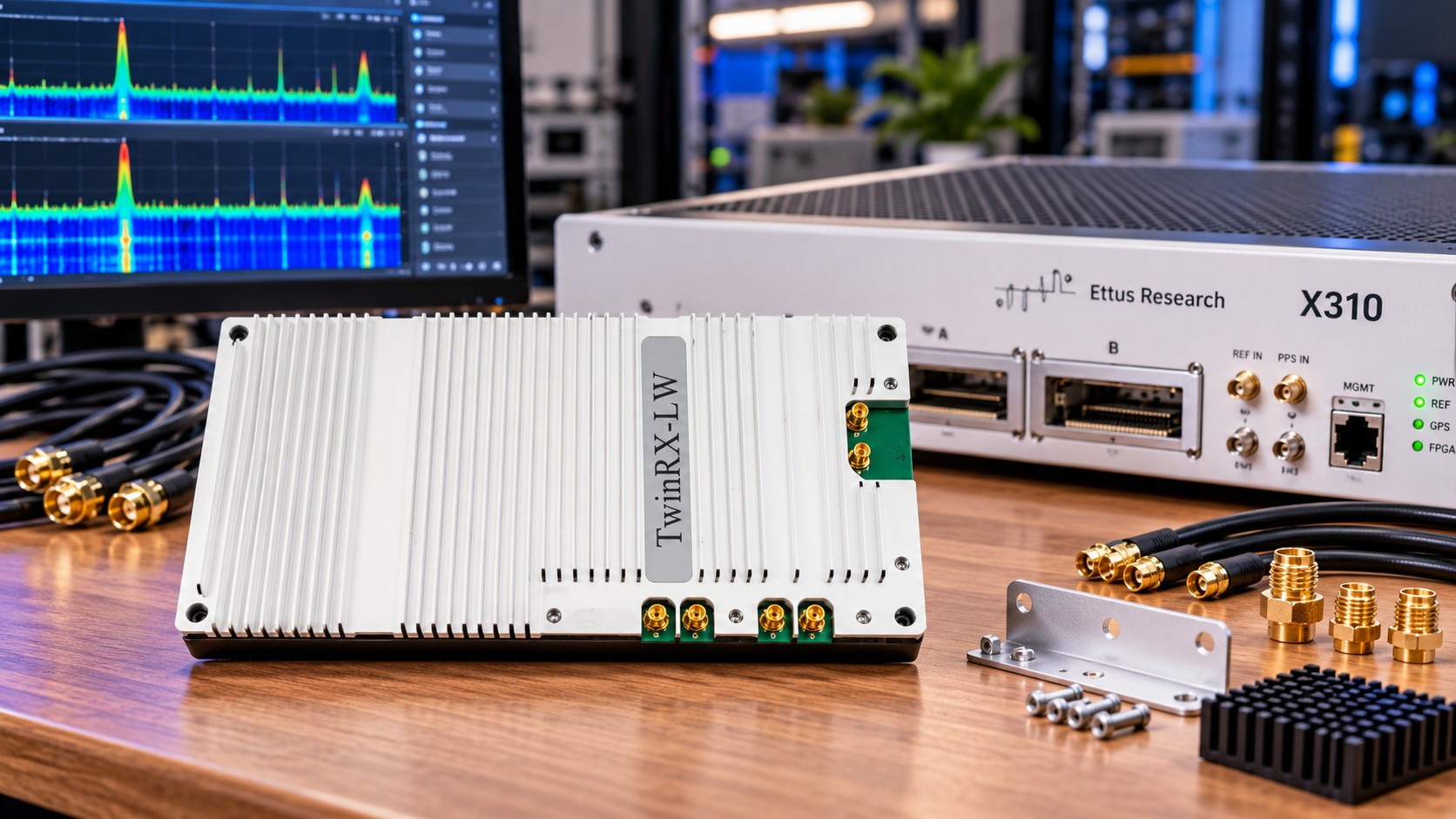
The Luowave TwinRX-LW is a receive-only daughterboard listed for X310 systems, with two receive channels covering 10 MHz–6 GHz and 80 MHz bandwidth per channel. Buy it for a multichannel receiver project, and specify the motherboard, driver, FPGA image and host transport alongside the board.
Our TwinRX-LW listing is an expansion product, not a complete USB SDR. It needs a compatible host radio, a computer and the correct signal connections. LUOWAVE's product page identifies X310 compatibility; do not assume the board also fits an N210.
Count receivers by installed hardware
| Proposed configuration | Receiver hardware | Integration requirement |
|---|---|---|
| One TwinRX-LW | Two RX frontends on the board | Verify both appear and stream with the selected UHD/FPGA combination |
| Two TwinRX-LW boards | Four RX frontends across two slots | Require explicit four-channel FPGA, routing and transport confirmation |
| TwinRX-LW plus a transceiver board | Depends on the second board | Verify mixed-board support and available DSP chains |
Two boards give four physical receiver frontends. That arithmetic does not establish four simultaneous host streams at full bandwidth. The FPGA needs enough processing paths, and UHD must expose the intended channel mapping. Request a demonstrated configuration if four-channel capture is the buying requirement.
Likewise, two 80 MHz receivers do not automatically become a contiguous 160 MHz receiver. Combining adjacent captures requires deliberate tuning, overlap and calibration. Two independent bands may be the more useful application.
Understand what the compatibility claim covers
The Ettus TwinRX reference documentation describes a two-channel superheterodyne receiver with independent tuning and LO-sharing options. That explains the underlying system concept. It does not independently verify every electrical or software detail of a third-party TwinRX-LW revision.
Before ordering, state whether the host is an Ettus X310 or a LUOWAVE LW-X310, its revision and the installed software. Obtain the supported UHD version, FPGA image, daughterboard identification and any vendor-specific installation steps. Avoid rewriting EEPROM IDs or loading an unrelated image to make detection appear successful.
Receive-only means there is no transmit path on TwinRX-LW. If your experiment includes signal generation, specify a compatible transmit-capable board or a separate transmitter. A motherboard with two transceiver slots cannot transmit through a receiver-only daughterboard.
A complete two-channel receiving bill of materials
| Part | Quantity | What to confirm |
|---|---|---|
| Compatible X310-class motherboard and chassis | 1 | Exact manufacturer, revision, supply and supported installation |
| TwinRX-LW | 1 | Two-channel operation with the selected driver and image |
| Host computer | 1 | CPU, memory and sustained processing requirements |
| Host network interface and radio link | 1 suitable link initially | Supported 10GbE NIC and compatible DAC, or matched optics and fibre |
| RF input paths | 2 | Antennas or test cables, connector routing and band coverage |
| Internal RF mounting and cabling parts | As required | Explicit package contents and connector mating |
| RF protection and filtering | Per input | Signal levels, DC handling, attenuation and strong-signal environment |
A short copper DAC is an alternative to an optical link. If you choose fibre, allow for a compatible transceiver at each end plus the fibre, rather than adding one optical module and assuming the connection is complete. Confirm compatibility with both the NIC and radio.
Our X310-class listing provides a starting product reference. Specify daughterboards explicitly; a chassis frequency headline does not identify the RF boards in your quotation.
Budget the sample transport and storage
For complex sc16 samples, each sample contains 16-bit I and 16-bit Q, totalling four bytes. Two channels at an illustrative 100 MS/s require 2 × 100 million × 4 = 800 MB/s of sample payload before network overhead. Four such channels require 1.6 GB/s.
These are transport calculations, not validated TwinRX-LW operating points. They show why a four-channel design cannot be approved from a single 10GbE label. Actual stream rates, FPGA processing, link count and host limits need confirmation. Disk recording adds its own sustained-write requirement.
Add synchronisation only as the experiment requires
For coherent measurements, specify the clock reference, time alignment, LO routing and calibration separately. A common 10 MHz reference helps frequency alignment; PPS helps establish time. Neither alone proves phase alignment at the antenna connectors after retuning or restarting.
Ask for the correct LO-sharing cables and termination scheme for the LW revision. Include suitable matched RF paths and a calibration signal if relative phase matters. Do not infer cable type or pinout from the reference board's photographs.
Bring up one channel before expanding
- Install with power removed and appropriate ESD handling.
- Probe the motherboard and record the detected daughterboard identities.
- Confirm channel names, antenna ports, sample rates and tuning ranges.
- Receive a known signal on each input separately at low rates.
- Stream both channels together, then increase load toward the intended configuration.
- Check reference lock and relative phase only after ordinary reception is stable.
If enumeration or routing differs from the agreed setup, restore the supported image and seek vendor guidance. More gain or a faster network cannot repair a missing DSP path.
Frequently asked questions
Does TwinRX-LW work with N210?
It is listed for X310. Do not order it as an N210 expansion without a separate explicit compatibility statement.
Can it transmit?
No. The product is a dual receiver; a transmit experiment needs other hardware.
Are two boards guaranteed to provide four full-bandwidth streams?
No. Obtain confirmation of the exact four-channel FPGA, driver and transport configuration.
Does LO sharing remove the need for calibration?
No. Cable, frontend and frequency-dependent phase offsets still matter for the assembled system.
Use Add to Quote with your motherboard identity, desired channel count, bandwidth and synchronisation requirement so the board and supporting parts can be specified together.
Shop products for this guide
Explore relevant products from our store.
Alternatives considered
Other relevant options for this guide.
-
USRP B210 USB SDR | 2x2 MIMO, 70MHz–6GHz, AD9361, UHD, GNURadio
B210 ofrece 2x2 y USB 3.0, pero el artículo exige un host X310 compatible con la TwinRX-LW; no se indica compatibilidad de esta daughterboard con B210.
No posts found
Write a review






We support all major card and digital payment options. More local methods are available and shown during checkout.
You enter into a binding sales contract once you have received an 'order confirmation and sales receipt' email from us, in line with our Sales & Delivery conditions. Therefore, sdrstore.eu has the right to cancel your order in the event of technical problems, delivery failure, Fair use policy and other similar situations.






Your payments are protected by advanced encryption and 3-D Secure authentication for safe online shopping.