





Best SDR Software in 2026: SDR++, SDRSharp, SDRangel, GQRX, GNU Radio, SatDump, and OpenWebRX
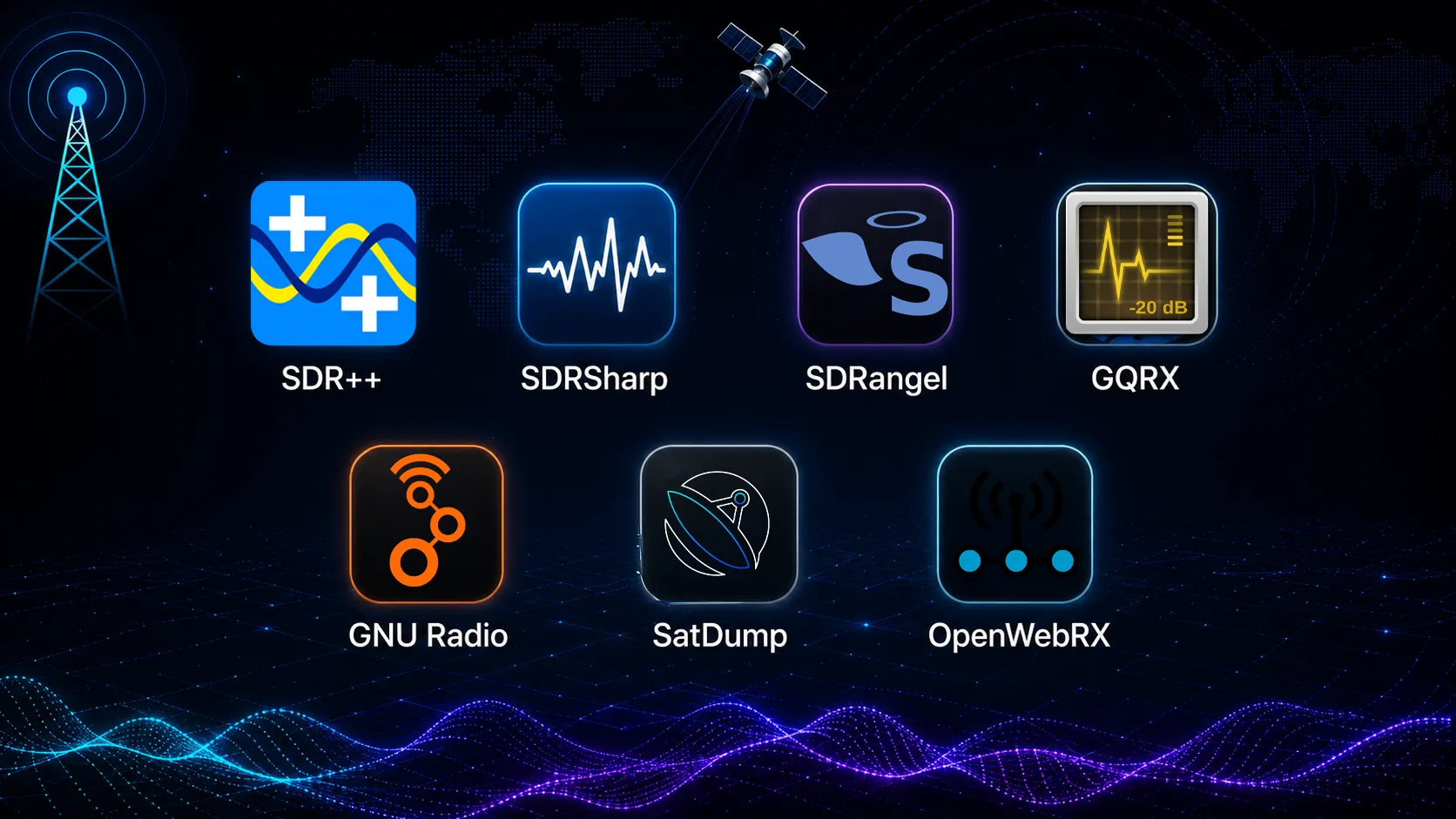
Choosing the best SDR software in 2026 depends on what you want to do with your radio. A beginner using an RTL-SDR for scanning needs a different program than a student building GNU Radio flowgraphs, a satellite hobbyist decoding weather images, or a lab setting up a web-based receiver.
The good news is that SDR software has never been stronger. SDR++, SDRSharp, SDRangel, GQRX, GNU Radio, SatDump, and OpenWebRX all have a place in a modern SDR setup. The best choice depends on your hardware, operating system, experience level, and project type.
In this guide, we compare the best SDR software in 2026 for RTL-SDR, HackRF, PlutoSDR, USRP, and other popular software-defined radio devices.
Quick Answer: Best SDR Software in 2026
| Software | Best For | Best User |
|---|---|---|
| SDR++ | Fast, modern, cross-platform general SDR listening | Most beginners and daily users |
| SDRSharp | Windows SDR listening, plugins, Airspy, RTL-SDR, scanning workflows | Windows users |
| SDRangel | Advanced RX/TX, signal analysis, satellites, MIMO, transmit-capable SDRs | Intermediate and advanced users |
| GQRX | Simple open-source SDR receiver on Linux/macOS | Linux users and lightweight setups |
| GNU Radio | SDR development, DSP, research, labs, custom flowgraphs | Students, engineers, researchers |
| SatDump | Weather satellites and satellite data decoding | Satellite hobbyists |
| OpenWebRX | Web-based remote SDR receiver access | Remote stations, schools, clubs, shared receivers |
For most beginners, SDR++ is the best first choice. For Windows users who want plugins, SDRSharp is still very popular. For satellite decoding, SatDump is the clear choice. For development, GNU Radio is the standard. For web access, OpenWebRX is the best option.
Best Overall SDR Software for Beginners: SDR++
SDR++ is one of the best SDR software choices in 2026 because it is fast, modern, cross-platform, and easy to understand. It works well for general listening, scanning, waterfall viewing, and everyday SDR use.
If you are starting with an RTL-SDR Blog V3 Kit or another RTL-SDR receiver, SDR++ is one of the easiest programs to recommend. It gives beginners a clean interface without feeling outdated.
SDR++ is best for:
- Beginner SDR listening
- RTL-SDR, Airspy, HackRF, SDRplay, and other common SDRs
- Fast spectrum and waterfall viewing
- Windows, Linux, macOS, and Android workflows
- Users who want a modern alternative to older SDR programs
SDR++ pros
- Modern interface
- Fast performance
- Cross-platform support
- Good beginner experience
- Works with many SDR devices
- Active nightly builds for newer features
SDR++ cons
- Nightly builds may change quickly
- Not as plugin-heavy as SDRSharp
- Not a full development environment like GNU Radio
Best recommendation: install SDR++ first if you are new to SDR and want a clean, fast receiver program for general use.
Best SDR Software for Windows Plugins: SDRSharp
SDRSharp, also written as SDR#, remains one of the most popular SDR programs for Windows users. It is especially strong for people using Airspy receivers, but it is also commonly used with RTL-SDR, HackRF, and other supported devices through drivers and plugins.
SDRSharp is a good choice if you want a Windows-focused SDR program with many plugin workflows, scanner-style usage, and a long history in the SDR community.
SDRSharp is best for:
- Windows SDR users
- Airspy receivers
- RTL-SDR scanning and listening
- Plugin-based workflows
- Users who want a familiar SDR interface with many tutorials
SDRSharp pros
- Very popular on Windows
- Strong Airspy support
- Many plugins and tutorials
- Good for scanning and monitoring workflows
- Works well for common receiver tasks
SDRSharp cons
- Mainly Windows-focused
- Plugin compatibility can vary by version
- Not as simple for Linux or macOS users
Best recommendation: use SDRSharp if you are on Windows and want a powerful plugin-friendly SDR receiver program.
Best Advanced SDR Software: SDRangel
SDRangel is one of the most powerful SDR programs available in 2026. It is not only a basic receiver. It supports advanced receive and transmit workflows, signal analysis, satellite tools, MIMO devices, mapping, scanning, and many device plugins.
SDRangel is especially useful with transmit-capable SDRs such as HackRF, PlutoSDR, and USRP. It is also a good choice for users who want more than simple listening.
SDRangel is best for:
- Advanced SDR users
- RX and TX workflows
- HackRF, PlutoSDR, USRP, and other advanced SDRs
- Signal analysis
- MIMO and multi-device work
- Satellite and mapping-related tools
- Users who want one program with many technical features
SDRangel pros
- Very feature-rich
- Supports receive and transmit workflows
- Useful for advanced SDR hardware
- Includes many analysis and utility features
- Good for users who want to grow beyond basic listening
SDRangel cons
- More complex than SDR++ or GQRX
- Can feel overwhelming for beginners
- Requires more time to learn properly
Best recommendation: choose SDRangel if you already know SDR basics and want a serious all-in-one tool for receive, transmit, analysis, and advanced hardware.
Best Lightweight Open-Source SDR Receiver: GQRX
GQRX is a simple open-source SDR receiver powered by GNU Radio and the Qt graphical toolkit. It is especially popular with Linux users who want a reliable, lightweight SDR receiver without installing a complicated development environment.
GQRX works well for basic listening, tuning, waterfall viewing, and general receiver tasks. It is not the newest-looking program, but it remains useful because it is stable and available through many Linux software channels.
GQRX is best for:
- Linux SDR users
- Simple receive-only listening
- RTL-SDR, HackRF, Airspy, and other supported devices
- Low-friction open-source SDR use
- Users who want something lighter than SDRangel
GQRX pros
- Open source
- Simple receiver interface
- Good Linux availability
- Powered by GNU Radio
- Works with many common SDR receivers
GQRX cons
- Less modern than SDR++
- Receive-focused
- Not ideal for advanced TX or development workflows
Best recommendation: use GQRX if you want a simple Linux-friendly SDR receiver for basic listening and monitoring.
Best SDR Software for Development: GNU Radio
GNU Radio is not just an SDR receiver program. It is a full open-source signal processing toolkit used for SDR development, wireless communications, research, education, and prototyping.
If SDR++ and SDRSharp are like ready-to-use radios, GNU Radio is more like a laboratory. You build signal chains using blocks, create flowgraphs, test modulation and demodulation, process I/Q data, and design custom SDR applications.
GNU Radio is especially useful with devices such as PLUTO+ SDR, HackRF Pro, and USRP.
GNU Radio is best for:
- SDR development
- DSP learning
- University labs
- Wireless communications research
- GNU Radio Companion flowgraphs
- Custom transmit and receive projects
- USRP, PlutoSDR, HackRF, and advanced SDR hardware
GNU Radio pros
- Extremely powerful
- Open source
- Used in research, education, industry, and hobby projects
- Supports custom signal processing
- Works with many SDR devices
- GNU Radio 4 development is active in 2026
GNU Radio cons
- Steep learning curve
- Not the best first program for simple listening
- Requires understanding of DSP concepts for serious use
Best recommendation: choose GNU Radio if you want to build, test, or learn SDR systems instead of only listening to signals.
Best SDR Software for Weather Satellites: SatDump
SatDump is the best SDR software choice for satellite data reception and decoding in 2026. It is especially important for weather satellite work, including workflows around Meteor LRPT, NOAA legacy modes, GOES HRIT, LRIT, HRPT, and other satellite data products.
For users with an RTL-SDR Blog V4 Kit or RTL-SDR Blog V3 Kit, SatDump is one of the best programs to install if the goal is weather satellite reception.
SatDump is best for:
- Weather satellite reception
- Meteor LRPT decoding
- GOES HRIT and advanced satellite workflows
- Satellite pass recording and processing
- Image products and satellite data visualization
- Users following current SatDump V2 tutorials
SatDump pros
- Best dedicated satellite decoding workflow
- Supports many satellite signal types
- Works with RTL-SDR and other SDR devices
- Active tutorial and V2 development trend
- Useful for both beginners and advanced satellite users
SatDump cons
- Not a general everyday SDR receiver like SDR++
- Satellite setup depends heavily on antenna and pass timing
- Some V2/nightly features may be less beginner-safe than stable builds
Best recommendation: use SatDump if your main goal is receiving weather satellite images or satellite data with RTL-SDR or other SDR hardware.
Best SDR Software for Remote Web Receivers: OpenWebRX
OpenWebRX is different from the other software in this comparison. It is designed to run an SDR receiver that multiple users can access through a web browser. This makes it ideal for clubs, schools, remote receivers, public web SDR stations, and shared monitoring setups.
Instead of installing SDR software on every client computer, users can connect through a browser. The server computer handles the SDR hardware, while remote users access the receiver interface online.
OpenWebRX is best for:
- Remote SDR stations
- Web-accessible receivers
- Radio clubs and education
- Shared HF or VHF monitoring
- Users who want browser-based SDR access
- Raspberry Pi or server-style receiver setups
OpenWebRX pros
- Browser-based access
- Multi-user receiver support
- Good for remote stations
- No client software required for listeners
- Ideal for schools, clubs, and shared receivers
OpenWebRX cons
- Requires server setup
- Not as simple as opening SDR++ on a laptop
- Best for receive-only web access, not general SDR development
Best recommendation: choose OpenWebRX if you want to share an SDR receiver over a network or the internet.
Best SDR Software by Hardware
| Hardware | Best First Software | Best Advanced Software |
|---|---|---|
| RTL-SDR | SDR++ or SDRSharp | SatDump, GNU Radio, OpenWebRX |
| HackRF | SDR++ or SDRangel | GNU Radio, SDRangel |
| HackRF PortaPack | Mayhem firmware on-device | SDRangel or GNU Radio when connected to a computer |
| PlutoSDR / PLUTO+ | SDRangel | GNU Radio with IIO workflows |
| USRP | GNU Radio | GNU Radio, UHD-based workflows |
| Airspy | SDRSharp | SDR++, SDRangel, GNU Radio depending on workflow |
Best SDR Software by Use Case
| Use Case | Best Software | Why |
|---|---|---|
| Beginner listening | SDR++ | Modern, fast, simple, and cross-platform |
| Windows plugin workflows | SDRSharp | Strong Windows ecosystem and plugin history |
| Linux simple receiver | GQRX | Lightweight and open source |
| Advanced RX/TX and analysis | SDRangel | Feature-rich and supports advanced SDR hardware |
| SDR development | GNU Radio | Full signal processing toolkit |
| Weather satellites | SatDump | Built for satellite data decoding and image processing |
| Remote web receiver | OpenWebRX | Browser-based multi-user SDR access |
Which SDR Software Should Beginners Install First?
Beginners should usually start with SDR++. It is modern, simple, and works well for general SDR listening. If you are on Windows and want plugin workflows, SDRSharp is also a good first choice.
After that, install software based on your project. If you want weather satellites, install SatDump. If you want development, install GNU Radio. If you want advanced RX/TX controls with HackRF or PlutoSDR, install SDRangel.
Recommended beginner software path
- Install SDR++ for general listening.
- Install SDRSharp if you use Windows and want plugins.
- Install SatDump if you want weather satellite reception.
- Install GNU Radio once you want to build custom SDR projects.
- Install OpenWebRX if you want browser-based remote access.
Best SDR Software for RTL-SDR in 2026
For RTL-SDR users, the best software depends on the project. SDR++ is the best first receiver program. SDRSharp is a strong Windows option. SatDump is the best for weather satellites. OpenWebRX is ideal for a remote RTL-SDR station. GNU Radio is best for learning DSP and building custom flows.
If you are starting from zero, the RTL-SDR Blog V3 Kit is still one of the easiest hardware choices, while the RTL-SDR category includes receivers, kits, antennas, and accessories for many beginner SDR projects.
Best SDR Software for HackRF in 2026
HackRF users should consider SDR++, SDRangel, and GNU Radio. SDR++ is useful for quick receive testing. SDRangel is better for advanced receive and transmit workflows. GNU Radio is best for custom experiments and signal processing.
If you want a portable device with a screen and Mayhem firmware, browse HackRF and PortaPack options. If you want PC-based development, the HackRF Pro Development Board is a strong option.
Best SDR Software for PlutoSDR and PLUTO+
For PlutoSDR and PLUTO+ users, SDRangel and GNU Radio are usually the most important choices. SDRangel is easier for visual testing and practical receive/transmit workflows. GNU Radio is better for custom digital communications experiments and IIO-based development.
For users who want Ethernet, 2T2R, and AD9363-based workflows, the PLUTO+ SDR is a strong hardware match for SDRangel and GNU Radio.
Best SDR Software for USRP
USRP users usually choose GNU Radio because USRP devices are commonly used for research, labs, university projects, and custom wireless development. SDRangel can also be useful depending on hardware support and workflow, but GNU Radio remains the most important software environment for many USRP users.
If you are buying for a lab, classroom, or research project, browse USRP SDR platforms.
Final Recommendation
The best SDR software in 2026 is not one single program. It depends on the project.
Choose SDR++ if you want the best general beginner SDR receiver. Choose SDRSharp if you are a Windows user who wants plugin workflows. Choose SDRangel if you want advanced receive/transmit features and signal analysis. Choose GQRX if you want a simple open-source Linux receiver. Choose GNU Radio if you want to build SDR systems and learn DSP. Choose SatDump if you want weather satellite decoding. Choose OpenWebRX if you want a browser-based remote SDR receiver.
For most users, the best setup is not one program but a small toolkit: SDR++ for daily listening, SatDump for satellites, GNU Radio for development, and OpenWebRX if you want remote access.
FAQ
What is the best SDR software in 2026?
SDR++ is the best general SDR software for most beginners in 2026. SDRSharp is best for Windows plugin workflows, GNU Radio is best for development, and SatDump is best for weather satellites.
What is the best SDR software for RTL-SDR?
The best SDR software for RTL-SDR is SDR++ for general listening, SDRSharp for Windows users, SatDump for weather satellites, GNU Radio for development, and OpenWebRX for remote web access.
Is SDR++ better than SDRSharp?
SDR++ is usually better for users who want a modern cross-platform receiver. SDRSharp is better for Windows users who want its plugin ecosystem and Airspy-focused workflows.
Is GNU Radio good for beginners?
GNU Radio is powerful but not the easiest first SDR program. Beginners should usually start with SDR++ or SDRSharp, then move to GNU Radio when they want to learn DSP and custom flowgraphs.
What SDR software should I use for weather satellites?
SatDump is the best SDR software for weather satellite reception and decoding, especially for users working with RTL-SDR and satellite image workflows.
What SDR software works with HackRF?
HackRF works with several SDR programs, including SDR++, SDRangel, GNU Radio, and SDRSharp depending on the driver and operating system.
What SDR software works with PlutoSDR?
PlutoSDR and PLUTO+ are commonly used with SDRangel and GNU Radio. GNU Radio with IIO support is especially useful for development and digital communications experiments.
What is OpenWebRX used for?
OpenWebRX is used to create a web-based SDR receiver that multiple users can access from a browser without installing SDR software on each client device.
No posts found
Write a review






We support all major card and digital payment options. More local methods are available and shown during checkout.
You enter into a binding sales contract once you have received an 'order confirmation and sales receipt' email from us, in line with our Sales & Delivery conditions. Therefore, sdrstore.eu has the right to cancel your order in the event of technical problems, delivery failure, Fair use policy and other similar situations.






Your payments are protected by advanced encryption and 3-D Secure authentication for safe online shopping.