





PLUTO+ SDR Review: AD9363 2T2R SDR Transceiver with Ethernet and 70 MHz–6 GHz Coverage
PLUTO+ SDR Review: AD9363 2T2R SDR Transceiver with Ethernet and 70 MHz–6 GHz Coverage
The PLUTO+ SDR is one of the most interesting PlutoSDR-style transceivers for users who want more flexibility than the standard ADALM-PLUTO design. It is based around the AD9363 RF transceiver, supports 2 transmit and 2 receive channels, includes Gigabit Ethernet, supports Micro SD booting, and is listed with wide 70 MHz–6 GHz coverage.
In this PLUTO+ SDR review, we look at what makes this board different, who should buy it, what the Bundle 6 antenna package includes, and whether it is a good choice for SDR development, wireless experiments, education, and RF testing.
You can view the product here: PLUTO+ SDR AD9363 2T2R Radio SDR Transceiver 70MHz–6GHz.
Quick Verdict: Is the PLUTO+ SDR Worth Buying?
The PLUTO+ SDR is worth considering if you want a PlutoSDR-style platform with more advanced hardware features, especially 2T2R operation, Ethernet connectivity, Micro SD boot support, external clock options, and a more development-focused layout.
Compared with a standard PlutoSDR-style device, the PLUTO+ SDR is better suited for users who want to experiment with full-duplex workflows, MIMO-style testing, GNU Radio projects, custom firmware, network-connected SDR setups, and more flexible RF development.
It is not the simplest SDR for absolute beginners who only want to listen to local radio signals. For that, an RTL-SDR is easier. But for users who already understand SDR basics and want to move into transmit-capable experiments, digital communications, and AD936x development, the PLUTO+ SDR is a strong option.
PLUTO+ SDR Key Specifications
| Feature | PLUTO+ SDR |
|---|---|
| RF transceiver | AD9363 |
| Transmit / receive channels | 2TX and 2RX |
| Listed RF range | 70 MHz–6 GHz |
| Reference clock | 40 MHz VCTCXO, 0.5 ppm |
| Processor / FPGA | Zynq7010 FPGA |
| RAM | 512 MB |
| Flash | 32 MB |
| USB | USB 2.0 with OTG support |
| Ethernet | 1000 Mb Gigabit Ethernet |
| Micro SD | Supported for booting |
| Power input | 5V ±0.5V, 2A via microUSB |
What Makes the PLUTO+ SDR Different?
The biggest difference is that the PLUTO+ SDR is designed as a more capable PlutoSDR-style board. The standard ADALM-PLUTO is already popular because it gives students, hobbyists, and engineers an affordable way to experiment with transmit and receive SDR workflows. The PLUTO+ SDR builds on that idea with extra hardware features that are useful for more advanced projects.
The main upgrades are 2TX and 2RX support, Gigabit Ethernet, Micro SD boot support, and more hardware access for users who want to experiment beyond a simple USB-only SDR setup.
Main advantages of the PLUTO+ SDR
- 2 transmit and 2 receive channels for more flexible experiments
- Gigabit Ethernet for network-connected SDR setups
- Micro SD boot support for custom firmware workflows
- External reference clock input option
- AD9363-based design with PlutoSDR-style software ecosystem
- Useful for GNU Radio, libiio, SDR development, and wireless testing
Bundle 6 Contents
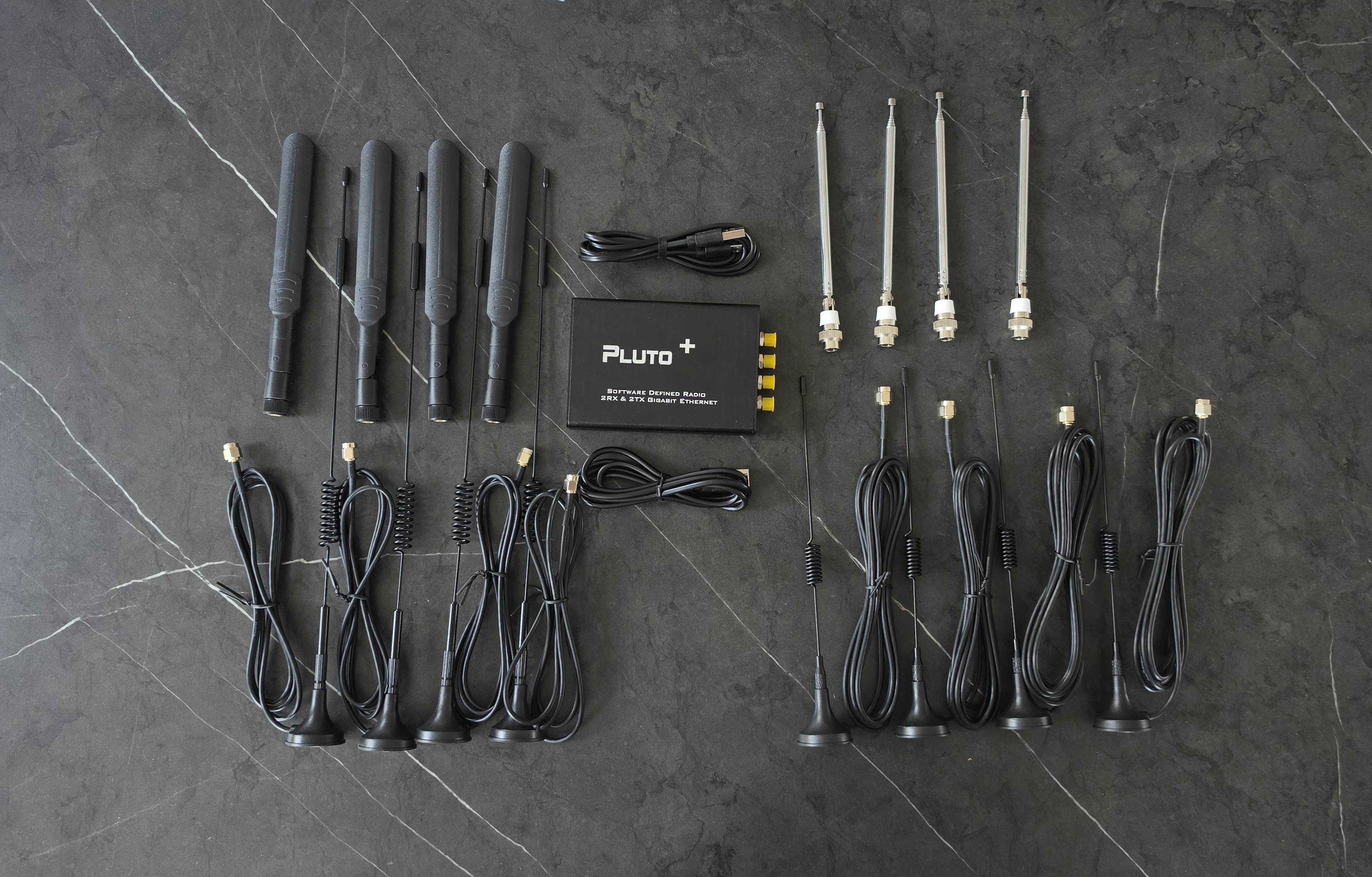
The PLUTO+ SDR Bundle 6 is a strong package because it includes the SDR board plus multiple antenna sets for different frequency ranges. This makes it more practical for users who want to start experimenting immediately instead of buying antennas separately.
| Bundle 6 Item | Quantity | Best Use |
|---|---|---|
| PLUTO+ SDR | 1 | Main AD9363 2T2R SDR transceiver |
| 8 dBi 2.4 / 5 / 5.8 GHz antennas | 4 | WiFi-band experiments, 2.4 GHz and 5 GHz testing, ISM-band projects |
| 5 dBi 40 MHz–860 MHz antennas | 4 | Lower-frequency receiving and general VHF/UHF experimentation |
| USB cables | 2 | Power, data, setup, and backup cable convenience |
| 40 MHz–6 GHz telescopic antennas | 4 | General testing across multiple bands and flexible bench use |
| 12 dBi 700 MHz–2700 MHz antennas | 4 | LTE, cellular-band, ISM, and mid-band RF experiments |
This antenna mix makes Bundle 6 especially useful for buyers who want to test different bands without building a custom antenna kit from the beginning. The four-piece antenna sets also make sense for 2TX/2RX experiments where multiple ports may be used.
Why 2T2R Matters
A normal beginner SDR is often one receive channel only. The PLUTO+ SDR is different because it supports 2 transmit and 2 receive channels. This is important for more advanced users because it opens the door to experiments that need multiple RF paths.
2T2R can be useful for wireless communications testing, MIMO-style learning, diversity experiments, full-duplex style workflows, phase-aware testing, and more complex GNU Radio projects. It gives users more room to grow compared with a simple single-channel SDR.
2T2R is useful for:
- MIMO-style SDR experiments
- Transmit and receive testing
- Digital communications research
- Wireless protocol learning
- GNU Radio flowgraphs with multiple channels
- Lab and university SDR projects
Ethernet Is One of the Biggest Reasons to Choose PLUTO+
Gigabit Ethernet is one of the most important advantages of the PLUTO+ SDR. Many SDR users prefer Ethernet because it can make lab setups cleaner, reduce USB cable limitations, and allow the SDR to be placed away from the main computer.
For development, Ethernet is useful when the SDR needs to be integrated into a test bench, connected to a network, used with a remote machine, or placed near antennas while the computer remains somewhere else.
This does not mean Ethernet automatically gives unlimited bandwidth in every software workflow. Actual performance still depends on drivers, software, sample rate, network conditions, firmware, and how the SDR is configured. But for many users, having Ethernet available is a major advantage compared with USB-only devices.
70 MHz–6 GHz Coverage: What Buyers Should Understand
The PLUTO+ SDR product listing specifies 70 MHz–6 GHz RF coverage. This is one of the main reasons the board is attractive, because it covers many useful RF bands for experimentation.
However, buyers should understand that the AD9363 chip itself is officially associated with a narrower native operating range than the extended 70 MHz–6 GHz range often advertised in PlutoSDR-style devices. In practice, extended tuning ranges may depend on firmware configuration, calibration, hardware implementation, and performance expectations at the edges of the range.
For casual experiments, the wide listed range is very useful. For serious measurements, edge-band work, or professional RF testing, users should verify real-world performance in their specific frequency range and use suitable filters, attenuators, antennas, and test equipment.
Who Should Buy the PLUTO+ SDR?
The PLUTO+ SDR is best for users who want more than a basic SDR receiver. It is a development board for people who want to transmit, receive, test, modify, and build SDR projects.
The PLUTO+ SDR is a good choice for:
- Students learning SDR and wireless communications
- Universities and teaching labs
- GNU Radio users
- RF developers and experimenters
- Digital communications projects
- 2T2R and MIMO-style experiments
- Users who want Ethernet and Micro SD boot support
- Buyers who want a more flexible PlutoSDR-style platform
If you want this type of development platform, the PLUTO+ SDR AD9363 2T2R transceiver is a strong option.
Who Should Not Buy the PLUTO+ SDR?
The PLUTO+ SDR is powerful, but it is not the simplest SDR for every buyer. If your only goal is to listen to FM radio, airband, ADS-B, or basic local signals, an RTL-SDR kit is usually easier and cheaper.
The PLUTO+ SDR also requires more technical understanding. Users may need to work with firmware, drivers, libiio, GNU Radio, network settings, antennas, gain control, and RF safety. It is a better fit for people who want to learn and experiment rather than users who want a plug-and-play radio scanner.
Consider a simpler SDR if:
- You only want receive-only radio scanning
- You do not need transmit capability
- You are not interested in SDR software development
- You want the cheapest possible beginner SDR
- You do not want to configure software, firmware, or network settings
PLUTO+ SDR vs Standard PlutoSDR
The standard ADALM-PLUTO is popular because it is compact, affordable, and widely supported by software tools such as GNU Radio, MATLAB, Simulink, and libiio. It is a great learning platform.
The PLUTO+ SDR is more interesting for users who want extra hardware flexibility. The 2T2R design, Ethernet support, Micro SD boot option, and external reference clock input make it more suitable for advanced experiments.
| Feature | Standard PlutoSDR-style device | PLUTO+ SDR |
|---|---|---|
| Transmit / receive channels | Usually 1TX / 1RX | 2TX / 2RX |
| Ethernet | Usually USB-focused | Gigabit Ethernet supported |
| Micro SD boot | Not the main focus | Supported |
| Best for | Learning SDR fundamentals | More advanced SDR development and experiments |
| Buyer type | Beginner to intermediate | Intermediate to advanced |
PLUTO+ SDR vs HackRF
Many buyers compare the PLUTO+ SDR with HackRF because both are transmit-capable SDRs. The best choice depends on the project.
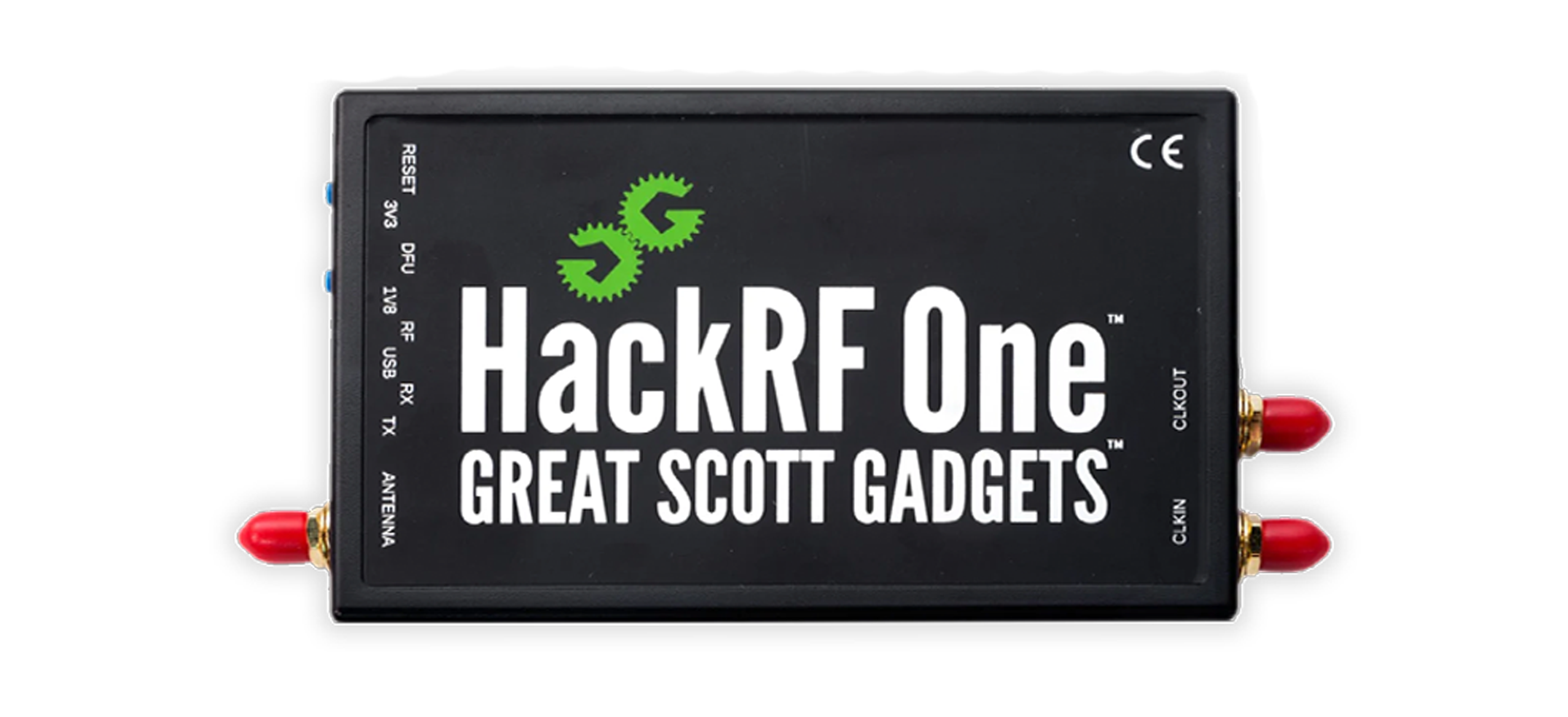
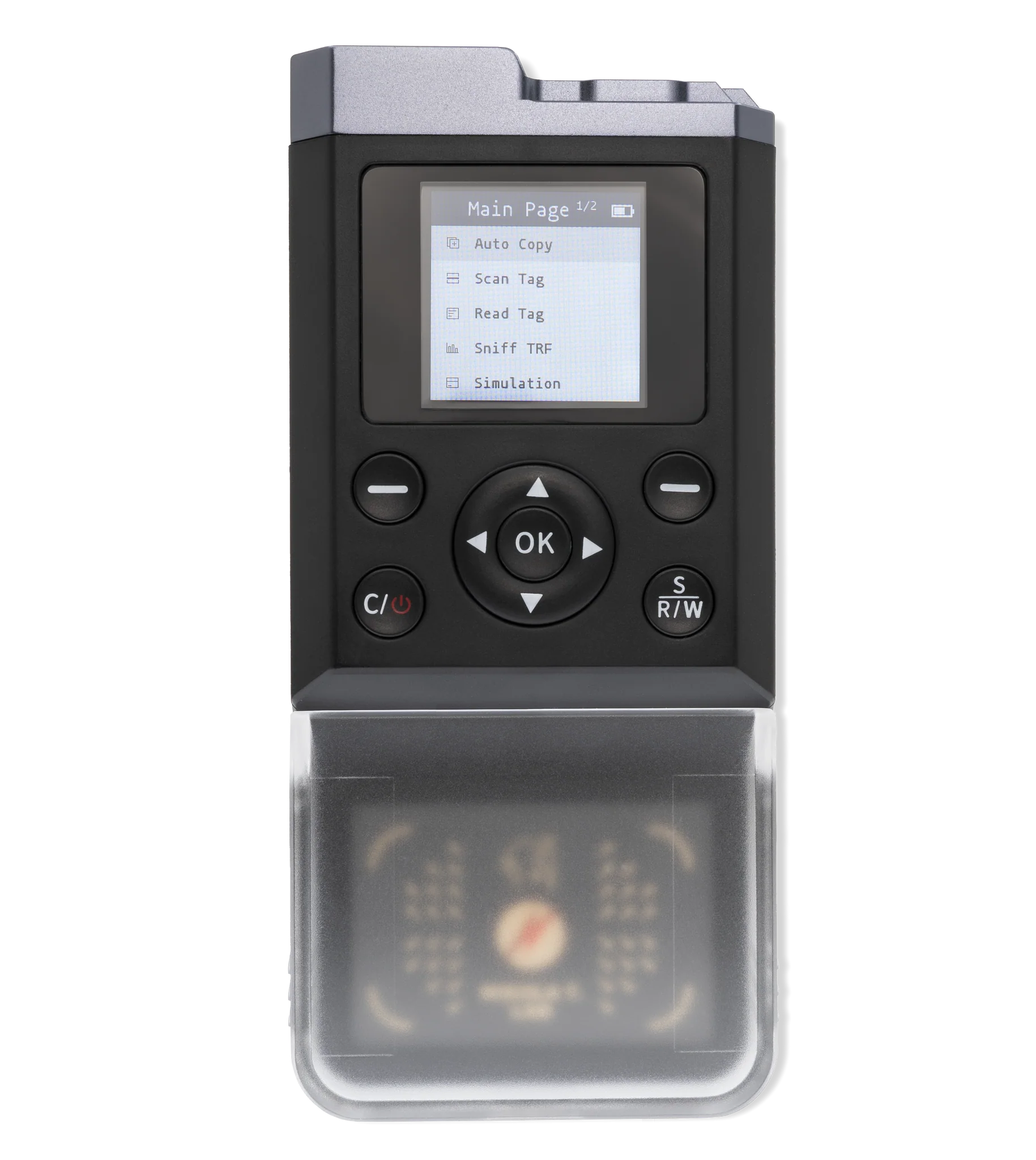
HackRF is usually better for wideband, portable, general RF exploration, especially when paired with a PortaPack. PLUTO+ SDR is usually better for users who care about AD936x workflows, 2T2R experiments, full-duplex style testing, Ethernet, and digital communications development.
| Use Case | Better Choice |
|---|---|
| Portable handheld use with screen | HackRF PortaPack |
| 2T2R experiments | PLUTO+ SDR |
| AD936x development | PLUTO+ SDR |
| General RF exploration | HackRF or PLUTO+ depending on workflow |
| Ethernet-connected SDR setup | PLUTO+ SDR |
Software Compatibility and Workflow
One of the advantages of PlutoSDR-style devices is the software ecosystem. Users commonly work with tools such as GNU Radio, MATLAB, Simulink, libiio, SDRangel, custom Python scripts, and Linux-based SDR workflows.
The PLUTO+ SDR is especially attractive for users who want to learn how real SDR transmit and receive chains are built. It is not just a receiver. It is a platform for generating signals, receiving signals, testing digital communication concepts, and building custom SDR applications.
Typical software use cases include:
- GNU Radio transmit and receive flowgraphs
- Digital modulation and demodulation experiments
- Signal generation and testing
- Wireless communication education
- Linux-based SDR development
- Network-connected SDR workflows over Ethernet
Realistic Use Cases for the PLUTO+ SDR
The PLUTO+ SDR is useful across a wide range of projects, but it performs best when used by someone who understands that SDR results depend on antennas, filters, gain settings, software configuration, and RF environment.
Good PLUTO+ SDR projects include:
- Learning SDR transmit and receive chains
- Testing modulation and demodulation in GNU Radio
- WiFi-band and ISM-band experiments with the included 2.4 / 5 / 5.8 GHz antennas
- LTE and cellular-band experiments with the included 700 MHz–2700 MHz antennas
- General RF testing from VHF through microwave bands
- 2T2R and MIMO-style experiments
- Remote SDR placement using Ethernet
- University lab and training projects
Important RF Safety and Legal Notes
Because the PLUTO+ SDR can transmit, users must follow local radio regulations. Do not transmit on frequencies where you are not licensed or authorized. For testing, use suitable attenuators, dummy loads, shielding, or controlled lab environments.
The included antennas make the bundle convenient, but they also make it easy to accidentally radiate signals if the software is configured incorrectly. When learning transmit workflows, start with low power, use a dummy load where possible, and understand your local rules before connecting an antenna.
Pros and Cons
Pros
- 2TX and 2RX support
- Gigabit Ethernet connectivity
- Micro SD boot support
- Listed 70 MHz–6 GHz coverage
- AD9363-based PlutoSDR-style ecosystem
- Useful for GNU Radio and SDR development
- Bundle 6 includes multiple antenna sets for different bands
- Good option for labs, students, developers, and advanced hobbyists
Cons
- Not as simple as an RTL-SDR for absolute beginners
- Transmit use requires legal awareness and RF safety
- Extended frequency range should be tested for serious edge-band work
- May require firmware, driver, network, or software configuration
- Not a calibrated lab instrument by itself
Best Buying Advice
Buy the PLUTO+ SDR if you want a more serious SDR development platform than a basic receiver. It is a good match for users who want transmit and receive capability, 2T2R experiments, Ethernet, Micro SD booting, and AD936x-based wireless development.
Choose Bundle 6 if you want the most practical ready-to-experiment package. The included antenna sets cover several useful bands, including 40 MHz–860 MHz, 700 MHz–2700 MHz, 2.4 / 5 / 5.8 GHz, and telescopic 40 MHz–6 GHz experiments.
If your goal is only simple listening, start with an RTL-SDR. If your goal is development, testing, and learning real SDR transmit and receive workflows, the PLUTO+ SDR AD9363 2T2R transceiver is a much better long-term platform.
Final Verdict
The PLUTO+ SDR is a strong choice for users who want a flexible PlutoSDR-style platform with more hardware capability. The combination of AD9363, 2TX/2RX, Gigabit Ethernet, Micro SD boot support, external clock options, and wide listed RF coverage makes it much more than a basic SDR dongle.
The Bundle 6 package makes the product even more attractive because it includes four sets of antennas for multiple frequency ranges, plus two USB cables. This gives buyers a more complete starting point for RF experiments across VHF, UHF, cellular, ISM, WiFi, and microwave bands.
For students, engineers, labs, and advanced hobbyists, the PLUTO+ SDR is one of the most interesting SDR transceivers in its price range. It is not the easiest SDR for a complete beginner, but it is a very capable platform for users who want to learn, build, test, and experiment seriously.
FAQ
What is the PLUTO+ SDR?
The PLUTO+ SDR is an AD9363-based software-defined radio transceiver with 2 transmit and 2 receive channels, Gigabit Ethernet, Micro SD boot support, and listed 70 MHz–6 GHz coverage.
Is the PLUTO+ SDR better than a standard PlutoSDR?
The PLUTO+ SDR is better for users who need 2T2R support, Ethernet connectivity, Micro SD booting, and more advanced development options. A standard PlutoSDR-style device may still be simpler for basic learning.
Does the PLUTO+ SDR support full duplex?
The PLUTO+ SDR supports transmit and receive operation with 2TX and 2RX channels. Actual full-duplex project performance depends on software configuration, isolation, antennas, filters, and the RF setup.
What is included in PLUTO+ SDR Bundle 6?
Bundle 6 includes one PLUTO+ SDR, four 8 dBi 2.4 / 5 / 5.8 GHz antennas, four 5 dBi 40 MHz–860 MHz antennas, two USB cables, four 40 MHz–6 GHz telescopic antennas, and four 12 dBi 700 MHz–2700 MHz antennas.
Can beginners use the PLUTO+ SDR?
Yes, but it is better for motivated beginners or intermediate users. For simple receive-only listening, an RTL-SDR is easier. For transmit-capable SDR development, PLUTO+ SDR is a stronger platform.
What software works with PLUTO+ SDR?
PlutoSDR-style devices are commonly used with GNU Radio, libiio, MATLAB, Simulink, SDRangel, Linux tools, and custom SDR workflows, depending on firmware and driver configuration.
Is the 70 MHz–6 GHz range native to the AD9363?
The product is listed with 70 MHz–6 GHz coverage, but the AD9363 chip itself is officially associated with a narrower native range. Extended coverage should be treated as device and firmware dependent, especially for serious measurements.
Should I buy PLUTO+ SDR or HackRF?
Buy PLUTO+ SDR for AD936x development, 2T2R experiments, Ethernet, and digital communications work. Buy HackRF if you want a more general wideband SDR, especially for portable use with a PortaPack.
Shop products for this guide
Explore relevant products from our store.
No posts found
Write a review






We support all major card and digital payment options. More local methods are available and shown during checkout.
You enter into a binding sales contract once you have received an 'order confirmation and sales receipt' email from us, in line with our Sales & Delivery conditions. Therefore, sdrstore.eu has the right to cancel your order in the event of technical problems, delivery failure, Fair use policy and other similar situations.






Your payments are protected by advanced encryption and 3-D Secure authentication for safe online shopping.