





MicroPhase ANTSDR U200 vs U220: Which USB SDR Fits Your Project?
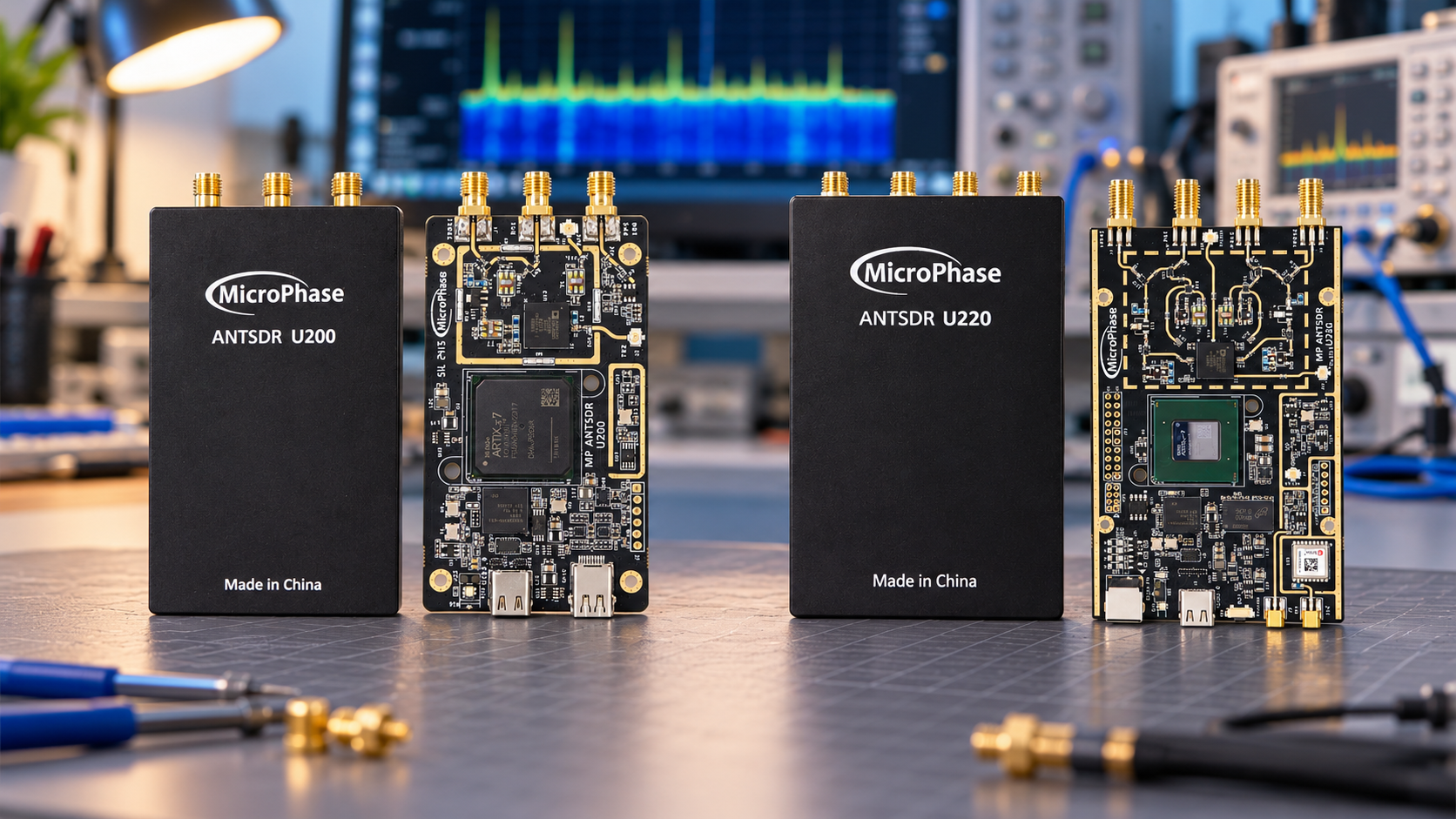
Choose the ANTSDR U200 for projects needing one transmit and one receive channel within its documented 325 MHz–3.8 GHz range and up to 20 MHz analog bandwidth. Choose the ANTSDR U220 when you need two transmit and two receive channels. For wider tuning coverage and up to 56 MHz analog bandwidth, select the U220 AD9361 version. In the ANTSDR U200 vs U220 comparison, channel count and the selected RF chip matter before FPGA size.
ANTSDR U200 vs U220: compare the exact versions
The MicroPhase ANTSDR U200 listing specifies AD9363 hardware. The ANTSDR U220 listing offers an AD9363 or AD9361 chipset selection. Choose that option deliberately: the U220 model name alone does not establish its RF limits.
The following comparison uses MicroPhase's U200 hardware manual and U220 hardware manual.
| Feature | U200 AD9363 | U220 AD9363 | U220 AD9361 |
|---|---|---|---|
| Transmit / receive channels | 1 TX / 1 RX | 2 TX / 2 RX | 2 TX / 2 RX |
| Documented RF range | 325 MHz–3.8 GHz | 325 MHz–3.8 GHz | 70 MHz–6 GHz |
| Maximum analog bandwidth | 20 MHz | 20 MHz | 56 MHz |
| Full-duplex operation | Supported | Supported | Supported |
| FPGA | Artix-7 XC7A100T | Artix-7 XC7A200T | Artix-7 XC7A200T |
| ADC / DAC resolution | 12 bit | 12 bit | 12 bit |
| Host sample interface | USB 3.0 Type-C | USB 3.0 Type-C | USB 3.0 Type-C |
Full duplex means transmitting and receiving simultaneously. It does not mean the U200 has two receive channels: its documented board configuration remains one transmitter and one receiver.
Start with your frequency and signal bandwidth
A single-channel experiment at 900 MHz or 2.4 GHz can fit within the U200's documented RF range, provided the required bandwidth also fits. A project around 100 MHz or 5.8 GHz points toward the U220 AD9361 version among these listed configurations.
Analog Devices specifies the AD9363 for 325 MHz–3.8 GHz operation and channel bandwidth up to 20 MHz. The AD9361 supports channel bandwidth up to 56 MHz, with a specified receive tuning range of 70 MHz–6 GHz.
An AD9363-equipped U220 adds channels, not the AD9361's specified RF coverage. If firmware exposes wider settings on AD9363 hardware, treat those as extended operation requiring validation. They do not change the installed chip or its manufacturer specifications.
Also distinguish tuning range from instantaneous bandwidth. Tuning range tells you where the receiver can be centered. Analog bandwidth describes the width of the RF channel it can accept at that setting. Neither figure alone guarantees the amount of spectrum your application can stream and process continuously.
When the U200 is enough—and when two channels matter
One receive stream is sufficient for many spectrum displays, demodulator projects and digital-communications exercises. The U200 can also support a transmit-and-receive experiment using its single channel in each direction, subject to suitable software and RF setup.
The U220 becomes useful when your experiment depends on two simultaneous receive paths, two transmit paths or a two-stream multiple-input, multiple-output (MIMO) arrangement. Possible uses include receive-diversity exercises and channel-estimation experiments.
Two RF connectors do not by themselves establish a complete coherent measurement system. For phase-sensitive work, verify simultaneous channel access, sample alignment, gain behavior and your calibration method. Read the 2x2 MIMO SDR guide for the wider system requirements.
What the larger U220 FPGA changes
A field-programmable gate array (FPGA) can implement custom processing before samples reach the computer. AMD's Artix-7 resource table lists 101,440 logic cells and 240 digital signal processing (DSP) slices for the XC7A100T, versus 215,360 logic cells and 740 DSP slices for the XC7A200T.
The U220 therefore offers more hardware capacity for a custom filter, correlator or modem design. That is potential development capacity, not an automatic application-speed increase. The supplied design already consumes some resources, and a larger FPGA does not make a slow host application process samples faster.
If FPGA development is part of your purchase decision, obtain matching sources, board constraints, build instructions and toolchain requirements before ordering. Confirm the general-purpose input/output (GPIO) connector too: MicroPhase documents a 22-pin FPC connection on U200 and a 20-pin 2.54 mm header on U220. They need different integration hardware.
USB 3.0 provides the transport; your setup determines throughput
MicroPhase documents USB 3.0 sample transfer for both U-series boards, with a nominal 5 Gbit/s link. A USB-C connector alone does not establish that speed: the computer port and cable must also support the required USB mode.
For an illustrative receive-data budget, assume a 16-bit in-phase value and a 16-bit quadrature value per complex I/Q sample. At 30.72 million samples per second, one receive channel produces 122.88 MB/s of raw payload; two produce 245.76 MB/s. These are calculated figures, not measured ANTSDR results, and exclude USB overhead and host processing.
The converters' 12-bit resolution does not necessarily mean samples occupy only 12 bits per component in transport or memory. Check the actual sample format. Transmit traffic, recording to disk and real-time processing add further demands.
MicroPhase also describes additional data buffering on U220. Buffering can help with brief transfer interruptions, but it cannot compensate indefinitely for an application that consumes data too slowly. Test your required channel count and sample rate for a sustained period, checking for overruns, underruns and dropped samples.
Qualify the UHD software stack before buying
MicroPhase's U200 setup guide and U220 setup guide describe a USRP Hardware Driver (UHD) workflow with board-specific driver and FPGA-image files, including Windows and Ubuntu examples.
UHD API compatibility does not make either board an Ettus USRP or establish compatibility with every current UHD package. Use a driver, image and application combination supported for the exact model, chipset and hardware revision.
- GNU Radio: verify the UHD integration and confirm the source and sink expose your required channels.
- SDRangel: match its UHD library to the supported ANTSDR package rather than assuming automatic detection.
- Cellular research: validate the exact software release, sample rate, timing and RF configuration. A project name in a product listing is not a tested deployment specification.
A practical acceptance check starts with uhd_usrp_probe using the supported package, followed by one receive channel at a modest sample rate. Add the second channel, higher rates and transmit operation only after the basic connection works. Keep the working driver and image files with your project documentation.
Clock inputs, accessories and total project cost
Both hardware manuals list an external PPS/10 MHz reference connection; PPS means pulse per second. U220 also lists a GPS synchronization input. A timing input does not prove that a GPS-disciplined oscillator (GPSDO) is included in the retail package.
For synchronized experiments, confirm the supplied timing hardware, connector, electrical requirements and supported clock sources. MicroPhase's U220 timing documentation describes external clock and time-source selection. Reference lock is one requirement; repeatable RF phase behavior may require additional calibration.
Compare current pricing and availability for the exact chipset. Include a suitable USB data cable, band-appropriate antennas, RF cables and any required clock or GPIO adapters. Confirm retail package contents rather than assuming every accessory shown in documentation is included.
Start with receive-only tests. Before transmitting, follow the authorization and operating conditions for your country and band; UK amateur users can consult Ofcom's licensing guidance.
Which ANTSDR configuration fits your project?
- U200 AD9363: choose it when one TX/RX pair, the documented RF range and up to 20 MHz analog bandwidth meet the project.
- U220 AD9363: choose it when the project needs a second TX/RX channel but remains within AD9363 specifications.
- U220 AD9361: choose it when two channels and wider tuning coverage or greater analog bandwidth are required.
If your lab is also considering other USB platforms, the USRP B210 alternatives guide compares the wider options. For multiple units, use SDRstore's quotation process: select the chipset, use Add to Quote and specify quantities, operating bands, channel count and required software. Confirm that configuration before standardizing the project.
Frequently asked questions
Is ANTSDR U200 a two-channel MIMO board?
No. MicroPhase documents the U200 with one transmit channel and one receive channel. Choose U220 when your experiment requires two channels in each direction.
Does U220 AD9363 have the same RF limits as U220 AD9361?
No. MicroPhase specifies 325 MHz–3.8 GHz and up to 20 MHz analog bandwidth for AD9363, versus 70 MHz–6 GHz and up to 56 MHz for the AD9361 configuration.
Can U200 transmit and receive simultaneously?
Yes. Its documented hardware supports full-duplex operation using one transmit and one receive channel. The application and RF setup must support the intended experiment.
Do both boards use USB for SDR sample transfer?
Yes. Both U-series hardware manuals specify USB 3.0 Type-C as the host interface. Use their model-specific setup instructions rather than applying an ANTSDR E-series Ethernet procedure.
Will either board work with any standard UHD installation?
Do not assume so. MicroPhase documents board-specific driver and FPGA-image requirements. Confirm the supported package for your hardware revision, chipset, operating system and application.
Does the U220 include a GPSDO?
A GPS synchronization input does not establish that a GPSDO is included. Confirm the timing hardware and package contents for the configuration you intend to purchase.
No posts found
Write a review






We support all major card and digital payment options. More local methods are available and shown during checkout.
You enter into a binding sales contract once you have received an 'order confirmation and sales receipt' email from us, in line with our Sales & Delivery conditions. Therefore, sdrstore.eu has the right to cancel your order in the event of technical problems, delivery failure, Fair use policy and other similar situations.






Your payments are protected by advanced encryption and 3-D Secure authentication for safe online shopping.