





USRP B210 Alternatives: Lower-Cost SDR Boards for Universities and RF Labs
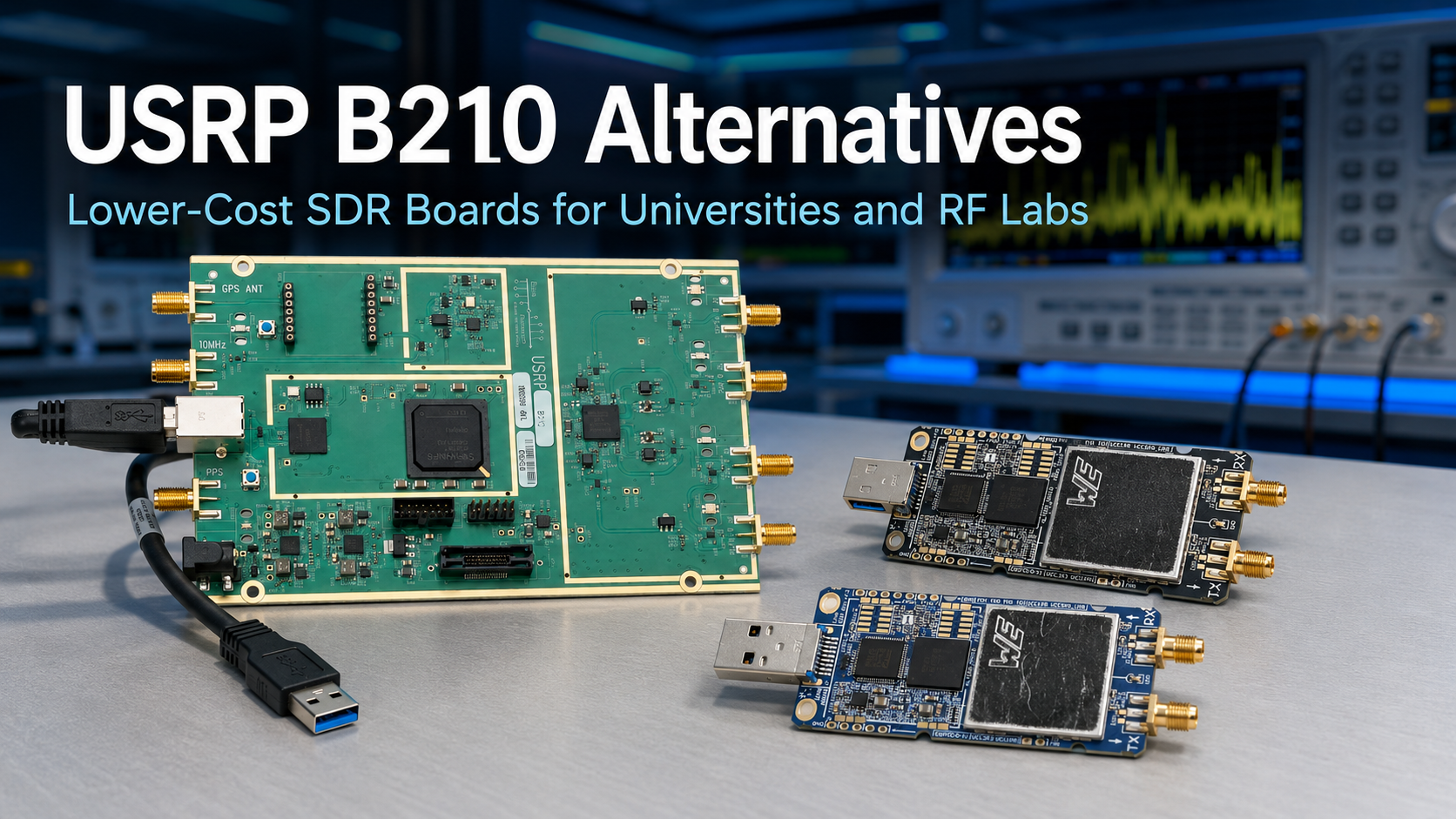
USRP B210 is one of the most widely recognized software-defined radio platforms for university laboratories, wireless-communications courses, GNU Radio development, private 5G testbeds, and RF research. Its compact USB-powered design, integrated AD9361 RF transceiver, 2×2 MIMO capability, and mature UHD workflow make it a practical reference platform.
However, purchasing a USRP B210 for every student station or laboratory bench is not always the most efficient use of a university budget. Some courses need a genuine 2×2 MIMO transceiver. Others only need controlled transmit-and-receive exercises, FPGA experimentation, network-connected SDR access, or a lower-cost platform for student projects.
This guide compares the most relevant USRP B210 alternatives for universities, engineering departments, RF laboratories, cybersecurity research teams, and wireless-development projects. It explains which boards are genuine 2×2 alternatives, which options are only suitable for narrower teaching roles, and which compatibility claims must be validated before purchasing multiple units.
Browse current hardware in the software-defined radio equipment category, the USRP devices category, the bladeRF category, and the PlutoSDR and Pluto-style SDR category.
Quick Answer: What Are the Best USRP B210 Alternatives?
The best alternative depends on what the laboratory actually needs. No single lower-cost board replaces every USRP B210 workflow.
| SDR platform | Best use | 2×2 MIMO | Main interface | Important buyer note |
|---|---|---|---|---|
| USRP B210 | Reference platform for standardized UHD labs | Yes | USB 3.0 | Best choice when official Ettus documentation and predictable UHD workflows matter most |
| MicroPhase ANTSDR U220 AD9361 | Lower-cost USB 3.0 research bench | Yes | USB 3.0 Type-C | Choose the AD9361 version when the project needs 70 MHz–6 GHz coverage and up to 56 MHz bandwidth |
| LibreSDR B220 Mini AD9361 | Budget-focused USRP-style experimentation | Yes | USB workflow | Validate the custom FPGA image, UHD configuration, operating system, and application before fleet deployment |
| bladeRF 2.0 micro xA4 | FPGA development, GNU Radio, waveform research, and portable 2×2 MIMO | Yes | USB 3.0 | Uses the Nuand libbladeRF ecosystem rather than being a drop-in UHD replacement |
| LimeSDR USB | LimeSuite development, MIMO teaching, and lower-frequency experimentation | Yes | USB 3.0 | Genuine 2×2 platform, but availability and software workflow should be checked before procurement |
| PLUTO+ SDR | Affordable network-connected transceiver teaching and Pluto-style development | Board-listed 2TX and 2RX | Gigabit Ethernet and USB | Useful development board, but not an official ADALM-PLUTO specification and not a direct B210 replacement |
| MicroPhase ANTSDR E316 | Embedded and network-connected SDR projects | Yes | Gigabit Ethernet and embedded workflow | Better suited to embedded projects than simple USB-only classroom stations |
Why Is USRP B210 Difficult to Replace?
USRP B210 is not popular only because of its RF specifications. Its strongest advantage is the combination of hardware, documentation, UHD driver support, educational familiarity, and predictable integration with common research workflows.
The official USRP B210 design combines:
- Two transmit channels and two receive channels
- Coherent 2×2 MIMO capability
- Continuous 70 MHz–6 GHz RF coverage
- Analog Devices AD9361 RFIC
- Up to 56 MHz real-time bandwidth
- USB 3.0 SuperSpeed connectivity
- USB bus power
- External timing-reference support
- UHD software support
- GNU Radio integration
View the USRP B210 USB SDR with 2×2 MIMO, AD9361, UHD, and GNU Radio support.
A cheaper SDR board may match several items on this list while still behaving differently in practice. The most important purchasing question is not whether another board looks similar on paper. The question is whether it supports the exact experiment, operating system, driver version, sample-rate requirement, clocking method, and software stack your laboratory intends to use.
Hardware Similarity Is Not the Same as Workflow Compatibility
Many SDR boards use AD9361 or AD9363 RF transceivers, USB connectivity, FPGA processing, and two transmit plus two receive channels. That does not automatically make them interchangeable.
Before selecting a USRP B210 alternative, separate the comparison into four layers:
| Layer | Questions to ask |
|---|---|
| RF hardware | Does the board have the required tuning range, bandwidth, number of channels, RF connectors, clock input, and frequency stability? |
| Transport | Does it use USB 3.0, Gigabit Ethernet, PCIe, or another interface? Can the host computer sustain the required data rate? |
| Drivers and firmware | Does the project require standard UHD, modified UHD, libiio, libbladeRF, LimeSuite, a custom FPGA image, or a board-specific firmware profile? |
| Application validation | Has the exact board been tested with your GNU Radio flowgraph, srsRAN configuration, OpenAirInterface branch, operating system, and channel bandwidth? |
This distinction matters most when a laboratory wants to build cellular testbeds, automated teaching images, repeatable research environments, or larger fleets of student devices.
Best Overall Lower-Cost USB Alternative: MicroPhase ANTSDR U220
MicroPhase ANTSDR U220 is one of the closest lower-cost alternatives for laboratories that want a USB-connected 2×2 SDR with a modern FPGA and multiple synchronization options.
MicroPhase documentation lists:
- Xilinx Artix-7 XC7A200T FPGA
- Analog Devices AD9361 or AD9363 RFIC options
- USB 3.0 Type-C connectivity
- Two transmit channels and two receive channels
- Half-duplex or full-duplex operation
- Flexible-rate 12-bit ADC and DAC direction
- External PPS and 10 MHz reference input
- GPS synchronization input
- GPIO and JTAG expansion
Choose the correct ANTSDR U220 RFIC version
The AD9361 and AD9363 versions should not be treated as identical.
| ANTSDR U220 variant | Official RF range direction | Official analog-bandwidth direction | Best fit |
|---|---|---|---|
| AD9361 version | 70 MHz–6 GHz | 200 kHz–56 MHz | Closest U220 choice for labs comparing against USRP B210 |
| AD9363 version | 325 MHz–3.8 GHz | 200 kHz–20 MHz | Lower-cost teaching and narrower-band experiments where the wider B210 profile is unnecessary |
View the MicroPhase ANTSDR U220 SDR development board.
When ANTSDR U220 makes sense
- Your lab needs two transmit and two receive channels.
- You want a compact USB 3.0 Type-C device.
- You need external timing-reference options.
- You want an Artix-7 FPGA with more modern resources than older compact platforms.
- You are prepared to qualify the board for your software image and research stack.
When USRP B210 may still be the safer purchase
- Your course material is already written around official UHD examples.
- You need the lowest possible integration risk.
- You are building a standardized institutional testbed.
- Your grant, partner organization, or research paper explicitly requires USRP B210 hardware.
Lowest-Cost USRP-Style Direction: LibreSDR B210 Mini and B220 Mini
LibreSDR B210 Mini and B220 Mini boards are interesting for cost-sensitive laboratories because they are designed around a USRP-style workflow and are positioned as compact alternatives for experimentation.
The live SDRstore.eu listing distinguishes two versions:
| LibreSDR version | FPGA | RFIC | Best buyer direction |
|---|---|---|---|
| LibreSDR B210 Mini | Xilinx Artix-7 XC7A100T | AD9363 | Lower-cost development where the narrower AD9363 profile is acceptable |
| LibreSDR B220 Mini | Xilinx Artix-7 XC7A200T | AD9361 | More relevant option when the goal is a wider-band B210-style research board |
View the LibreSDR B210 Mini and B220 Mini product page.
What buyers must understand before ordering a fleet
LibreSDR should be presented as a board-specific alternative, not as an official Ettus product. Public setup resources describe custom FPGA images and UHD configuration steps. That can be useful for experienced researchers, but it also means the laboratory should test a sample unit before ordering a large quantity.
Validate:
- The exact model: B210 Mini or B220 Mini
- The installed RFIC: AD9363 or AD9361
- The FPGA image required by the board revision
- The UHD version
- The operating system and kernel version
- GNU Radio source and sink blocks
- Matlab or Simulink workflows if required
- srsRAN or OpenAirInterface configuration if cellular work is planned
- Clocking behavior and USB stability under sustained load
- Multi-channel operation at the intended sample rates
Best LibreSDR use case
LibreSDR is most attractive when a technically capable laboratory wants to reduce the cost of selected benches and is comfortable maintaining validated software images. It is less suitable when instructors need every student station to behave identically with minimal troubleshooting.
Best Independent FPGA Development Alternative: bladeRF 2.0 micro xA4
bladeRF 2.0 micro xA4 is one of the strongest alternatives for universities that want genuine 2×2 MIMO hardware, USB 3.0 connectivity, FPGA access, open development resources, and a distinct ecosystem designed for experimentation.
Nuand officially lists bladeRF 2.0 micro with:
- 2×2 MIMO support
- 47 MHz–6 GHz tuning direction
- 61.44 MSPS sampling rate
- 56 MHz filtered bandwidth
- USB 3.0 SuperSpeed support
- 12-bit ADC and DAC resolution
- Factory-calibrated VCTCXO
- Bias-tee support for compatible peripherals
- Open-source libraries, utilities, firmware, and HDL direction
- Windows, Linux, and macOS support direction
View the bladeRF 2.0 micro xA4 or browse bladeRF SDR devices and accessories.
bladeRF xA4 vs xA9
| Model | FPGA direction | Choose it when |
|---|---|---|
| bladeRF 2.0 micro xA4 | 49 kLE Cyclone V FPGA direction | You want a capable lower-cost 2×2 development board for GNU Radio, waveform projects, and student research |
| bladeRF 2.0 micro xA9 | 301 kLE Cyclone V FPGA direction | You need substantially more FPGA room for HDL signal processing, accelerators, filters, correlators, or modem development |
Why bladeRF is not a drop-in B210 replacement
bladeRF uses libbladeRF and its own software ecosystem. It is a strong alternative when the research objective is waveform development, DSP, FPGA programming, or portable RF experimentation. It should not be purchased under the assumption that every UHD-based USRP tutorial will work without modification.
Best bladeRF use cases
- GNU Radio development
- FPGA and HDL education
- Custom modem research
- 2×2 MIMO fundamentals
- Portable RF experimentation
- Cybersecurity research in authorized environments
- Wireless-protocol analysis and controlled testbeds
Best Lime Ecosystem Alternative: Full-Size LimeSDR USB
Full-size LimeSDR USB is a genuine 2×2 MIMO platform and remains relevant for wireless experimentation, LimeSuite development, lower-frequency projects, and teaching laboratories that want an open SDR ecosystem.
Lime Microsystems officially lists:
- LMS7002M RF transceiver
- Two transmit and two receive channels
- 100 kHz–3.8 GHz frequency range
- 61.44 MHz bandwidth
- 61.44 MSPS sample rate
- 12-bit sample depth
- USB 3.0 controller
- External clock input and output direction
Browse current devices in the LimeSDR category.
Full-size LimeSDR USB is not the same as LimeSDR Mini
This distinction matters. The full-size LimeSDR USB is a genuine 2×2 platform. LimeSDR Mini models are compact devices for different use cases and should not automatically be treated as equivalent 2×2 replacements.
Choose LimeSDR USB when
- Your laboratory already uses LimeSuite.
- You need genuine 2×2 MIMO operation.
- You want coverage below the 70 MHz lower boundary of many AD9361-based boards.
- You want an open development ecosystem.
- Your project does not require a standard UHD workflow.
Best Affordable Pluto-Style Teaching Board: PLUTO+ SDR
PLUTO+ SDR is a useful lower-cost option for university teaching, GNU Radio projects, network-connected SDR development, digital-communications exercises, and controlled transceiver experiments.
The live SDRstore.eu product listing specifies:
- Two transmit channels and two receive channels
- Gigabit Ethernet
- MicroSD boot support
- AD9363 RF transceiver
- PlutoSDR-style development direction
- Board-advertised expanded tuning profile
View the PLUTO+ SDR AD9363 2T2R transceiver and read the PLUTO+ SDR review.
PLUTO+ SDR should not be confused with standard ADALM-PLUTO
Analog Devices officially specifies standard ADALM-PLUTO with one transmitter, one receiver, 325 MHz–3.8 GHz RF coverage, and up to 20 MHz instantaneous bandwidth. PLUTO+ is an expanded third-party Pluto-style design with additional board-level features.
For accurate buyer advice, treat PLUTO+ 2T2R support, Ethernet connectivity, MicroSD boot support, and expanded frequency profile as board-specific features. Do not describe them as official standard ADALM-PLUTO specifications.
Choose PLUTO+ SDR when
- You want lower-cost transceiver benches for student projects.
- You need Ethernet-connected SDR experiments.
- You want Pluto-style GNU Radio and libiio workflows.
- You want to teach modulation, demodulation, link budgets, filtering, and digital communications.
- You can validate edge-band performance for your own application.
Do not choose PLUTO+ SDR as an automatic B210 substitute when
- Your research procedure explicitly requires standard UHD behavior.
- Your application depends on an officially specified AD9361 range and bandwidth.
- Your laboratory needs a documented USRP reference platform.
- You are purchasing hardware for a repeatable cellular testbed without prior validation.
Best Embedded Alternative: MicroPhase ANTSDR E316
Some laboratories need more than a USB peripheral. They may want an embedded SDR that can be placed near antennas, connected over Ethernet, integrated into a field setup, or used for standalone development.
MicroPhase ANTSDR E316 is relevant for this direction. The SDRstore.eu listing describes a Zynq-7020 SoC platform with AD9361 or AD9363 direction, 2×2 MIMO, Gigabit Ethernet, MicroSD support, timing features, and embedded-development potential.
View the MicroPhase ANTSDR E316.
Choose ANTSDR E316 when
- You want an embedded Linux-capable SDR direction.
- Gigabit Ethernet is more useful than USB-only operation.
- You are building remote or networked RF nodes.
- You need a portable research platform with onboard processing direction.
- You are willing to manage board-specific firmware and software images.
Standard ADALM-PLUTO and LimeSDR Mini: Useful, but Not Direct B210 Replacements
A university does not need a 2×2 MIMO board at every student desk. Lower-cost single-channel devices can still be excellent for teaching.
| Platform | Why it is useful | Why it is not a direct B210 replacement |
|---|---|---|
| Standard ADALM-PLUTO | Accessible learning platform for modulation, demodulation, GNU Radio, Matlab, Simulink, and libiio workflows | Officially one transmitter and one receiver, with narrower RF coverage and bandwidth than B210 |
| LimeSDR Mini | Compact Lime ecosystem platform for student exercises and prototyping | Not the same architecture or multi-channel configuration as full-size LimeSDR USB |
| RTL-SDR receiver | Very affordable receive-only hardware for FM, ADS-B, AIS, satellites, antennas, waterfalls, and GNU Radio fundamentals | No transmit capability and no 2×2 MIMO |
The best university lab normally mixes affordable student devices with a smaller number of advanced shared platforms. Read our university SDR lab hardware checklist for a complete layered purchasing strategy.
USRP B210 Alternative Comparison Table
| Platform | RFIC direction | Channels | Frequency range direction | Bandwidth direction | Software ecosystem | Best fit |
|---|---|---|---|---|---|---|
| USRP B210 | AD9361 | 2TX / 2RX | 70 MHz–6 GHz | Up to 56 MHz | Official UHD | Standardized research labs and documented USRP workflows |
| ANTSDR U220 AD9361 | AD9361 | 2TX / 2RX | 70 MHz–6 GHz | 200 kHz–56 MHz | MicroPhase workflow with board-specific validation | Lower-cost USB 3.0 RF benches |
| ANTSDR U220 AD9363 | AD9363 | 2TX / 2RX | 325 MHz–3.8 GHz | 200 kHz–20 MHz | MicroPhase workflow with board-specific validation | Narrower-band teaching and experimentation |
| LibreSDR B220 Mini | AD9361 | 2R2T direction | 70 MHz–6 GHz direction | Board-specific direction | Custom FPGA image and UHD configuration direction | Technically capable budget-focused laboratories |
| bladeRF 2.0 micro xA4 | AD9361 direction | 2×2 MIMO | 47 MHz–6 GHz direction | 56 MHz filtered bandwidth | libbladeRF, GNU Radio, SoapySDR, and related tools | FPGA, DSP, waveform, and modem development |
| LimeSDR USB | LMS7002M | 2TX / 2RX | 100 kHz–3.8 GHz | 61.44 MHz | LimeSuite | Lime ecosystem, MIMO teaching, and lower-frequency research |
| PLUTO+ SDR | AD9363 | Board-listed 2TX / 2RX | Board-advertised expanded profile | Validate for the exact workflow | Pluto-style libiio and GNU Radio direction | Affordable transceiver education and networked SDR projects |
Best SDR Board by University Lab Objective
For official UHD documentation and predictable integration
Choose USRP B210. It remains the safest default when the laboratory values documentation, standardization, and a mature USRP workflow more than the lowest possible unit price.
For a lower-cost USB 3.0 2×2 research bench
Consider ANTSDR U220 with the AD9361 RFIC. It offers a compelling hardware direction for labs that can qualify the board against their software environment.
For the lowest-cost USRP-style experimentation
Consider LibreSDR B220 Mini with AD9361. Purchase one test unit first, document the working FPGA image and UHD configuration, then decide whether it is suitable for wider deployment.
For FPGA, HDL, and modem development
Choose bladeRF 2.0 micro xA4 for a lower-cost board or xA9 when FPGA capacity is a major requirement. bladeRF is a strong research platform in its own right rather than merely a B210 substitute.
For LimeSuite and lower-frequency coverage
Choose full-size LimeSDR USB. Its 100 kHz lower tuning direction can be valuable for projects outside the normal AD9361 starting range.
For affordable student transceiver stations
Choose PLUTO+ SDR or standard ADALM-PLUTO-class hardware according to the required channel count, networking features, and budget. These devices are useful for controlled teaching exercises but should not be described as equivalent to B210.
For embedded or remote SDR nodes
Consider ANTSDR E316 or another suitable embedded SDR platform with Gigabit Ethernet, MicroSD support, and onboard processing direction.
What About srsRAN, Open5GS, and OpenAirInterface?
USRP B210 is a practical starting platform for private 5G and cellular learning because official srsRAN documentation includes B210-based workflows. However, this does not mean that every board with an AD9361 RFIC or two RF channels will behave identically.
For cellular research, validate:
- The precise software stack and version
- The selected RF band
- The required channel bandwidth
- USB or Ethernet transport stability
- Clocking and synchronization
- Host CPU performance
- Driver installation procedure
- Firmware image and FPGA image
- COTS handset compatibility where applicable
- SIM credentials and core-network configuration
- Local spectrum authorization
Read our guides:
- Best SDR for 5G Research: USRP B210, X310, X410, and Lower-Cost Alternatives
- OpenAirInterface vs srsRAN: Which Open-Source 5G Stack Is Better for Your SDR Lab?
- USRP B210 vs X310: Which SDR Should a Research Lab Buy?
Important limitation: B210 is not the correct tool for every advanced cellular experiment
A compact 2×2 USB SDR is a strong starting point for many projects, but it is not a universal answer. Advanced multi-cell, handover, wider-bandwidth, low-latency, modular RF, and rack-based research may justify USRP X310, X410, or another higher-end platform.
Do not purchase a B210 alternative only because the specifications appear similar. Start with the exact experiment and work backward to the hardware requirements.
Recommended Purchasing Strategy for a University SDR Lab
The best university SDR laboratory normally uses multiple hardware tiers. Buying the same expensive SDR for every desk is rarely necessary.
| Lab layer | Suggested hardware direction | Main purpose |
|---|---|---|
| Introductory student stations | RTL-SDR receivers and portable antennas | FM, ADS-B, AIS, satellites, gain, filtering, waterfalls, and GNU Radio fundamentals |
| Controlled transceiver benches | Standard Pluto-class hardware or PLUTO+ SDR | Modulation, demodulation, cabled loopback, digital communications, and Ethernet-connected projects |
| Shared 2×2 communications benches | USRP B210, ANTSDR U220 AD9361, bladeRF 2.0 micro, or validated LibreSDR B220 Mini | MIMO, channel estimation, OFDM, cellular learning, and advanced GNU Radio projects |
| Embedded research bench | ANTSDR E316 or suitable embedded SDR | Remote nodes, Ethernet access, onboard processing, and field experiments |
| Advanced shared research platform | USRP X310, X410, or another suitable high-end system | Handover, wider bandwidth, modular RF front ends, rack integration, advanced FPGA workflows, and scalable testbeds |
Example 12-student laboratory direction
| Equipment | Suggested quantity | Why |
|---|---|---|
| RTL-SDR receivers | 12 units or 6 units for paired work | Affordable receive-only access for every student |
| Pluto-class or PLUTO+ SDR boards | 4–6 units | Shared controlled transmit-and-receive teaching benches |
| USRP B210 | 1–2 units | Official reference platform for UHD, cellular, and comparison testing |
| ANTSDR U220 AD9361 | 1–2 units | Evaluate lower-cost USB 3.0 2×2 research benches |
| bladeRF 2.0 micro xA4 | 1–2 units | FPGA, DSP, HDL, and waveform-development projects |
| LibreSDR B220 Mini | 1 evaluation unit initially | Validate firmware, UHD configuration, and application suitability before expanding |
| NanoVNA and TinySA instruments | Shared units | Antenna, cable, filter, SWR, and protected spectrum-measurement exercises |
| Attenuators, dummy loads, RF cables, adapters, and DC blocks | Multiple sets | Safe and repeatable RF bench operation |
USRP B210 Alternative Buyer Checklist
Before purchasing an SDR board for a university or RF laboratory, define the actual requirement.
1. Confirm the RFIC
Do not assume every board version uses the same transceiver. AD9361 and AD9363 versions can have materially different official tuning and bandwidth profiles.
2. Confirm the channel count
Check whether the board is genuinely capable of two transmit and two receive channels. A single transmit and single receive platform may still be useful for teaching, but it is not a 2×2 substitute.
3. Confirm the required bandwidth
Maximum theoretical bandwidth is not the same as stable throughput in every application. Real performance depends on the active channels, sample format, driver, firmware, host computer, USB controller, network interface, and signal-processing chain.
4. Confirm the driver ecosystem
| Ecosystem | Typical hardware direction |
|---|---|
| UHD | Official USRP platforms and selected validated compatible devices |
| Modified or board-specific UHD | Some ANTSDR and USRP-style alternatives |
| libiio | ADALM-PLUTO and Pluto-style platforms |
| libbladeRF | Nuand bladeRF devices |
| LimeSuite | LimeSDR devices |
5. Confirm synchronization requirements
External 10 MHz reference input, PPS input, GPS synchronization, reference output, and multi-device coherence may matter for MIMO, direction finding, channel measurements, cellular experiments, and distributed testbeds.
6. Confirm the physical interface
USB 3.0 is convenient for portable benches. Gigabit Ethernet helps with remote placement and network-connected labs. Embedded processing is valuable for field systems. PCIe and 10 Gigabit Ethernet become important for higher-end systems.
7. Confirm accessories
A research SDR is only one part of a functional bench. Plan for:
- Suitable antennas
- 50-ohm dummy loads
- Fixed attenuators
- Variable attenuators where useful
- DC blocks
- RF cables
- SMA adapters
- Bias tees where required
- Filters
- LNAs for appropriate receive-only situations
- External clocking where required
- Spare USB and Ethernet cables
RF Safety and Legal Notes
Transmit-capable SDR boards must be used responsibly. Do not transmit on frequencies where you are not licensed or authorized. Cellular bands, public-safety frequencies, aviation bands, satellite services, and other regulated spectrum may have strict legal restrictions.
For laboratory work:
- Begin with cabled loopback tests.
- Use suitable attenuation between transmitter and receiver.
- Use dummy loads where radiation is unnecessary.
- Verify signal levels before connecting sensitive equipment.
- Do not connect a transmitter directly to a receiver input without a safe link-budget calculation.
- Do not connect a transmitter directly to a spectrum analyzer, TinySA, NanoVNA, or other sensitive instrument without suitable protection.
- Use shielding or controlled RF environments where required.
- Obtain the required regulatory authorization before operating private cellular testbeds over the air.
Request a Formal Quote for University and RF Lab Equipment
Universities, laboratories, cybersecurity companies, telecom teams, engineering departments, and institutional buyers can request a formal quote directly from SDRstore.eu.
Use the Add to Quote button on product pages or the document icon on product cards. This allows your team to collect SDR boards, antennas, filters, attenuators, cables, clocking accessories, and RF measurement tools in one quote request.
A quote request is useful when you need:
- Custom pricing for multiple SDR devices
- A formal offer for internal approval
- University or laboratory procurement documentation
- Bulk quantities
- Advice on mixing student stations with advanced shared benches
- Accessories included in the same offer
- A comparison between USRP B210 and lower-cost alternatives
Read our guide: Request a Quote Online: A Faster Way to Get Custom Pricing from SDRstore.eu.
Where to Browse USRP B210 Alternatives
- Software-defined radio equipment
- USRP SDR devices and accessories
- USRP B210 USB SDR
- LibreSDR B210 Mini and B220 Mini
- MicroPhase ANTSDR U220
- MicroPhase ANTSDR E316
- bladeRF SDR devices and accessories
- bladeRF 2.0 micro xA4
- LimeSDR devices and accessories
- PlutoSDR and Pluto-style devices
- PLUTO+ SDR AD9363 2T2R transceiver
Related SDRstore.eu Guides
- Best SDR for 5G Research: USRP B210, X310, X410, and Lower-Cost Alternatives
- USRP B210 vs X310: Which SDR Should a Research Lab Buy?
- How to Build a University SDR Lab: Hardware Checklist for Teaching and Research
- SDR Hardware for Universities: Beginner, Intermediate, and Advanced Lab Setups
- 2×2 MIMO SDR Explained: USRP B210, PLUTO+, bladeRF, LimeSDR, and Research Use Cases
- AD9361 vs AD9363 SDR Boards: Bandwidth, MIMO, Use Cases, and Buyer Advice
- OpenAirInterface vs srsRAN: Which Open-Source 5G Stack Is Better for Your SDR Lab?
- PLUTO+ SDR Review: AD9363 2T2R SDR Transceiver with Ethernet
Official Resources
- Ettus Research USRP B210 official product page
- Ettus Research UHD manual for the B2x0 series
- MicroPhase ANTSDR U220 hardware manual
- Nuand bladeRF 2.0 micro official product page
- Lime Microsystems LimeSDR USB official product page
- Analog Devices ADALM-PLUTO official product page
- srsRAN official COTS UE tutorial
- srsRAN official handover tutorial
Final Verdict: Which USRP B210 Alternative Should You Buy?
USRP B210 remains the strongest default choice when a laboratory needs an official Ettus platform, standard UHD workflows, documented integration, coherent 2×2 MIMO, and predictable setup.
Choose ANTSDR U220 AD9361 when you want a lower-cost USB 3.0 2×2 board with modern FPGA resources, synchronization options, and a hardware profile that is closer to B210 direction.
Choose LibreSDR B220 Mini when reducing cost is a priority and your technical team can validate and maintain the required FPGA image and UHD configuration.
Choose bladeRF 2.0 micro xA4 when FPGA access, GNU Radio, waveform development, portable 2×2 MIMO, and the Nuand ecosystem are more important than UHD compatibility.
Choose full-size LimeSDR USB when LimeSuite, 2×2 MIMO, open development, and lower-frequency coverage matter.
Choose PLUTO+ SDR when you want an affordable Pluto-style platform for controlled teaching, digital communications, Ethernet-connected SDR projects, and student experimentation.
The best laboratory does not use the same SDR board everywhere. It combines affordable teaching stations, validated mid-tier development boards, one or more official reference platforms, and higher-end shared systems only where the research objective justifies them.
FAQ
What is the best lower-cost alternative to USRP B210?
MicroPhase ANTSDR U220 with the AD9361 RFIC is one of the closest lower-cost USB 3.0 alternatives for RF labs that need 2TX, 2RX, 70 MHz–6 GHz coverage direction, up to 56 MHz analog bandwidth direction, and synchronization options. Validate the board with your software stack before purchasing multiple units.
Is LibreSDR B220 Mini a direct replacement for USRP B210?
LibreSDR B220 Mini is a budget-focused USRP-style board with AD9361 and Artix-7 direction, but it should not be described as an official drop-in replacement. Public setup resources describe custom FPGA images and UHD configuration steps. Test the exact board revision, firmware, driver, operating system, and application first.
Is bladeRF 2.0 micro better than USRP B210?
Neither board is universally better. bladeRF 2.0 micro is a strong choice for FPGA access, libbladeRF development, GNU Radio, waveform research, and portable 2×2 MIMO projects. USRP B210 is usually the safer choice for official UHD workflows and standardized USRP-based laboratories.
Does LimeSDR support 2×2 MIMO?
The full-size LimeSDR USB officially supports two transmit and two receive channels. LimeSDR Mini models should not automatically be treated as the same 2×2 platform.
Is PLUTO+ SDR the same as ADALM-PLUTO?
No. Standard ADALM-PLUTO is officially specified by Analog Devices with one transmitter, one receiver, 325 MHz–3.8 GHz RF coverage, and up to 20 MHz instantaneous bandwidth. PLUTO+ is an expanded third-party Pluto-style board with board-listed 2TX, 2RX, Gigabit Ethernet, MicroSD boot support, and an expanded tuning profile.
Can I use a lower-cost B210 alternative with srsRAN?
Possibly, but validate the exact board, firmware, driver, RF band, bandwidth, operating system, clocking, and srsRAN configuration. Official srsRAN documentation includes USRP B210 workflows. Similar hardware does not guarantee identical behavior.
Can USRP B210 run every private 5G experiment?
No. B210 is a strong starting point for many private 5G and cellular learning projects, but advanced handover, multi-cell, wider-bandwidth, modular RF, low-latency, and scalable testbeds may require X310, X410, or another suitable higher-end platform.
Which SDR board is best for a university lab?
Use a layered strategy. Deploy affordable RTL-SDR receivers for introductory stations, Pluto-class or PLUTO+ boards for controlled transceiver exercises, USRP B210 or validated alternatives for shared 2×2 research benches, bladeRF for FPGA projects, and higher-end platforms only for advanced funded research.
Should a university buy USRP B210 for every student?
Usually not. Most universities gain more value by combining affordable student receivers, shared transceiver benches, a smaller number of 2×2 research platforms, RF test tools, cables, attenuators, dummy loads, and one or two official reference units.
How can a university request a formal SDR lab quote?
Add products to a quote request from SDRstore.eu product pages using the Add to Quote button or from product cards using the document icon. Include quantities, teaching goals, research projects, required RF ranges, accessories, clocking needs, and future expansion plans.
No posts found
Write a review






We support all major card and digital payment options. More local methods are available and shown during checkout.
You enter into a binding sales contract once you have received an 'order confirmation and sales receipt' email from us, in line with our Sales & Delivery conditions. Therefore, sdrstore.eu has the right to cancel your order in the event of technical problems, delivery failure, Fair use policy and other similar situations.






Your payments are protected by advanced encryption and 3-D Secure authentication for safe online shopping.