





OpenAirInterface vs srsRAN: Which Open-Source 5G Stack Is Better for Your SDR Lab?
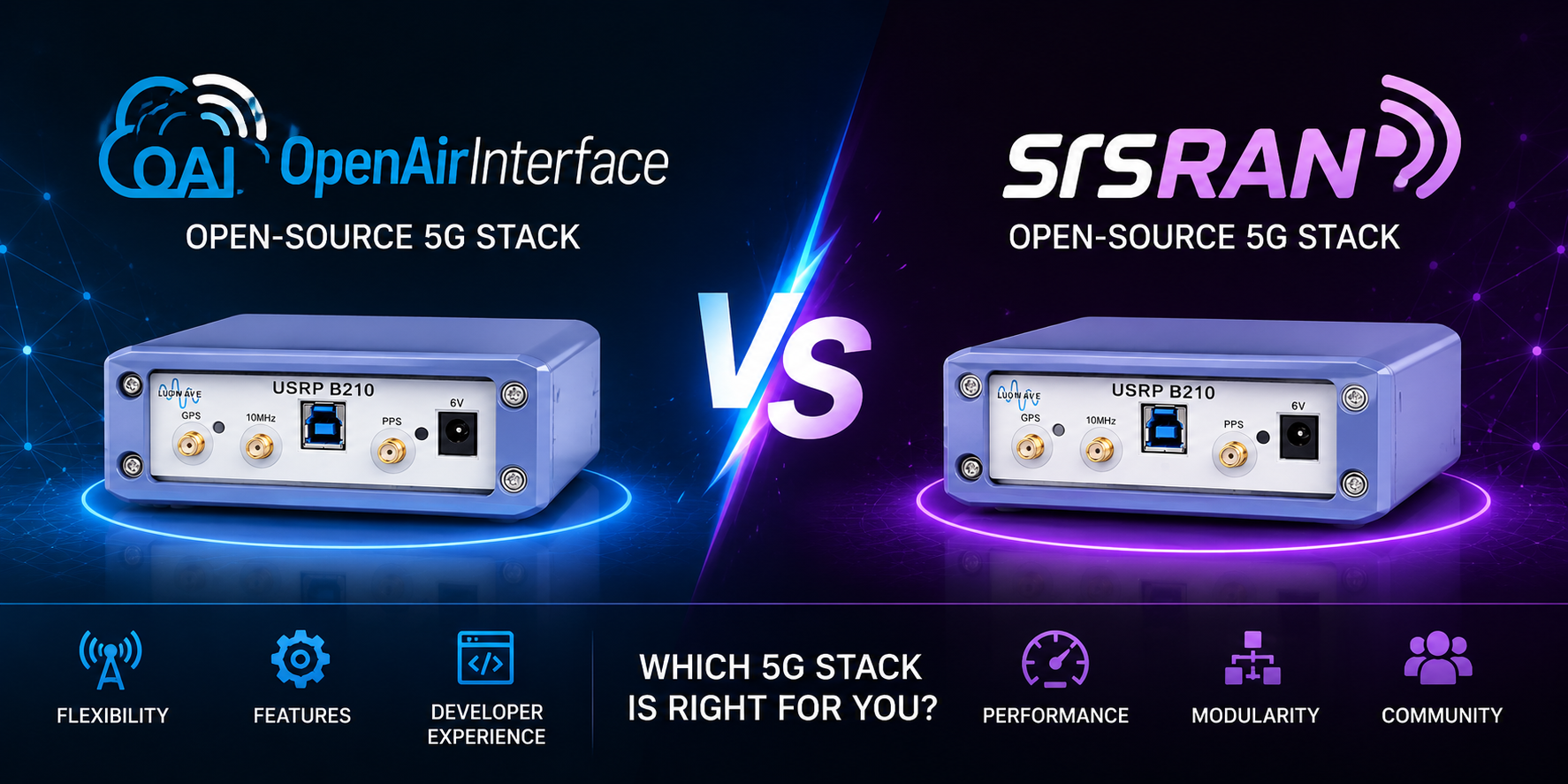
Updated: June 2026. This guide compares OpenAirInterface and srsRAN for software-defined radio laboratories, 5G standalone networks, USRP B210 and X310 hardware, Open5GS, OAI Core, commercial user equipment, O-RAN, CU-DU splits, radio units, RF simulation, PHY research, private-network testing, and university projects.
OpenAirInterface and srsRAN are two of the most important open-source platforms for building a 5G software-defined radio laboratory.
Both can help universities, telecom companies, cybersecurity teams, wireless researchers, and engineering students build private 5G testbeds, connect compatible user equipment, experiment with radio-access-network architecture, and study real cellular protocols using SDR hardware.
However, they are not identical tools.
srsRAN Project is usually the cleaner starting point for a practical 5G standalone lab using a USRP B210, a third-party 5G Core such as Open5GS, and a compatible commercial handset.
OpenAirInterface, usually shortened to OAI, is a broader end-to-end cellular research ecosystem. It includes an open 5G gNB, an open nrUE implementation, a separate OAI 5G Core project, RF simulation tools, PHY-level development workflows, O-RAN integrations, and advanced directions such as FR2, NTN, and AI-enhanced receiver research.
The best choice depends on what your laboratory wants to accomplish first.
This guide explains the differences between OpenAirInterface and srsRAN, which one is easier for beginners, which one is better for deep PHY research, which SDR hardware to buy, when USRP B210 is enough, when USRP X310 becomes necessary, and why many serious laboratories eventually use both stacks.
Browse current hardware in the USRP SDR devices, boards, and accessories category and the broader software-defined radio equipment category at SDRstore.eu.
Quick Answer: OpenAirInterface or srsRAN?
| Your Main Goal | Recommended Stack | Why |
|---|---|---|
| Build your first practical 5G SA SDR lab | srsRAN Project | Clear tutorials for USRP B210, Open5GS, commercial handsets, external clocks, and Split 8 deployment |
| Learn 5G RAN configuration with a commercial smartphone | srsRAN Project | Strong COTS UE documentation and tested-device guidance |
| Use an open gNB and an open software UE | OpenAirInterface | OAI maintains both gNB and nrUE implementations |
| Modify PHY behavior deeply | OpenAirInterface | Strong research direction for PHY simulation, RF simulation, gNB, UE, FR2, NTN, and advanced experiments |
| Study Open RAN architecture with Split 7.2 radio units | srsRAN Project or OAI | Both ecosystems support O-RAN-oriented research; srsRAN provides especially accessible current RU tutorials |
| Build a CU-DU Split 8 lab using a USRP B210 | srsRAN Project | Official documentation provides a B210, Open5GS, and COTS UE workflow |
| Run an intra-gNB handover lab with independent RF chains | srsRAN Project with USRP X310 | Official tutorial documents X310 for this use case |
| Use one open ecosystem for RAN, UE, and 5G Core research | OpenAirInterface | OAI provides separate but connected RAN, nrUE, and OAI Core projects |
| Test interoperability between open-source cellular stacks | Use both | A mixed lab provides broader research value than choosing only one ecosystem |
For many new laboratories, the safest first path is:
USRP B210 → srsRAN Project gNB → Open5GS Core → compatible 5G SA handsetFor deeper protocol-stack research, add:
OpenAirInterface gNB → OAI nrUE → OAI Core → RFsimulator and real SDR hardwareOpenAirInterface vs srsRAN Comparison Table
| Feature | OpenAirInterface | srsRAN Project |
|---|---|---|
| Main identity | Broad end-to-end cellular research ecosystem | Open-source 5G CU-DU RAN solution |
| 5G gNB | Yes | Yes |
| 5G UE implementation | Yes, OAI nrUE | srsRAN Project itself does not include a production-ready UE; prototype 5G extensions exist through srsUE from srsRAN 4G for proof-of-concept testing |
| Own 5G Core project | Yes, OAI Core Network | No integrated core; official tutorials commonly recommend Open5GS |
| Best first COTS UE lab | Possible | Strong starting choice due to accessible official documentation |
| Best deep PHY research direction | Strong advantage | Capable, but many users choose OAI when extensive PHY modification is the priority |
| RF simulation | Strong RFsimulator and PHY simulator direction | ZeroMQ, virtual-radio, dummy-RU, RU-emulation, and test-mode workflows |
| Commercial handset support direction | Yes | Yes, with official COTS UE tutorials and tested-device resources |
| O-RAN Split 7.2 direction | Yes, with continuing O-RAN fronthaul development | Yes, with detailed RU, switch, timing, DPDK, and Kubernetes documentation |
| CU-DU split | Yes | Yes, including documented Split 8 and Split 7.2 workflows |
| NearRT-RIC and xApps | Relevant O-RAN research direction | Documented E2 interface interoperability with third-party RIC frameworks and xApps |
| FR1 | Yes | Yes |
| FR2 | Official OAI RAN page lists FR2 support direction | Focus current entry-level SDR lab planning primarily on FR1 unless the selected srsRAN architecture and RF hardware explicitly support the intended FR2 project |
| NTN research | Active NTN research direction for GEO and LEO scenarios | Official feature direction includes NTN GEO support and an NTN tutorial |
| Beginner learning curve | Steeper for full-stack work | Often easier for the first practical B210-based lab |
| Best long-term lab strategy | Use for deep stack research and interoperability | Use for practical RAN deployment, Open RAN labs, and interoperability |
Important Clarification: These Projects Do Not Have the Same Scope
Comparing OpenAirInterface and srsRAN requires one important clarification.
srsRAN Project is primarily an open-source 5G CU-DU RAN implementation.
A practical srsRAN 5G standalone laboratory normally adds:
- A third-party 5G Core such as Open5GS
- A commercial 5G SA handset, test modem, or compatible UE
- A USRP device or O-RAN radio unit
- Suitable clocking and synchronization
- SIM credentials
- Authorized RF environment
OpenAirInterface is broader as an ecosystem.
OAI provides:
- OAI 5G gNB
- OAI nrUE
- OAI 5G Core Network
- OAI OAM direction
- RF simulation
- PHY simulation
- Real SDR integration
- Commercial UE testing
- O-RAN-related integrations
- FR1 and FR2 research directions
- NTN experimentation
This does not mean OAI is automatically better.
It means OAI exposes more of the cellular system for researchers who need to modify and study several layers.
What Is srsRAN Project?
srsRAN Project is an open-source 5G CU-DU RAN solution maintained by Software Radio Systems.
It includes a complete L1, L2, and L3 stack with limited external dependencies and is designed to scale from lower-power compute systems to cloud-RAN architectures.
srsRAN Project is especially useful for:
- Practical 5G SA laboratories
- USRP B210 private-network experiments
- Commercial handset attachment
- Open5GS integration
- CU-DU splits
- Split 8 USRP labs
- O-RAN Split 7.2 radio-unit labs
- NearRT-RIC and xApp research
- Intra-gNB handover
- Network slicing experiments
- Kubernetes deployment
- DPDK-oriented deployments
- Performance tuning
- NTN GEO research direction
- University courses
- Telecom prototyping
Current srsRAN Project feature direction
- 3GPP Release 17 alignment
- FDD and TDD support
- FR1 bands
- Up to 100 MHz TDD bandwidth direction
- Up to 50 MHz FDD bandwidth direction
- 15 kHz and 30 kHz subcarrier spacing
- 256-QAM
- 4×4 MIMO direction
- RAN slicing
- CU-DU split
- Split 7.2 support through its Open Fronthaul library
- E2 interface direction
- Multiple cells per gNB
- Intra-gNB handover
- NTN GEO direction
What Is OpenAirInterface?
OpenAirInterface is an open-source cellular research ecosystem maintained through the OpenAirInterface Software Alliance.
OAI RAN provides a software-based implementation for 5G and future networking technologies, with simulation, prototyping, end-to-end deployment, commercial-hardware integration, and advanced research workflows.
OAI RAN includes:
- 5G gNB
- 5G nrUE
- 4G LTE eNB
- 4G LTE UE
- SA and NSA support direction
- FR1 research
- FR2 research
- Commercial handset interoperability
- Real SDR integration
- RF simulation
- PHY simulators
- O-RAN-related workflows
- Advanced protocol-stack experimentation
OAI RAN official 5G direction
| Capability | Official OAI RAN Direction |
|---|---|
| FR1 gNB bandwidth | 10–100 MHz |
| FR2 gNB bandwidth | 100–200 MHz |
| Subcarrier spacing direction | 15 kHz and 30 kHz for listed FR1 gNB workflows; 120 kHz for listed FR2 direction |
| Layers | Up to 4 downlink and 2 uplink layers direction |
| Modulation | 256-QAM direction |
| Deployment direction | SA and NSA |
OAI 5G Core vs Open5GS
The core-network choice is one of the clearest practical differences between the ecosystems.
srsRAN tutorials normally use Open5GS as the third-party 5G Core.
OAI provides its own separate 5G Core Network project.
| Core Network | Best For | Main Advantage |
|---|---|---|
| Open5GS | First srsRAN labs, straightforward private-network learning, and broad community familiarity | Common practical pairing with srsRAN tutorials |
| OAI 5G Core | Researchers who want to study, modify, and deploy an OAI-based end-to-end architecture | Integrated OAI ecosystem direction with several deployment modes and advanced core-network features |
OAI 5G Core direction includes:
- 5G Standalone core-network implementation
- AMF
- SMF
- UPF
- NRF
- AUSF
- UDM
- UDR
- NSSF
- PCF
- NWDAF
- Network slicing
- N2 handover direction
- Multiple UPFs
- QoS-enabled deployments
- AI-enabled core direction
- Docker-Compose deployment
- Kubernetes and Helm deployment
- Virtual-machine and bare-metal deployment
Choose Open5GS first if:
- You want the shortest practical route into an srsRAN lab.
- You are following official srsRAN tutorials.
- You want a compact first private 5G SA setup.
- You want to focus on the RAN before studying the core deeply.
Choose OAI Core if:
- You want an OAI end-to-end architecture.
- You are researching 5G Core behavior.
- You want several deployment flavors.
- You are studying slicing, QoS, multiple UPFs, NWDAF, or OAI-specific interoperability.
- You want to modify the core network as part of the project.
Best Stack for a First USRP B210 5G Lab
Choose srsRAN Project first.
The official srsRAN documentation provides a clear path for running a 5G standalone network with:
- Linux computer
- srsRAN Project
- USRP B210 connected over USB 3.0
- Open5GS 5G Core
- Compatible 5G SA commercial handset
- Test SIM credentials
- External clock source where required
SDRstore.eu offers the USRP B210 USB SDR with 2×2 MIMO, AD9361, UHD, and GNU Radio support.
Why B210 and srsRAN are a strong starting combination
- Compact SDR hardware
- USB 3.0 connectivity
- 70 MHz–6 GHz coverage
- 2×2 MIMO
- Full-duplex operation
- Mature UHD driver direction
- Documented COTS UE setup
- Documented Open5GS setup direction
- Simpler than building an advanced rack-based system immediately
Read our dedicated guide: USRP B210 for srsRAN and OpenAirInterface: What Researchers Need to Know.
When Should You Use OpenAirInterface with USRP B210?
USRP B210 is also relevant for OAI research.
OAI works with common USRP platforms through UHD-based integration, including B200-series devices, B210, X310, N300-series devices, and X410 direction.
Use OAI with B210 when:
- You want to learn OAI gNB deployment.
- You want to experiment with OAI nrUE.
- You want a low-cost path into OAI RAN development.
- You want to compare OAI and srsRAN on similar hardware.
- You want to test RFsimulator workflows before enabling real RF.
- You are studying open-source protocol-stack behavior.
Move beyond B210 when:
- You need wider bandwidth.
- You need several independently configurable RF chains.
- You need advanced O-RAN radio-unit integration.
- You need more FPGA resources.
- You are working on FR2.
- You are building high-throughput or AI-enhanced research platforms.
Best Stack for PHY Research
Choose OpenAirInterface when deep physical-layer experimentation is the main goal.
OAI exposes a broad research environment for:
- PHY simulators
- RFsimulator
- Real RF boards
- gNB PHY development
- nrUE PHY development
- Channel coding
- Transport-channel simulation
- MIMO behavior
- FR1 research
- FR2 research
- NTN research
- AI-enhanced receiver projects
- Dataset generation
- O-RAN fronthaul integration
OAI PHY simulators can help test:
- PBCH
- PRACH
- PUCCH
- DLSCH
- ULSCH
- LDPC behavior
- Polar-code behavior
- SNR sensitivity
- Channel-model behavior
- Transport-channel performance
OAI is especially attractive when researchers need to change the cellular implementation itself rather than only deploy and configure a network.
Best Stack for COTS Handset Testing
Choose srsRAN first when the primary goal is connecting a commercial 5G SA handset with a clear tutorial path.
srsRAN documentation provides:
- COTS UE tutorial
- Tested handset resources
- Open5GS integration
- SIM-programming guidance
- SUCI configuration direction
- External-clock recommendations
- USRP B210 workflow
- X310 handover workflow
OAI also supports commercial UE testing, but the broader research scope can make the learning path feel more complex for a first private-network lab.
| Goal | Recommended First Choice |
|---|---|
| Connect a commercial handset as quickly as practical | srsRAN Project with B210 and Open5GS |
| Compare a commercial handset with an open nrUE | Add OpenAirInterface |
| Research gNB and UE behavior together | OpenAirInterface |
| Run interoperability experiments | Use both |
Does srsRAN Include a 5G UE?
srsRAN Project itself does not include a production-ready 5G UE application.
The srsRAN ecosystem includes a prototype 5G UE direction through srsUE from srsRAN 4G. Official documentation describes it as a proof-of-concept and initial-testing option rather than a deployment-ready 5G UE.
Current prototype srsUE limitations include:
- 15 kHz subcarrier spacing direction
- FDD-band direction
- 5, 10, 15, or 20 MHz bandwidth direction
- No handover support
Use a compatible commercial handset when you want a practical srsRAN private-network test.
Use OAI nrUE when the open software UE itself is part of the research objective.
Best Stack for an Open UE
Choose OpenAirInterface.
OAI maintains an nrUE implementation that researchers can compile, run, inspect, and modify.
An open nrUE is valuable when studying:
- Initial access
- Synchronization
- Random access
- PHY behavior
- MAC behavior
- RRC behavior
- Measurements
- Mobility
- NTN changes
- MIMO
- FR2 behavior
- Interoperability
- Protocol debugging
Commercial handsets are useful for realistic testing, but they do not expose the internal software behavior that an open nrUE provides.
RF Simulation: OAI RFsimulator vs srsRAN Virtual Workflows
| Workflow | OpenAirInterface | srsRAN Project |
|---|---|---|
| Software-only experiments before enabling RF | RFsimulator and PHY simulators | ZeroMQ, dummy-RU, RU-emulation, no-core, and test-mode workflows |
| Debug protocol changes | Strong option, especially when gNB and nrUE are both open | Strong option for CU-DU and RAN-focused testing |
| Meaningful real-time RF throughput measurement | Use actual RF hardware rather than relying only on RF simulation | Use actual RF hardware or suitable RU hardware |
| Repeatable software development | Strong option | Strong option |
Start with simulation when:
- You are learning the stack.
- You are modifying source code.
- You are testing configuration files.
- You want to avoid accidental RF transmission.
- You want reproducible debugging.
- You do not yet own SDR hardware.
Move to real SDR hardware only after the software path works reliably.
Split 8 vs Split 7.2 Explained
The correct architecture depends on whether the laboratory connects directly to a USRP or uses an O-RAN radio unit.
| Architecture | Typical RF Front End | Best For |
|---|---|---|
| Split 8 | USRP B210, X310, or other compatible SDR directly connected to the host | Entry-level SDR labs, GNU Radio users, private-network learning, and compact research systems |
| Split 7.2 | O-RAN radio unit connected over fronthaul | Open RAN architecture, RU interoperability, DPDK, timing, synchronization, switches, and scalable deployments |
Start with Split 8 if:
- You are new to open-source 5G.
- You own a USRP B210.
- You want a compact lab.
- You want fewer infrastructure dependencies.
- You want to focus on RAN software before learning O-RAN fronthaul.
Move to Split 7.2 if:
- You want to study O-RAN architecture.
- You need third-party O-RU interoperability.
- You want DU and RU disaggregation.
- You have a suitable real-time server.
- You understand PTP and timing synchronization.
- You have suitable switches, network cards, SFP+ modules, and cables.
Best Stack for O-RAN Split 7.2
srsRAN Project is an especially accessible starting point for a Split 7.2 lab because its official documentation provides a detailed RU guide.
The documented workflow covers:
- CU-DU server
- Open Fronthaul library
- Split 7.2 radio unit
- Fronthaul switch
- SFP+ fiber connectivity
- 10 Gigabit network-interface direction
- Real-time Linux direction
- Open5GS Core
- Commercial handset
- PTP synchronization
- Supported O-RU examples
OAI is also relevant to O-RAN 7.2 research and continues to develop O-RAN fronthaul, O-RU integration, FAPI, M-plane, E2, and advanced integration directions.
| Your O-RAN Goal | Recommended Direction |
|---|---|
| Build a documented first Split 7.2 O-RU lab | srsRAN Project |
| Study O-RAN alongside deep OAI PHY changes | OpenAirInterface |
| Test interoperability across open stacks and commercial RUs | Use both |
NearRT-RIC and xApp Research
srsRAN Project provides official documentation for using its E2 interface with third-party near-real-time RIC frameworks and xApps.
This is useful for:
- RAN monitoring
- KPM metrics
- RAN-control experiments
- xApp development
- Policy experimentation
- Closed-loop optimization
- AI-assisted RAN research
- O-RAN education
OAI also participates in O-RAN and FlexRIC-oriented research directions, making it valuable for laboratories studying end-to-end O-RAN interoperability and RAN intelligence.
USRP B210 vs X310 for OAI and srsRAN
| SDR Hardware | Best Use | Recommended Stack Direction |
|---|---|---|
| USRP B210 | First practical 5G SA lab, portable teaching setup, USB 3.0 workflow, 2×2 MIMO fundamentals | Start with srsRAN and Open5GS; add OAI for comparison and deeper experimentation |
| USRP X310 | Independent RF chains, intra-gNB handover, wider bandwidth, 10 Gigabit Ethernet, modular daughterboards, FPGA research | Use with srsRAN handover workflows, advanced OAI projects, and long-term lab infrastructure |
| USRP X410 | Multi-channel RFSoC research, wide bandwidth, AI-enhanced PHY, advanced OAI, 5G-to-6G investment | Compare OAI and advanced research architectures carefully |
Read our detailed hardware comparison: USRP B210 vs X310: Which SDR Should a Research Lab Buy?.
USRP B210: Best First Purchase for Most SDR Labs
The USRP B210 is the strongest default recommendation for most laboratories starting OAI or srsRAN experiments.
USRP B210 key features
- 70 MHz–6 GHz continuous RF coverage
- Analog Devices AD9361 RFIC
- 2 transmit channels
- 2 receive channels
- Coherent 2×2 MIMO
- Full-duplex operation
- Up to 56 MHz real-time bandwidth
- USB 3.0 connectivity
- UHD compatibility
- GNU Radio support
- External timing-reference support
Choose B210 if:
- You are starting with srsRAN.
- You are starting with OAI.
- You want a compact USRP.
- You want to use a laptop or workstation over USB 3.0.
- You want to connect a compatible commercial handset.
- You are building a classroom lab.
- You want to buy several radios for students.
- You do not need independent RF-chain handover.
USRP X310: Best Upgrade for Advanced Labs
The USRP X310 becomes the better choice when the research program outgrows a compact USB SDR.
X310 advantages
- Two RF daughterboard slots
- DC–6 GHz direction with suitable daughterboards
- Up to 160 MHz bandwidth per channel with suitable daughterboards
- Larger Kintex-7 FPGA
- Dual 10 Gigabit Ethernet
- Dual 1 Gigabit Ethernet
- PCIe options
- Optional GPSDO direction
- Rack-based testbed direction
- Independent RF-chain workflows
Choose X310 if:
- You are running srsRAN intra-gNB handover experiments.
- You need independently configurable RF chains.
- You need 10 Gigabit Ethernet.
- You need wider bandwidth.
- You need modular daughterboards.
- You are building a permanent research rack.
- You need larger FPGA resources.
- You are moving into advanced OAI or srsRAN projects.
Lower-Cost SDR Alternatives
USRP hardware offers the safest documentation path, but lower-cost SDR boards can still be valuable for teaching, prototyping, GNU Radio, embedded research, and selected cellular experiments.
| SDR | Best For | Important Note |
|---|---|---|
| LibreSDR B210 Mini or B220 Mini | Lower-cost 2R2T SDR experimentation and OAI-oriented learning | Validate chipset, firmware, UHD direction, and software compatibility carefully |
| MicroPhase ANTSDR U220 | Budget-conscious USB 3.0 MIMO prototyping | Confirm exact AD9361 or AD9363 variant and software stack |
| MicroPhase ANTSDR E316 | Embedded Ethernet-connected research | Useful for Zynq, MicroSD, GPS, and PPS-oriented projects |
| bladeRF 2.0 micro | GNU Radio, FPGA development, custom PHY, and portable 2×2 MIMO projects | Not a universal drop-in replacement for UHD-based tutorials |
| PLUTO+ SDR | Low-cost learning, Pluto-style workflows, Ethernet, and early prototyping | Not the safest first choice for a documented commercial-handset 5G lab |
Which Stack Is Easier to Learn?
srsRAN Project is usually easier for the first practical 5G SA lab.
Why srsRAN often feels easier initially
- Clear installation guide
- Clear running guide
- USRP B210 tutorial
- Open5GS recommendation
- COTS UE tutorial
- Tested handset guidance
- External-clock guidance
- Configuration reference
- Troubleshooting resources
- Performance-tuning resources
OAI becomes especially valuable when the laboratory is ready to work deeper inside the cellular stack.
Why OAI has a steeper learning curve
- Broader project scope
- More research directions
- Separate RAN and Core projects
- Open nrUE
- RFsimulator
- PHY simulators
- More low-level experimentation
- More configuration paths
- Advanced FR2 and NTN direction
A steeper learning curve is not a weakness when the objective is deep cellular research.
Which Stack Is Better for Universities?
| University Goal | Recommended Stack |
|---|---|
| Teach students how a 5G SA lab works | srsRAN Project with Open5GS and USRP B210 |
| Teach Open RAN architecture | srsRAN Project Split 7.2 direction |
| Study gNB, nrUE, and core behavior together | OpenAirInterface |
| Modify PHY algorithms | OpenAirInterface |
| Study RF simulation before purchasing hardware | OpenAirInterface RFsimulator and srsRAN virtual workflows |
| Research interoperability | Use both |
| Build a long-term research program | Start with srsRAN, add OAI, and standardize suitable USRP hardware |
Which Stack Is Better for Cybersecurity Research?
Both stacks can be valuable in a controlled and authorized environment.
srsRAN is useful for:
- Private-network deployment
- Configuration testing
- COTS handset attachment
- RAN behavior monitoring
- O-RAN RIC and xApp experiments
- Handover testing
- Network-isolation exercises
OAI is useful for:
- Protocol-stack inspection
- Open UE behavior
- PHY-level research
- RF simulation
- Core-network modification
- Interoperability testing
- Controlled reproduction of edge cases
Use only test SIM cards, authorized frequencies, shielded environments, conducted RF paths, and systems you own or have explicit permission to test.
Which Stack Is Better for NTN Research?
Both ecosystems have NTN research direction, but they are not identical.
srsRAN Project documentation includes NTN GEO support direction and an NTN tutorial.
OAI has active NTN development covering simulation and gNB or UE behavior for satellite scenarios, including GEO and LEO-oriented work.
| NTN Goal | Recommended Direction |
|---|---|
| Learn NTN concepts within an accessible RAN project | Explore srsRAN NTN documentation |
| Modify gNB and nrUE behavior for satellite scenarios | OpenAirInterface |
| Research GEO and LEO channel behavior deeply | OpenAirInterface RFsimulator and NTN direction |
| Compare implementation approaches | Use both |
Recommended Upgrade Path for a New Laboratory
- Start with software-only virtual experiments.
- Install srsRAN Project and Open5GS.
- Use USRP B210 for the first practical 5G SA lab.
- Add a compatible commercial handset and programmable test SIM.
- Add an external reference clock when connection stability requires it.
- Install OpenAirInterface and test OAI RFsimulator.
- Compare OAI gNB, OAI nrUE, and OAI Core workflows.
- Move to USRP X310 when independent RF chains, handover, daughterboards, 10 Gigabit Ethernet, or PCIe become necessary.
- Move to Split 7.2 O-RU architecture when the project requires Open RAN fronthaul.
- Compare X410 and higher-tier platforms when wideband, multi-channel, AI-enhanced PHY, or future-facing 6G research justifies the investment.
Legal and RF Safety Warning
Operating a private 5G network on cellular frequencies may be regulated or restricted in your country.
Use:
- Authorized frequencies
- Shielded RF enclosures
- Conducted RF connections
- Suitable attenuators
- Dummy loads
- Low transmit power
- Test SIM cards
- Known credentials
- Regulator approval where required
- Qualified RF-engineering practices
Do not transmit into licensed cellular bands without authorization.
Do not interfere with public mobile networks.
What Hardware Does a 5G SDR Lab Need?
- Suitable Linux workstation
- USRP B210 for entry-level Split 8 experiments
- USRP X310 for independent RF chains and advanced labs
- Suitable X310 daughterboards where required
- Compatible 5G SA handset or test UE
- Programmable test SIM
- SIM-card reader and writer
- External reference clock where required
- GPSDO or OctoClock direction where required
- RF cables
- Fixed and variable attenuators
- Dummy loads
- DC blocks
- Band-pass filters
- Suitable antennas
- Shielded enclosure where required
- 10 Gigabit Ethernet NIC for advanced X310 or RU workflows
- SFP+ modules and cables for networked setups
- Real-time Linux direction for demanding Split 7.2 setups
- Spectrum analyzer
- Vector network analyzer
Where to Browse SDR Hardware for OAI and srsRAN
- USRP SDR devices, boards, and accessories
- USRP B210 USB SDR with 2×2 MIMO, AD9361, UHD, and GNU Radio
- USRP X310 SDR with Kintex-7, SFP+, PCIe, and daughterboard support
- LibreSDR B210 Mini and B220 Mini
- MicroPhase ANTSDR U220
- MicroPhase ANTSDR E316
- Nuand bladeRF SDR devices
- PLUTO+ SDR AD9363 2T2R Transceiver
- Antennas and RF accessories
- RF amplifiers, LNAs, and signal boosters
- RF test and measurement equipment
Request a Quote for a University or Research Laboratory
Universities, telecom companies, research laboratories, integrators, cybersecurity firms, and purchasing departments can request a formal quotation directly from SDRstore.eu.
Use the Add to Quote button on product pages or the document icon on product cards to request:
- Formal quotations
- Bulk pricing
- Several USRP B210 units
- USRP X310 configurations
- X310 daughterboards
- Complete OAI or srsRAN laboratory configurations
- Clocking equipment
- RF cables
- Attenuators
- Antennas
- Shielded test accessories
- Test and measurement equipment
- Invoice details for internal purchasing approval
Read our guide: Request a Quote Online: A Faster Way to Get Custom Pricing from SDRstore.eu.
Related SDRstore.eu Guides
- Best SDR for 5G Research: USRP B210, X310, X410, and Lower-Cost Alternatives
- USRP B210 vs X310: Which SDR Should a Research Lab Buy?
- USRP B210 for srsRAN and OpenAirInterface: What Researchers Need to Know
- PlutoSDR vs HackRF One: Which SDR Is Better for Transmit, Receive, and Research?
- Best SDR Receivers in 2026: RTL-SDR, SDRplay, Airspy, HackRF, PlutoSDR, and More
- Do You Need an LNA for SDR? When It Helps and When It Makes Signals Worse
- TinySA Ultra Setup Guide: Spectrum Scanning, Signal Generator, LNA, and Attenuator
- Best Antenna Analyzer for Ham Radio: NanoVNA, RigExpert, and Other Options Compared
Official Resources
- srsRAN Project official documentation
- srsRAN gNB with COTS UEs tutorial
- srsRAN gNB with prototype srsUE tutorial
- srsRAN gNB handover tutorial
- srsRAN O-RAN CU-DU split tutorial
- srsRAN O-RAN 7.2 RU guide
- srsRAN NearRT-RIC and xApp tutorial
- OpenAirInterface RAN official page
- OpenAirInterface 5G Core official page
- OpenAirInterface code and deployment resources
- OpenAirInterface 5G GitLab repository
- Ettus Research USRP B210 official product page
- Ettus Research USRP X310 official product page
Final Verdict: OpenAirInterface vs srsRAN
Choose srsRAN Project first when your laboratory wants the clearest route into a practical 5G standalone SDR network.
It is an excellent starting point for a USRP B210, Open5GS, compatible commercial handset, test SIM, and controlled RF setup. Its documentation also creates a clear upgrade path toward CU-DU splits, O-RAN Split 7.2 radio units, NearRT-RIC, xApps, Kubernetes, DPDK, handover, NTN, and performance tuning.
Choose OpenAirInterface when the research objective extends deeper into the cellular implementation.
OAI is especially valuable when you need an open gNB, an open nrUE, an OAI 5G Core, RFsimulator, PHY simulators, deep PHY modification, protocol debugging, FR2, NTN, advanced interoperability, or future-facing cellular research.
Do not treat the decision as permanent.
The strongest long-term laboratory often uses both.
Start with srsRAN when you want to bring up a practical B210-based 5G SA network efficiently.
Add OpenAirInterface when the team is ready to modify, simulate, compare, and study the cellular stack at a deeper level.
FAQ
Which is better: OpenAirInterface or srsRAN?
srsRAN is usually the better first choice for a practical 5G SA lab using USRP B210, Open5GS, and a compatible commercial handset. OpenAirInterface is stronger when researchers need an open gNB, open nrUE, OAI Core, RF simulation, deep PHY work, FR2, NTN, or broader end-to-end experimentation.
What is the difference between OpenAirInterface and srsRAN?
srsRAN Project is primarily an open-source 5G CU-DU RAN implementation. OpenAirInterface is a broader cellular research ecosystem with a 5G gNB, open nrUE, separate OAI 5G Core project, RF simulation, PHY simulators, and advanced research workflows.
Is srsRAN easier than OpenAirInterface?
srsRAN is often easier for a first practical 5G SA lab because its documentation provides a clear B210, Open5GS, commercial-handset, SIM, clocking, and troubleshooting path. OAI has a broader scope and can require more learning.
Is OpenAirInterface better for research?
OpenAirInterface is especially strong for deep cellular research because it exposes an open gNB, an open nrUE, RF simulation, PHY simulators, core-network options, FR1, FR2, NTN, and low-level protocol-stack experimentation.
Can srsRAN run with USRP B210?
Yes. USRP B210 is one of the strongest starting devices for srsRAN. Official documentation provides B210-based 5G SA workflows with Open5GS and compatible commercial handsets.
Can OpenAirInterface run with USRP B210?
Yes. OAI supports common USRP hardware through UHD-based integration, including USRP B210. It is a useful lower-cost platform for OAI gNB, nrUE, and RF experimentation.
Can OpenAirInterface and srsRAN use USRP X310?
Yes. X310 is useful when a lab needs modular daughterboards, independent RF chains, 10 Gigabit Ethernet, PCIe, wider bandwidth, and more FPGA resources.
Does srsRAN include a 5G Core?
srsRAN Project does not include an integrated 5G Core. Official tutorials commonly use Open5GS as the third-party core network.
Does OpenAirInterface include a 5G Core?
Yes. OAI maintains a separate 5G Standalone Core project with several network functions, deployment modes, UPF options, slicing, QoS, and cloud-native deployment paths.
Does srsRAN include a 5G UE?
srsRAN Project itself does not include a production-ready UE. Prototype 5G extensions are available through srsUE from srsRAN 4G for proof-of-concept and initial testing, but official documentation lists several limitations.
Does OpenAirInterface include a 5G UE?
Yes. OAI maintains an open nrUE implementation. This is valuable when researchers need to inspect, modify, simulate, and test UE-side cellular behavior.
Which stack is better for commercial smartphone testing?
srsRAN is usually the easier first choice because its official documentation provides a practical COTS UE workflow with Open5GS, USRP B210, SIM configuration, and external-clock guidance.
Which stack is better for PHY research?
OpenAirInterface is generally the stronger choice for deep PHY research because it provides PHY simulators, RFsimulator, real SDR support, gNB and nrUE code, FR2 direction, NTN work, and extensive low-level experimentation paths.
Which stack is better for O-RAN Split 7.2?
Both ecosystems are relevant. srsRAN is an especially accessible starting point because it provides detailed current documentation for O-RAN radio units, fronthaul switches, 10 Gigabit networking, PTP synchronization, DPDK, and Kubernetes deployment.
Which stack is better for NearRT-RIC and xApps?
srsRAN provides a documented E2 interface workflow with third-party NearRT-RIC frameworks and xApps. OAI is also relevant for broader O-RAN and FlexRIC-oriented research.
Should I start with Split 8 or Split 7.2?
Start with Split 8 using a USRP B210 when learning open-source 5G. Move to Split 7.2 when you are ready to study O-RAN radio units, fronthaul networking, synchronization, PTP, and disaggregated architecture.
What SDR should I buy for srsRAN?
Start with USRP B210 for a compact 5G SA lab. Choose USRP X310 when you need independent RF chains, handover, modular daughterboards, 10 Gigabit Ethernet, PCIe, or wider bandwidth.
What SDR should I buy for OpenAirInterface?
USRP B210 is a strong entry point. Move to X310, X410, or another suitable platform when you need wider bandwidth, more channels, O-RAN integration, FR2, larger FPGA resources, or advanced PHY research.
Can I learn OAI and srsRAN without SDR hardware?
Yes. Start with software-only experiments. OAI provides RFsimulator and PHY simulators. srsRAN provides virtual and emulated test workflows including ZeroMQ, dummy-RU, RU-emulation, no-core, and test-mode directions.
Can I use OpenAirInterface and srsRAN in the same lab?
Yes. Using both stacks is valuable for interoperability research, implementation comparison, education, protocol debugging, and long-term laboratory flexibility.
Is Open5GS the same as OpenAirInterface Core?
No. Open5GS is a separate open-source 5G Core commonly used in srsRAN tutorials. OAI Core is the separate 5G Core project maintained within the OpenAirInterface ecosystem.
Can I transmit a private 5G network legally?
Rules vary by country. Use authorized frequencies, shielded or conducted RF setups, attenuation, low power, test SIM cards, and regulator approval where required. Do not interfere with public cellular networks.
Which stack should a university choose?
Start with srsRAN, Open5GS, and USRP B210 for practical teaching labs. Add OpenAirInterface when students and researchers need open nrUE, PHY simulation, deeper protocol-stack work, interoperability testing, FR2, or NTN research.
How can a laboratory request a formal quotation?
Add products to a quote request directly from SDRstore.eu product pages using the Add to Quote button or from product cards using the document icon. This is useful for universities, telecom teams, research labs, and purchasing departments.
No posts found
Write a review






We support all major card and digital payment options. More local methods are available and shown during checkout.
You enter into a binding sales contract once you have received an 'order confirmation and sales receipt' email from us, in line with our Sales & Delivery conditions. Therefore, sdrstore.eu has the right to cancel your order in the event of technical problems, delivery failure, Fair use policy and other similar situations.






Your payments are protected by advanced encryption and 3-D Secure authentication for safe online shopping.