





USRP B210 vs X310: Which SDR Should a Research Lab Buy?
Updated: June 2026. This guide compares USRP B210 and USRP X310 for wireless research laboratories, universities, 5G NR, srsRAN, OpenAirInterface, GNU Radio, MIMO, handover, FPGA development, synchronization, private-network testbeds, and long-term SDR investment.
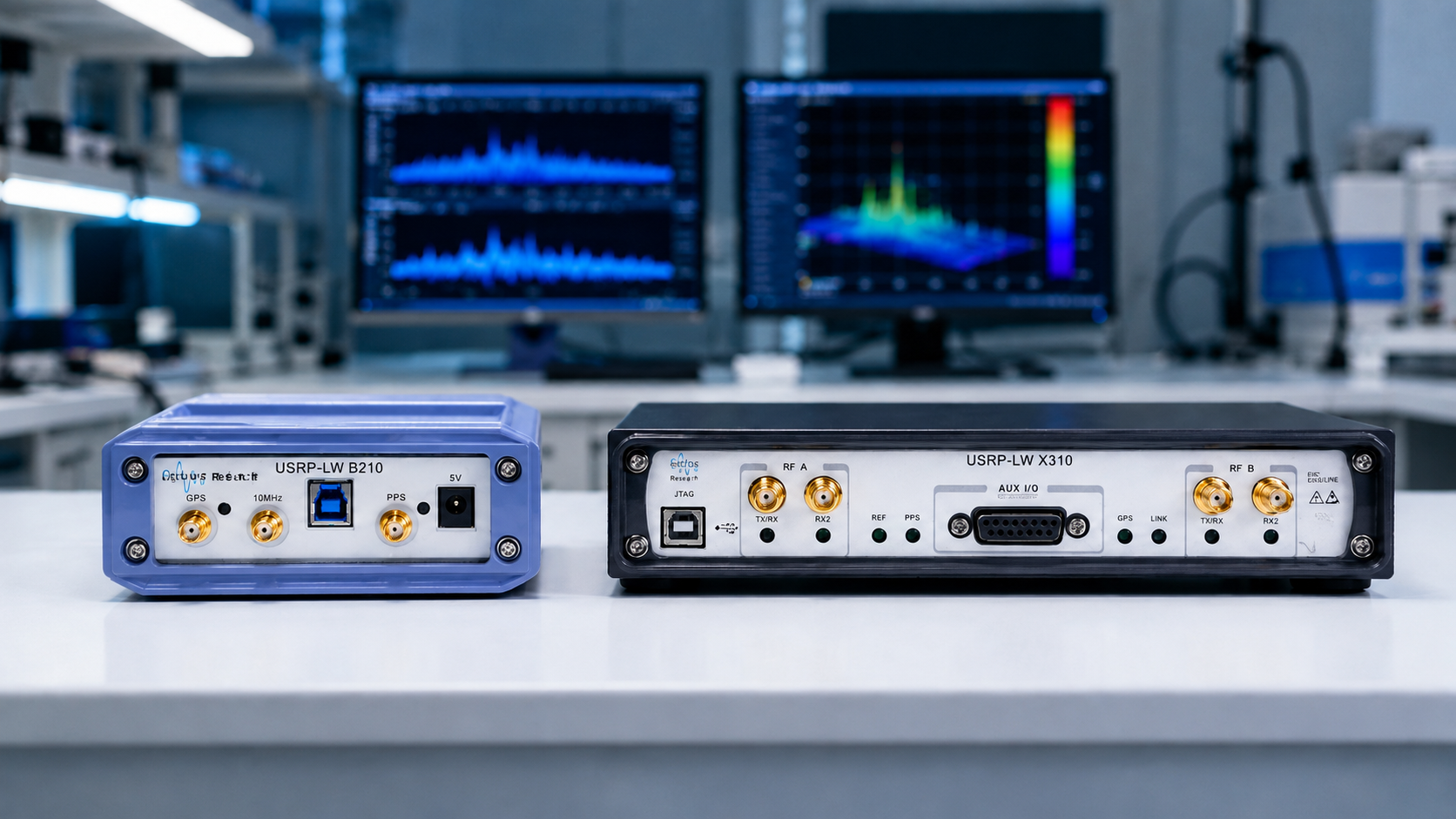
USRP B210 and USRP X310 are both powerful software-defined radio platforms, but they are designed for different stages of a research program.
USRP B210 is a compact, integrated, USB-connected SDR that provides an accessible path into 2×2 MIMO, cellular research, GNU Radio, srsRAN, Open5GS, OpenAirInterface, and university teaching.
USRP X310 is a larger, modular, high-performance platform built for laboratories that need wider bandwidth, independently configurable RF chains, daughterboard flexibility, 10 Gigabit Ethernet, PCIe, larger FPGA resources, rack integration, and more advanced wireless experiments.
The correct choice depends on the laboratory’s first real project.
A team building its first controlled 5G standalone network does not automatically need X310. A laboratory testing multi-cell handover, wider channels, several RF front ends, or custom FPGA signal processing should not choose B210 only because it is less expensive.
This USRP B210 vs X310 comparison explains the differences, which accessories each platform requires, when B210 is enough, when X310 is worth the upgrade, and how a research laboratory should choose between them.
Browse the USRP SDR devices, boards, and accessories category at SDRstore.eu.
Quick Answer: Should Your Research Lab Buy USRP B210 or X310?
| Choose | Best For | Main Reason |
|---|---|---|
| USRP B210 | First 5G SA lab, university courses, GNU Radio, Open5GS, srsRAN, OpenAirInterface learning, portable experiments, and cost-sensitive 2×2 MIMO projects | Integrated 70 MHz–6 GHz SDR with USB 3.0, coherent 2×2 MIMO, full duplex, UHD, and a much simpler deployment path |
| USRP X310 | Advanced research labs, multi-cell handover, independent RF chains, wider bandwidth, custom FPGA DSP, 10 Gigabit Ethernet, PCIe, and rack-based testbeds | Modular daughterboard architecture, Kintex-7 FPGA, higher host throughput, and a more scalable platform |
The easiest buying rule is:
- Choose USRP B210 if your laboratory is building its first practical SDR or 5G NR testbed.
- Choose USRP X310 if the experiment requires independent RF chains, wideband daughterboards, 10 Gigabit Ethernet, PCIe, larger FPGA resources, or a longer-term modular research platform.
Do not buy X310 only because it has a larger specification list.
Do not buy B210 only because it is easier to deploy.
Buy the SDR that matches the software stack, number of RF chains, bandwidth, synchronization requirements, host interface, and experiments your team expects to run during the next several years.
USRP B210 vs X310 Comparison Table
| Feature | USRP B210 | USRP X310 |
|---|---|---|
| Main role | Compact integrated USB SDR for affordable experimentation | High-performance modular SDR for advanced research and scalable systems |
| RF coverage | 70 MHz–6 GHz continuously | DC–6 GHz with suitable daughterboards |
| RF architecture | Integrated Analog Devices AD9361 RFIC | Two replaceable RF daughterboard slots |
| Transmit channels | 2 | Depends on selected daughterboards; commonly configured with two bidirectional RF paths |
| Receive channels | 2 | Depends on selected daughterboards; commonly configured with two bidirectional RF paths |
| Duplex operation | Full duplex | Full duplex with suitable daughterboards and configuration |
| MIMO direction | Coherent 2×2 MIMO using both AD9361 signal chains | Advanced MIMO and independent RF-chain workflows with suitable daughterboards, references, and configuration |
| Real-time bandwidth | Up to 56 MHz | Up to 160 MHz per channel with suitable daughterboards |
| Main host interface | SuperSpeed USB 3.0 | Dual 1 Gigabit Ethernet, dual 10 Gigabit Ethernet, and PCIe options |
| FPGA | Xilinx Spartan-6 XC6SLX150 | Xilinx Kintex-7 XC7K410T |
| FPGA-development headroom | Useful for advanced users but more limited | Substantially larger FPGA for custom DSP blocks and more demanding research |
| Daughterboards required | No | Yes, select daughterboards based on frequency and bandwidth requirements |
| External power | USB bus-powered workflow | External power supply required |
| Optional GPSDO | Board-mounted GPSDO direction available | Optional internal GPSDO direction available |
| External timing | 10 MHz and PPS reference support | 10 MHz and PPS reference support with more scalable synchronization options |
| Portability | Excellent | Designed more for desktop or rack-based laboratory use |
| Setup complexity | Lower | Higher |
| Best first purchase | Most new labs | Labs with defined advanced requirements |
What Is USRP B210?
USRP B210 is a fully integrated single-board software-defined radio platform designed for accessible wireless experimentation.
It combines an Analog Devices AD9361 direct-conversion RF transceiver, a Xilinx Spartan-6 FPGA, USB 3.0 connectivity, and two transmit plus two receive signal chains in a compact board.
SDRstore.eu offers the USRP B210 USB SDR with 2×2 MIMO, 70 MHz–6 GHz coverage, AD9361, UHD, and GNU Radio support.
USRP B210 official key features
- Continuous 70 MHz–6 GHz RF coverage
- Analog Devices AD9361 RFIC
- Full-duplex operation
- 2 transmit channels
- 2 receive channels
- Coherent 2×2 MIMO capability
- Up to 56 MHz real-time bandwidth
- 61.44 MS/s quadrature throughput direction
- Xilinx Spartan-6 XC6SLX150 FPGA
- SuperSpeed USB 3.0 connectivity
- USB bus-powered workflow
- UHD support
- GNU Radio support
- External timing-reference support
USRP B210 is commonly used for:
- Wireless-communications education
- GNU Radio development
- 5G NR learning
- srsRAN testbeds
- Open5GS private-network labs
- OpenAirInterface experiments
- LTE research
- IoT prototyping
- Wi-Fi research
- GNSS experiments
- Spectrum monitoring
- Custom waveform generation
- MIMO fundamentals
- University student projects
What Is USRP X310?
USRP X310 is a modular high-performance SDR platform intended for advanced research, scalable wireless systems, FPGA development, and laboratories that need more bandwidth and more flexibility than a compact USB SDR can provide.
It does not use an integrated wideband RFIC in the same way as B210.
X310 provides two RF daughterboard slots. The laboratory selects daughterboards according to the required frequency range, bandwidth, transmit capability, receive capability, and project goals.
SDRstore.eu offers the USRP X310 SDR platform with Kintex-7 FPGA, SFP+, PCIe, and DC–6 GHz daughterboard direction.
USRP X310 official key features
- Two wide-bandwidth RF daughterboard slots
- DC–6 GHz coverage with suitable daughterboards
- Up to 160 MHz bandwidth per channel with suitable daughterboards
- Xilinx Kintex-7 XC7K410T FPGA
- 14-bit 200 MS/s ADC direction
- 16-bit 800 MS/s DAC direction
- Dual 1 Gigabit Ethernet interfaces
- Dual 10 Gigabit Ethernet interfaces
- PCIe interface options
- Optional GPSDO
- 10 MHz reference support
- PPS timing-reference support
- 1 GB DDR3 memory
- UHD support
- GNU Radio support
- Desktop or rack-mountable half-wide 1U form factor
USRP X310 is commonly used for:
- Advanced 5G research
- srsRAN handover experiments
- Multi-cell testbeds
- OpenAirInterface research
- PHY and MAC research
- Low-latency PCIe workflows
- Wideband wireless prototyping
- Custom FPGA signal processing
- Massive-MIMO-oriented laboratory architectures
- Passive radar
- Spectrum monitoring
- Signals-intelligence research in authorized environments
- Rack-based university laboratories
- Long-term professional wireless-development programs
The Biggest Difference: Integrated Simplicity vs Modular Scalability
The main B210 vs X310 difference is not only bandwidth.
It is system architecture.
USRP B210 architecture
Integrated AD9361 RFIC → Spartan-6 FPGA → USB 3.0 → host computerB210 arrives as a compact integrated radio. Connect antennas or a protected cabled RF path, connect USB 3.0, install UHD, and begin testing.
USRP X310 architecture
Selected RF daughterboards → Kintex-7 FPGA → 1 GigE, 10 GigE, or PCIe → host computerX310 requires more planning.
The laboratory must choose the correct daughterboards, network interface, cables, timing setup, power accessories, antennas, and optional synchronization equipment.
| Priority | Better Choice |
|---|---|
| Begin testing quickly | USRP B210 |
| Carry the SDR between classrooms or demonstrations | USRP B210 |
| Build a modular long-term testbed | USRP X310 |
| Select RF hardware for different frequency ranges | USRP X310 |
| Use PCIe for lower latency | USRP X310 |
| Use 10 Gigabit Ethernet for wider streaming | USRP X310 |
Frequency Coverage: B210 Is Integrated, X310 Depends on Daughterboards
USRP B210 covers 70 MHz–6 GHz continuously through its integrated AD9361 RF transceiver.
USRP X310 can cover DC–6 GHz, but its real RF coverage depends on the installed daughterboards.
| Frequency Requirement | USRP B210 | USRP X310 |
|---|---|---|
| 70 MHz–6 GHz general wideband experiments | Supported through integrated AD9361 RFIC | Supported with suitable daughterboards |
| Below 70 MHz | Outside official operating range | Possible with suitable HF or baseband daughterboards |
| HF experiments | Not the main official operating range | Use LFRX, LFTX, BasicRX, or BasicTX direction where appropriate |
| Sub-6 GHz cellular and wireless research | Strong general-purpose option | Strong advanced option with suitable daughterboards |
| Different RF front ends for different projects | Not modular | Strong advantage |
USRP X310 Daughterboards Explained
X310 does not become a complete RF testbed until suitable daughterboards are selected.
This is one of the most important buying differences.
| Daughterboard | Frequency Range | Bandwidth Direction | Best Use |
|---|---|---|---|
| UBX-160 | Approximately 10 MHz–6 GHz | Up to 160 MHz | General wideband RX and TX research, cellular prototyping, and broad laboratory use |
| UBX-40 | Approximately 10 MHz–6 GHz | Up to 40 MHz | Wide-frequency projects that do not require the full UBX-160 bandwidth |
| WBX-120 | Approximately 50 MHz–2.2 GHz | Up to 120 MHz | Lower-frequency wireless research |
| SBX-120 | Approximately 400 MHz–4.4 GHz | Up to 120 MHz | Many cellular, ISM, and wireless-research projects |
| CBX-120 | Approximately 1.2 GHz–6 GHz | Up to 120 MHz | Higher-frequency sub-6 GHz projects |
| TwinRX | Approximately 10 MHz–6 GHz | 80 MHz per channel, 160 MHz total direction | Dual-channel receive-only applications, spectrum monitoring, and phase-coherent receiving |
| LFRX and LFTX | HF and lower-frequency direction | Up to approximately 30 MHz per channel direction | Lower-frequency baseband and HF experimentation |
| BasicRX and BasicTX | Baseband or IF direction | Project dependent | Custom external RF front ends and specialized laboratory systems |
For many general-purpose sub-6 GHz laboratories, UBX-160 is the most flexible X310 daughterboard direction.
Confirm the exact included accessories and daughterboards before placing an order. A laboratory may need two daughterboards, antennas, RF cables, a regional power cord, a suitable network interface, SFP+ accessories, and synchronization hardware.
Bandwidth: When Does X310 Matter?
USRP B210 provides up to 56 MHz of real-time bandwidth.
USRP X310 can provide up to 160 MHz per channel with suitable daughterboards, FPGA image, host interface, and computer performance.
| Project | USRP B210 | USRP X310 |
|---|---|---|
| Basic GNU Radio learning | More than sufficient | Usually unnecessary |
| Entry-level 5G SA laboratory | Strong choice | Also suitable but more complex |
| Lower-bandwidth private-network testing | Strong choice | Useful when the lab needs future expansion |
| Wider spectrum capture | Limited compared with X310 | Better choice |
| High-throughput PHY research | May become limiting | Better choice |
| Custom FPGA DSP at larger scale | More limited | Better choice |
Wider bandwidth also increases:
- Host-computer requirements
- Network throughput
- Storage requirements
- CPU load
- Memory use
- RF filtering requirements
- Dataset size
- Configuration complexity
Do not buy maximum bandwidth only because it looks better in a product comparison.
USB 3.0 vs 10 Gigabit Ethernet vs PCIe
The host interface changes how the laboratory is built.
USRP B210: USB 3.0
B210 connects directly to a host computer through SuperSpeed USB 3.0.
Advantages
- Simple setup
- Portable workflow
- No dedicated network card required
- USB bus power
- Easy classroom deployment
- Lower accessory cost
Limitations
- Host USB-controller quality matters.
- USB topology can affect performance.
- Scaling several radios becomes more complicated.
- USB is less suitable than 10 Gigabit Ethernet or PCIe for some high-throughput workflows.
USRP X310: 1 Gigabit Ethernet
X310 includes a convenient 1 Gigabit Ethernet direction for initial setup and lower-throughput workflows.
Ettus lists approximately 25 MS/s at 16-bit I/Q as the host-throughput direction for 1 Gigabit Ethernet.
USRP X310: 10 Gigabit Ethernet
Use 10 Gigabit Ethernet when the project needs substantially more streaming bandwidth.
Ettus recommends 10 Gigabit Ethernet to achieve maximum X310 throughput and lists approximately 200 MS/s at 16-bit I/Q as the interface-performance direction.
USRP X310: PCIe
PCIe is attractive when low latency matters.
Ettus specifically recommends PCIe for applications that benefit from deterministic low-latency behavior, including PHY and MAC research.
| Interface | Platform | Best For |
|---|---|---|
| USB 3.0 | USRP B210 | Compact labs, courses, portable use, and practical first experiments |
| 1 Gigabit Ethernet | USRP X310 | Initial setup and lower-throughput workflows |
| 10 Gigabit Ethernet | USRP X310 | Wider-bandwidth streaming and advanced networked laboratories |
| PCIe x4 | USRP X310 | Low-latency PHY and MAC research |
FPGA Comparison: Spartan-6 vs Kintex-7
USRP B210 includes a Xilinx Spartan-6 XC6SLX150 FPGA.
USRP X310 includes a substantially larger Xilinx Kintex-7 XC7K410T FPGA.
| FPGA Goal | USRP B210 | USRP X310 |
|---|---|---|
| Run standard UHD workflows | Strong choice | Strong choice |
| Learn SDR development | Strong starting point | More advanced than necessary for beginners |
| Add custom DSP blocks | Possible for advanced users | More design margin and better long-term direction |
| Build complex FPGA pipelines | More limited | Better choice |
| Prepare for larger research projects | Useful for compact work | Stronger scalable platform |
Choose X310 when FPGA resources are part of the research plan rather than an optional future interest.
Important: Coherent 2×2 MIMO Does Not Mean Independent RF Chains
This distinction matters greatly for cellular research.
USRP B210 uses both signal chains of its AD9361 RFIC and provides coherent 2×2 MIMO capability.
This is useful for:
- MIMO learning
- Spatial-diversity experiments
- Multi-antenna prototyping
- Wireless channel experiments
- Cellular learning
- GNU Radio research
However, B210 does not replace X310 for every experiment.
Some workflows require independently configurable RF chains.
srsRAN’s official intra-gNB handover tutorial uses X310 because the experiment requires a dual-channel RF front end with independent RF chains. The tutorial explicitly notes that B200-series USRPs are not suitable for that specific use case.
| Experiment | USRP B210 | USRP X310 |
|---|---|---|
| Coherent 2×2 MIMO fundamentals | Yes | Yes, with suitable daughterboards and setup |
| Single-cell 5G SA testbed | Strong choice | Also suitable |
| Independent RF-chain multi-cell handover tutorial | Not suitable for the documented srsRAN workflow | Recommended platform |
| Separate RF daughterboard selection | No | Yes |
| More advanced RF-chain flexibility | Limited by integrated architecture | Strong advantage |
USRP B210 for srsRAN and Open5GS
USRP B210 is one of the strongest practical starting points for an srsRAN 5G standalone laboratory.
The official srsRAN COTS UE tutorial demonstrates a 5G SA network using:
- Linux-based host computer
- srsRAN Project CU and DU
- B210 USRP RF front end
- Open5GS 5G Core
- 5G SA-capable commercial handset
- Test SIM or programmable SIM card with known credentials
- External clock source direction
Choose B210 for srsRAN when:
- You are building your first 5G SA lab.
- You want to connect a compatible COTS handset in a controlled environment.
- You want a compact USB-connected SDR.
- You want a documented starting architecture.
- You are teaching private-network concepts.
- You are using one RF front end for a lower-complexity setup.
Choose X310 for srsRAN when:
- You want intra-gNB handover testing.
- You need independent RF chains.
- You want a 10 Gigabit Ethernet architecture.
- You expect to scale the laboratory.
- You need wider channels.
- You want more FPGA headroom.
USRP B210 vs X310 for OpenAirInterface
Both B210 and X310 are relevant to OpenAirInterface research through USRP Hardware Driver workflows.
| OpenAirInterface Goal | Better Starting Choice |
|---|---|
| Learn the OAI software stack affordably | USRP B210 |
| Build a compact USB-based testbed | USRP B210 |
| Run more advanced RF configurations | USRP X310 |
| Use daughterboard flexibility | USRP X310 |
| Use higher-throughput host interfaces | USRP X310 |
| Research larger custom FPGA pipelines | USRP X310 |
Verify the current OAI branch, hardware support, channel-bandwidth limits, kernel requirements, UHD version, RF frontend, and host-computer performance before purchasing equipment for a fixed deployment.
External Clocking: Do You Need a GPSDO or OctoClock?
Not every first experiment requires an external clock.
However, clock accuracy becomes increasingly important when:
- Connecting commercial 5G handsets
- Running longer experiments
- Synchronizing several SDR devices
- Testing multi-cell behavior
- Running handover tests
- Generating repeatable datasets
- Building coherent multi-radio systems
- Investigating carrier-frequency offset problems
- Improving timing stability
The official srsRAN COTS UE tutorial recommends an external clock source such as an OctoClock or GPSDO. It explains that an external clock is not essential but can reduce synchronization problems caused by frequency and timing inaccuracies that commercial handsets may not tolerate.
| Clocking Goal | Recommended Direction |
|---|---|
| First basic GNU Radio experiment | Internal clock may be enough |
| Connect a commercial 5G handset reliably | Consider an external reference clock |
| Synchronize several radios in the same laboratory | Shared 10 MHz and PPS reference direction |
| Synchronize geographically separated devices | GPSDO direction where appropriate |
| Distribute reference clock and PPS to several SDR units | OctoClock or OctoClock-G direction |
Host Computer Requirements
Buying the correct SDR is not enough.
The host computer must process samples in real time.
USRP B210 host direction
- Modern Linux workstation or laptop
- Reliable USB 3.0 controller
- Sufficient CPU performance for the selected software stack
- Avoid overloaded USB hubs
- Use direct motherboard USB 3.0 connectivity where practical
- Check CPU governor and real-time tuning for demanding srsRAN workloads
USRP X310 host direction
- Linux workstation suitable for the selected workload
- Gigabit Ethernet for lower-throughput setup and testing
- 10 Gigabit Ethernet NIC for wider-bandwidth streaming
- Compatible SFP+ accessories and cables
- PCIe interface kit when low-latency operation is required
- Correct network configuration
- Suitable receive and transmit buffers
- CPU performance appropriate for PHY and MAC research
Choose the host together with the SDR
A powerful SDR connected to an unsuitable host computer will not deliver the expected results.
Portability and Classroom Use
USRP B210 is the better choice when the SDR needs to move between classrooms, laboratories, demonstrations, field experiments, and student projects.
| Use Case | USRP B210 | USRP X310 |
|---|---|---|
| Carry between rooms | Excellent | Possible but less convenient |
| Connect to a laptop | Simple USB 3.0 workflow | Possible, but workstation and network planning are more important |
| Student lab with several stations | Strong choice | Usually too expensive and complex for every desk |
| Permanent rack testbed | Less suitable | Strong choice |
| Long-term scalable research infrastructure | Useful entry platform | Better direction |
Which SDR Is Better for Universities?
| University Goal | Recommended SDR | Why |
|---|---|---|
| Teach GNU Radio fundamentals | USRP B210 | Integrated, portable, and widely supported |
| Teach MIMO concepts | USRP B210 | Coherent 2×2 MIMO in a compact board |
| Build a first private 5G SA laboratory | USRP B210 | Strong srsRAN and Open5GS learning direction |
| Buy several student stations | USRP B210 | Lower complexity and cost direction |
| Research handover | USRP X310 | Independent RF-chain workflow |
| Research PHY and MAC behavior with lower latency | USRP X310 | PCIe and larger FPGA direction |
| Build a rack-based long-term testbed | USRP X310 | Modularity, networking, and synchronization options |
| Research very wideband, multi-channel, or AI-native PHY systems | Compare USRP X410 and additional higher-tier platforms | X310 may no longer be the final upgrade |
Which SDR Is Better for 5G Research?
| 5G Research Goal | Recommended SDR |
|---|---|
| First srsRAN and Open5GS 5G SA testbed | USRP B210 |
| Connect a compatible COTS handset in a controlled setup | USRP B210 with suitable clocking, SIM, host, and RF setup |
| Learn OpenAirInterface | USRP B210 |
| Build a portable demonstration | USRP B210 |
| Test intra-gNB handover | USRP X310 |
| Use independent RF chains | USRP X310 |
| Run wider-bandwidth wireless experiments | USRP X310 with suitable daughterboards and host interface |
| Develop custom FPGA DSP | USRP X310 |
| Scale toward large synchronized testbeds | USRP X310 or a higher-tier networked USRP platform |
Read our complete overview: Best SDR for 5G Research: USRP B210, X310, X410, and Lower-Cost Alternatives.
Which SDR Is Better for GNU Radio?
Both USRP B210 and X310 work with GNU Radio through UHD.
Choose B210 for GNU Radio when:
- You are learning GNU Radio.
- You want a portable USB workflow.
- You want to test modulation, demodulation, receiving, transmitting, and MIMO fundamentals.
- You want one board for several student projects.
- You value fast setup more than maximum throughput.
Choose X310 for GNU Radio when:
- You need larger sample throughput.
- You want 10 Gigabit Ethernet.
- You need PCIe.
- You are adding FPGA DSP blocks.
- You are building a modular testbed.
- You need different daughterboards for different RF experiments.
Do You Need a USRP X310 Immediately?
Many laboratories do not.
Start with B210 if:
- Your team is new to UHD.
- You are teaching students.
- You want to learn srsRAN.
- You want a compact Open5GS testbed.
- You need one or several portable 2×2 MIMO boards.
- You have not yet identified a bandwidth limitation.
- You do not need independent-chain handover experiments.
- You want to minimize setup complexity.
Move to X310 when:
- Your team can describe the exact reason USB 3.0 or B210 architecture is limiting the research.
- You need independently configurable RF chains.
- You need wider daughterboard bandwidth.
- You need 10 Gigabit Ethernet.
- You need PCIe for lower latency.
- You want a rack-mounted laboratory platform.
- You need larger FPGA resources.
- You want modular RF front ends.
Is X310 Always the Final Upgrade?
No.
X310 is a strong advanced platform, but some laboratories will eventually require:
- More than two RF channels
- Higher instantaneous bandwidth
- Integrated RFSoC processing
- 100 Gigabit Ethernet
- Additional phase-coherent channels
- Remote-management capabilities
- Advanced 5G and 6G architectures
- Beamforming
- AI-enhanced PHY research
Compare higher-tier options such as USRP X410, N310, N320, N321, and other suitable networked SDR platforms when X310 no longer matches the project.
Do You Need Filters, Attenuators, Antennas, and Test Equipment?
Yes. An SDR is only one component of a research setup.
A controlled laboratory may also need:
- Band-appropriate antennas
- RF cables
- Fixed attenuators
- Variable attenuators
- Dummy loads
- Directional couplers
- DC blocks
- Band-pass filters
- Shielded RF enclosures
- External clock source
- GPSDO
- OctoClock or OctoClock-G direction
- Spectrum analyzer
- Vector network analyzer
- Suitable computer networking
- Reliable power supplies
Use a cabled setup when practical
SDR transmitter → suitable attenuation → receiver or protected test pathDo not connect a transmitter output directly to a sensitive receiver input without calculating power levels and using suitable attenuation.
Legal Warning for Cellular Research
Operating a private LTE or 5G network on cellular frequencies may be tightly regulated in your jurisdiction.
Use:
- Authorized frequencies
- Shielded test environments
- Conducted RF connections
- Suitable attenuation
- Low transmit power
- Test SIM cards with known credentials
- Regulator approval where required
- Qualified RF engineering practices
Do not transmit into licensed mobile bands without authorization.
Do not interfere with public cellular networks.
USRP B210 Buying Checklist
- USRP B210 board
- Suitable USB 3.0 cable
- Protective enclosure if required
- Band-appropriate antennas or protected cabled test setup
- RF cables
- Attenuators
- Dummy loads
- Compatible Linux workstation
- UHD
- GNU Radio where required
- srsRAN or OpenAirInterface where required
- Open5GS where required
- Test SIM card where required
- External clock source where required
USRP X310 Buying Checklist
- USRP X310 chassis
- One or two suitable RF daughterboards
- Regional power cord
- Suitable power supply
- Gigabit Ethernet, 10 Gigabit Ethernet, or PCIe interface plan
- Compatible SFP+ modules and cables where required
- 10 Gigabit Ethernet NIC where required
- Band-appropriate antennas or protected cabled test setup
- RF cables
- Attenuators
- Dummy loads
- Optional GPSDO where required
- 10 MHz and PPS reference plan where required
- Rack-mount hardware where required
- High-performance Linux workstation
- UHD and correct FPGA image
- GNU Radio, srsRAN, or OpenAirInterface software stack
Common USRP B210 vs X310 Buying Mistakes
Buying X310 without daughterboards
X310 requires suitable RF daughterboards. Select them according to the intended frequencies, bandwidth, and transmit or receive requirements.
Buying B210 for an experiment requiring independent RF chains
B210 provides coherent 2×2 MIMO, but it is not suitable for every independent-chain workflow. Use X310 for the documented srsRAN intra-gNB handover architecture.
Buying X310 without a network plan
Define whether the laboratory will use 1 Gigabit Ethernet, 10 Gigabit Ethernet, or PCIe. Wideband X310 workflows often justify 10 Gigabit Ethernet or PCIe.
Ignoring the host computer
The host computer can become the bottleneck. Match the CPU, operating system, USB controller, NIC, memory, and performance tuning to the project.
Ignoring external clocking
Commercial handsets may be sensitive to timing and frequency errors. Add a suitable external clock when connection reliability or synchronization matters.
Buying by frequency range alone
Frequency range does not describe bandwidth, host throughput, independent RF-chain behavior, FPGA resources, driver support, or setup complexity.
Buying maximum bandwidth without a use case
More bandwidth increases hardware cost, host load, network traffic, data storage, and configuration complexity.
Transmitting without authorization
Use cabled RF paths, shielding, permitted frequencies, suitable attenuation, and regulator-approved practices.
Which SDR Should Your Lab Buy?
| Your Laboratory Requirement | Buy |
|---|---|
| First professional SDR for a university lab | USRP B210 |
| Portable GNU Radio platform | USRP B210 |
| First srsRAN and Open5GS 5G SA laboratory | USRP B210 |
| Compact 2×2 MIMO learning platform | USRP B210 |
| Several student workstations | Several USRP B210 units or lower-cost teaching alternatives where appropriate |
| Intra-gNB handover research | USRP X310 |
| Independent RF chains | USRP X310 with suitable daughterboards |
| 10 Gigabit Ethernet streaming | USRP X310 |
| Low-latency PCIe research | USRP X310 |
| Wider bandwidth per channel | USRP X310 with suitable daughterboards |
| Custom FPGA DSP with more development margin | USRP X310 |
| Modular long-term RF research platform | USRP X310 |
| Four channels, RFSoC, up to 400 MHz bandwidth, or 100 Gigabit Ethernet | Compare USRP X410 |
Where to Browse USRP B210, X310, and Accessories
- USRP SDR devices, boards, daughterboards, and accessories
- USRP B210 USB SDR with 2×2 MIMO, AD9361, UHD, and GNU Radio
- USRP X310 SDR with Kintex-7, SFP+, PCIe, and daughterboard support
- Software-defined radio equipment
- Antennas and RF accessories
- RF amplifiers, LNAs, and signal boosters
- RF test and measurement equipment
Request a Quote for Research-Lab Equipment
Universities, companies, purchasing departments, integrators, and research laboratories can request a formal quotation directly from SDRstore.eu.
Use the Add to Quote button on a product page or the document icon on a product card to request:
- Formal quotations
- Bulk pricing
- Several USRP devices
- Complete laboratory configurations
- RF daughterboards
- Clocking equipment
- Antennas
- Attenuators
- RF cables
- Test and measurement equipment
- Invoice details for internal approval
Read our guide: Request a Quote Online: A Faster Way to Get Custom Pricing from SDRstore.eu.
Related SDRstore.eu Guides
- Best SDR for 5G Research: USRP B210, X310, X410, and Lower-Cost Alternatives
- Best SDR Receivers in 2026: RTL-SDR, SDRplay, Airspy, HackRF, PlutoSDR, and More
- PlutoSDR vs HackRF One: Which SDR Is Better for Transmit, Receive, and Research?
- Do You Need an LNA for SDR? When It Helps and When It Makes Signals Worse
- TinySA Ultra Setup Guide: Spectrum Scanning, Signal Generator, LNA, and Attenuator
- Best Antenna Analyzer for Ham Radio: NanoVNA, RigExpert, and Other Options Compared
Official Resources
- Ettus Research USRP B210 official product page
- Ettus Research USRP X310 official product page
- Ettus Research X300 and X310 knowledge-base guide
- srsRAN gNB with COTS UEs tutorial
- srsRAN gNB handover tutorial
- srsRAN performance and troubleshooting guide
- Ettus Research GPSDO selection guide
Final Verdict: USRP B210 vs X310
USRP B210 is the better purchase for most laboratories starting SDR, cellular, or 5G NR research.
It combines continuous 70 MHz–6 GHz RF coverage, an integrated AD9361 transceiver, coherent 2×2 MIMO, full-duplex operation, up to 56 MHz real-time bandwidth, USB 3.0, UHD, GNU Radio, and a compact portable design.
Choose B210 when your laboratory wants a practical first 5G SA testbed, srsRAN and Open5GS learning platform, OpenAirInterface entry point, GNU Radio radio, teaching device, or portable wireless-research board.
USRP X310 is the better choice when the research program has already outgrown a compact USB SDR.
It adds two RF daughterboard slots, DC–6 GHz coverage with suitable daughterboards, up to 160 MHz bandwidth per channel, a larger Kintex-7 FPGA, dual 10 Gigabit Ethernet, dual 1 Gigabit Ethernet, PCIe, optional GPSDO, rack integration, and a stronger path toward scalable laboratories.
Choose X310 when you need independent RF chains, intra-gNB handover, modular RF front ends, wider bandwidth, low-latency PCIe workflows, custom FPGA processing, or a longer-term rack-based research platform.
B210 is not a cheap version of X310.
X310 is not automatically a better B210.
They solve different laboratory problems.
Choose the platform that matches the first experiment your research team needs to complete and the upgrade path the laboratory expects to follow.
FAQ
What is the difference between USRP B210 and X310?
USRP B210 is a compact integrated USB 3.0 SDR with an AD9361 RFIC, continuous 70 MHz–6 GHz coverage, coherent 2×2 MIMO, and up to 56 MHz real-time bandwidth. USRP X310 is a modular high-performance SDR with two daughterboard slots, DC–6 GHz coverage with suitable daughterboards, up to 160 MHz bandwidth per channel, a larger Kintex-7 FPGA, dual 10 Gigabit Ethernet, dual 1 Gigabit Ethernet, and PCIe options.
Should a research lab buy USRP B210 or X310?
Most new research laboratories should start with USRP B210. Choose USRP X310 when the project requires independent RF chains, handover experiments, wider bandwidth, modular daughterboards, 10 Gigabit Ethernet, PCIe, or larger FPGA resources.
Is USRP B210 good for 5G research?
Yes. USRP B210 is a strong starting point for 5G NR learning, srsRAN, Open5GS, OpenAirInterface experiments, controlled private-network labs, COTS handset testing, and university courses.
Is USRP X310 good for 5G research?
Yes. USRP X310 is a strong advanced platform for multi-cell experiments, handover, independent RF chains, wider channels, 10 Gigabit Ethernet, PCIe, custom FPGA DSP, and scalable research laboratories.
Can USRP B210 run srsRAN?
Yes. The official srsRAN COTS UE tutorial uses USRP B210 with srsRAN Project and Open5GS to demonstrate a practical 5G standalone network.
Can USRP X310 run srsRAN?
Yes. The official srsRAN intra-gNB handover tutorial uses USRP X310 as the RF front end because the experiment requires independent RF chains.
Can USRP B210 perform handover experiments?
USRP B210 is not suitable for every handover workflow. The official srsRAN intra-gNB handover tutorial requires independent RF chains and explicitly notes that B200-series devices are not suitable for that use case.
Does USRP B210 support 2×2 MIMO?
Yes. USRP B210 uses both AD9361 signal chains and supports coherent 2×2 MIMO with two transmit and two receive channels.
Why is B210 not suitable for every dual-cell experiment if it supports 2×2 MIMO?
Coherent 2×2 MIMO and independently configurable RF chains are not the same capability. Some multi-cell experiments require independent tuning and RF-chain behavior, which is why X310 is the better choice for the documented srsRAN handover workflow.
What frequency range does USRP B210 cover?
USRP B210 covers 70 MHz–6 GHz continuously through its integrated AD9361 RF transceiver.
What frequency range does USRP X310 cover?
USRP X310 can cover DC–6 GHz with suitable RF daughterboards. The exact coverage depends on the installed daughterboards.
How much bandwidth does USRP B210 support?
USRP B210 supports up to 56 MHz of real-time bandwidth. Actual usable performance depends on the configuration, host USB controller, software stack, and number of active channels.
How much bandwidth does USRP X310 support?
USRP X310 supports up to 160 MHz of bandwidth per channel with suitable daughterboards and a suitable host interface.
Does USRP X310 include RF daughterboards?
Confirm the exact product bundle before purchasing. X310 uses two modular RF daughterboard slots, and the laboratory must select daughterboards suited to its target frequency range, bandwidth, and transmit or receive requirements.
Which daughterboard should I use with USRP X310?
UBX-160 is one of the most flexible X310 daughterboard directions for general-purpose wideband research because it covers approximately 10 MHz–6 GHz with up to 160 MHz bandwidth. Choose a different daughterboard when your project has more specific frequency or receive-only requirements.
Does USRP B210 use USB 3.0?
Yes. USRP B210 uses SuperSpeed USB 3.0 and supports a convenient bus-powered workflow.
Does USRP X310 support 10 Gigabit Ethernet?
Yes. USRP X310 supports dual 10 Gigabit Ethernet interfaces. It also supports dual 1 Gigabit Ethernet and PCIe interface directions.
Should I use 1 Gigabit Ethernet, 10 Gigabit Ethernet, or PCIe with X310?
Use 1 Gigabit Ethernet for lower-throughput setup and testing. Use 10 Gigabit Ethernet for wider streaming. Use PCIe when lower latency and deterministic operation matter, especially for PHY and MAC research.
Which has the better FPGA: B210 or X310?
X310 has the substantially larger FPGA. B210 uses a Spartan-6 XC6SLX150, while X310 uses a Kintex-7 XC7K410T with more resources for custom DSP and long-term expansion.
Do I need an external clock for USRP B210?
Not for every experiment. However, an external clock can reduce timing and frequency-offset problems when connecting commercial 5G handsets, synchronizing devices, or running more demanding cellular tests.
Can USRP B210 and X310 be used with GNU Radio?
Yes. Both platforms work with GNU Radio through the USRP Hardware Driver software architecture.
Can USRP B210 and X310 be used with OpenAirInterface?
Both platforms are relevant to OpenAirInterface research through UHD-based workflows. Verify the current OAI branch, channel bandwidth, hardware support, host requirements, and RF setup before standardizing a laboratory deployment.
Is USRP X310 worth the additional cost?
X310 is worth the upgrade when the laboratory needs independent RF chains, daughterboard flexibility, wider bandwidth, 10 Gigabit Ethernet, PCIe, a larger FPGA, rack integration, or a scalable long-term platform. B210 remains the better value when those capabilities are unnecessary.
Is USRP B210 enough for a university laboratory?
Yes. B210 is a strong default choice for university courses, student projects, GNU Radio, MIMO fundamentals, 5G SA learning, and compact research stations.
Can I transmit on cellular bands with USRP B210 or X310?
Only when legally authorized. Cellular frequencies may be tightly regulated. Use permitted frequencies, shielding, conducted RF paths, attenuation, low power, test SIM cards, and regulator approval where required.
How can a university request a formal quotation?
Add the required products to a quote request directly from SDRstore.eu product pages using the Add to Quote button or from product cards using the document icon. This is useful for universities, companies, laboratories, and purchasing departments.
No posts found
Write a review






We support all major card and digital payment options. More local methods are available and shown during checkout.
You enter into a binding sales contract once you have received an 'order confirmation and sales receipt' email from us, in line with our Sales & Delivery conditions. Therefore, sdrstore.eu has the right to cancel your order in the event of technical problems, delivery failure, Fair use policy and other similar situations.






Your payments are protected by advanced encryption and 3-D Secure authentication for safe online shopping.