





Best SDR Receivers in 2026: RTL-SDR, SDRplay, Airspy, HackRF, PlutoSDR, and More
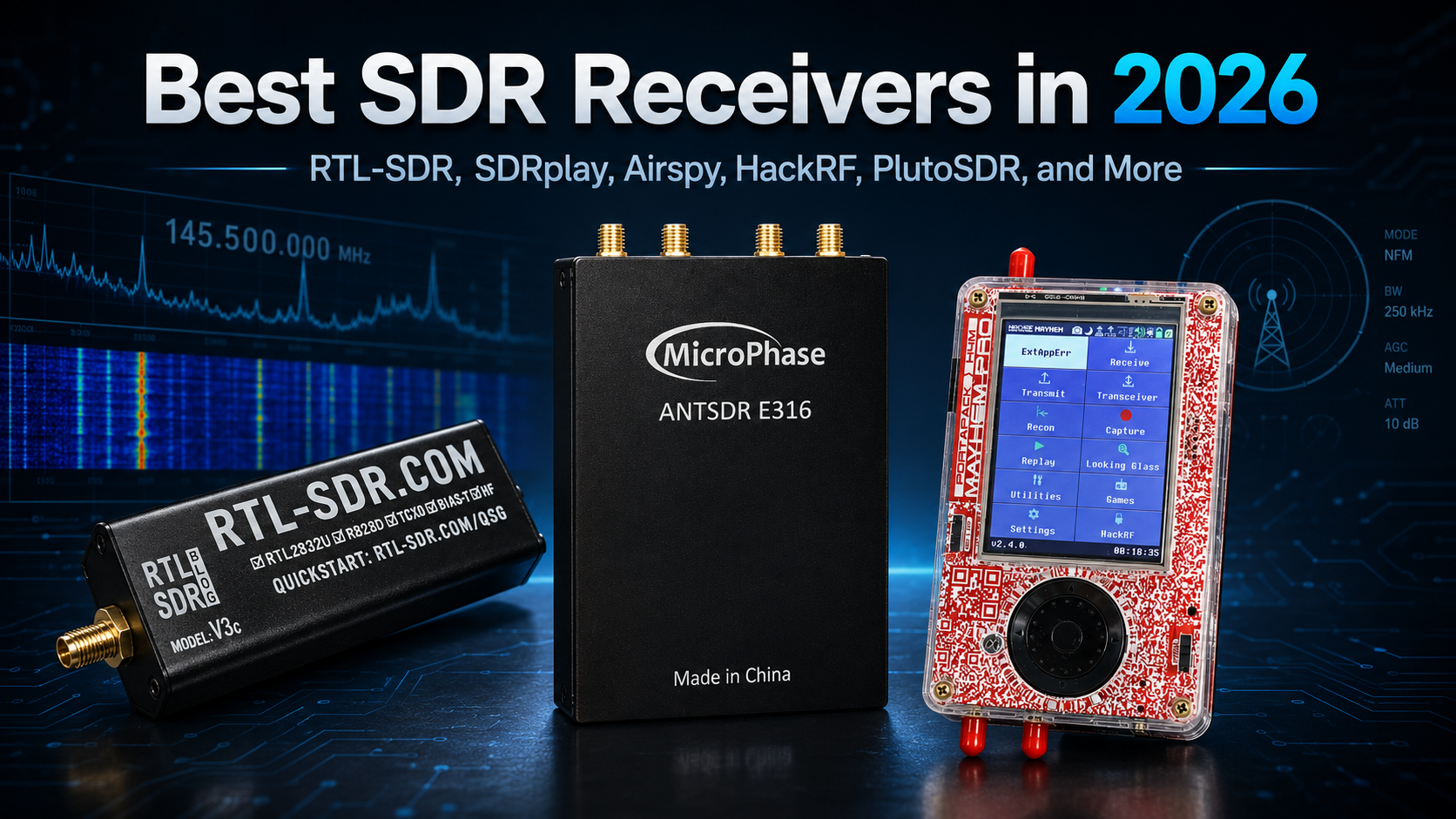
Updated: June 2026. This guide compares the best SDR receivers and transceiver platforms for beginners, radio hobbyists, shortwave listeners, satellite users, students, developers, and RF researchers.
Choosing the best SDR receiver in 2026 is more difficult than it first appears. A low-cost RTL-SDR dongle can receive aircraft signals, weather satellites, FM radio, amateur-radio transmissions, and many other signals. An SDRplay or Airspy receiver may offer better dynamic range and a more refined listening experience. A HackRF, PlutoSDR, USRP, or bladeRF adds transmission support and wider development possibilities.
The best choice depends on what you actually want to do.
A beginner learning radio reception does not need a complex MIMO transceiver. A shortwave listener may prefer a receive-only SDR with a strong HF front end. A university lab may need full-duplex operation, wider bandwidth, GNU Radio support, and multiple coherent channels. A portable RF enthusiast may prefer a HackRF PortaPack H4M with a built-in screen.
This guide compares the best SDR receivers in 2026, including RTL-SDR, SDRplay, Airspy, HackRF, PlutoSDR, PLUTO+ SDR, USRP B210, bladeRF, and specialized networked receivers.
To browse SDR hardware directly, visit the software-defined radio equipment category at SDRstore.eu.
Quick Answer: Which SDR Receiver Should You Buy?
| SDR Device | Best For | Receive or Transmit? | Buyer Recommendation |
|---|---|---|---|
| RTL-SDR Blog V3 Kit | Beginners, ADS-B, FM radio, weather satellites, scanners, and affordable SDR learning | Receive only | Best first SDR receiver for most beginners |
| RTL-SDR Blog V4 or V4 Lite | Budget users interested in improved filtering and the evolving RTL-SDR Blog lineup | Receive only | Buy only after checking current stock and driver support |
| SDRplay RSP1B | General radio listening from VLF to 2 GHz with more spectrum visibility and stronger receiver performance | Receive only | Best all-purpose receive-only upgrade |
| SDRplay RSPdx-R2 | HF, medium wave, long wave, multiple antennas, and serious listening setups | Receive only | Best SDRplay option for HF-focused users |
| Airspy HF+ Discovery | Weak-signal HF, shortwave, broadcast listening, airband, and compact receive-only setups | Receive only | Best compact HF and VHF listening receiver |
| Airspy R2 or Airspy Mini | High-quality VHF and UHF reception, ADS-B, scanners, and spectrum monitoring | Receive only | Best VHF/UHF-focused receive-only upgrade |
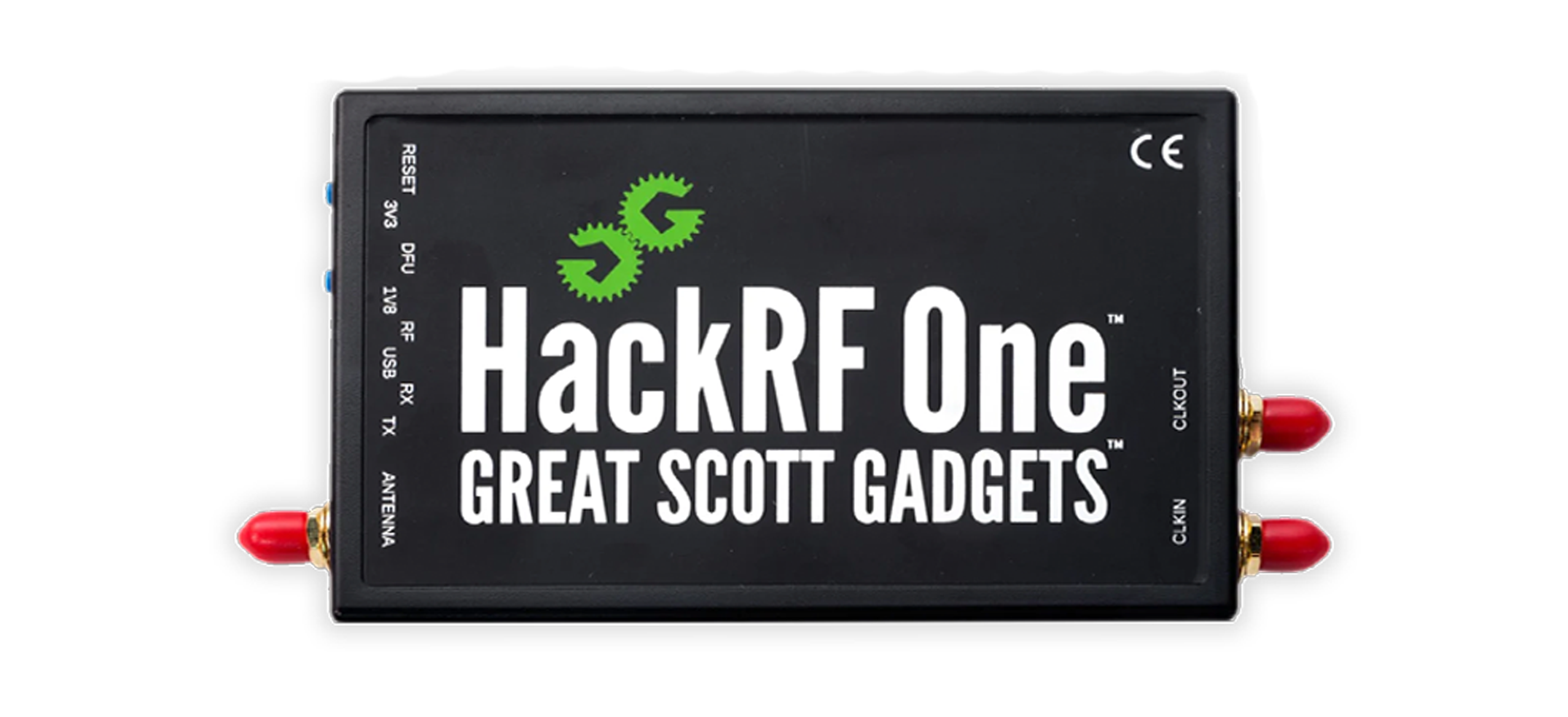
| HackRF One or HackRF Pro | Wideband RF experimentation, transmit-and-receive development, and portable PortaPack use | Half-duplex transceiver | Best wideband experimental platform |
| PLUTO+ SDR | Ethernet SDR, 2TX/2RX development, SDRangel, GNU Radio, and digital communications | 2TX/2RX transceiver | Best value development platform with Ethernet |
| USRP B210 | Universities, research, 2×2 MIMO, GNU Radio, srsRAN, OpenAirInterface, and lab work | 2TX/2RX full-duplex transceiver | Best advanced research platform |
| bladeRF 2.0 micro | FPGA-heavy development, high-bandwidth 2×2 MIMO, custom signal processing, and prototyping | 2TX/2RX transceiver | Best advanced FPGA development option |
| SDRplay nRSP-ST | Remote radio listening and network-accessible general coverage | Receive only | Best networked receive-only SDR |
For most new users, the recommendation is simple:
- Choose RTL-SDR Blog V3 Kit if you want the best low-cost beginner receiver.
- Choose SDRplay RSP1B if you want a serious receive-only upgrade with wider spectrum visibility.
- Choose Airspy HF+ Discovery if weak-signal HF and VHF reception matter most.
- Choose HackRF PortaPack H4M if you want portable wideband RF experimentation.
- Choose PLUTO+ SDR if you want Ethernet, 2TX/2RX, GNU Radio, and SDRangel development.
- Choose USRP B210 or bladeRF 2.0 micro if you need advanced MIMO and research capabilities.
Receiver or Transceiver: Understand the Difference Before Buying
Not every popular SDR device is simply an SDR receiver.
A receive-only SDR is designed to listen to radio signals. This is enough for many projects:
- FM radio
- Shortwave listening
- Airband reception
- ADS-B aircraft tracking
- Weather satellite reception
- Digital voice monitoring where legal
- Amateur-radio listening
- Spectrum exploration
A transceiver can also generate or transmit RF signals. This is useful for controlled development, authorized testing, digital communications, laboratory experiments, and wireless research.
Transmission capability adds complexity and legal responsibility. Do not buy a transceiver only because it appears more powerful on paper. Choose one when your projects genuinely need it.
| Device Type | Good Examples | Best Buyer |
|---|---|---|
| Receive-only SDR | RTL-SDR, SDRplay, Airspy, KiwiSDR | Listeners, beginners, scanner users, ADS-B users, and satellite hobbyists |
| Half-duplex transceiver | HackRF One, HackRF Pro | RF experimenters and developers who need wide frequency coverage |
| Full-duplex or multi-channel transceiver | ADALM-PLUTO, PLUTO+ SDR, USRP B210, bladeRF 2.0 micro | Students, engineers, universities, developers, and research labs |
Best SDR Receiver for Beginners: RTL-SDR Blog V3 Kit
The RTL-SDR Blog V3 Kit remains one of the easiest SDR receivers to recommend in 2026.
It is affordable, compact, widely supported, and capable of receiving an enormous variety of radio signals. The kit includes the receiver and a multipurpose dipole antenna set, which makes it more useful for a beginner than buying a bare dongle alone.
RTL-SDR Blog V3 key features
- RTL2832U ADC chipset
- R820T2 or R860 tuner family
- Approximately 500 kHz–1.7 GHz tuning depending on mode and setup
- Up to 3.2 MHz bandwidth, with around 2.4 MHz commonly treated as stable
- HF reception through direct-sampling mode
- 1 PPM TCXO for frequency stability
- SMA female antenna connector
- Aluminium enclosure with passive cooling
- Software-switchable bias tee for compatible accessories
- Windows, Linux, macOS, Android, and Raspberry Pi compatibility
Best RTL-SDR beginner projects
- FM broadcast radio
- Airband listening
- ADS-B aircraft tracking
- Meteor weather satellite reception
- Amateur-radio reception
- NOAA weather radio where available
- Marine and utility monitoring where legal
- Basic HF experiments
- Learning SDR++ and SDRSharp
- Using SatDump for satellite decoding
Read our full review: RTL-SDR Blog V3 Kit Review: Is It Still Worth Buying in 2026?
For setup instructions, read: RTL-SDR Setup Guide for Windows: SDRSharp, SDR++, Zadig, Drivers, and First Signal.
RTL-SDR Blog V4 and V4 Lite: What Buyers Should Know
RTL-SDR Blog V4 became popular because it improved filtering and HF handling compared with earlier budget dongles. It used the R828D tuner, a triplexed input design, an HF upconverter, improved filtering, a 1 PPM TCXO, an aluminium enclosure, and a bias-tee circuit.
However, RTL-SDR Blog announced in May 2026 that V4 is reaching the end of its production cycle because the R828D tuner is no longer produced.
RTL-SDR Blog also announced a V4 Lite, sometimes shortened to V4L, using the R828S tuner. The V4 Lite is expected to be a limited-edition product because the R828S is also no longer in production. It also requires an updated driver.
Buyer advice for RTL-SDR V4 and V4 Lite
- Do not assume that RTL-SDR Blog V4 stock will remain available.
- Check whether your preferred software supports V4 Lite before ordering.
- Choose V3 if you want a stable, widely documented beginner option immediately.
- Choose V4 or V4 Lite only when you understand the stock and driver situation.
Read our guide: Is the RTL-SDR Blog V4 Reaching End of Life? V4 Lite Explained.
RTL-SDR V3 vs V4 vs V4 Lite
| Feature | RTL-SDR Blog V3 | RTL-SDR Blog V4 | RTL-SDR Blog V4 Lite |
|---|---|---|---|
| Main tuner | R820T2 or R860 family | R828D | R828S |
| Status in 2026 | Stable and practical beginner option | End-of-line stock situation | Limited-edition replacement announced |
| Driver situation | Mature support | Requires compatible V4 drivers | Requires updated V4 Lite-compatible drivers |
| Best buyer | Beginners and users who want easy compatibility | Users buying remaining stock who understand the differences | Users willing to confirm software support before ordering |
Read our full comparison: RTL-SDR V3 vs V4 vs V4 Lite: Which Budget SDR Should You Buy?
Best Receive-Only Upgrade: SDRplay RSP1B
SDRplay RSP1B is one of the best choices for users who have outgrown a budget dongle but still want a receive-only SDR.
It covers 1 kHz to 2 GHz and provides up to 10 MHz of visible spectrum. Its 14-bit design gives users a stronger general-coverage listening platform than a basic entry-level SDR dongle.
Choose SDRplay RSP1B if you want:
- General coverage from VLF through HF, VHF, UHF, and up to 2 GHz
- Up to 10 MHz of visible spectrum
- A receive-only device rather than a transceiver
- A desktop listening setup
- Shortwave, broadcast, amateur-radio, scanner, and airband reception
- A step up from RTL-SDR without jumping into laboratory hardware
- SDRuno or multiplatform SDRconnect workflows
RTL-SDR vs SDRplay RSP1B
| Feature | RTL-SDR Blog V3 | SDRplay RSP1B |
|---|---|---|
| Best use | Affordable first SDR and general learning | Higher-performance general-coverage listening |
| Visible bandwidth | Approximately 2.4 MHz commonly treated as stable | Up to 10 MHz |
| HF experience | Useful for basic learning and experiments | More suitable for serious general-coverage listening |
| Complexity | Beginner-friendly and widely documented | Still accessible, with more capability |
| Best buyer | New SDR user | User ready for a receive-only upgrade |
Best SDRplay Receiver for HF and Multiple Antennas: RSPdx-R2
SDRplay RSPdx-R2 is designed for users who want a more advanced receive-only SDR with strong low-frequency and HF capabilities.
It covers 1 kHz to 2 GHz, offers up to 10 MHz spectrum visibility, and includes three antenna ports. Two SMA ports operate across the full range, while a BNC input is intended for frequencies up to 200 MHz.
Choose RSPdx-R2 if you want:
- HF, medium-wave, and long-wave listening
- Multiple antennas connected at the same time
- A serious desktop listening station
- A receive-only device with broad frequency coverage
- Enhanced dynamic-range modes for suitable low-frequency work
Best Dual-Tuner Receive-Only SDR: SDRplay RSPduo
SDRplay RSPduo is designed for users who need two independent tuners.
Each tuner can operate independently between 1 kHz and 2 GHz. The device can monitor two separate spectrum slices at the same time, making it useful for advanced monitoring, diversity experiments, and more complex receiving setups.
Choose RSPduo if you want:
- Two receivers in one enclosure
- Simultaneous monitoring of separate frequencies
- Diversity reception experiments
- Advanced scanner or monitoring workflows
- A receive-only platform rather than a transmitter
Best Networked SDR Receiver: SDRplay nRSP-ST
SDRplay nRSP-ST is a networked general-coverage receiver. It combines an SDR receiver and host computer in one enclosure, allowing remote access without leaving a separate computer next to the radio.
It covers 1 kHz to 2 GHz and provides up to 10 MHz spectrum visibility.
Choose nRSP-ST if you want:
- A remotely accessible personal SDR
- A receiver installed near a better antenna location
- Remote listening from another room, building, or location
- A plug-and-play networked receiver
- A shared receiver for a small group of trusted users
Best Compact HF and VHF Receiver: Airspy HF+ Discovery
Airspy HF+ Discovery is one of the best compact receive-only SDRs for users who care about weak-signal performance.
It covers approximately 0.5 kHz to 31 MHz for HF and 64 MHz to 260 MHz for VHF. This makes it especially useful for shortwave listening, broadcast radio, amateur-radio reception, airband, and VHF monitoring.
Choose Airspy HF+ Discovery if you want:
- Shortwave listening
- Weak-signal HF reception
- Broadcast-band monitoring
- VHF airband reception
- A compact desktop receiver
- A receive-only radio with a refined front end
- A portable antenna setup such as a passive loop
SDRstore.eu offers the YouLoop portable passive HF and VHF magnetic loop antenna, which is designed for low-noise receivers such as Airspy HF+ Discovery.
Best Airspy Receiver for VHF and UHF: Airspy R2 or Mini
Airspy R2 and Airspy Mini are strong receive-only options for VHF and UHF reception.
Both cover approximately 24 MHz to 1700 MHz natively. Airspy R2 offers 10 MSPS IQ output, while Airspy Mini supports 10, 6, and 3 MSPS output modes and is optimized for more portable setups.
Choose Airspy R2 if you want:
- High-quality VHF and UHF reception
- Wide spectrum visibility
- ADS-B reception
- Scanner and monitoring projects
- A desktop receiver with strong RF performance
Choose Airspy Mini if you want:
- A smaller portable receiver
- VHF and UHF reception
- Lower-output-rate options for tablets or lightweight computers
- A compact ADS-B or scanner setup
Best Portable Wideband SDR: HackRF PortaPack H4M
HackRF One is not simply a receiver. It is a half-duplex software-defined radio transceiver capable of receiving or transmitting between 1 MHz and 6 GHz.
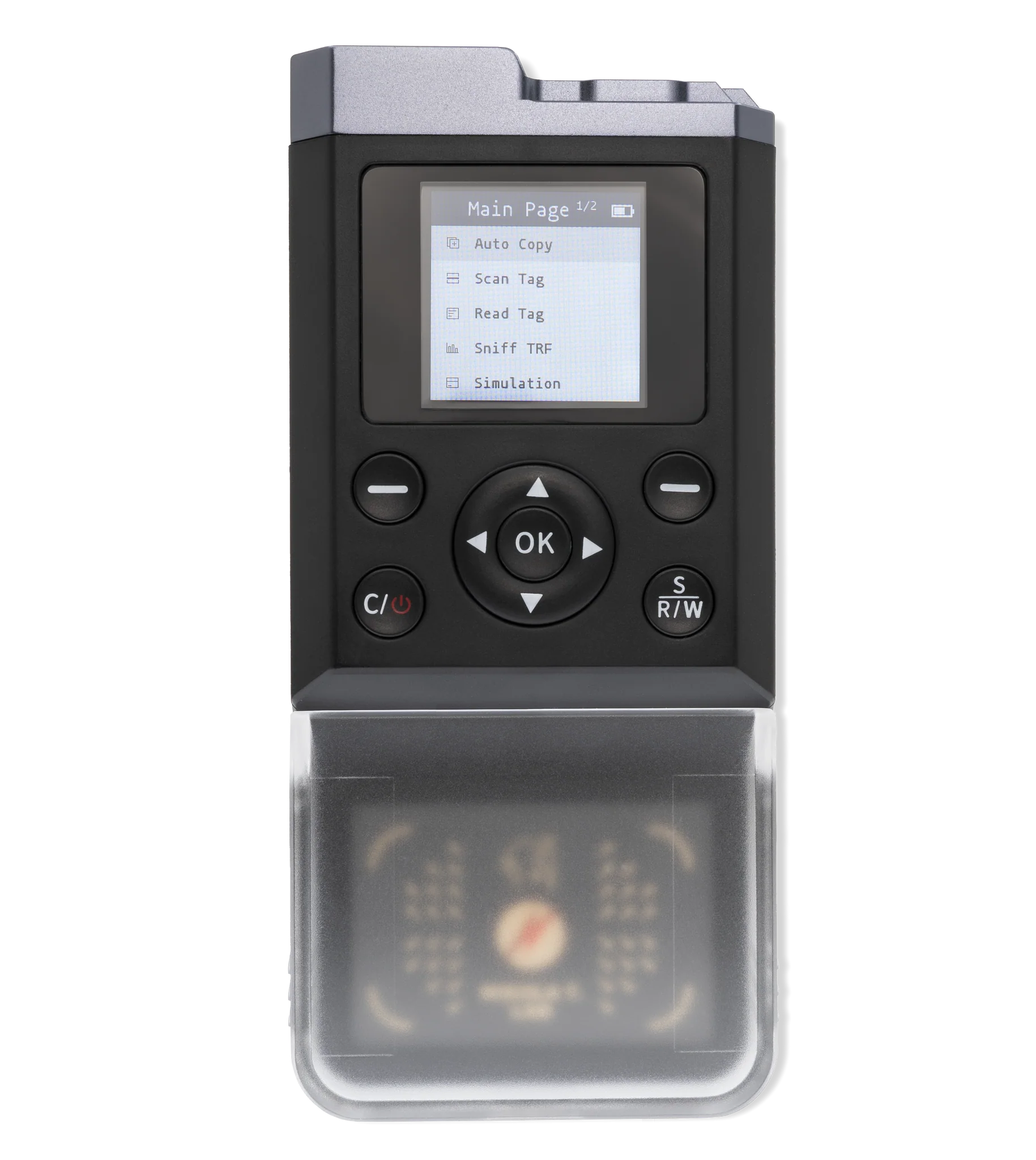
When paired with a PortaPack H4M, HackRF becomes a portable screen-based RF platform. The HackRF PortaPack H4M Mayhem Signature Edition is one of the most flexible portable SDR devices for radio experimentation.
HackRF One key features
- 1 MHz–6 GHz operating-frequency range
- Half-duplex transmit and receive
- Up to 20 million samples per second
- 8-bit I/Q sampling
- GNU Radio, SDR#, and other software support
- USB operation for computer-based workflows
- PortaPack support for portable use
Choose HackRF PortaPack H4M if you want:
- A portable SDR with a screen and physical controls
- Wideband RF spectrum exploration
- Mayhem firmware workflows
- Receive and authorized transmit experiments
- A flexible platform for RF learning
- A device that can also connect to a computer
HackRF is not the best choice for users who only want the cleanest receive-only shortwave experience. Its advantage is flexibility and wide frequency coverage.
HackRF Pro: The Newer Wideband Development Board
HackRF Pro Development Board is the newer Great Scott Gadgets platform for users who want an upgraded wideband transceiver.
HackRF Pro covers 100 kHz to 6 GHz, remains half-duplex, supports up to 20 million samples per second, and uses USB-C.
Choose HackRF Pro if you want:
- A newer official HackRF development board
- Lower-frequency coverage beginning at 100 kHz
- USB-C connectivity
- Wideband RF development
- GNU Radio and SDR software compatibility
- A platform for authorized receiving and transmitting experiments
Read the comparison: HackRF Pro vs PortaPack H4M: Which One Should You Buy?
Best Value Ethernet Development SDR: PLUTO+ SDR
The PLUTO+ SDR AD9363 2T2R Transceiver is one of the most interesting development options for users who need more than receive-only operation.
PLUTO+ is a PlutoSDR-style platform based around the AD9363 transceiver. It is listed with 70 MHz–6 GHz coverage, 2 transmit and 2 receive channels, Gigabit Ethernet, and MicroSD support.
Choose PLUTO+ SDR if you want:
- 2TX and 2RX operation
- Gigabit Ethernet
- MicroSD boot support
- SDRangel workflows
- GNU Radio projects
- Digital communications experiments
- A flexible lab SDR without immediately moving to USRP pricing
Read our full review: PLUTO+ SDR Review: AD9363 2T2R SDR Transceiver with Ethernet and 70 MHz–6 GHz Coverage.
For installation instructions, read: PLUTO+ SDR Setup Guide: First Signal with SDRangel, GNU Radio, and Ethernet.
Standard ADALM-PLUTO vs PLUTO+ SDR
Standard ADALM-PLUTO and PLUTO+ SDR should not be treated as identical products.
Analog Devices lists the standard ADALM-PLUTO as a portable RF learning module based on the AD9363 transceiver and Zynq-7010 FPGA. Its official specification includes 325 MHz–3.8 GHz RF coverage, up to 20 MHz instantaneous bandwidth, and one transmit plus one receive channel.
PLUTO+ SDR is a modified PlutoSDR-style platform with a different feature set, including listed 70 MHz–6 GHz coverage, 2TX/2RX operation, Gigabit Ethernet, and MicroSD support.
| Feature | Standard ADALM-PLUTO | PLUTO+ SDR |
|---|---|---|
| Main purpose | Official RF learning module | Expanded PlutoSDR-style development platform |
| Official or modified design | Official Analog Devices product | Third-party enhanced platform |
| Channels | 1TX and 1RX | 2TX and 2RX |
| Networking | USB-focused | Gigabit Ethernet support |
| Best buyer | Students and users who want the official learning platform | Users who want more flexible development features |
Best Advanced Research SDR: USRP B210
USRP B210 is designed for advanced SDR research, university labs, wireless prototyping, and MIMO experimentation.
It covers 70 MHz to 6 GHz, supports 2TX and 2RX operation, provides fully coherent 2×2 MIMO capability, and can stream up to 56 MHz of real-time bandwidth over USB 3.0 on suitable systems.
Choose USRP B210 if you want:
- 2×2 MIMO research
- Full-duplex operation
- GNU Radio development
- UHD driver support
- Wireless communications research
- srsRAN and OpenAirInterface experiments
- University teaching labs
- Advanced prototyping
USRP B210 is not the normal beginner recommendation. It is the better choice when your project requirements justify the added cost, complexity, and host-computer demands.
Browse USRP SDR boards and accessories.
Best FPGA Development SDR: bladeRF 2.0 Micro
The bladeRF 2.0 micro xA4 is a compact high-performance SDR transceiver platform from Nuand.
It covers 47 MHz to 6 GHz, supports 2×2 MIMO, offers a 61.44 MHz sampling rate, and provides 56 MHz filtered bandwidth. The xA4 and xA9 models use different FPGA sizes, allowing buyers to choose based on their custom signal-processing requirements.
Choose bladeRF 2.0 micro if you want:
- 2×2 MIMO streaming
- High-bandwidth SDR development
- USB 3.0 connectivity
- FPGA customization
- GNU Radio and SoapySDR compatibility
- Custom modem development
- Hardware-accelerated signal processing
- A compact lab transceiver
Choose the xA9 version when your project needs more FPGA resources for custom processing chains.
Browse bladeRF SDR devices and accessories.
Best Remote HF Receiver: KiwiSDR 2
KiwiSDR 2 is a specialized networked SDR receiver for users who want remote access to HF spectrum.
It provides full 0–30 MHz coverage through a browser-based interface. This makes it useful for shortwave listening, remote antenna sites, amateur-radio monitoring, and shared receiver projects.
Choose KiwiSDR 2 if you want:
- Remote HF listening through a web browser
- A receiver installed at a low-noise antenna location
- Full 0–30 MHz HF coverage
- A shared listening station
- Shortwave and amateur-radio monitoring
KiwiSDR 2 is specialized. It is not the right choice for VHF, UHF, satellite, or wideband transceiver projects.
Best SDR Receiver by Use Case
| Your Goal | Best Starting Choice | Why |
|---|---|---|
| First SDR receiver | RTL-SDR Blog V3 Kit | Affordable, versatile, widely supported, and includes antennas |
| ADS-B aircraft tracking | RTL-SDR Blog V3 or Airspy Mini | RTL-SDR is affordable; Airspy Mini is a stronger specialist upgrade |
| Weather satellite reception | RTL-SDR Blog V3 Kit | Good beginner path with compatible antenna experiments and SatDump |
| Shortwave listening | Airspy HF+ Discovery or SDRplay RSPdx-R2 | Better receive-only front ends for HF-focused use |
| General desktop listening | SDRplay RSP1B | Wide 1 kHz–2 GHz coverage and up to 10 MHz spectrum visibility |
| Dual-tuner monitoring | SDRplay RSPduo | Two independent tuners |
| Remote general-coverage receiving | SDRplay nRSP-ST | Integrated networked receiver and host system |
| Remote HF receiving | KiwiSDR 2 | Browser-accessible 0–30 MHz specialization |
| Portable RF exploration | HackRF PortaPack H4M | Wideband transceiver with portable screen-based workflows |
| Newer official HackRF development board | HackRF Pro | 100 kHz–6 GHz official platform with USB-C |
| Ethernet SDR development | PLUTO+ SDR | 2TX/2RX, Gigabit Ethernet, and MicroSD support |
| University and MIMO research | USRP B210 | 2×2 coherent MIMO, UHD, USB 3.0, and up to 56 MHz bandwidth |
| FPGA-heavy custom development | bladeRF 2.0 micro | High-bandwidth 2×2 MIMO and configurable FPGA resources |
Best SDR Receiver for ADS-B Aircraft Tracking
ADS-B tracking is one of the easiest SDR projects for beginners. Aircraft transmit position and flight data around 1090 MHz in many regions.
RTL-SDR Blog V3 is an affordable starting point. Add a suitable 1090 MHz antenna and filtering when needed.
Airspy Mini and Airspy R2 are stronger receive-only upgrades when ADS-B performance and monitoring quality matter more.
Best SDR Receiver for Weather Satellites
RTL-SDR Blog V3 Kit remains one of the best beginner choices for weather satellite experiments.
The included multipurpose dipole antenna set can be configured for 137 MHz satellite reception. In 2026, Meteor LRPT reception with SatDump is one of the most practical beginner weather-satellite projects.
Read our guide: SatDump V2 with RTL-SDR: Complete Beginner Setup Guide.
Best SDR Receiver for Shortwave and HF
Shortwave listening is where receive-only specialist SDRs become more attractive.
| HF Goal | Recommended SDR |
|---|---|
| Basic affordable HF experimentation | RTL-SDR Blog V3 in direct-sampling mode |
| Compact low-noise HF and VHF receiving | Airspy HF+ Discovery |
| Broad desktop general coverage | SDRplay RSP1B |
| Advanced HF with multiple antenna inputs | SDRplay RSPdx-R2 |
| Remote browser-based HF listening | KiwiSDR 2 |
Best SDR for GNU Radio
GNU Radio can work with many SDR devices, but the best choice depends on the project.
| GNU Radio Goal | Recommended SDR |
|---|---|
| Learn basic receiving flows | RTL-SDR Blog V3 |
| Learn transmit and receive concepts affordably | ADALM-PLUTO |
| Use Ethernet and 2TX/2RX Pluto-style hardware | PLUTO+ SDR |
| Experiment across a wide frequency range | HackRF One or HackRF Pro |
| Build advanced MIMO research projects | USRP B210 |
| Develop FPGA-heavy signal-processing chains | bladeRF 2.0 micro |
Best SDR Software for These Receivers
Hardware matters, but software can completely change the experience.
| Software | Best For |
|---|---|
| SDR++ | Modern cross-platform general receiving |
| SDRSharp | Windows receiving, plugins, RTL-SDR, and Airspy workflows |
| SDRconnect | Modern SDRplay workflows |
| SDRuno | Traditional SDRplay desktop receiving |
| SDRangel | Advanced receiving, transmitting, and channel-processing tools |
| GNU Radio | Custom signal-processing flows and SDR development |
| SatDump | Satellite reception, decoding, and image processing |
| GQRX | Accessible Linux and macOS receiving workflows |
Read our comparison: Best SDR Software in 2026: SDR++, SDRSharp, SDRangel, GQRX, GNU Radio, SatDump, and OpenWebRX Compared.
How Much Bandwidth Do You Actually Need?
Beginners often assume that more bandwidth is always better. It is not.
Wider bandwidth allows you to view or process more spectrum at once, but it also increases USB traffic, storage requirements, CPU usage, and software complexity.
| Project | Typical Bandwidth Need | Suitable Device Tier |
|---|---|---|
| FM radio listening | Low | RTL-SDR is enough |
| ADS-B tracking | Low to moderate | RTL-SDR or Airspy |
| Weather-satellite decoding | Moderate | RTL-SDR is often enough for beginner projects |
| General wideband listening | Moderate | SDRplay or Airspy |
| GNU Radio development | Depends on the signal | PlutoSDR, HackRF, PLUTO+, USRP, or bladeRF |
| 2×2 MIMO research | Higher and multi-channel | USRP B210 or bladeRF 2.0 micro |
What About Bit Depth?
Bit depth affects how much signal-level detail the converter can represent. However, comparing SDR devices only by the advertised number of bits can be misleading.
RF filtering, noise figure, dynamic range, front-end design, gain control, bandwidth, clock quality, software support, and the local RF environment all matter.
For example:
- RTL-SDR remains extremely useful despite its budget architecture.
- SDRplay’s 14-bit receive-only designs are attractive for general listening.
- Airspy receivers focus heavily on receive performance and RF front-end quality.
- HackRF prioritizes wide frequency coverage and experimental flexibility.
- USRP and bladeRF prioritize development, bandwidth, multi-channel capability, and software integration.
Which SDR Receiver Is Best for Beginners?
RTL-SDR Blog V3 Kit is the best first recommendation for most beginners.
It is inexpensive enough for learning, flexible enough for many projects, and widely supported by tutorials and software.
Start with RTL-SDR Blog V3 if you want to learn:
- How SDR software works
- How to install drivers
- How gain affects reception
- How antennas affect signal quality
- How to decode ADS-B
- How to receive satellites
- How to listen to FM, airband, and amateur radio
- Which advanced projects interest you before buying expensive hardware
Browse RTL-SDR receivers, kits, antennas, filters, and accessories.
When Should You Upgrade from RTL-SDR?
Upgrade only when your project requires something RTL-SDR does not provide.
| Your Limitation | Recommended Upgrade |
|---|---|
| You want a better general receive-only experience | SDRplay RSP1B |
| You want serious HF listening | Airspy HF+ Discovery or SDRplay RSPdx-R2 |
| You want better VHF/UHF receiving | Airspy R2 or Mini |
| You want portable wideband SDR | HackRF PortaPack H4M |
| You want to transmit in controlled experiments | ADALM-PLUTO, PLUTO+ SDR, HackRF, USRP, or bladeRF |
| You want Ethernet and 2TX/2RX | PLUTO+ SDR |
| You want coherent 2×2 MIMO and UHD | USRP B210 |
| You want FPGA-heavy custom development | bladeRF 2.0 micro |
Common SDR Buying Mistakes
Buying the most expensive SDR first
Start with the simplest device that fits your project. A beginner can learn more from an RTL-SDR kit and a suitable antenna than from an advanced transceiver that remains unused.
Confusing receive-only SDRs with transceivers
RTL-SDR, SDRplay, and Airspy are mainly receive-only choices. HackRF, PlutoSDR, PLUTO+, USRP, and bladeRF add transmission capabilities.
Ignoring antennas
A suitable antenna often improves reception more than replacing the receiver. Match the antenna to the target frequency and project.
Assuming wider bandwidth is always better
More bandwidth requires more processing power, storage, and USB throughput. Buy based on the actual signal you want to receive or generate.
Ignoring filtering and overload
Strong local FM, AM, cellular, paging, or broadcast signals can overload a receiver. Add an appropriate filter when needed.
Buying a transmitter without understanding regulations
Transmit only on frequencies, power levels, and systems where you are legally allowed and authorized to do so.
Where to Browse SDR Receivers and Transceivers
- Software-defined radio equipment
- RTL-SDR receivers, kits, antennas, filters, and accessories
- HackRF One, HackRF Pro, PortaPack H4M, and accessories
- PlutoSDR and PLUTO+ SDR radios
- USRP SDR devices, boards, and accessories
- bladeRF SDR devices and accessories
- Antennas and RF accessories
Final Verdict: Best SDR Receivers in 2026
The best SDR receiver depends on the project, not the longest specification list.
Choose RTL-SDR Blog V3 Kit if you want the best first SDR receiver for learning, ADS-B, weather satellites, FM radio, scanners, and affordable experimentation.
Choose SDRplay RSP1B if you want an all-purpose receive-only upgrade. Choose SDRplay RSPdx-R2 or Airspy HF+ Discovery if HF listening matters most. Choose Airspy R2 or Mini for stronger VHF and UHF receive-only workflows.
Choose HackRF PortaPack H4M if you want portable wideband RF experimentation. Choose HackRF Pro if you want the newer official HackRF development board. Choose PLUTO+ SDR if you want Ethernet, 2TX/2RX, SDRangel, and GNU Radio development.
Choose USRP B210 or bladeRF 2.0 micro only when your work genuinely requires advanced MIMO, wider bandwidth, FPGA capabilities, or research-grade development workflows.
Start with the SDR that matches your first real project. Upgrade when you can clearly identify the limitation you need to solve.
FAQ
What is the best SDR receiver in 2026?
RTL-SDR Blog V3 Kit is the best starting point for most beginners. SDRplay RSP1B is a strong receive-only upgrade, Airspy HF+ Discovery is excellent for HF and VHF listening, and HackRF, PLUTO+, USRP, or bladeRF are better when development and transmit capability matter.
What is the best SDR receiver for beginners?
RTL-SDR Blog V3 Kit is one of the best beginner choices because it is affordable, widely supported, compatible with popular software, and useful for many radio-reception projects.
Is RTL-SDR still worth buying in 2026?
Yes. RTL-SDR Blog V3 remains a practical budget receiver for learning, FM radio, ADS-B, weather satellites, airband, amateur-radio reception, and many other projects.
Is RTL-SDR Blog V4 discontinued?
RTL-SDR Blog announced that V4 is reaching end of line because the R828D tuner is no longer produced. A limited V4 Lite using the R828S tuner has been announced and requires updated drivers.
Should I buy RTL-SDR V3 or wait for V4 Lite?
Buy RTL-SDR Blog V3 if you want stable compatibility and a well-documented beginner receiver now. Consider V4 Lite only after checking availability and software-driver support.
Is SDRplay better than RTL-SDR?
SDRplay is a stronger receive-only upgrade for users who need wider spectrum visibility, more refined general coverage, and a desktop listening platform. RTL-SDR remains better for low-cost learning and beginner projects.
Is Airspy better than RTL-SDR?
Airspy receivers are attractive upgrades when receive performance matters more than price. Airspy HF+ Discovery is strong for HF and VHF listening, while Airspy R2 and Mini suit VHF and UHF projects.
What is the best SDR for shortwave listening?
Airspy HF+ Discovery and SDRplay RSPdx-R2 are strong shortwave choices. SDRplay RSP1B is also suitable for broad general coverage, while RTL-SDR V3 works for basic HF experiments.
What is the best SDR for ADS-B?
RTL-SDR Blog V3 is a good low-cost ADS-B receiver. Airspy Mini and Airspy R2 are useful upgrades when you want stronger specialist performance.
What is the best SDR for weather satellites?
RTL-SDR Blog V3 Kit is a strong beginner choice for receiving Meteor LRPT weather satellites with SatDump and a suitable 137 MHz antenna arrangement.
Can RTL-SDR transmit?
No. RTL-SDR is a receive-only platform. Choose HackRF, ADALM-PLUTO, PLUTO+ SDR, USRP, or bladeRF when you need authorized transmit experiments.
What is the difference between HackRF and RTL-SDR?
RTL-SDR is an affordable receive-only SDR. HackRF is a wider-frequency half-duplex transceiver designed for RF experimentation and development.
Should I buy HackRF One or HackRF Pro?
HackRF One remains a widely supported 1 MHz–6 GHz platform. HackRF Pro is the newer official board with 100 kHz–6 GHz operating coverage, USB-C, and updated hardware.
Is HackRF PortaPack H4M a good SDR receiver?
HackRF PortaPack H4M is a strong portable wideband RF platform with a built-in screen and Mayhem firmware. It is best for flexible experimentation rather than users seeking only the cleanest receive-only listening experience.
What is the difference between ADALM-PLUTO and PLUTO+ SDR?
Standard ADALM-PLUTO is an official Analog Devices learning module with 1TX and 1RX. PLUTO+ SDR is an expanded third-party PlutoSDR-style platform with listed 2TX/2RX operation, Gigabit Ethernet, MicroSD support, and wider modified coverage.
What is the best SDR for GNU Radio?
RTL-SDR is suitable for beginner receiving flows. ADALM-PLUTO, PLUTO+ SDR, HackRF, USRP B210, and bladeRF are better when GNU Radio projects need transmit support, full duplex, wider bandwidth, or multiple channels.
What is the best SDR for university research?
USRP B210 is a strong university and research platform because it supports coherent 2×2 MIMO, full-duplex operation, UHD drivers, GNU Radio, and up to 56 MHz of real-time bandwidth.
What is the best SDR for FPGA development?
bladeRF 2.0 micro is a strong choice for FPGA-focused development, custom signal processing, high-bandwidth 2×2 MIMO, and advanced wireless prototyping.
Do I need a transceiver or a receive-only SDR?
Choose a receive-only SDR for listening, ADS-B, satellites, scanners, and most beginner projects. Choose a transceiver only when your authorized development or research work requires transmitting.
Which SDR should I buy first?
Start with RTL-SDR Blog V3 Kit unless you already know that your project needs stronger HF reception, transmission, Ethernet, wider bandwidth, multiple channels, or MIMO.
Shop products for this guide
Explore relevant products from our store.
No posts found
Write a review






We support all major card and digital payment options. More local methods are available and shown during checkout.
You enter into a binding sales contract once you have received an 'order confirmation and sales receipt' email from us, in line with our Sales & Delivery conditions. Therefore, sdrstore.eu has the right to cancel your order in the event of technical problems, delivery failure, Fair use policy and other similar situations.






Your payments are protected by advanced encryption and 3-D Secure authentication for safe online shopping.