





SDR Hardware for Universities: Beginner, Intermediate, and Advanced Lab Setups
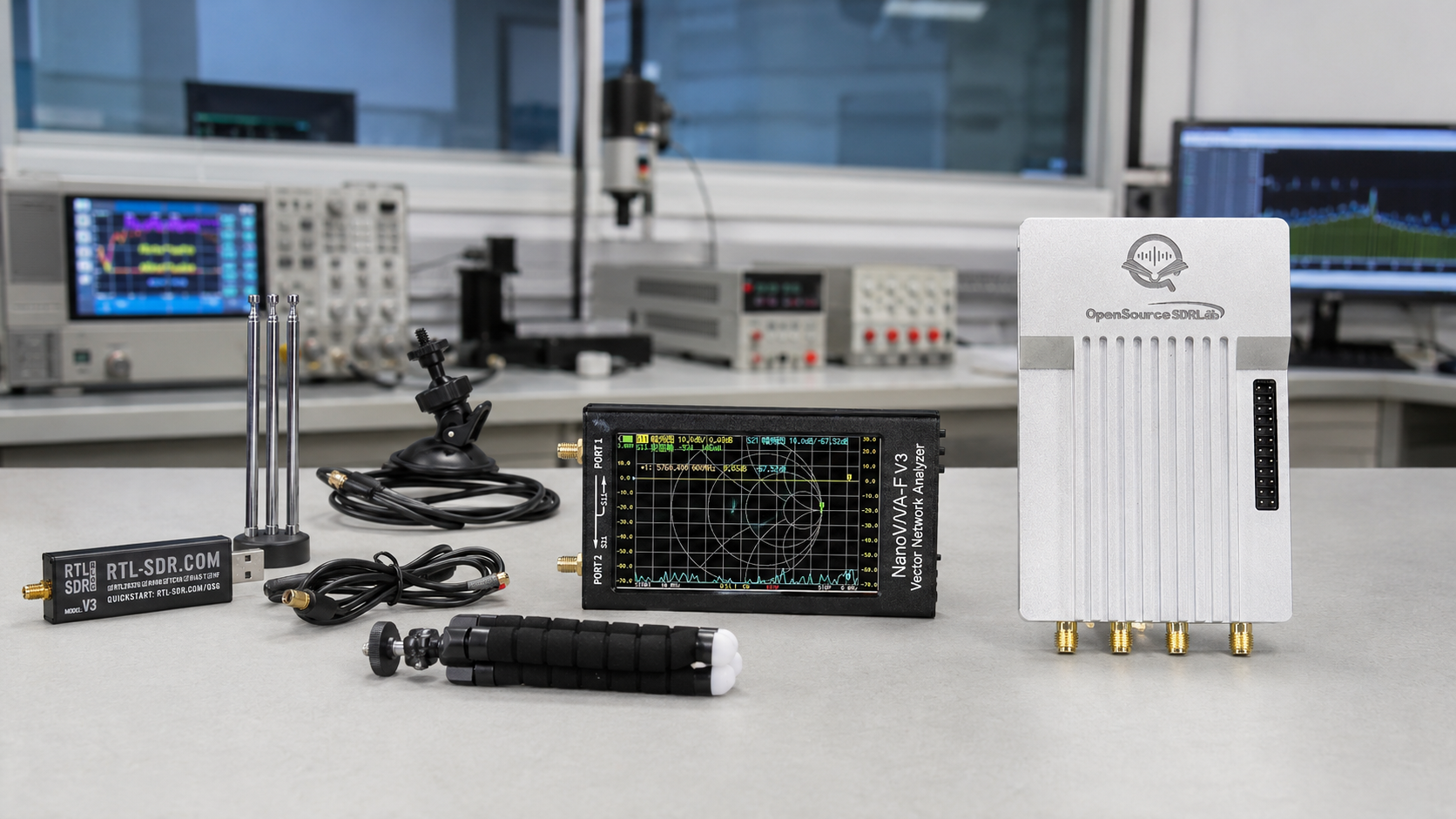
Updated: June 2026. This guide compares beginner, intermediate, and advanced software-defined radio hardware setups for universities, engineering departments, telecom laboratories, cybersecurity teams, and wireless-research institutes.
Choosing SDR hardware for a university is not simply a matter of buying the most capable radio available.
A successful software-defined radio laboratory should give students enough hands-on access while preserving a clear upgrade path for advanced research.
Introductory students need affordable receivers they can use without complex setup or unnecessary transmit risk. Communications-engineering students need controlled transmit and receive platforms for modulation, demodulation, GNU Radio, and digital-signal-processing projects. Postgraduate researchers may need 2×2 MIMO, private 5G testbeds, FPGA development, networked SDR systems, synchronization, direction finding, or wideband RF capture.
Buying expensive SDR hardware for every desk usually wastes budget.
Buying only entry-level receivers can limit future research.
The strongest university SDR lab uses several hardware tiers:
- Beginner stations for affordable receive-only learning
- Intermediate benches for controlled transmit and receive projects
- Advanced shared platforms for MIMO, private 5G, FPGA development, and scalable wireless research
- RF measurement tools for antennas, filters, cables, interference, and safe troubleshooting
- Enough accessories, computers, networking, and spare parts to keep practical sessions running
This guide explains which SDR devices belong in each tier, how many units to buy, which accessories universities commonly forget, and how to build a laboratory that remains useful as teaching and research requirements grow.
Browse our software-defined radio equipment, RF test and measurement tools, and antennas and RF accessories.
Quick Answer: Which SDR Hardware Should a University Buy?
| Lab Tier | Recommended SDR Hardware | Main Purpose | Best Buyer |
|---|---|---|---|
| Beginner | RTL-SDR Blog V3 kits | Receive-only fundamentals, GNU Radio introductions, spectrum viewing, ADS-B, AIS, weather satellites, antennas, and filters | Universities building affordable student stations |
| Beginner to intermediate | ADALM-PLUTO-class devices or PLUTO+ SDR | Controlled transmit and receive experiments, modulation, demodulation, link budgets, digital communications, and Ethernet-connected projects | Communications-engineering courses |
| Intermediate | LimeSDR Mini 2.0, bladeRF 2.0 micro xA4, or selected lower-cost MIMO SDR boards | Full-duplex communications, GNU Radio, prototyping, custom waveforms, and more advanced SDR development | Departments moving beyond introductory labs |
| Intermediate to advanced | USRP B210 | 2×2 MIMO, UHD, private 5G, srsRAN, OpenAirInterface, Open5GS, OFDM, and research projects | University communications labs and wireless-research groups |
| Advanced | bladeRF 2.0 micro xA9 | FPGA acceleration, HDL projects, modem development, FFT pipelines, correlators, and custom DSP | Embedded, FPGA, and wireless-protocol research teams |
| Advanced shared bench | USRP X310 with suitable daughterboards | Independent RF chains, wider bandwidth, handover, 10 Gigabit Ethernet, PCIe, rack-based research, and custom FPGA work | Postgraduate and professional research laboratories |
| Premium institutional research | USRP X410 or another suitable RFSoC platform | Wideband multi-channel research, AI-enhanced PHY, advanced MIMO, large datasets, and future-facing 5G or 6G projects | Funded institutional research programs |
| Specialized receive research | KrakenSDR and Web-888 | Direction finding, passive radar, antenna arrays, HF monitoring, and remote multi-user access | Research groups with specialized projects |
Beginner, Intermediate, and Advanced SDR Lab Setups Compared
| Feature | Beginner Teaching Lab | Intermediate Communications Lab | Advanced Research Lab |
|---|---|---|---|
| Main goal | Teach SDR, RF, antennas, receiving, waterfalls, and basic DSP | Teach transmit and receive systems, modulation, GNU Radio, and digital communications | Support MIMO, private 5G, FPGA, Open RAN, synchronization, and postgraduate research |
| Student access model | One affordable receiver per student or pair | Shared transmit-capable benches | Shared specialist platforms managed by trained researchers |
| Primary SDR | RTL-SDR Blog V3 | PLUTO+ SDR, LimeSDR Mini 2.0, and bladeRF xA4 | USRP B210, bladeRF xA9, X310, and selected X410-class hardware |
| Transmit capability | Normally no | Yes, through controlled and attenuated signal paths | Yes, with written RF procedures and project-specific authorization |
| Typical host connection | USB | USB and Gigabit Ethernet | USB 3.0, Gigabit Ethernet, 10 Gigabit Ethernet, PCIe, and specialized high-speed links |
| RF test equipment | Shared NanoVNA-H4 and TinySA Ultra units | Multiple shared RF tools, attenuation sets, filters, and dummy loads | Expanded RF measurement bench, synchronization, shield boxes, and specialist instruments |
| Typical software | SDR++, SDRSharp, GQRX, GNU Radio, SatDump, and Python | GNU Radio, SDRangel, libiio, libbladeRF, LimeSuite, Python, and Wireshark | UHD, GNU Radio, srsRAN, OpenAirInterface, Open5GS, FPGA toolchains, Linux automation, and research software |
Beginner SDR Lab Setup
A beginner SDR lab should maximize access, minimize setup time, and reduce RF safety risks.
The goal is not to teach every radio concept immediately.
The goal is to give students enough hardware access to understand tuning, waterfalls, sample rates, bandwidth, gain, antennas, interference, filters, propagation, and basic digital-signal-processing workflows.
Recommended beginner hardware
- RTL-SDR Blog V3 kits
- Portable multipurpose dipole antennas
- Reliable USB cables
- Windows or Linux computers
- Headphones
- Shared FM rejection filters
- Shared wideband LNAs
- Shared ADS-B filters and antennas where relevant
- Shared 137 MHz weather-satellite antennas
- One or two NanoVNA-H4 analyzers
- One or two TinySA Ultra analyzers
- Labelled storage boxes for adapters and accessories
RTL-SDR Blog V3: Best Beginner SDR for Universities
The RTL-SDR Blog V3 kit remains one of the strongest first purchases for a university SDR lab.
It is affordable enough to place at every desk while remaining useful for genuine radio-reception projects.
Why RTL-SDR works well for students
- Receive-only architecture reduces accidental-transmission risks.
- Students can receive their first signals quickly.
- The software ecosystem is mature.
- It supports Windows, Linux, macOS, Raspberry Pi, and selected Android workflows.
- The same receiver can support several courses.
- Students can compare antennas, gain settings, bandwidth, filters, and LNAs.
- Devices can be assigned individually or used in pairs.
Beginner RTL-SDR exercises
- Receive FM broadcast stations
- Compare automatic and manual gain
- Observe bandwidth and sample-rate changes
- Identify strong local interference
- Build a GNU Radio FM receiver
- Receive ADS-B aircraft signals
- Receive AIS vessel signals where geographically relevant
- Receive NOAA APT and Meteor weather-satellite signals
- Compare indoor and outdoor antenna placement
- Test an FM rejection filter
- Add an LNA and recognize overload
- Build a Raspberry Pi remote-monitoring node
Read our guides:
- RTL-SDR Setup Guide for Windows: SDRSharp, SDR++, Zadig, Drivers, and First Signal
- RTL-SDR Blog V3 Kit Review: Is It Still Worth Buying in 2026?
- Best SDR for ADS-B: RTL-SDR Kits, Antennas, Filters, and LNAs Compared
- SatDump V2 with RTL-SDR: Complete Beginner Setup Guide
Suggested Beginner Setup for 12 Students
| Equipment | Recommended Quantity | Reason |
|---|---|---|
| RTL-SDR Blog V3 kit | 12 units, or 6 units for paired work | Give every student practical receiver access |
| Portable antenna kit | One per RTL-SDR station | Teach frequency, antenna length, placement, and polarization |
| Linux-capable or Windows computers | 6–12 units | Run SDR software and GNU Radio exercises |
| NanoVNA-H4 | 1–2 shared units | Introduce SWR, impedance, calibration, cables, and filters |
| TinySA Ultra | 1–2 shared units | Introduce spectrum analysis, markers, RBW, interference, and overload |
| FM rejection filter | 2–4 shared units | Demonstrate strong-signal rejection |
| Wideband LNA | 2–4 shared units | Demonstrate weak-signal improvement and overload trade-offs |
| Labelled accessory boxes | One per bench | Prevent lost adapters and damaged cables |
Intermediate SDR Lab Setup
An intermediate communications lab should introduce transmit-capable SDR hardware without overwhelming students with expensive infrastructure.
Students should learn how transmit and receive chains work, how to calculate safe signal levels, how attenuation changes a link, and why RF outputs must not be connected directly to sensitive inputs without protection.
Recommended intermediate hardware
- PLUTO+ SDR or ADALM-PLUTO-class boards
- LimeSDR Mini 2.0
- bladeRF 2.0 micro xA4
- Fixed RF attenuator sets
- Variable attenuators
- 50-ohm dummy loads
- DC blocks
- Short SMA cables
- Filters
- Bias tees
- LNAs
- Gigabit Ethernet switch
- NanoVNA-H4 analyzers
- TinySA Ultra analyzers
ADALM-PLUTO-Class Hardware for Communications Education
ADALM-PLUTO was designed as an active-learning module for SDR, RF, and wireless-communications education.
Pluto-style hardware is a strong next step after RTL-SDR because it introduces controlled transmission while remaining accessible for students.
SDRstore.eu offers the PLUTO+ SDR AD9363 2T2R transceiver.
PLUTO+ SDR listed features
- AD9363 RF transceiver
- 2 transmit channels
- 2 receive channels
- Listed 70 MHz–6 GHz tuning direction
- Gigabit Ethernet
- USB OTG
- MicroSD boot support
- External-reference-clock option
- Zynq7010 FPGA direction
- 512 MB RAM
Recommended Pluto-style exercises
- Generate and receive FM through a protected cabled signal path
- Compare AM, FM, FSK, PSK, and QAM
- Build a basic digital link
- Measure the impact of attenuation
- Introduce link budgets
- Compare bandwidth and sample rate
- Experiment with IQ imbalance
- Control the SDR over Ethernet
- Use GNU Radio and SDRangel
- Introduce FPGA and embedded-Linux concepts
Read our guides:
- PLUTO+ SDR Review: AD9363 2T2R SDR Transceiver with Ethernet
- PLUTO+ SDR Setup Guide: First Signal with SDRangel, GNU Radio, and Ethernet
LimeSDR Mini 2.0 for Full-Duplex Prototyping
LimeSDR devices can be useful in intermediate university labs that want compact full-duplex SDR hardware and LimeSuite workflows.
LimeSDR Mini 2.0 direction
- Compact SDR platform
- Full-duplex operation
- 10 MHz–3.5 GHz frequency direction
- Up to 40 MHz RF bandwidth direction
- 12-bit sample depth
- 30.72 MSPS sample-rate direction
- 1 transmit channel
- 1 receive channel
- LimeSuite software ecosystem
- GNU Radio integration
Use LimeSDR Mini 2.0 for:
- Full-duplex radio fundamentals
- GNU Radio
- LimeSuite
- Digital-modulation exercises
- IoT prototypes
- Wireless-protocol experimentation
- Student capstone projects
bladeRF 2.0 micro xA4 for Intermediate SDR Development
The bladeRF 2.0 micro xA4 is a strong intermediate platform when the lab needs 2×2 MIMO and a clearer path toward FPGA development.
bladeRF 2.0 micro direction
- 47 MHz–6 GHz coverage
- 2×2 MIMO
- 61.44 MHz sampling rate
- 56 MHz filtered bandwidth
- USB 3.0 SuperSpeed
- Linux, macOS, and Windows support
- GNU Radio and SoapySDR workflows
- Open-source libraries, utilities, firmware, HDL, and schematics direction
- Programmable FPGA and USB peripheral controller
Use bladeRF xA4 for:
- Custom waveforms
- 2×2 MIMO demonstrations
- GNU Radio
- Portable SDR development
- Protocol prototyping
- FPGA introductions
- Senior undergraduate projects
Suggested Intermediate Setup for 12 Students
| Equipment | Recommended Quantity | Reason |
|---|---|---|
| RTL-SDR Blog V3 kits | 12 units | Keep beginner receiver projects available |
| PLUTO+ SDR or suitable Pluto-style boards | 6 shared units | Support paired transmit and receive exercises |
| LimeSDR Mini 2.0 | 2 shared units | Add full-duplex LimeSuite workflows |
| bladeRF 2.0 micro xA4 | 2 shared units | Add 2×2 MIMO and FPGA-oriented development |
| Fixed attenuator sets | At least 2 sets per transmitting bench | Protect receiver inputs and test tools |
| 50-ohm dummy loads | At least 1 per transmitting bench | Terminate low-power RF outputs safely |
| DC blocks | 6–12 units | Protect equipment from unexpected DC voltage |
| NanoVNA-H4 | 2 units | Measure antennas, filters, and cables |
| TinySA Ultra | 2 units | Teach spectrum analysis and interference troubleshooting |
| Managed Gigabit Ethernet switch | 1 unit | Support network-connected SDR projects |
Advanced SDR Research Lab Setup
Advanced university laboratories should invest in shared specialist hardware rather than place premium radios at every workstation.
Researchers should be able to explain the experiment before selecting the platform.
Advanced hardware may include:
- USRP B210
- bladeRF 2.0 micro xA9
- USRP X310
- Suitable X310 daughterboards
- USRP X410 or another premium RFSoC platform where justified
- KrakenSDR
- Web-888 network receiver
- External clock sources
- GPSDO
- 10 MHz and PPS distribution
- 10 Gigabit Ethernet
- SFP+ modules and cables
- RF shield boxes
- RF attenuators
- Dummy loads
- Directional couplers
- Filters
- VNAs
- Spectrum analyzers
USRP B210: Best Default Research SDR for Many Universities
The USRP B210 USB SDR is the strongest default upgrade for many university research groups.
USRP B210 official direction
- 70 MHz–6 GHz continuous RF coverage
- Full-duplex operation
- 2 transmit channels
- 2 receive channels
- Coherent 2×2 MIMO
- Up to 56 MHz real-time bandwidth
- USB 3.0 connectivity
- UHD support
- GNU Radio support
- Spartan-6 FPGA direction
- External timing-reference support
Use B210 for:
- 2×2 MIMO fundamentals
- OFDM
- Channel estimation
- Private 5G SA labs
- srsRAN Project
- Open5GS
- OpenAirInterface
- LTE research
- GNU Radio
- IoT and wireless-protocol development
- COTS handset testing in authorized environments
- Master’s and PhD projects
Read our guides:
- Best SDR for 5G Research: USRP B210, X310, X410, and Lower-Cost Alternatives
- USRP B210 vs X310: Which SDR Should a Research Lab Buy?
- OpenAirInterface vs srsRAN: Which Open-Source 5G Stack Is Better for Your SDR Lab?
bladeRF 2.0 micro xA9 for FPGA-Intensive Research
The bladeRF 2.0 micro xA9 is a strong shared platform when a university needs more FPGA resources for custom DSP and modem development.
Why choose bladeRF xA9?
- 47 MHz–6 GHz coverage
- 2×2 MIMO
- USB 3.0
- 61.44 MHz sampling-rate direction
- 56 MHz filtered bandwidth
- Large 301KLE Cyclone V FPGA
- Hardware-accelerator direction
- HDL signal-processing projects
- Open libraries and development resources
Use bladeRF xA9 for:
- FPGA-accelerated FFT pipelines
- Transmit modulators and filters
- Receive acquisition correlators
- Burst-modem development
- Custom PHY research
- Embedded-system coursework
- Hardware-software co-design
USRP X310 for Modular Advanced Research
The USRP X310 SDR platform belongs on a shared advanced bench.
It is appropriate when researchers can identify a clear limitation in B210-class hardware.
USRP X310 official direction
- Two RF daughterboard slots
- DC–6 GHz coverage with suitable daughterboards
- Up to 160 MHz bandwidth per slot with suitable daughterboards
- Xilinx Kintex-7 XC7K410T FPGA
- Dual 10 Gigabit Ethernet interfaces
- Dual 1 Gigabit Ethernet interfaces
- PCIe interface options
- Optional GPSDO direction
- 10 MHz reference support
- PPS timing-reference support
- Desktop and rack integration
Choose X310 when the project needs:
- Independent RF chains
- Intra-gNB handover
- Multi-cell experiments
- Modular RF daughterboards
- Wider bandwidth
- 10 Gigabit Ethernet
- PCIe for lower-latency workflows
- Larger FPGA resources
- Rack-based research systems
- Long-term expansion
Do not forget X310 accessories
- Suitable RF daughterboards
- Power supply and regional power cord
- Compatible NIC
- SFP+ modules and cables
- RF cables
- Attenuators
- Dummy loads
- Antennas
- Optional GPSDO
- Shared reference-clock distribution where required
- Rack accessories where required
USRP X410 for Premium Institutional Projects
USRP X410 is not the first SDR most universities should buy.
It becomes relevant when a funded project requires capabilities beyond B210 and X310.
X410 official direction
- Four independent transmit and receive channels
- 1 MHz–7.2 GHz operating range
- Tunable up to 8 GHz
- Up to 400 MHz instantaneous bandwidth per channel
- Zynq UltraScale+ ZU28DR RFSoC
- QSFP28 high-speed interfaces
- 100 Gigabit Ethernet direction
- PCIe Gen3 x8 direction
- Advanced timing and synchronization direction
- Embedded Linux
Choose X410 when the project needs:
- Several synchronized RF channels
- Very wide instantaneous bandwidth
- High-speed RF datasets
- AI-enhanced PHY
- Neural receivers
- Advanced MIMO
- Beamforming
- GPU-connected pipelines
- Long-term 5G and 6G research infrastructure
Specialized University SDR Hardware
KrakenSDR for Direction Finding and Passive Radar
KrakenSDR systems add coherent multi-channel receiving to a university lab.
KrakenSDR is a five-channel coherent receive platform designed for applications such as radio direction finding and passive radar.
Use KrakenSDR for:
- Radio direction finding
- Passive radar
- Phase coherence
- Antenna arrays
- Beamforming fundamentals
- Interference-source tracking
- Field assignments
- Final-year projects
Web-888 for Remote HF Monitoring
The Web-888 network receiver is useful when a university wants shared browser-based HF access.
Use Web-888 for:
- HF propagation classes
- Shortwave listening
- Remote antenna sites
- Browser-based listening
- Multi-user access
- Digital-mode demonstrations
- Radio-club collaboration
Suggested Advanced Setup for a University Research Group
| Equipment | Recommended Quantity | Use |
|---|---|---|
| USRP B210 | 2–4 units | Portable MIMO, private 5G, GNU Radio, OAI, and srsRAN benches |
| bladeRF 2.0 micro xA9 | 1–2 units | Custom FPGA DSP and modem development |
| USRP X310 | 1–2 shared units | Independent RF chains, wider bandwidth, handover, 10 Gigabit Ethernet, and modular RF front ends |
| X310 daughterboards | Project dependent | Select RF coverage, bandwidth, and TX/RX behavior |
| 10 Gigabit Ethernet NIC and SFP+ accessories | One set per X310 workstation | Support high-throughput streaming |
| External reference-clock solution | One shared system or project-specific units | Support synchronization and repeatable experiments |
| KrakenSDR | 1 shared unit | Direction finding and passive radar |
| Web-888 | 1 shared unit | Remote HF access |
| RF shield box | 1–2 units | Reduce RF leakage during controlled experiments |
| NanoVNA-H4 | 2–4 units | Antenna, cable, and filter measurements |
| TinySA Ultra | 2–4 units | Spectrum analysis and protected RF measurements |
RF Test Equipment Every University SDR Lab Needs
SDR hardware alone is not enough.
Students and researchers should learn how to measure antennas, inspect filters, test cables, recognize overload, protect receiver inputs, and troubleshoot interference.
NanoVNA-H4 for SWR, Impedance, Cables, and Filters
The NanoVNA-H4 portable vector network analyzer is a strong shared tool for university labs.
Use NanoVNA-H4 to teach:
- SWR
- Return loss
- Resistance
- Reactance
- Impedance
- Smith Charts
- Open, short, and load calibration
- Measurement planes
- Antenna resonance
- Antenna bandwidth
- Cable testing
- Filter response
Read our guides:
- NanoVNA Setup Guide: Calibration, SWR, Smith Chart, and Antenna Testing
- How to Test Antenna SWR with a NanoVNA
- Best Antenna Analyzer for Ham Radio: NanoVNA, RigExpert, and Other Options Compared
TinySA Ultra for Spectrum Analysis
The TinySA Ultra portable spectrum analyzer and RF generator complements a NanoVNA.
Use TinySA Ultra to teach:
- Spectrum scanning
- Center frequency and span
- Start and stop frequency
- Resolution bandwidth
- Video bandwidth
- Markers
- Peak search
- Max hold
- Waterfalls
- Noise floor
- Attenuation
- LNAs
- Overload
- Interference hunting
- Signal-generator concepts
Never connect a transmitter directly to a TinySA input.
Read our guide: TinySA Ultra Setup Guide: Spectrum Scanning, Signal Generator, LNA, and Attenuator.
RF Accessories Universities Commonly Forget
| Accessory | Why It Matters | Recommended Strategy |
|---|---|---|
| Short SMA cables | Connect SDRs, filters, attenuators, and RF tools | Keep several lengths at every bench |
| SMA male-to-male adapters | Connect common RF accessories | Keep several spares |
| SMA female-to-female adapters | Join cables and components | Keep several spares |
| SMA-to-BNC adapters | Connect traditional lab equipment | Share several sets |
| SMA-to-N adapters | Connect outdoor antennas and larger RF cables | Share several sets |
| Fixed attenuators | Protect receiver inputs and test equipment | Keep several attenuation values at each transmitting bench |
| Variable attenuators | Demonstrate signal-level and link-budget changes | Share 1–2 units |
| 50-ohm dummy loads | Terminate RF outputs safely | At least one per transmitting bench |
| DC blocks | Protect equipment from bias-tee DC voltage | Keep several shared units |
| Bias tees | Power active antennas and LNAs over coaxial cable | Buy according to project requirements |
| FM rejection filters | Reduce strong broadcast interference | Keep several shared units |
| Band-pass filters | Isolate ADS-B, satellite, GNSS, LoRa, and cellular test bands | Buy according to course projects |
| Wideband LNAs | Teach weak-signal reception and overload | Keep several shared units |
| Spare USB cables | Prevent simple cable failures from stopping a class | Keep labelled spares for every SDR type |
Browse our antennas and RF accessories and RF amplifiers, LNAs, and signal boosters.
Computers and Networking
| Hardware Tier | Computer and Network Direction |
|---|---|
| RTL-SDR beginner station | Modern Windows or Linux computer with stable USB ports |
| GNU Radio teaching station | Linux-capable computer with a modern multi-core CPU, sufficient RAM, and SSD storage |
| PLUTO+ SDR bench | USB and Gigabit Ethernet direction |
| LimeSDR or bladeRF station | Reliable USB connection and suitable software stack |
| USRP B210 station | Modern Linux workstation with reliable direct USB 3.0 connectivity |
| USRP X310 station | Linux workstation with a suitable NIC, SFP+ accessories, network tuning, and potentially 10 Gigabit Ethernet or PCIe |
| X410-class research platform | Project-specific high-performance Linux workstation with suitable CPU, GPU, storage, and high-speed networking |
Computer-lab advice
- Prefer direct motherboard USB ports for higher-throughput SDRs.
- Avoid overloaded USB hubs.
- Use SSD storage for IQ recordings.
- Keep reproducible Linux images for advanced benches.
- Document driver, firmware, and software versions.
- Use version-controlled GNU Radio flowgraphs.
- Assign static IP addresses to networked SDR hardware.
- Use a separate lab VLAN where practical.
- Add a dedicated 10 Gigabit Ethernet segment for X310-class research.
Software Checklist
| Software | Main Use | Recommended Hardware |
|---|---|---|
| GNU Radio | DSP flowgraphs, modulation, demodulation, custom blocks, and education | RTL-SDR, Pluto-style devices, LimeSDR, bladeRF, and USRP |
| SDR++ | Accessible general SDR receiving | RTL-SDR and supported receivers |
| SDRSharp | Windows-based receiving and plugins | RTL-SDR and supported receivers |
| GQRX | Linux and macOS SDR receiving | Supported SDR hardware |
| SDRangel | Advanced applications and Pluto-style workflows | PLUTO+ SDR and supported devices |
| SatDump | Weather-satellite decoding | RTL-SDR and suitable antennas |
| UHD | USRP drivers and APIs | B210, X310, X410, and compatible USRP platforms |
| libiio | Analog Devices and Pluto-style workflows | ADALM-PLUTO, PLUTO+, and related hardware |
| libbladeRF | bladeRF control and development | bladeRF devices |
| LimeSuite | LimeSDR control and development | LimeSDR hardware |
| srsRAN Project | Open-source 5G CU-DU RAN labs | B210 for entry labs and X310 for selected advanced workflows |
| Open5GS | Open-source 5G Core and EPC | Private LTE and 5G labs |
| OpenAirInterface | Open gNB, nrUE, OAI Core, RF simulation, PHY, and cellular research | B210, X310, X410, and supported platforms |
| Wireshark | Packet capture and protocol analysis | Networked and private-cellular projects |
| Python | Automation, DSP, plotting, analysis, and custom tools | All tiers |
Read our guide: Best SDR Software in 2026: SDR++, SDRSharp, SDRangel, GQRX, GNU Radio, SatDump, and OpenWebRX Compared.
Which Setup Fits Your Department?
| Department or Course | Recommended Hardware Setup |
|---|---|
| Introductory electronics | RTL-SDR Blog V3, NanoVNA-H4, TinySA Ultra, antennas, and basic filters |
| Signals and systems | RTL-SDR, GNU Radio, Pluto-style SDRs, and protected cabled RF links |
| Digital communications | PLUTO+, LimeSDR Mini 2.0, bladeRF xA4, B210, attenuators, and dummy loads |
| Embedded systems | PLUTO+, bladeRF, Python, FPGA toolchains, and networked SDR projects |
| FPGA and HDL courses | bladeRF xA9 and selected USRP platforms |
| Wireless networking | B210, GNU Radio, Open5GS, srsRAN, and OpenAirInterface |
| 5G and Open RAN research | B210, X310, suitable daughterboards, clocking, 10 Gigabit Ethernet, and controlled RF infrastructure |
| Cybersecurity research | Receive-only RTL-SDR stations, B210, bladeRF, KrakenSDR, spectrum tools, and isolated authorized test environments |
| Satellite communications | RTL-SDR, B210, Pluto-style SDRs, suitable antennas, filters, LNAs, and SatDump |
| Direction finding and sensing | KrakenSDR, matched antenna array, TinySA Ultra, and field computers |
Recommended Upgrade Path
- Start with RTL-SDR Blog V3 kits for individual or paired student stations.
- Add portable antennas, filters, LNAs, NanoVNA-H4, and TinySA Ultra.
- Add PLUTO+ SDR or ADALM-PLUTO-class boards for controlled transmit and receive projects.
- Add LimeSDR Mini 2.0 or bladeRF xA4 when students need more advanced full-duplex and MIMO projects.
- Add USRP B210 units for MIMO, private 5G, srsRAN, OpenAirInterface, and research work.
- Add bladeRF xA9 when FPGA resources and custom DSP matter.
- Add X310 when independent RF chains, daughterboards, wider bandwidth, 10 Gigabit Ethernet, PCIe, or handover justify the cost.
- Add KrakenSDR, Web-888, and specialized antennas for specific research projects.
- Add X410-class hardware only when a funded institutional project requires wideband, multi-channel, or RFSoC capabilities.
RF Safety Rules
Every university SDR lab should have written RF safety procedures.
Core rules
- Begin with receive-only RTL-SDR projects.
- Use conducted RF paths where practical.
- Add suitable attenuation between SDR transmitters and receiver inputs.
- Use dummy loads.
- Do not connect transmitters directly to receivers without calculating signal levels.
- Do not connect transmitters directly to NanoVNA or TinySA inputs.
- Use DC blocks when bias-tee voltage may be present.
- Label transmit-capable hardware clearly.
- Restrict advanced transmitting equipment to trained users.
- Document permitted frequencies and maximum power levels.
- Use RF shield boxes where required.
- Do not transmit into licensed bands without authorization.
- Do not interfere with public cellular, aviation, maritime, satellite, emergency, or other radio systems.
Safe cabled experiment concept
SDR TX → suitable attenuation → optional additional attenuation → protected SDR RXPrivate 5G Lab Planning
Private LTE and 5G labs need additional controls.
Use:
- Authorized frequencies
- Shielded or conducted RF paths
- Low transmit power
- Suitable attenuation
- Test SIM cards
- Known credentials
- Compatible UEs
- External clocking where required
- Regulator approval where required
- Qualified RF-engineering supervision
Read our guides:
- Best SDR for 5G Research: USRP B210, X310, X410, and Lower-Cost Alternatives
- OpenAirInterface vs srsRAN: Which Open-Source 5G Stack Is Better for Your SDR Lab?
Asset Management and Maintenance
Small adapters, cables, and calibration accessories are easy to lose.
Track each device using:
- Asset number
- Model
- Serial number
- Assigned workstation
- Firmware version
- Driver version
- Accessories issued with the device
- Last tested date
- Calibration date where relevant
- Known issues
Keep spare items
- USB cables
- SMA adapters
- Short coaxial cables
- MicroSD cards
- Antenna elements
- Fixed attenuators
- Dummy loads
- DC blocks
Common Purchasing Mistakes
Buying B210 or X310 for every beginner desk
Most introductory exercises do not require expensive SDR platforms. Use RTL-SDR kits for individual access and share advanced hardware.
Buying receivers without antennas
Add portable dipoles and project-specific antennas.
Buying transmit-capable SDRs without attenuators
Protected cabled RF experiments require attenuators and dummy loads.
Buying X310 without daughterboards
X310 requires suitable RF daughterboards selected according to frequency, bandwidth, and project requirements.
Buying X310 without a networking plan
Define whether the lab needs Gigabit Ethernet, 10 Gigabit Ethernet, or PCIe. Add NICs, SFP+ modules, and cables accordingly.
Ignoring cables and adapters
A missing SMA adapter can stop an entire practical class.
Ignoring synchronization
Add suitable external clocking when timing stability, COTS handset attachment, repeatability, or multi-radio experiments require it.
Using TinySA instead of NanoVNA for antenna SWR
Use NanoVNA for antenna SWR, impedance, cables, and filters. Use TinySA Ultra for spectrum activity, interference, signal levels, and protected RF measurements.
Transmitting without authorization
Teach safe and legal RF practice from the first session.
Procurement Checklist
Define these requirements before requesting a quote
- Number of students per session
- Number of beginner stations
- Number of shared communications benches
- Number of advanced research benches
- Receive-only projects
- Transmit-capable projects
- Frequency ranges
- Bandwidth requirements
- MIMO requirements
- Private 5G requirements
- FPGA-development requirements
- GNU Radio requirements
- Computer specifications
- Network topology
- Clocking and synchronization
- Antenna types
- Filters
- LNAs
- Attenuators
- Dummy loads
- RF test instruments
- Asset-management requirements
- Safety procedures
- Future expansion path
Request a Formal Quote from SDRstore.eu
Universities, research institutes, telecom teams, engineering departments, integrators, and cybersecurity firms can request a formal quotation directly from SDRstore.eu.
Use the Add to Quote button on product pages or the document icon on product cards to build a quote request.
Use the quote system for:
- Beginner SDR teaching stations
- Intermediate communications benches
- Advanced research setups
- RTL-SDR classroom kits
- PLUTO+ SDR boards
- bladeRF devices
- USRP B210 units
- USRP X310 configurations
- X310 daughterboards
- Antennas
- Filters
- LNAs
- RF cables
- Attenuators
- Dummy loads
- RF test and measurement tools
- Bulk pricing
- Internal purchasing approval
Read our guide: Request a Quote Online: A Faster Way to Get Custom Pricing from SDRstore.eu.
Where to Browse University SDR Hardware
- Software-defined radio equipment
- RTL-SDR receivers, kits, filters, LNAs, and accessories
- RTL-SDR Blog V3 kit
- PlutoSDR and PLUTO+ SDR devices
- PLUTO+ SDR AD9363 2T2R transceiver
- LimeSDR devices
- bladeRF devices and accessories
- bladeRF 2.0 micro xA4
- bladeRF 2.0 micro xA9
- USRP SDR devices, boards, daughterboards, and accessories
- USRP B210 USB SDR
- USRP X310 SDR platform
- KrakenSDR systems
- Web-888 network receiver
- RF test and measurement tools
- NanoVNA-H4 portable vector network analyzer
- TinySA Ultra portable spectrum analyzer and RF generator
- Antennas and RF accessories
- RF amplifiers, LNAs, and signal boosters
Related SDRstore.eu Guides
- How to Build a University SDR Lab: Hardware Checklist for Teaching and Research
- Best SDR for 5G Research: USRP B210, X310, X410, and Lower-Cost Alternatives
- USRP B210 vs X310: Which SDR Should a Research Lab Buy?
- OpenAirInterface vs srsRAN: Which Open-Source 5G Stack Is Better for Your SDR Lab?
- Best SDR Receivers in 2026: RTL-SDR, SDRplay, Airspy, HackRF, PlutoSDR, and More
- Best SDR Software in 2026: SDR++, SDRSharp, SDRangel, GQRX, GNU Radio, SatDump, and OpenWebRX Compared
- NanoVNA vs TinySA: Which RF Tool Do You Actually Need?
- TinySA Ultra Setup Guide: Spectrum Scanning, Signal Generator, LNA, and Attenuator
- Request a Quote Online: A Faster Way to Get Custom Pricing from SDRstore.eu
Official Resources
- GNU Radio official website
- GNU Radio official tutorials
- GNU Radio RTL-SDR FM receiver tutorial
- Analog Devices ADALM-PLUTO official page
- Lime Microsystems LimeSDR Mini 2.0 official page
- Nuand bladeRF 2.0 micro official page
- Ettus Research USRP product overview
- Ettus Research USRP B210 official page
- Ettus Research USRP X310 official page
- Ettus Research USRP X410 official page
- KrakenRF KrakenSDR official page
- NanoVNA official website
- TinySA official website
Final Verdict: SDR Hardware for Universities
The best university SDR lab is not the one with the most expensive radios.
It is the lab that gives students practical access while preserving an upgrade path for advanced research.
Start with RTL-SDR Blog V3 kits for beginner teaching stations. They are affordable, receive only, easy to deploy, and suitable for GNU Radio, antennas, ADS-B, satellites, filters, LNAs, and spectrum fundamentals.
Add PLUTO+ SDR or ADALM-PLUTO-class boards for controlled transmit and receive lessons.
Add LimeSDR Mini 2.0 and bladeRF xA4 when students need full-duplex prototyping, custom waveforms, MIMO, and more advanced development.
Add USRP B210 when the department moves into serious communications research, 2×2 MIMO, private 5G, OpenAirInterface, srsRAN, and Open5GS.
Add bladeRF xA9 when FPGA resources, HDL, and custom DSP matter.
Add X310 only when independent RF chains, modular daughterboards, wider bandwidth, 10 Gigabit Ethernet, PCIe, handover, or rack-based research justify the investment.
Add X410-class platforms only for funded institutional projects that require multi-channel RFSoC hardware, wide bandwidth, high-speed datasets, AI-enhanced PHY, advanced MIMO, or future-facing 5G and 6G research.
Do not forget NanoVNA-H4, TinySA Ultra, antennas, RF cables, adapters, attenuators, dummy loads, DC blocks, filters, labelled storage, networking, and written safety procedures.
A tiered setup remains affordable for teaching, useful for research, easier to maintain, and simpler to expand as the university’s wireless program grows.
FAQ
What SDR hardware should a university buy first?
Start with RTL-SDR Blog V3 kits, portable antenna kits, computers, one or two NanoVNA-H4 analyzers, one or two TinySA Ultra analyzers, cables, filters, LNAs, and labelled storage.
What is the best beginner SDR for a university lab?
RTL-SDR Blog V3 is one of the strongest beginner choices because it is affordable, receive only, easy to deploy, and useful for FM, ADS-B, AIS, satellites, antennas, filters, interference, and GNU Radio lessons.
What should students use after RTL-SDR?
Add PLUTO+ SDR or ADALM-PLUTO-class boards for controlled transmit and receive lessons. Students can learn modulation, demodulation, link budgets, digital communications, and cabled RF testing.
Is PLUTO+ SDR suitable for university teaching?
Yes. PLUTO+ SDR is useful for Pluto-style development, GNU Radio, SDRangel, Ethernet-connected projects, controlled transmission, digital communications, and early 2T2R research.
Is LimeSDR Mini 2.0 useful for universities?
Yes. LimeSDR Mini 2.0 is useful for compact full-duplex projects, LimeSuite, GNU Radio, digital communications, IoT prototypes, and student capstone work.
Is bladeRF useful for university research?
Yes. bladeRF 2.0 micro is useful for 2×2 MIMO, GNU Radio, portable development, FPGA programming, custom DSP, HDL, modem development, and hardware-software co-design.
Should a university buy bladeRF xA4 or xA9?
Choose xA4 for intermediate 2×2 MIMO and FPGA introductions. Choose xA9 when the project needs a much larger FPGA for hardware accelerators, FFTs, filters, correlators, and modem development.
What is the best USRP for a university lab?
USRP B210 is the strongest default choice for many university labs. It offers 70 MHz–6 GHz coverage, full-duplex 2×2 MIMO, USB 3.0, UHD, GNU Radio, and up to 56 MHz real-time bandwidth.
When should a university buy USRP X310?
Buy X310 when researchers need independent RF chains, wider bandwidth, modular daughterboards, 10 Gigabit Ethernet, PCIe, handover, larger FPGA resources, or rack-based research infrastructure.
Does USRP X310 need daughterboards?
Yes. X310 uses RF daughterboards. Select them according to the required frequency range, bandwidth, transmit capability, receive capability, and research objective.
When should a university consider USRP X410?
Consider X410-class hardware only when a funded institutional project requires several synchronized channels, very wide bandwidth, RFSoC resources, AI-enhanced PHY, high-speed datasets, advanced MIMO, or future-facing 5G and 6G research.
Does an SDR lab need NanoVNA-H4?
Yes. NanoVNA-H4 helps students measure antenna SWR, impedance, resistance, reactance, return loss, Smith Chart behavior, cables, and filters.
Does an SDR lab need TinySA Ultra?
Yes. TinySA Ultra helps students learn spectrum scanning, RBW, markers, waterfalls, interference, attenuation, LNAs, overload, and protected signal-generator workflows.
What is the difference between NanoVNA and TinySA Ultra?
NanoVNA measures antenna and RF-component behavior such as SWR, impedance, cables, and filter response. TinySA Ultra displays spectrum activity and supports interference hunting and signal-generator exercises.
How many SDR units should a university buy?
Give each student or pair an affordable RTL-SDR receiver. Share transmit-capable boards, B210 units, X310 platforms, NanoVNA analyzers, TinySA analyzers, and specialized equipment between benches.
Why does an SDR lab need attenuators?
Attenuators protect SDR receiver inputs and test equipment during cabled RF experiments. They also help students understand link budgets, receiver sensitivity, and overload.
Can students connect an SDR transmitter directly to a receiver?
Not without calculating signal levels and adding suitable attenuation. Use protected cabled RF paths, dummy loads, and conservative safety margins.
Can students connect a transmitter directly to NanoVNA or TinySA?
No. Transmitter power can damage sensitive RF measurement tools. Use dummy loads, suitable couplers or samplers, external attenuation, and safe procedures.
Can universities teach private 5G with SDR hardware?
Yes. Start with USRP B210, srsRAN, Open5GS, test SIM cards, suitable clocking, and a controlled RF environment. Add X310 when handover, independent RF chains, or advanced networking become necessary.
What is KrakenSDR used for in a university lab?
KrakenSDR is a coherent five-channel receive platform used for radio direction finding, passive radar, phase coherence, antenna arrays, interference-source tracking, and field projects.
How should a university request a formal SDR lab quote?
Add products to a quote request directly from SDRstore.eu product pages using the Add to Quote button or from product cards using the document icon. Include quantities, teaching goals, research projects, frequency ranges, accessories, RF tools, clocking, and future expansion requirements.
No posts found
Write a review






We support all major card and digital payment options. More local methods are available and shown during checkout.
You enter into a binding sales contract once you have received an 'order confirmation and sales receipt' email from us, in line with our Sales & Delivery conditions. Therefore, sdrstore.eu has the right to cancel your order in the event of technical problems, delivery failure, Fair use policy and other similar situations.






Your payments are protected by advanced encryption and 3-D Secure authentication for safe online shopping.