





USRP N310 vs X310: Which SDR Should a Research Lab Buy?
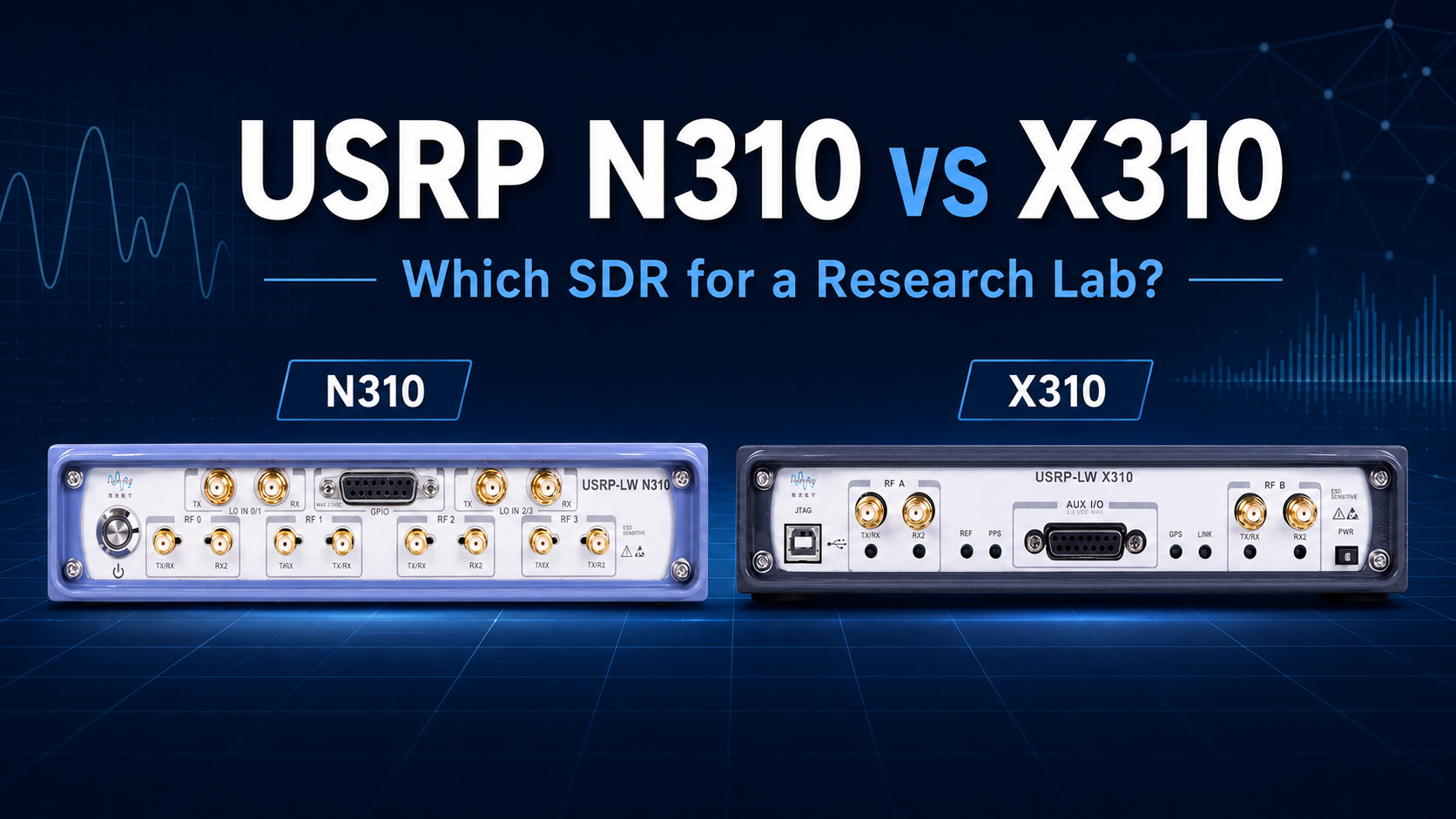
The USRP N310 and USRP X310 are both high-end software-defined radio platforms used in universities, telecom laboratories, MIMO testbeds, GNU Radio research, private cellular networks, spectrum-monitoring systems, RF cybersecurity laboratories, and advanced wireless development.
But they solve different problems.
The USRP N310 is an integrated four-channel networked SDR designed for high channel density, distributed deployments, remote management, 4×4 MIMO, and synchronized radio systems. The USRP X310 is a modular two-slot SDR platform designed around high per-channel bandwidth, interchangeable RF daughterboards, large FPGA resources, 10 Gigabit Ethernet, PCIe, and highly customizable laboratory workflows.
The simplest buying rule is: choose N310 when four integrated RF channels and networked deployment are central to the experiment. Choose X310 when two high-bandwidth RF chains, daughterboard flexibility, custom FPGA work, or PCIe/10GbE performance matter more.
This guide compares the USRP N310 vs X310 for channel count, RF bandwidth, frequency range, FPGA architecture, networking, synchronization, local oscillators, GNU Radio, UHD, RFNoC, MIMO, beamforming, 5G research, channel sounding, distributed testbeds, university labs, and long-term purchasing.
Browse the USRP N310 4×4 networked SDR, USRP X310 modular research SDR, USRP SDR devices and accessories, and request a formal research-lab quote from SDRstore.eu.
Quick Answer: N310 or X310?
| Research requirement | Better choice | Why |
|---|---|---|
| 4×4 MIMO in one chassis | USRP N310 | Four TX and four RX channels are integrated into one networked SDR. |
| Maximum per-channel instantaneous bandwidth | USRP X310 | Up to 160 MHz per channel with suitable daughterboards such as UBX-160. |
| Remote or distributed deployment | USRP N310 | Embedded Linux, remote management, built-in GPSDO, network-focused architecture. |
| Custom RF daughterboards | USRP X310 | Two interchangeable daughterboard slots let the lab configure the RF front end around each project. |
| Custom FPGA DSP | USRP X310 | Large Kintex-7 FPGA and a long-established X-Series FPGA/RFNoC development workflow. |
| Four-channel beamforming or MIMO | USRP N310 | Higher integrated RF channel density without synchronizing multiple two-channel radios. |
| PCIe host connection | USRP X310 | X310 supports PCIe in addition to Ethernet interfaces. |
| Standalone processing near the radio | USRP N310 | Zynq SoC includes ARM processors and runs embedded Linux. |
| HF or unusual RF front-end configuration | USRP X310 | Daughterboards such as LFRX/LFTX, BasicRX/TX, UBX and others change the available RF range and behavior. |
| Simple integrated rack deployment | USRP N310 | RF front ends, GPSDO, processor, FPGA and networking are integrated. |
For a new four-channel MIMO laboratory, N310 is usually the more natural choice. For an advanced two-channel bench that needs 160 MHz bandwidth, custom FPGA work, modular RF front ends, or PCIe, X310 remains extremely strong.
USRP N310 vs X310 Specifications
| Feature | USRP N310 | USRP X310 |
|---|---|---|
| Architecture | Integrated networked SDR | Modular SDR chassis with RF daughterboards |
| TX channels | 4 | Depends on daughterboards; commonly 2 with two transceiver boards |
| RX channels | 4 | Depends on daughterboards |
| Typical MIMO configuration | 4×4 | 2×2 with two full-duplex daughterboards |
| RF range | 10 MHz–6 GHz integrated | Depends on daughterboards; up to DC–6 GHz across available board families |
| Maximum instantaneous bandwidth | Up to 100 MHz per channel | Up to 160 MHz per channel with suitable daughterboards |
| RFIC / RF architecture | 2 × AD9371 | Determined by installed daughterboards |
| ADC | 16 bit | 14 bit, 200 MS/s |
| DAC | 14 bit | 16 bit, 800 MS/s |
| FPGA | Xilinx Zynq-7100 SoC | Xilinx Kintex-7 XC7K410T |
| Embedded CPU | Dual-core ARM Cortex-A9 | No equivalent onboard Linux application processor |
| Embedded Linux | Yes | No |
| 10 Gigabit Ethernet | Dual SFP+ | Dual SFP+ |
| 1 Gigabit Ethernet | SFP+ plus RJ45 management/data capability | Dual Ethernet interfaces depending configuration |
| PCIe | Not the primary host interface | Yes |
| GPSDO | Built in | Optional |
| 10 MHz reference | Yes | Yes |
| PPS | Yes | Yes |
| External LO | Yes, grouped by AD9371 RF pair | Depends on selected daughterboard |
| UHD | Yes | Yes |
| GNU Radio | Yes through UHD | Yes through UHD |
| RFNoC | Supported | Supported |
| Remote management | Strong | Primarily host-controlled |
The Biggest Difference: Integrated vs Modular
The most important difference between N310 and X310 is not bandwidth or price. It is architecture.
N310: integrated radio
The N310 contains its RF transceivers, FPGA, ARM processor, networking, timing hardware, GPSDO, operating system, and four RF channels in one system.
This makes it suitable for:
- Permanent research installations
- Remote radio nodes
- Distributed spectrum monitoring
- 4×4 MIMO
- Multi-antenna sensing
- Beamforming experiments
- Networked SDR arrays
- High-density rack installations
X310: modular radio
The X310 chassis provides the FPGA, ADC/DAC infrastructure, high-speed host interfaces, synchronization, and two RF daughterboard slots. Researchers select daughterboards according to the project.
That means an X310 purchase is not complete until the RF daughterboards are chosen.
Possible daughterboard families include:
- UBX-160
- WBX
- SBX
- CBX
- TwinRX
- LFRX
- LFTX
- BasicRX
- BasicTX
This modularity is one of X310's greatest strengths, but it also makes purchasing more complicated.
Important: X310 Does Not Automatically Mean DC–6 GHz and 160 MHz
A common specification mistake is to treat the X310 chassis itself as a DC–6 GHz, 160 MHz transceiver.
The actual RF specifications depend on the installed daughterboards.
For example:
| Daughterboard | Typical role | Frequency / bandwidth direction |
|---|---|---|
| UBX-160 | Wideband full-duplex transceiver | Approximately 10 MHz–6 GHz, up to 160 MHz |
| WBX-120 | VHF/UHF/microwave transceiver | Approximately 50 MHz–2.2 GHz, up to 120 MHz |
| SBX-120 | UHF/microwave transceiver | Approximately 400 MHz–4.4 GHz, up to 120 MHz |
| CBX-120 | Higher-frequency transceiver | Approximately 1.2–6 GHz, up to 120 MHz |
| TwinRX | Dual-channel receive | Approximately 10 MHz–6 GHz, receive-only architecture |
| LFRX/LFTX | HF and direct baseband-style work | Low-frequency research below approximately 30 MHz |
Define the experiment first, then select the X310 daughterboards.
Channel Count: N310 Wins for Integrated 4×4
The N310 provides four receive channels and four transmit channels in one chassis.
This is a major advantage for:
- 4×4 MIMO
- Four-element antenna arrays
- Beamforming research
- Multi-user MIMO
- Channel estimation
- Direction finding
- Integrated sensing and communications
- Multi-antenna RF fingerprinting
Using one four-channel platform can also simplify timing, cabling, rack space, network management, and device inventory compared with synchronizing several separate 2×2 SDRs.
But N310 Does Not Have Four Completely Independent LOs
This detail matters for advanced research.
The N310 uses two AD9371 transceivers. Each AD9371 provides a 2×2 RF pair, and the two channels inside that pair share the transceiver's local oscillator.
Conceptually:
AD9371 #1
→ RF channel 0
→ RF channel 1
→ shared tuning / LO domain

AD9371 #2
→ RF channel 2
→ RF channel 3
→ shared tuning / LO domain
The two AD9371 devices can be tuned independently of each other, but the four channels should not be interpreted as four completely unrelated center-frequency synthesizers.
This is ideal for:
- 4×4 same-band MIMO
- Spatial multiplexing
- Beamforming
- Coherent multi-antenna experiments
- Four-channel channel sounding
This can matter for:
- Multi-cell experiments with several unrelated center frequencies
- Independent carrier aggregation research
- Experiments requiring four independently tunable LO domains
Do not select N310 purely from the phrase “four independent channels.” Check the actual LO requirements of the experiment.
X310 and Independent RF Chains
The X310 has two physical daughterboard slots. When each slot contains a separate full-duplex RF daughterboard, the lab can create two independently configurable RF chains.
This is particularly useful for experiments where two carriers or cells must be tuned independently.
Existing cellular research workflows have used X310 for this reason: two daughterboard paths can be configured as genuinely separate RF chains rather than two MIMO channels sharing one transceiver LO.
If your experiment is specifically a two-cell or handover design, this distinction may matter more than the N310's higher total channel count.
Bandwidth: X310 Wins Per Channel
The N310 provides up to 100 MHz instantaneous bandwidth per channel.
The X310 can provide up to 160 MHz per channel with suitable daughterboards such as UBX-160.
| Requirement | N310 | X310 |
|---|---|---|
| 20 MHz LTE | More than enough | More than enough |
| 40 MHz waveform | Comfortable | Comfortable |
| 80 MHz experiment | Supported direction | Supported direction |
| 100 MHz 5G NR channel | Natural fit | Natural fit |
| 120–160 MHz custom waveform | Beyond nominal per-channel instantaneous bandwidth | Choose suitable 120/160 MHz daughterboard |
If the research question explicitly needs more than 100 MHz on one RF channel, X310 has the advantage.
Four Channels vs More Bandwidth: Which Matters More?
This is often the actual N310 vs X310 decision.
Choose more channels when your algorithm is spatial:
- 4×4 MIMO
- Beamforming
- Direction finding
- Spatial diversity
- Multi-user MIMO
- ISAC
Choose more bandwidth when your algorithm is spectrally demanding:
- Wideband channel sounding
- High-rate waveform research
- Very wide OFDM signals
- Wide spectrum capture
- High-resolution radar waveforms
A lab should not sacrifice the channel count required by the experiment just to buy a radio with a bigger bandwidth number.
FPGA Architecture
USRP N310
N310 uses a Xilinx Zynq-7100 SoC. This combines programmable logic with dual ARM Cortex-A9 processors.
The architecture supports:
- RFNoC
- Custom FPGA processing
- On-device software
- Embedded control
- Remote services
- Network-focused deployment
USRP X310
X310 uses the Xilinx Kintex-7 XC7K410T FPGA.
It is particularly attractive for:
- Custom FPGA DSP
- RFNoC block development
- Real-time filtering
- Channelization
- Modulation and demodulation
- Low-latency signal processing
- Custom research accelerators
If the research grant specifically includes custom FPGA development, X310 deserves serious consideration even if the N310 has more RF channels.
Embedded CPU: Major N310 Advantage
The N310's Zynq SoC includes dual-core ARM processors running OpenEmbedded Linux.
This lets the radio perform management and application functions locally rather than depending entirely on a nearby host PC.
N310 can support:
- Remote software updates
- Remote reboot
- Factory reset
- Self-test
- System-health monitoring
- Local services
- Standalone operation
This is valuable when radios are installed:
- On rooftops
- In remote laboratories
- Across different buildings
- Inside permanent test infrastructure
- At distributed spectrum-monitoring sites
- In a networked multi-radio testbed
The X310 is more naturally treated as a powerful peripheral attached to a research workstation or server.
Networking: Both Support 10GbE, but Their Philosophy Is Different
Both radios can use high-speed Ethernet, but the N310 was designed from the start as a network-deployed radio.
N310 interfaces
- Two SFP+ ports
- 1 Gigabit Ethernet
- 10 Gigabit Ethernet
- Aurora
- RJ45 Gigabit Ethernet
- Embedded management network
X310 interfaces
- Dual 10 Gigabit Ethernet
- Dual 1 Gigabit Ethernet
- PCIe
- ExpressCard legacy direction where applicable
Choose N310 when the radio itself should behave like a managed network appliance.
Choose X310 when very high host interaction, FPGA streaming, PCIe, or a conventional workstation-attached architecture is preferable.
PCIe: Unique X310 Advantage
X310 supports PCIe host connectivity.
This can be valuable when the laboratory needs:
- Low host-interface latency
- High sustained sample streaming
- Dedicated workstation integration
- Real-time DSP experiments
- Permanent rack-mounted processing servers
If PCIe is specifically part of the research architecture, X310 is the obvious choice between these two radios.
Synchronization and Timing
Both radios are suitable for synchronized research, but the timing architecture differs.
N310 includes
- Built-in GPSDO
- 10 MHz reference input/output direction
- 1 PPS reference
- External RX LO inputs
- External TX LO inputs
- Timed UHD commands
X310 supports
- External reference clocking
- 1 PPS
- Optional internal GPSDO
- OctoClock-style clock distribution
- Timed UHD commands
- Daughterboard-dependent LO architectures
The N310 is generally easier when GPS-disciplined timing should be integrated into every radio node without adding an internal GPSDO option separately.
Clock Synchronization Is Not the Same as Phase Coherence
This is one of the most important concepts in MIMO purchasing.
Sharing:
- 10 MHz
- 1 PPS
- GPS time
can synchronize frequency and sample timing, but it does not automatically guarantee that every RF channel has exactly the same absolute carrier phase after every retune or restart.
If your research depends on phase coherence for:
- Beamforming
- Direction finding
- Massive MIMO
- Channel sounding
- Interferometry
you should also plan:
- Shared LO where appropriate
- Timed tuning commands
- Calibration signals
- Known cable delays
- Matched RF cables
- Phase calibration after tuning
The radio alone does not eliminate the need for array calibration.
N310 for 4×4 MIMO
N310 is the stronger of these two radios when one chassis must provide four transmit and four receive paths.
A typical 4×4 testbed can include:
- 1 × USRP N310
- 4 matched antennas
- 4 equal-length RF cables
- 10 MHz/PPS timing plan
- 10GbE workstation
- Calibration signal path
- Attenuators
- Dummy loads
- RF power meter
- Spectrum analyzer
- NanoVNA or professional VNA
This is a cleaner starting architecture than synchronizing two separate 2×2 SDRs when four channels are required.
X310 for Advanced 2×2 MIMO
The X310 is a very strong two-channel research platform when paired with suitable daughterboards.
Choose X310 for 2×2 MIMO when you need:
- Up to 160 MHz bandwidth
- Separate RF daughterboard paths
- Custom FPGA DSP
- 10GbE
- PCIe
- External timing
- Long-term rack integration
For a 2×2 project, the X310 can provide capabilities that the N310 does not, even though the N310 has more total RF channels.
N310 vs X310 for 5G Research
Both can be relevant to private 5G, OpenAirInterface, srsRAN, custom OFDM, and PHY research, but the correct radio depends on the exact experiment.
| 5G research goal | Recommended direction |
|---|---|
| Single 100 MHz NR carrier | Either N310 or X310 |
| 2×2 high-bandwidth PHY research | X310 |
| 4×4 MIMO PHY research | N310 |
| Two independently tuned RF chains | X310 can be particularly useful with suitable daughterboards |
| Distributed radio nodes | N310 |
| Custom FPGA PHY acceleration | X310 deserves strong consideration |
| Remote managed radio installation | N310 |
Do not choose hardware from the words “5G compatible” alone. Check the exact software release, sample rate, clock requirements, RF band, channel count, LO topology, and host-interface requirements.
N310 vs X310 for O-RAN Research
For O-RAN-related research, the distinction is similar.
Choose N310 when:
- You want networked radio nodes.
- The testbed uses multiple distributed SDRs.
- Remote management matters.
- 4×4 MIMO matters.
- Embedded processing close to the radio is useful.
Choose X310 when:
- You want a powerful host-attached radio.
- Custom FPGA processing is central.
- 160 MHz per-channel bandwidth matters.
- PCIe is useful.
- Existing laboratory software is already built around X-Series hardware.
Read: O-RAN Research Lab Hardware: USRP, Compute, Networking, Timing, and RF Test Equipment.
N310 vs X310 for GNU Radio
Both use UHD and work with GNU Radio through USRP Source and USRP Sink blocks.
For ordinary GNU Radio flowgraphs, the software difference is smaller than the hardware difference.
N310 advantages in GNU Radio
- Four RF channels
- Network deployment
- Integrated timing hardware
- Embedded Linux architecture
X310 advantages in GNU Radio
- Wider possible per-channel bandwidth
- Daughterboard flexibility
- PCIe
- Large custom-FPGA ecosystem
- Long history in advanced GNU Radio labs
For a university, the decision should come from the course or research objective rather than GNU Radio compatibility alone.
RFNoC and FPGA Development
Both platforms support RFNoC, allowing researchers to move selected DSP operations from the host into FPGA logic.
Possible RFNoC research includes:
- FFT processing
- Digital downconversion
- Filtering
- Channelization
- Packet processing
- Custom modulation
- Low-latency PHY operations
X310 has a particularly mature reputation for custom FPGA and RFNoC research because its large Kintex-7 FPGA and modular architecture were designed around laboratory development.
N310 also supports programmable FPGA logic, but many buyers choose it primarily for integrated multi-channel networked radio operation.
Remote Management: N310 Wins
The N310 can be administered like a networked computing appliance.
Researchers can remotely:
- Update software
- Reboot the radio
- Run self-tests
- Monitor health
- Factory reset
- Manage embedded software
This can save substantial time when a university deploys multiple radios across a building, campus, test range, or research facility.
One operational detail is important: when the N310 is used in network mode, the UHD version on the host should match the UHD environment expected by the device image. Maintain radio images and host software as a controlled lab configuration.
Maintenance and Lab Administration
N310 administration
The laboratory needs to track:
- Device filesystem image
- Host UHD version
- FPGA image
- Network configuration
- Device IP address
- GPSDO state
- Firmware and system image
X310 administration
The laboratory needs to track:
- UHD version
- FPGA image
- Daughterboard model
- Daughterboard calibration
- Network or PCIe configuration
- Optional GPSDO
- External timing setup
Neither should be treated like a simple USB receiver. Build a documented asset and software-management process.
Hidden Cost: X310 Daughterboards
The X310 chassis price is not the complete system price.
A realistic budget may also require:
- 1 or 2 RF daughterboards
- 10GbE NIC
- SFP+ modules or direct-attach cables
- Optional GPSDO
- External clocking
- RF cables
- Rack accessories
- Attenuators
- Dummy loads
- Antennas
N310 costs more as an integrated platform, but it already includes four RF channels and built-in GPSDO hardware.
Compare complete system cost, not only chassis price.
When N310 Is the Better Buy
Choose the USRP N310 when the lab needs several of these at the same time:
- 4 RX and 4 TX channels
- 4×4 MIMO
- High channel density
- Integrated 10 MHz–6 GHz RF front ends
- Built-in GPSDO
- External LO capability
- Remote management
- Embedded Linux
- Distributed radio nodes
- Permanent networked infrastructure
- Beamforming or multi-antenna experiments
N310 is especially easy to justify when the research proposal explicitly requires four simultaneous RF channels.
When X310 Is the Better Buy
Choose the USRP X310 when the lab needs several of these:
- Up to 160 MHz bandwidth per channel
- Two independently configurable RF daughterboard slots
- Custom daughterboard selection
- HF or specialized RF front ends
- Large Kintex-7 FPGA
- Extensive custom FPGA development
- RFNoC experimentation
- PCIe
- 10GbE
- Existing X-Series laboratory infrastructure
- Advanced two-channel research
X310 remains a very capable research platform even though its underlying architecture is older than the N310.
When Neither Is the Right Choice
Research labs should not automatically buy N310 or X310 because they are expensive professional SDRs.
Consider USRP B210 when:
- You only need 2×2 MIMO.
- 56 MHz bandwidth is enough.
- USB 3.0 is acceptable.
- You are building a first private 5G lab.
- You need several student benches instead of one expensive shared radio.
Consider N320/N321-class hardware when:
- You want a newer networked architecture.
- You only need two RF channels.
- Higher instantaneous bandwidth matters.
Consider X410-class hardware when:
- You need a newer premium multi-channel architecture.
- Very wide bandwidth is required.
- RFSoC processing matters.
- AI-RAN, 6G, ISAC, or future-facing PHY research justifies the additional budget.
Start with the experiment and work backward to the SDR.
Research Goal Decision Table
| Research goal | N310 | X310 |
|---|---|---|
| GNU Radio teaching | Overkill for most classes | Overkill for most classes |
| Advanced GNU Radio research | Excellent | Excellent |
| 2×2 MIMO | Excellent but underuses channels | Excellent |
| 4×4 MIMO | Excellent | Requires another architecture or multiple radios |
| Beamforming | Strong four-channel choice | Strong for advanced 2-channel experiments |
| 160 MHz waveform | No | Yes with suitable daughterboard |
| Distributed monitoring | Excellent | Possible, but less deployment-focused |
| Remote unmanned node | Excellent | Less natural |
| Custom FPGA DSP | Strong | Excellent |
| PCIe research | No primary PCIe host path | Excellent |
| HF experimentation | Starts around 10 MHz | More flexible with LF/Basic daughterboards |
| Long-term networked testbed | Excellent | Strong with suitable host infrastructure |
Recommended N310 Research Lab
- USRP N310
- Linux workstation or server
- 10GbE NIC
- SFP+ direct-attach or optical link
- 4 matched antennas
- 4 equal-length RF cables
- Calibration signal path
- Fixed and variable attenuators
- Dummy loads
- RF power meter
- Spectrum analyzer
- NanoVNA or laboratory VNA
- GNU Radio and UHD
Best for: 4×4 MIMO, beamforming, multi-channel sensing, distributed radio research, channel sounding, and networked university infrastructure.
Recommended X310 Research Lab
- USRP X310
- 1 or 2 suitable RF daughterboards
- Linux workstation
- 10GbE NIC or PCIe interface
- SFP+ direct-attach cable
- Optional GPSDO or external 10 MHz/PPS timing
- Matched antennas
- RF attenuators
- Dummy loads
- RF power meter
- Spectrum analyzer
- VNA
- GNU Radio, UHD, RFNoC and FPGA-development tools
Best for: high-bandwidth two-channel research, custom FPGA DSP, wideband waveform generation, channel sounding, radar prototypes, advanced cellular research, and permanent host-connected laboratory rigs.
University Purchasing Strategy
Do not purchase one N310 or X310 for every student desk.
A more efficient laboratory architecture is:
| Lab layer | Suggested hardware |
|---|---|
| Beginner SDR teaching | RTL-SDR |
| Controlled TX/RX teaching | PLUTO+ or equivalent |
| 2×2 MIMO student research | USRP B210 or bladeRF |
| Advanced shared 2×2 bench | USRP X310 |
| Advanced shared 4×4 bench | USRP N310 |
| Premium wideband institutional bench | X410 or other justified high-end platform |
Read: How to Build a University SDR Lab: Hardware Checklist for Teaching and Research.
Purchase-Order Justification Examples
USRP N310 justification
USRP N310 is required as an integrated four-channel networked software-defined radio platform for 4×4 MIMO, beamforming, multi-antenna wireless research, distributed SDR deployment, external synchronization, GNU Radio, UHD, and RFNoC experiments.
USRP X310 justification
USRP X310 is required as a modular high-bandwidth software-defined radio platform for advanced 2×2 wireless research, interchangeable RF daughterboards, up to 160 MHz per-channel bandwidth, 10 Gigabit Ethernet, PCIe, custom FPGA DSP, UHD, GNU Radio, and RFNoC development.
N310 timing and MIMO accessories justification
Matched antennas, equal-length RF cables, calibration hardware, attenuators, dummy loads, spectrum analysis equipment, and synchronization accessories are required to create repeatable four-channel MIMO and beamforming measurements with the USRP N310.
X310 daughterboard and networking justification
RF daughterboards, 10 Gigabit Ethernet interfaces, SFP+ cabling, external timing hardware, and RF test accessories are required to configure the USRP X310 for the selected frequency range, bandwidth, synchronization, and host-streaming requirements.
Request a Quote for N310 or X310 Research Hardware
Universities, telecom laboratories, wireless research groups, cybersecurity teams, companies, public-sector organizations, and engineering departments can request a formal quotation directly from SDRstore.eu.
Use the Add to Quote button on product pages or the document icon on product cards. Add USRP N310, X310, daughterboards, B210, clocking equipment, antennas, RF cables, attenuators, dummy loads, filters, RF power meters, spectrum analyzers, NanoVNA/VNA hardware, networking equipment, and project requirements to one quote request.
A quote request is particularly useful for:
- University grant purchases
- Multiple N310 or X310 units
- 4×4 MIMO laboratories
- Private 5G research systems
- O-RAN and OpenAirInterface projects
- Channel-sounding testbeds
- RFNoC and FPGA research
- Formal company or public-sector procurement
Read: How to Choose SDR Hardware for a Research Grant or University Purchase Order.
Related SDRstore.eu Guides
- MIMO Testbed Hardware: 2×2, 4×4, Synchronization, Clocks, and Antennas
- How to Build a University SDR Lab
- SDR Hardware for Universities
- USRP B210 for srsRAN and OpenAirInterface
- OpenAirInterface vs srsRAN
- O-RAN Research Lab Hardware
- Best SDR for GNU Radio Projects
- How to Choose SDR Hardware for a Research Grant or University Purchase Order
Official and Technical Resources
- Ettus Research USRP N310
- Ettus N300/N310 Knowledge Base
- Ettus Research USRP X310
- Ettus X300/X310 Knowledge Base
- Ettus X300/X310 Getting Started Guide
- Ettus GPSDO Selection Guide
- Ettus TwinRX Documentation
- UHD Manual
- GNU Radio
Final Recommendation
Choose the USRP N310 if your research requires four integrated TX/RX channels, 4×4 MIMO, beamforming, high channel density, embedded Linux, built-in GPSDO, remote management, or distributed networked radio nodes.
Choose the USRP X310 if your research requires up to 160 MHz bandwidth per channel, modular RF daughterboards, two independently configurable RF paths, PCIe, extensive FPGA development, RFNoC experimentation, or specialized RF coverage.
N310 is not simply a four-channel X310, and X310 is not simply an older N310. The N310 is a networked integrated radio system. The X310 is a modular high-performance FPGA and RF development platform.
For most new 4×4 MIMO testbeds, N310 is the cleaner choice. For advanced 2×2 research, wideband channel sounding, custom FPGA work, or laboratories that need interchangeable RF front ends, X310 can still be the better platform.
Before purchasing either one, define six requirements: number of simultaneous RF channels, required instantaneous bandwidth, number of independent LO domains, synchronization requirements, host/network architecture, and FPGA-processing requirements. Those six answers usually make the N310 vs X310 decision clear.
FAQ
What is the main difference between USRP N310 and X310?
N310 is an integrated four-channel networked SDR with 10 MHz–6 GHz RF front ends, embedded Linux, built-in GPSDO, and four TX/RX channels. X310 is a modular two-slot SDR platform with interchangeable RF daughterboards, up to 160 MHz bandwidth per channel, a large Kintex-7 FPGA, 10GbE, and PCIe.
Is N310 better than X310?
Not universally. N310 is better for integrated 4×4 MIMO, distributed deployment, remote management, and high channel density. X310 is better when higher per-channel bandwidth, modular daughterboards, PCIe, or extensive custom FPGA development matter.
Does N310 support 4×4 MIMO?
Yes. N310 provides four transmit and four receive channels and is well suited to 4×4 MIMO. However, its channels are arranged across two AD9371 transceivers, so researchers should understand the LO-sharing architecture before assuming four completely independent tuning domains.
Does N310 have four independent local oscillators?
No. The N310 uses two AD9371 transceivers. Each transceiver serves two RF channels that share an LO domain, while the two AD9371 devices can be tuned independently.
How many channels does X310 have?
The final channel configuration depends on the installed daughterboards. A common full-duplex research setup uses one transceiver daughterboard in each of the two slots, creating a 2×2 configuration. Receive-only daughterboards such as TwinRX can create other configurations.
Which has more bandwidth, N310 or X310?
X310 can provide up to 160 MHz instantaneous bandwidth per channel with suitable daughterboards such as UBX-160. N310 provides up to 100 MHz per channel.
Does X310 include RF daughterboards?
The X310 architecture requires compatible RF daughterboards to define its RF frequency range and capabilities. Verify exactly what is included in the product configuration before purchasing.
Which is better for 4×4 MIMO?
N310 is the more natural choice because it provides four TX and four RX channels in one chassis. A four-channel X310-based setup generally requires a different daughterboard strategy or multiple radios.
Which is better for FPGA research?
X310 is particularly attractive for FPGA and RFNoC research because of its large Kintex-7 FPGA and mature custom-development ecosystem. N310 also supports RFNoC and FPGA modification but is commonly selected for its integrated multi-channel networked architecture.
Which is better for distributed SDR systems?
N310. It was specifically designed for large-scale and distributed wireless systems and includes embedded Linux, remote management, dual SFP+, built-in GPSDO, system-health monitoring, and standalone operation.
Which is better for private 5G research?
It depends. X310 is strong for high-bandwidth 2×2 work, independently configurable RF paths, and FPGA experimentation. N310 is stronger when the project needs 4×4 MIMO, high channel density, or distributed networked radio nodes. Verify compatibility with the exact srsRAN or OpenAirInterface release before purchasing.
Can SDRstore.eu quote a complete N310 or X310 research lab?
Yes. Use the Add to Quote button on product pages or the document icon on product cards. Add the N310 or X310, required daughterboards, clocking equipment, antennas, cables, attenuators, dummy loads, RF power meters, spectrum analyzers, VNA tools, and project requirements so the complete system can be quoted together.
No posts found
Write a review






We support all major card and digital payment options. More local methods are available and shown during checkout.
You enter into a binding sales contract once you have received an 'order confirmation and sales receipt' email from us, in line with our Sales & Delivery conditions. Therefore, sdrstore.eu has the right to cancel your order in the event of technical problems, delivery failure, Fair use policy and other similar situations.






Your payments are protected by advanced encryption and 3-D Secure authentication for safe online shopping.