





GNU Radio 4.0 Explained: Architecture, Scheduler, APIs, and What Changed from 3.10
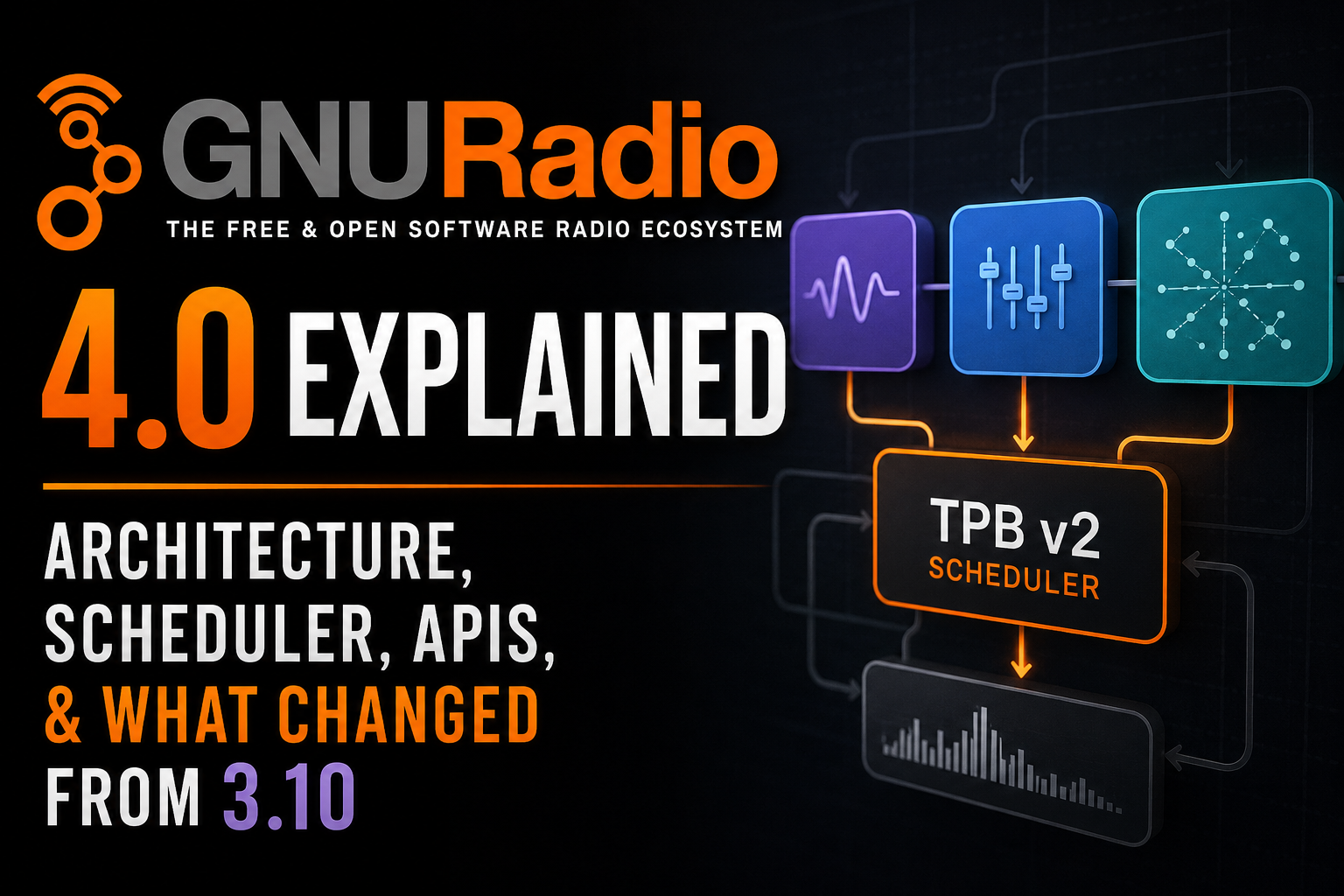
GNU Radio 4 is not simply GNU Radio 3.10 with a new interface. It is a major redesign of the runtime, block model, scheduler, type system, execution architecture, and developer APIs underneath GNU Radio flowgraphs.
The familiar idea remains: connect reusable signal-processing blocks into a graph and execute that graph. What changes is how those blocks are defined, connected, scheduled, optimized, inspected, and deployed.
GNU Radio 4 introduces a modern C++23 foundation, strongly typed ports, modular schedulers, explicit graph lifecycle, reflection, plugin discovery, SIMD-oriented processing, compile-time block composition, lock-free data movement, recursive graphs, improved support for heterogeneous compute, and a cleaner separation between the signal-processing graph and the runtime responsible for executing it.
There is also an important release-status detail. GNU Radio announced GNU Radio 4 Release Candidate 1 in March 2026, but as of August 7, 2026 the official GR4 repository still describes GNU Radio 4 as being in a maturing state approaching its first stable release. GNU Radio 3.x therefore remains the stable choice for production deployments that depend on the existing ecosystem.
This guide explains GNU Radio 4 architecture, the new scheduler model, block APIs, processOne and processBulk, strongly typed ports, std::expected, reflection, compile-time block merging, SIMD, SoapySDR, WebAssembly, and what has changed compared with GNU Radio 3.10.
Browse software-defined radio hardware, HackRF SDR hardware, bladeRF SDR hardware, USRP SDR hardware, and request a formal SDR lab quote from SDRstore.eu.
Quick Answer: What Changed in GNU Radio 4?
| Area | GNU Radio 3.10 | GNU Radio 4 |
|---|---|---|
| Core architecture | Mature 3.x runtime architecture | Clean redesigned runtime and block architecture |
| C++ baseline | C++17-era architecture | Modern C++23 |
| Scheduler | Runtime scheduling behavior largely defined by GNU Radio itself | Modular and application-selectable scheduling architecture |
| Block API | Inheritance-heavy block types and work functions | Modern strongly typed blocks with simplified processing APIs |
| Ports | Stream and message interfaces based on established 3.x abstractions | Ports are strongly typed, first-class constructs |
| Error handling | Traditional return values, exceptions, and runtime errors | Explicit composable errors using std::expected in key APIs |
| Metadata | Separate YAML, bindings, runtime information, and GRC metadata | Built-in reflection can expose parameters, ports, constraints, and metadata |
| Performance | Highly optimized but constrained by established runtime architecture | SIMD-first design, lock-free buffers, block merging, compile-time composition |
| Feedback graphs | More constrained streaming graph model | Recursive directed graphs and feedback are architectural features |
| Accelerators | Custom buffers introduced groundwork for GPU/FPGA integration | Architecture designed explicitly for heterogeneous execution |
| Licensing | GNU Radio core under GPLv3 | GR4 core/runtime under MIT; individual block libraries may use other compatible licensing |
| Current status | Stable production series | Approaching first stable release as of August 2026 |
The biggest conceptual change is this: GNU Radio 3.x mostly gives you a signal-processing graph running on GNU Radio's established runtime. GNU Radio 4 makes the execution strategy itself a configurable part of the system.
Is GNU Radio 4 Stable Yet?
Not as of August 7, 2026.
GNU Radio announced the first GR4 release candidate on March 22, 2026. At that point, the project said the architecture was stable, the execution model was well defined, and major API-breaking changes were no longer expected.
However, the current official gnuradio/gnuradio4 repository still describes GR4 as a maturing pre-stable release and says GNU Radio 3.x remains the current stable release series.
What that means for users
- Use GNU Radio 3.10 when you need the mature existing ecosystem today.
- Test GNU Radio 4 when you want to learn the future architecture.
- Develop new GR4-native blocks if your project can tolerate ecosystem changes.
- Do not assume every GNU Radio 3.10 block or out-of-tree module already has a GR4 equivalent.
- Do not assume old
.grcprojects can simply be opened and run unchanged. - For long-lived research projects starting now, evaluate both 3.10 and GR4 before choosing an architecture.
Why Was GNU Radio 4 Necessary?
GNU Radio 3.x has been extremely successful, but its architecture reflects design decisions made when general-purpose CPU execution was the dominant target and modern C++ language features, heterogeneous acceleration, WebAssembly, large multi-core systems, and modern deployment architectures did not look the way they do today.
GNU Radio 3.10 introduced important improvements, including:
- Custom buffers for accelerator-oriented data movement
- Built-in SoapySDR support
- gr-iio
- gr-pdu
- Modernized logging
- More C++17 usage
- Improved GNU Radio Companion
- Improved RFNoC and hardware integration
But some limitations could not be removed cleanly without changing the fundamental runtime and block APIs.
GNU Radio 4 therefore started with a much more fundamental question:
If GNU Radio were designed today for modern CPUs, SIMD, GPUs, accelerators, embedded systems, large research facilities, web environments, and production DSP applications, what should the runtime look like?
GNU Radio 4 Architecture Explained
A useful way to understand GR4 is to separate the system into several layers:
- Blocks define signal-processing behavior.
- Ports define typed data connections.
- The graph defines which blocks are connected.
- Buffers and edges move data between blocks.
- The scheduler decides when and where work executes.
- The runtime manages graph execution and lifecycle.
- Reflection and the plugin registry expose blocks and metadata to tools.
The signal-processing graph answers what should happen. The scheduler and runtime answer how it should execute.
Blocks Are Still the Center of GNU Radio
The basic GNU Radio programming model has not disappeared. Developers still build applications from reusable signal-processing blocks.
A block may represent:
- Signal source
- Gain stage
- FIR filter
- FFT
- Demodulator
- Decoder
- Hardware source
- Hardware sink
- Network interface
- Visualization
- Control-system component
What changed is the amount of boilerplate required to define many blocks and how strongly the framework understands their inputs, outputs, settings, and processing behavior.
The New Block API
One of the clearest examples of the GR4 design is the simplified processing API.
A simple block can conceptually look like this:
template
struct MultiplyConst : gr::Block> {
    gr::PortIn in;
    gr::PortOut out;

    T gain = T{1};

    GR_MAKE_REFLECTABLE(MultiplyConst, in, out, gain);

    constexpr T processOne(T value) const noexcept {
        return value * gain;
    }
};
The developer describes the operation. The framework can handle much of the surrounding work such as:
- Input consumption
- Output production
- Port typing
- Scheduling integration
- SIMD execution where applicable
- Block metadata
This is different from the traditional GNU Radio 3.x model where block writers often deal directly with forecast logic, scheduler-driven work calls, input/output item arrays, and explicit produced/consumed counts depending on block type.
processOne vs processBulk
GNU Radio 4 supports different processing styles because different algorithms have different requirements.
processOne
processOne is useful when one output value can be calculated naturally from one or a small fixed number of input values.
Examples include:
- Multiply by constant
- Add constant
- Simple sample transformation
- Stateless mathematical operations
- Small per-sample DSP operations
The framework can then decide how many samples to process at once and may take advantage of SIMD.
processBulk
Bulk-processing APIs are useful when an algorithm naturally operates on a span or batch of samples.
Examples include:
- FFT processing
- Framing
- Variable-rate blocks
- Packet processing
- Algorithms requiring explicit consumption and production behavior
- Algorithms that benefit from batch-oriented optimization
GR4 developer tutorials discuss both ordinary spans and consumable/produceable span interfaces for advanced bulk-processing blocks.
Strongly Typed Ports
Type safety is much more central in GNU Radio 4.
A port can explicitly carry a type such as:
gr::PortIn
gr::PortOut
or:
gr::PortIn> This provides several advantages:
- Invalid connections can be detected earlier.
- The compiler understands more about the graph.
- Blocks can use C++ templates naturally.
- Structured application-specific data types become easier to support.
- Tools can inspect port types through reflection.
GR4 is not limited to traditional scalar numeric stream types. Its architecture is intended to support structured and application-specific data as first-class types.
What Changed in the Scheduler?
The scheduler is one of the most important architectural changes in GNU Radio 4.
A scheduler decides:
- Which block should run
- When it should run
- How much data it should process
- Which thread should execute it
- Which CPU or resource may be used
- How latency and throughput should be balanced
GNU Radio 3.x approach
GNU Radio 3.x provides a mature scheduler tightly integrated with the runtime. The long-established thread-per-block style works well for many traditional streaming SDR applications.
But one scheduler strategy is not ideal for every application.
A radio receiver may prioritize throughput. A feedback controller may prioritize deterministic latency. A GPU pipeline may prefer large batches. A many-core CPU may prefer work stealing. An embedded system may prioritize memory footprint.
GNU Radio 4 approach
GR4 turns scheduling into a modular part of the architecture.
The graph defines the DSP system. A scheduler can then choose the execution strategy appropriate for that system.
Why Pluggable Schedulers Matter
Different schedulers can optimize for different goals.
| Goal | Possible scheduling strategy |
|---|---|
| Minimum latency | Small work chunks, prioritized execution, CPU affinity |
| Maximum throughput | Larger blocks of samples and efficient parallel execution |
| Real-time control | Deterministic priorities and dedicated execution resources |
| Many-core CPU | Shared queues, per-core queues, or work stealing |
| GPU | Larger transfers and GPU-specific scheduling domains |
| Embedded system | Minimal runtime and carefully constrained resources |
| Batch DSP | Large work units optimized for aggregate throughput |
This is why the scheduler change matters beyond benchmarks. It makes execution policy an architectural choice rather than a hidden assumption.
The Simple Scheduler
GNU Radio 4 includes a simple scheduler useful for straightforward graphs and examples.
It can operate as a single-threaded scheduler, running normal blocks in one thread apart from dedicated I/O behavior.
It can also be configured for multithreaded operation, including behavior similar to the traditional one-thread-per-block model familiar to GNU Radio 3.10 users.
This is useful because GR4 does not force every application into an exotic new scheduler. A simple application can still use a simple execution strategy.
Graph Construction and Execution Are More Explicit
GNU Radio 4 separates graph construction from graph execution more clearly.
The general model is:
- Create blocks.
- Add them to a graph.
- Connect typed ports.
- Validate construction.
- Create or select an execution strategy.
- Run the graph.
- Stop, wait, or manage the graph explicitly.
This explicit lifecycle makes GR4 easier to integrate into:
- Services
- Test automation
- Remote control systems
- Industrial software
- Experiment orchestration systems
- Managed research infrastructure
The Connection API Changed
GR4's connection API intentionally exposes errors instead of hiding them behind implicit graph-building semantics.
A runtime-style connection may conceptually use:
graph.connect(source, "out", sink, "in");A compile-time C++ connection can identify ports at compile time:
graph.connect<"out", "in">(source, sink);Connection operations can return std::expected, allowing errors to be handled explicitly.
This is important for:
- Invalid port names
- Type mismatches
- Invalid graph topology
- Automated graph construction
- Production systems that cannot silently ignore errors
std::expected and Explicit Error Handling
GR4 makes greater use of modern C++ error-handling patterns such as std::expected.
Instead of an operation simply failing somewhere deep in runtime execution, graph construction and other APIs can return either:
- A successful result
- A structured error
This is particularly useful for software that generates or modifies flowgraphs dynamically.
It also makes APIs easier to compose in robust production software.
Reflection: Blocks Can Describe Themselves
Reflection is one of the less obvious but potentially most important GR4 features.
Block information can be exposed programmatically, including:
- Ports
- Settings
- Parameters
- Types
- Constraints
- Metadata
This gives external tools a reliable machine-readable description of a block.
Why reflection matters
It can support:
- Graphical flowgraph editors
- Automatic configuration interfaces
- Block browsers
- Remote APIs
- Schema validation
- Automated documentation
- Dynamic block discovery
- AI-assisted signal-processing tooling
Instead of maintaining separate definitions for a block's C++ implementation, GUI representation, and external metadata, more information can be derived from the block itself.
The GR4 Plugin and Block Registry
GNU Radio 4 can build with a runtime block registry enabled.
The official repository currently exposes the CMake option:
-DGR_ENABLE_BLOCK_REGISTRY=ONThe registry helps applications discover blocks dynamically.
It is especially useful for:
- Graphical tooling
- Plugin-based applications
- Dynamically constructed flowgraphs
- Python or external-language integration
- Runtime block selection
GR4 can also be built with the runtime registry disabled for more static deployments.
Compile-Time Block Composition
One of GR4's most technically interesting features is compile-time block composition.
Normally, a DSP graph contains separate blocks connected through buffers:
source → multiply → divide → add → sinkEach runtime boundary may introduce:
- Buffer operations
- Scheduler decisions
- Function-call overhead
- Reduced optimization across block boundaries
GR4 can merge suitable blocks into a compile-time composition.
The compiler can then optimize a larger DSP pipeline as one unit.
Potential advantages
- Fewer intermediate buffers
- Lower memory traffic
- Better cache behavior
- Better SIMD optimization
- Less runtime overhead
- Very fast feedback-heavy DSP
Linear, Feedback, and Parallel Composition
The GR4 block-merging API supports multiple forms of composition.
Linear merge
Input
→ Block A
→ Block B
→ Output
The compiler can treat compatible stages as a merged processing chain.
Feedback merge
Feedback-oriented composition is useful for algorithms such as:
- IIR filters
- Control loops
- PLL-style algorithms
- Recursive DSP
Parallel composition
Parallel paths can be split, processed independently, and recombined.
This can be useful in:
- I/Q processing
- Filter banks
- Multi-channel DSP
- Parallel mathematical transforms
Why Feedback Is Important in GR4
Traditional streaming DSP frameworks are easiest to optimize when data flows forward from source to sink.
Feedback systems are harder because downstream results influence earlier processing.
GR4 explicitly supports recursive directed graphs and feedback-oriented composition, making it more natural for:
- Control systems
- Particle-accelerator feedback
- PLLs
- IIR processing
- Adaptive systems
- Real-time research instrumentation
This reflects GR4's development background at FAIR/GSI, where deterministic high-performance feedback processing is an important requirement.
SIMD Is a First-Class Design Goal
GNU Radio has long benefited from VOLK and SIMD-optimized kernels. GR4 pushes vectorized processing deeper into the architecture.
Instead of SIMD being only an optimization inside individual library functions, GR4 can use block structure and processing APIs to help determine efficient vector widths.
This can improve:
- Filters
- FFT operations
- Arithmetic chains
- Signal conversion
- High-rate sample processing
The project also includes SIMD-aware FFT work intended to integrate naturally with fused and compile-time DSP pipelines.
Lock-Free Buffers and Data Movement
At high sample rates, arithmetic is not always the bottleneck. Moving samples between blocks can consume significant memory bandwidth and CPU time.
GR4's runtime is designed around efficient data movement, including lock-free buffer approaches.
This matters when processing:
- High-bandwidth SDR streams
- Multiple channels
- MIMO systems
- Large FFT pipelines
- Real-time feedback systems
- CPU-to-accelerator transfers
The goal is to reduce unnecessary copies and synchronization overhead.
Heterogeneous Computing: CPU, GPU, FPGA, and Accelerators
GNU Radio 3.10 already introduced custom buffers to improve accelerator integration.
GR4 goes further by designing the runtime and scheduling model around heterogeneous execution from the start.
Future and application-specific schedulers can make decisions such as:
- Run these blocks on CPU cores.
- Move this subgraph to a GPU.
- Use larger work units across the CPU/GPU boundary.
- Keep latency-sensitive blocks on isolated CPU cores.
- Place hardware-specific processing near the associated device.
This is important for advanced SDR research involving:
- 5G and 6G PHY processing
- Large MIMO systems
- AI-assisted signal processing
- RF fingerprinting
- High-rate channelizers
- Real-time spectrum monitoring
- Beamforming
SoapySDR Integration
GR4 includes SoapySDR integration as an important hardware abstraction path.
SoapySDR allows one DSP application to communicate with multiple hardware families through a common interface where drivers exist.
This can simplify development with hardware such as:
- HackRF
- bladeRF
- RTL-SDR
- Airspy
- LimeSDR
- Other Soapy-supported radios
The benefit is architectural separation:
DSP application
↓
GNU Radio 4 block
↓
SoapySDR
↓
Hardware-specific driver
↓
SDR device
This makes it easier to swap a physical radio for another device, a recorded dataset, or a simulated source during development.
What About USRP and UHD?
USRP hardware remains extremely important for GNU Radio research, but users should distinguish between the mature 3.10 UHD ecosystem and developing GR4 hardware integrations.
If a project depends today on:
- USRP B210
- USRP X310
- USRP N310
- RFNoC
- srsRAN-related GNU Radio utilities
- Existing UHD flowgraphs
GNU Radio 3.10 remains the safer production choice until the required GR4 blocks and interfaces are confirmed for your exact workflow.
Read the USRP B210 for srsRAN and OpenAirInterface research guide.
WebAssembly Support
GNU Radio 4 is also being designed to run DSP pipelines through WebAssembly.
This enables use cases that were historically unusual for GNU Radio:
- DSP directly in a browser
- Interactive teaching demonstrations
- Portable signal-processing applications
- Sandboxed DSP execution
- Web-based instrumentation
- Shareable research demonstrations
A user may eventually be able to open a web application and run substantial GR4-based DSP without installing a complete traditional GNU Radio environment locally.
GNU Radio Companion and Graphical Development
GNU Radio Companion is one of the reasons GNU Radio became accessible to such a large community.
GR4 intends to preserve graphical flowgraph development, but users should not assume that the existing GNU Radio 3.10 GRC environment and block library are simply the GR4 frontend.
As GR4 approaches stable release, graphical interfaces and tooling are still being developed and improved.
For current users
- Keep GNU Radio 3.10 for mature GRC teaching labs.
- Experiment with GR4 separately.
- Do not overwrite a working classroom environment just to test GR4.
- Keep copies of existing
.grcfiles. - Expect block and parameter mapping work during migration.
Python vs C++ in GNU Radio 4
GNU Radio 3.x users often think of GNU Radio as a Python application controlling C++ DSP blocks.
GR4's architecture puts much stronger emphasis on modern C++ because C++23 features are central to:
- Compile-time typing
- Block templates
- Compile-time block composition
- SIMD
- Low-overhead execution
- Reflection infrastructure
Python remains important for prototyping, orchestration, teaching, and user-facing workflows, but developers who want to understand the core GR4 architecture should be comfortable reading modern C++.
Licensing Changed
GNU Radio 3.x core is distributed under GPLv3.
GNU Radio 4's core runtime is MIT licensed.
The project says individual block libraries can still use other licensing, including GPLv3 where appropriate.
Why this matters
A permissive core license can make GR4 easier to integrate into:
- Commercial RF products
- Embedded systems
- Industrial test platforms
- Mixed-license applications
- Proprietary orchestration software
This does not mean every GR4 component automatically has the same license. Developers still need to check the license of the individual block library and other dependencies they use.
GNU Radio 3.10 vs 4.0 Developer Model
| Developer task | GNU Radio 3.10 | GNU Radio 4 |
|---|---|---|
| Define simple DSP block | Traditional GNU Radio block inheritance and work API | Compact typed block, often with processOne |
| Bulk algorithm | general_work/work and buffer arrays | Bulk-processing/span-oriented interfaces |
| Connect blocks | Runtime graph connection | Runtime or compile-time typed connection APIs |
| Handle graph errors | Established 3.x error model | Explicit std::expected-style results in key APIs |
| Expose metadata | YAML, bindings, classes, GRC definitions | Reflection-driven metadata and registry model |
| Optimize chain | Optimize individual blocks, VOLK, buffers, scheduler parameters | Can additionally merge suitable block chains at compile time |
| Choose scheduler | Mostly established GNU Radio runtime behavior | Scheduler becomes selectable and extensible |
Will GNU Radio 3.10 Flowgraphs Work in GNU Radio 4?
Do not assume direct compatibility.
GNU Radio 4 is a new implementation with different core APIs and runtime concepts. Existing GNU Radio 3.10 flowgraphs, Python applications, and out-of-tree modules may require migration or replacement.
Expect migration work around
- Block names
- Block availability
- Port types
- Message APIs
- Tags
- Runtime settings
- Python APIs
- C++ block implementations
- GNU Radio Companion metadata
- Out-of-tree modules
For an important production system, keep the 3.10 implementation operational while developing and validating the GR4 version separately.
What Happens to Out-of-Tree Modules?
Existing GNU Radio 3.x out-of-tree modules are one of the largest migration considerations.
An OOT module containing custom C++ or Python blocks cannot generally be expected to compile unchanged against GR4.
The migration strategy should be:
- Inventory every custom block.
- Determine whether GR4 already provides equivalent functionality.
- Identify block inputs, outputs, settings, tags, and message behavior.
- Rewrite block interfaces using GR4 APIs.
- Select
processOneor bulk processing as appropriate. - Add reflection metadata.
- Build unit tests independent of the complete flowgraph.
- Benchmark GR3 vs GR4 implementations.
- Validate hardware and timing behavior.
What Has Not Changed?
Despite the major architecture rewrite, GNU Radio's fundamental purpose remains recognizable.
You still:
- Build signal-processing systems from blocks.
- Connect blocks into flowgraphs.
- Stream sampled data between processing stages.
- Use SDR hardware as sources and sinks.
- Build filters, demodulators, decoders, and analyzers.
- Prototype communications systems.
- Use GNU Radio for education and research.
A student who understands sampling, filters, FFTs, modulation, flowgraphs, complex I/Q data, and SDR hardware in GNU Radio 3.10 is not starting from zero in GR4.
The DSP knowledge transfers. The architecture and APIs change.
Who Benefits Most from GNU Radio 4?
High-throughput DSP developers
GR4's SIMD, block-merging, and lower-overhead runtime architecture can benefit applications processing large sample streams.
Low-latency systems
Flexible schedulers and feedback-oriented architecture are valuable for deterministic control and low-latency DSP.
Research labs
Researchers can experiment with custom schedulers, new hardware backends, structured types, and heterogeneous compute.
Industrial SDR applications
The explicit lifecycle, reflection system, modular runtime, and permissive core license make GR4 interesting for managed production software.
Embedded systems
The repository includes an embedded-oriented build option designed to reduce runtime features and code size.
Browser-based DSP
WebAssembly opens a new path for interactive DSP and teaching tools.
Who Should Stay on GNU Radio 3.10 for Now?
Stay with 3.10 when:
- Your production system is already stable.
- You depend on a large number of existing OOT modules.
- Your university course needs mature GRC workflows today.
- Your USRP workflow depends on mature UHD blocks.
- You rely on existing Python examples.
- Your project cannot tolerate API or packaging changes.
- You do not need the architectural advantages of GR4 yet.
There is no technical benefit in migrating a stable production flowgraph simply because the version number is newer.
Who Should Test GNU Radio 4 Now?
Start testing GR4 now when:
- You are beginning a multi-year research project.
- You write custom C++ DSP blocks.
- You need very low latency.
- You want custom scheduling.
- You are evaluating GPU or accelerator architectures.
- You need embedded deployment.
- You are building future GNU Radio tooling.
- You want to port an OOT library before the ecosystem moves.
- You maintain an SDR application that will eventually need GR4 support.
How to Build GNU Radio 4 Today
GNU Radio 4 currently targets modern development toolchains.
The official repository lists requirements including modern CMake and current C++ compilers, with C++23 as the language baseline.
A basic source build follows this pattern:
git clone https://github.com/gnuradio/gnuradio4.git
cd gnuradio4

cmake -B build -S . \
  -DCMAKE_BUILD_TYPE=RelWithAssert \
  -DGR_ENABLE_BLOCK_REGISTRY=ON

cmake --build build -- -j$(nproc)
Because GR4 has not yet reached its first stable release, users should check the current repository requirements before copying build commands into automated production environments.
Important GR4 Build Options
| Option | Purpose |
|---|---|
GR_ENABLE_BLOCK_REGISTRY |
Enable runtime block discovery and registry features. |
EMBEDDED |
Reduce code size and runtime features for constrained deployments. |
WARNINGS_AS_ERRORS |
Treat compiler warnings as build failures. |
TIMETRACE |
Enable compiler timing analysis. |
ADDRESS_SANITIZER |
Build with memory-error detection. |
UB_SANITIZER |
Detect undefined behavior. |
THREAD_SANITIZER |
Help diagnose threading problems, with significant performance overhead. |
Hardware for Learning GNU Radio 4
You do not need the most expensive SDR to learn GR4 architecture.
| Hardware | Best GR4 use | Notes |
|---|---|---|
| RTL-SDR | Receive-only experimentation | Low-cost option where the required Soapy hardware support is available. |
| HackRF Pro | Wideband GNU Radio experiments | Useful for receiving and controlled transmit projects. |
| PLUTO+ / AD936x hardware | Digital communications experiments | Check current GR4 driver integration for the exact board. |
| bladeRF 2.0 micro | MIMO, FPGA, and advanced SDR development | Strong research platform with Soapy integration possibilities. |
| USRP B210 | Research and MIMO | GNU Radio 3.10 remains the safer route for mature UHD workflows today. |
| USRP X310 / N310 | Advanced research labs | Evaluate GR4 hardware support against existing UHD/RFNoC requirements. |
Read: Best SDR for GNU Radio Projects: Student, Hobbyist, Lab, and Research Setups.
HackRF Pro and GNU Radio
HackRF Pro is useful for learning GNU Radio because it is flexible, wideband, and widely supported by existing SDR software.
For current production-style HackRF workflows, GNU Radio 3.10 remains mature. For GR4 experimentation, SoapySDR provides an important hardware-abstraction path.
Read the HackRF Pro Setup Guide: Firmware, Drivers, GNU Radio, SDR++, and First Signal.
bladeRF and GNU Radio 4
bladeRF is especially interesting for GR4 because its 2×2 MIMO hardware, USB 3.0 interface, and FPGA make it relevant to the heterogeneous-processing direction of the new architecture.
Potential research areas include:
- MIMO processing
- Custom waveform generation
- FPGA offload
- RF fingerprinting
- Real-time DSP
- Custom scheduler experiments
Read the bladeRF 2.0 micro Setup Guide.
GNU Radio 4 for Universities
Universities should not immediately replace every GNU Radio 3.10 workstation with GR4.
A better strategy is a staged lab.
Beginner teaching machines
- GNU Radio 3.10
- GNU Radio Companion
- RTL-SDR
- Simple FM, ADS-B, FFT, and filtering labs
Advanced development machines
- GNU Radio 4
- Modern C++ compiler
- HackRF Pro or bladeRF
- GR4 block-development examples
- Scheduler experiments
- SIMD benchmarks
Research systems
- GNU Radio 3.10 production environment where needed
- Separate GR4 development environment
- USRP or bladeRF hardware
- Version-controlled flowgraphs and source code
- Recorded IQ datasets for reproducible comparisons
This lets students learn mature GNU Radio concepts while researchers prepare for the GR4 ecosystem.
GNU Radio 4 for 5G, 6G, and MIMO Research
GR4's architecture is particularly interesting for future wireless research because modern PHY processing can require:
- High sample rates
- Large FFTs
- Multiple synchronized channels
- Low-latency feedback
- GPU acceleration
- SIMD-heavy processing
- AI inference
- Real-time adaptation
A modular scheduler and explicit heterogeneous-compute architecture can make these workloads easier to optimize than forcing every graph through one universal scheduling strategy.
This does not mean GR4 replaces srsRAN, OpenAirInterface, or specialized PHY frameworks. It means GR4 can become a stronger platform for custom DSP, instrumentation, prototyping, and research components around them.
GR4 Migration Checklist
- Do not remove your working GNU Radio 3.10 installation.
- Create an isolated GR4 development environment.
- Inventory every in-tree and out-of-tree block your project uses.
- Identify hardware dependencies such as UHD, SoapySDR, IIO, or bladeRF.
- Record sample rates, buffer settings, and scheduler behavior in the current system.
- Create known input IQ files for regression testing.
- Port simple stateless blocks first.
- Use
processOnewhere appropriate. - Port variable-rate or stateful algorithms using appropriate bulk APIs.
- Validate tags, settings, metadata, and control behavior.
- Benchmark throughput and latency independently.
- Validate hardware streaming.
- Compare output samples between GR3 and GR4.
- Only migrate production deployment after functional and performance validation.
Common Misunderstandings About GNU Radio 4
“GNU Radio 4 is just GNU Radio 3.11 renamed.”
No. GR4 is a separate architectural redesign of the runtime and block model.
“GNU Radio 3.10 is obsolete.”
No. GNU Radio 3.x remains the stable production series as GR4 approaches its first stable release.
“Every old GRC file will work automatically.”
No. Expect migration work and verify the availability of every block and hardware interface.
“GR4 is only faster GNU Radio.”
Performance is only part of the redesign. Scheduler flexibility, reflection, stronger typing, explicit graph lifecycle, heterogeneous execution, and deployment flexibility are equally important.
“GR4 is only for C++ experts.”
The core architecture uses advanced modern C++, but the project intends to remain useful to graphical, Python, educational, and application-level users as its tooling matures.
“A custom scheduler automatically makes everything faster.”
No. Scheduler choice depends on the workload. A low-latency scheduler, high-throughput scheduler, and accelerator scheduler may make different trade-offs.
“Compile-time merging should be used everywhere.”
No. Dynamic graphs, plugins, runtime reconfiguration, and separately schedulable blocks remain useful. Compile-time composition is another optimization option, not a requirement for every graph.
Recommended SDRstore.eu Hardware Packages
Package 1: GNU Radio learning setup
- RTL-SDR Blog receiver
- GNU Radio 3.10 for mature beginner labs
- Separate GR4 source build for architecture experiments
- Basic VHF/UHF antenna kit
Best for: students learning flowgraphs, FFTs, filtering, demodulation, and the transition from GR3 to GR4.
Package 2: GNU Radio 4 developer setup
- HackRF Pro
- Modern Linux workstation
- Current C++23-capable compiler
- GNU Radio 3.10 and GR4 in separate environments
- RTL-SDR as an independent receive monitor
- Attenuators and dummy loads for controlled TX work
Best for: developers writing GR4 blocks, experimenting with SoapySDR, and learning scheduler behavior.
Package 3: MIMO and performance research setup
- bladeRF 2.0 micro xA4 or xA9
- Matched antennas
- High-performance workstation
- GNU Radio 4 development environment
- GNU Radio 3.10 comparison environment
- RF attenuators and cabled test paths
Best for: MIMO, SIMD, scheduler experiments, FPGA-oriented development, and advanced DSP research.
Package 4: Advanced university SDR research lab
- USRP B210, X310, or N310 depending on research requirements
- HackRF Pro and bladeRF supporting nodes
- GNU Radio 3.10 stable environment
- GNU Radio 4 experimental environment
- 10 MHz and PPS synchronization hardware where needed
- RF shield boxes
- Attenuators, dummy loads, filters, and DC blocks
- NanoVNA or professional VNA
- Spectrum analyzer
Best for: MIMO, private 5G research, RF fingerprinting, wireless communications, real-time DSP, and long-term GNU Radio development.
Purchase-Order Justification Examples
GNU Radio 4 development workstation justification
A GNU Radio 4 development environment is required to evaluate the next-generation GNU Radio runtime, modern block APIs, modular scheduling, SIMD execution, reflection, heterogeneous computing, and migration of existing GNU Radio 3.10 research software.
HackRF Pro GR4 development justification
HackRF Pro is required as a wideband SDR platform for GNU Radio 4 hardware-integration testing, SoapySDR development, spectrum experiments, receive validation, and controlled signal-processing research.
bladeRF GR4 research justification
bladeRF 2.0 micro is required for GNU Radio 4 research involving 2×2 MIMO, high-rate streaming, FPGA-oriented workflows, scheduler evaluation, custom waveform development, and heterogeneous signal-processing experiments.
USRP research justification
USRP hardware is required to maintain mature GNU Radio 3.10/UHD research workflows while evaluating migration toward GNU Radio 4 for advanced MIMO, timing, synchronization, and next-generation DSP architectures.
Request a Quote for a GNU Radio Research Lab
Universities, RF laboratories, telecom research teams, cybersecurity groups, wireless product developers, and public-sector research organizations can request a formal quotation directly from SDRstore.eu.
Use the Add to Quote button on product pages or the document icon on product cards. Add HackRF Pro, RTL-SDR, PLUTO+, bladeRF, USRP B210, X310 or N310, antennas, synchronization hardware, filters, attenuators, dummy loads, TinySA, NanoVNA, cables, adapters, and project requirements to one quote request.
A quote request is useful when you need:
- GNU Radio teaching labs
- GNU Radio 4 migration test benches
- MIMO research hardware
- SDR scheduler and performance research setups
- 5G and 6G research hardware
- RF cybersecurity training equipment
- Multiple identical SDR nodes
- Formal university or company procurement pricing
Read the SDRstore.eu quote-request guide.
Related SDRstore.eu Guides
- Best SDR for GNU Radio Projects: Student, Hobbyist, Lab, and Research Setups
- Best SDR for GNU Radio: RTL-SDR, HackRF, PlutoSDR, bladeRF, and USRP
- HackRF Pro Setup Guide: Firmware, Drivers, GNU Radio, SDR++, and First Signal
- bladeRF 2.0 micro Setup Guide
- USRP B210 for srsRAN and OpenAirInterface
- MIMO Testbed Hardware
- RF Cyber Range Hardware
- SDR Hardware for RF Product Testing
- How to Choose SDR Hardware for a Research Grant or University Purchase Order
Official GNU Radio 4 Resources
- Official GNU Radio 4 GitHub repository
- GNU Radio 4 Release Candidate 1 announcement
- GNU Radio 4 Community Stewardship and Road to 4.0
- GNU Radio official website
- GNU Radio 3.x repository
- GNU Radio conference and tutorial archive
Final Recommendation
GNU Radio 4 should be understood as a new foundation, not as a routine upgrade from GNU Radio 3.10.
The biggest changes are architectural: modern C++23, strongly typed ports, simpler block processing APIs, modular schedulers, explicit graph lifecycle, reflection, plugin discovery, lock-free data movement, SIMD-oriented execution, recursive graphs, compile-time block composition, heterogeneous-compute support, SoapySDR integration, and WebAssembly deployment.
For production systems and mature teaching environments, GNU Radio 3.10 remains the safer choice today. For developers, research labs, universities, and organizations planning multi-year SDR systems, now is a good time to evaluate GR4, port custom blocks, benchmark workloads, and identify hardware-integration gaps before the first stable GNU Radio 4 release.
The most sensible migration strategy is not “replace 3.10.” Keep the stable environment working, build GR4 separately, feed both implementations the same test data, validate outputs, benchmark latency and throughput, and migrate only when the new system meets your functional and operational requirements.
FAQ
Is GNU Radio 4.0 officially stable?
Not yet as of August 7, 2026. GNU Radio announced GR4 Release Candidate 1 in March 2026, but the official repository still describes GR4 as approaching its first stable release and recommends GNU Radio 3.x for users requiring the current stable platform.
What is the biggest change in GNU Radio 4?
The biggest change is the architecture. GNU Radio 4 redesigns the runtime, scheduler, block API, data types, graph lifecycle, reflection system, and execution model rather than simply adding features to the GNU Radio 3.x runtime.
What happened to the GNU Radio scheduler in GR4?
Scheduling becomes modular and configurable. Applications can use or develop schedulers optimized for latency, throughput, parallelism, CPU resources, accelerators, or other application-specific requirements.
What is processOne in GNU Radio 4?
processOne is a simplified block-processing API for operations that naturally transform individual samples. The framework can manage surrounding buffering, scheduling, and SIMD execution.
What is processBulk in GNU Radio 4?
Bulk-processing interfaces allow blocks to operate efficiently on spans or groups of samples. They are useful for FFTs, framing, variable-rate processing, packet processing, and algorithms requiring explicit input and output handling.
Does GNU Radio 4 use C++23?
Yes. The current official GNU Radio 4 repository uses modern C++23 as its language baseline, allowing GR4 to make extensive use of templates, concepts, compile-time programming, std::expected, and other modern C++ features.
Will GNU Radio 3.10 flowgraphs work directly in GNU Radio 4?
Do not assume direct compatibility. GNU Radio 4 uses a different runtime and developer architecture, so existing blocks, GRC flowgraphs, Python code, and out-of-tree modules may need migration.
Is GNU Radio Companion available for GNU Radio 4?
Graphical development remains part of the GNU Radio 4 direction, but GR4 tooling is still maturing. GNU Radio 3.10 remains the safer choice for mature GRC-based teaching and production workflows today.
Does GNU Radio 4 support SoapySDR?
Yes. SoapySDR integration is part of the GR4 architecture and provides a common hardware-abstraction path for many SDR devices with compatible Soapy drivers.
Is GNU Radio 4 faster than GNU Radio 3.10?
GR4 is designed to reduce runtime overhead and improve SIMD, buffering, scheduling, and compile-time optimization. Some workloads can benefit substantially, but actual performance depends on the graph, scheduler, hardware, compiler, block implementation, and whether compile-time composition is appropriate.
Should a university switch from GNU Radio 3.10 to GNU Radio 4 now?
A staged approach is better. Keep GNU Radio 3.10 for mature classroom exercises while creating separate GNU Radio 4 development systems for advanced block development, scheduler experiments, SIMD work, and future course material.
Can SDRstore.eu quote hardware for a GNU Radio 4 research lab?
Yes. Use the Add to Quote button on product pages or the document icon on product cards. Add HackRF Pro, RTL-SDR, PLUTO+, bladeRF, USRP hardware, antennas, timing equipment, filters, attenuators, dummy loads, test instruments, and project notes so the complete research setup can be quoted together.
No posts found
Write a review






We support all major card and digital payment options. More local methods are available and shown during checkout.
You enter into a binding sales contract once you have received an 'order confirmation and sales receipt' email from us, in line with our Sales & Delivery conditions. Therefore, sdrstore.eu has the right to cancel your order in the event of technical problems, delivery failure, Fair use policy and other similar situations.






Your payments are protected by advanced encryption and 3-D Secure authentication for safe online shopping.