





AD9361 vs AD9363 SDR Boards: Bandwidth, MIMO, Use Cases, and Buyer Advice
Updated: June 2026. This guide compares AD9361 and AD9363 SDR boards for bandwidth, tuning range, MIMO, transmit and receive channels, PlutoSDR-style devices, USRP B210, GNU Radio, OpenAirInterface, srsRAN, university labs, wireless research, and buyer decisions.
AD9361 and AD9363 are two of the most common Analog Devices RF transceiver chips found inside software-defined radio boards.
They appear in USRP-style devices, PlutoSDR-compatible boards, compact wireless-development platforms, university teaching equipment, GNU Radio projects, private 5G labs, OpenAirInterface experiments, srsRAN testbeds, FPGA-based prototypes, and custom communications systems.
The names look similar, and many SDR product pages mention both chips.
However, AD9361 and AD9363 are not identical.
AD9361 is the stronger choice when a project needs a wider official tuning range, more channel bandwidth, broader RF experimentation, and a safer upgrade path for professional wireless research.
AD9363 is often the more affordable choice for education, PlutoSDR-style learning, moderate-bandwidth wireless experiments, and projects that remain within its official frequency and bandwidth limits.
There is one important complication:
The RF chip is only one part of an SDR board.
A board designer may expose one RF channel or two. The board may use USB 2.0, USB 3.0, or Gigabit Ethernet. It may include a stronger FPGA, a weaker FPGA, a stable reference clock, external synchronization, MicroSD boot support, or different RF front-end components. Some Pluto-style boards also advertise firmware profiles that extend beyond the official AD9363 operating specification.
This guide explains the official AD9361 vs AD9363 differences, what MIMO really means, how standard ADALM-PLUTO differs from expanded Pluto-style boards, why USRP B210 remains a strong AD9361 reference platform, and which SDR board you should buy for your project.
Browse current PlutoSDR and PLUTO+ SDR boards, USRP SDR devices and boards, and software-defined radio equipment at SDRstore.eu.
Quick Answer: AD9361 or AD9363?
| Your Priority | Recommended RFIC Direction | Why |
|---|---|---|
| Widest official RF coverage | AD9361 | Official receiver LO coverage from 70 MHz–6 GHz and transmitter LO coverage from 47 MHz–6 GHz |
| Up to 56 MHz channel bandwidth | AD9361 | Higher official bandwidth ceiling than AD9363 |
| Affordable SDR education | AD9363 | Strong fit for PlutoSDR-style learning and moderate-bandwidth experiments |
| Standard ADALM-PLUTO learning module | AD9363 | Official ADALM-PLUTO uses AD9363 with one transmitter, one receiver, and up to 20 MHz instantaneous bandwidth |
| Coherent 2×2 MIMO with a mature UHD workflow | AD9361 board such as USRP B210 | B210 uses both AD9361 signal chains and provides USB 3.0, UHD, GNU Radio, and up to 56 MHz real-time bandwidth |
| Low-cost Pluto-style experimentation with Ethernet | Expanded AD9363-based or AD936x Pluto-style board | Useful for learning and prototyping, but verify the selected board and firmware profile carefully |
| OpenAirInterface or srsRAN research | AD9361-based board when budget allows | Wider official range and bandwidth provide a safer research path |
| Repeatable lab measurements outside the AD9363 official range | AD9361 | Do not rely only on a software unlock when reproducibility matters |
The easiest buying rule is:
- Choose AD9363 when you want an affordable PlutoSDR-style platform for learning, GNU Radio, SDRangel, and moderate-bandwidth experiments.
- Choose AD9361 when you need a wider official RF range, up to 56 MHz channel bandwidth, professional research flexibility, or a safer long-term upgrade path.
- Check the board specification separately from the RFIC specification.
AD9361 vs AD9363 Comparison Table
| Feature | AD9361 | AD9363 |
|---|---|---|
| Official RF direction | Wider-range RF agile transceiver for general-purpose radio systems and cellular infrastructure | RF agile transceiver designed for femtocell and wireless-video applications |
| Official receive LO range | 70 MHz–6 GHz | 325 MHz–3.8 GHz |
| Official transmit LO range | 47 MHz–6 GHz | 325 MHz–3.8 GHz direction |
| Official channel bandwidth | Below 200 kHz to 56 MHz | Below 200 kHz to 20 MHz |
| Receive paths at RFIC level | Two independent direct-conversion receivers | Two independent direct-conversion receivers |
| Transmit paths at RFIC level | Dual transmitters | Dual transmitters |
| ADC and DAC direction | 12-bit data-path direction | 12-bit data-path direction |
| TDD and FDD direction | Supported | Supported |
| Digital interface | CMOS or LVDS | CMOS or LVDS |
| Best buyer | Researcher, university, communications lab, MIMO developer, private 5G lab, and professional prototyping team | Student, maker, educator, PlutoSDR user, and budget-conscious developer |
| Main advantage | Wider official range and up to 56 MHz channel bandwidth | Lower-cost direction for accessible SDR learning and experimentation |
For the official silicon specifications, see the Analog Devices AD9361 product page and Analog Devices AD9363 product page.
The Most Important Distinction: RFIC Specification vs SDR Board Specification
The chip name does not tell you everything about an SDR board.
Two devices can use the same AD9363 RFIC and still behave very differently because their board designs expose different capabilities.
The SDR board determines:
- How many transmit channels are physically routed to connectors
- How many receive channels are physically routed to connectors
- Whether 1×1 or 2×2 operation is available
- USB 2.0, USB 3.0, or Ethernet throughput
- FPGA model and available logic resources
- RAM
- Flash storage
- MicroSD support
- Clock stability
- External-reference support
- PPS support
- RF connectors
- RF filters and matching networks
- Power supply quality
- Thermal performance
- Firmware compatibility
- Driver compatibility
- Expected performance near the edge of the tuning range
Analog Devices explicitly notes that external board components can affect real RF performance even when the RFIC itself supports a wider range.
The correct question is not only:
Does this board use AD9361 or AD9363?Also ask:
Which RF channels are exposed, which bandwidth is supported, which interface is used, and how was the board validated?What Is AD9361?
AD9361 is a highly integrated RF agile transceiver designed for programmable wideband radio systems.
Analog Devices positions it for applications including point-to-point communications, femtocell, picocell, microcell base stations, and general-purpose radio systems.
Official AD9361 direction
- Receiver LO coverage from 70 MHz–6 GHz
- Transmitter LO coverage from 47 MHz–6 GHz
- Channel bandwidths from below 200 kHz to 56 MHz
- Two independent direct-conversion receivers
- Dual transmitters
- Integrated fractional-N synthesizers
- 2.4 Hz maximum LO step size direction
- Independent receive automatic gain control
- DC offset correction
- Quadrature correction
- Digital filtering
- 128-tap FIR-filter direction
- CMOS or LVDS digital interface
- Multichip-synchronization direction
Choose AD9361 when you need:
- Operation below 325 MHz
- Operation above 3.8 GHz
- Up to 56 MHz channel bandwidth
- Broader licensed and unlicensed-band research
- Professional MIMO prototyping
- Private LTE or 5G lab development
- OpenAirInterface experiments
- srsRAN experiments
- Wider GNU Radio projects
- More predictable official performance limits
- Longer-term research flexibility
What Is AD9363?
AD9363 is also a highly integrated RF agile transceiver.
Analog Devices positions it for 3G and 4G femtocell applications and wireless video transmission.
Official AD9363 direction
- 325 MHz–3.8 GHz official operating range
- Channel bandwidths from below 200 kHz to 20 MHz
- Two independent direct-conversion receivers
- Dual transmitters
- Independent automatic gain control
- DC offset correction
- Quadrature correction
- Digital filtering
- 128-tap FIR-filter direction
- Integrated fractional-N synthesizers
- 2.4 Hz LO step size direction
- CMOS or LVDS digital interface
Choose AD9363 when:
- Your experiments fit within 325 MHz–3.8 GHz.
- Your project does not need more than 20 MHz official channel bandwidth.
- You want an affordable PlutoSDR-style platform.
- You are teaching SDR fundamentals.
- You are learning GNU Radio.
- You are exploring digital communications.
- You want a portable RF-learning platform.
- You are building a budget-conscious prototype.
Bandwidth: 56 MHz vs 20 MHz
Bandwidth is one of the clearest differences between AD9361 and AD9363.
| RFIC | Official Channel Bandwidth Direction | Best Fit |
|---|---|---|
| AD9361 | Below 200 kHz to 56 MHz | Wideband communications, research, cellular experimentation, larger GNU Radio pipelines, and advanced lab work |
| AD9363 | Below 200 kHz to 20 MHz | Education, PlutoSDR-style projects, moderate-bandwidth digital communications, and lower-cost prototypes |
When does 56 MHz matter?
- Wider signal capture
- Wider OFDM experiments
- Higher-throughput research
- Cellular prototyping
- More flexible channel planning
- Broader spectrum snapshots
- More demanding GNU Radio flowgraphs
- Private-network experiments
- Research projects that may expand later
When is 20 MHz enough?
- Learning modulation and demodulation
- GNU Radio fundamentals
- FM, FSK, PSK, and QAM exercises
- Controlled digital links
- Open-source wireless projects
- University teaching
- Portable experiments
- Budget-conscious prototypes
Sample Rate Is Not the Same as Usable RF Bandwidth
Buyers sometimes compare SDR boards using only the maximum sample-rate number.
That can be misleading.
Sample rate, filtered RF bandwidth, host-interface throughput, number of active channels, FPGA processing, firmware configuration, and usable signal quality are related but not identical.
For example, the official ADALM-PLUTO page lists RF coverage from 325 MHz–3.8 GHz, up to 20 MHz instantaneous bandwidth, and RF-signal generation or acquisition at up to 61.44 MSPS.
Do not assume:
61.44 MSPS automatically means 61.44 MHz of clean usable RF bandwidth.MIMO: Both Chips Can Support Multiple Channels
Another common misunderstanding is that AD9363 is always 1×1 and AD9361 is always 2×2.
That is not accurate at the RFIC level.
Both AD9361 and AD9363 contain two receive paths and dual transmitters.
However, the SDR board may expose only one transmitter and one receiver.
| Device or Board Type | RFIC | Exposed Channel Direction | Important Note |
|---|---|---|---|
| Standard ADALM-PLUTO | AD9363 | 1 TX and 1 RX | Official learning module with up to 20 MHz instantaneous bandwidth |
| PLUTO+ SDR | AD9363 board direction | Advertised 2 TX and 2 RX | Expanded Pluto-style platform; verify selected version and board-specific claims |
| GeekRF One | AD9363 with advertised AD9361-style firmware profile | Advertised 2×2 MIMO | Useful for experimentation; treat expanded range and bandwidth as board-specific claims |
| USRP B210 | AD9361 | 2 TX and 2 RX | Official Ettus platform using both AD9361 signal chains for coherent MIMO |
What Does 2T2R Mean?
2T2R means two transmit paths and two receive paths.
A 2T2R board may support:
- Two-antenna reception
- Two-antenna transmission
- MIMO experiments
- Spatial diversity
- Beamforming fundamentals
- Channel-estimation research
- Direction-finding concepts
- Cellular research
- Custom wireless links
However, 2T2R does not automatically guarantee that every advanced cellular workflow will work.
Also check:
- Independent tuning requirements
- Phase coherence
- Shared oscillator behavior
- Host throughput
- Clock synchronization
- Driver support
- FPGA resources
- Software-stack compatibility
Standard ADALM-PLUTO: Best Official AD9363 Learning Platform
ADALM-PLUTO is the best-known AD9363 SDR learning platform.
Analog Devices designed it as a compact active-learning module for students, instructors, and self-learners.
Official ADALM-PLUTO direction
- AD9363 RF transceiver
- Xilinx Zynq Z-7010 FPGA
- 325 MHz–3.8 GHz official RF coverage
- Up to 20 MHz instantaneous bandwidth
- One transmitter
- One receiver
- Half-duplex or full-duplex operation
- Flexible-rate 12-bit ADC and DAC
- MATLAB and Simulink support
- GNU Radio source and sink blocks
- libiio API
- USB-powered portable design
Choose standard ADALM-PLUTO if:
- You want the official Analog Devices education platform.
- You are learning SDR fundamentals.
- You use MATLAB, Simulink, GNU Radio, or libiio.
- You want a compact USB-powered device.
- One transmitter and one receiver are enough.
- Your project fits the official 325 MHz–3.8 GHz and 20 MHz limits.
PLUTO+ SDR: Expanded Pluto-Style Board with Ethernet
SDRstore.eu offers the PLUTO+ SDR AD9363 2T2R transceiver.
This platform is aimed at buyers who like the PlutoSDR software ecosystem but want additional board-level features.
PLUTO+ SDR listed board direction
- AD9363 RFIC direction
- 2 transmit channels
- 2 receive channels
- Advertised expanded tuning profile
- Gigabit Ethernet
- USB OTG
- MicroSD boot support
- External-reference option
- Zynq7010 FPGA direction
- 512 MB RAM
Choose PLUTO+ SDR if:
- You want an affordable Ethernet-connected Pluto-style SDR.
- You want two transmit and two receive paths.
- You want GNU Radio and SDRangel projects.
- You want remote SDR access.
- You want MicroSD boot support.
- You understand that expanded range and bandwidth claims are board-specific rather than the official AD9363 silicon specification.
Read our guides:
- PLUTO+ SDR Review: AD9363 2T2R SDR Transceiver with Ethernet and 70 MHz–6 GHz Coverage
- PLUTO+ SDR Setup Guide: First Signal with SDRangel, GNU Radio, and Ethernet
GeekRF One: AD9363 Pluto-Style Board with Advanced Features
SDRstore.eu also offers the GeekRF One PlutoSDR-compatible SDR.
It is designed for buyers who want a more advanced Pluto-style platform with a stronger FPGA direction and additional connectivity.
GeekRF One listed board direction
- AD9363 with advertised AD9361-style firmware profile
- 2×2 MIMO direction
- Zynq 7020 FPGA
- 512 MB DDR3 RAM
- Flash storage
- TF card slot
- Gigabit Ethernet
- USB OTG
- USB-JTAG
- 0.5 PPM TCXO direction
- PlutoSDR firmware compatibility direction
- GNU Radio and MATLAB workflows
Choose GeekRF One if:
- You want a Pluto-style board with Zynq 7020.
- You want 2×2 MIMO experimentation.
- You want Ethernet.
- You want MicroSD-style storage expansion.
- You want open-source wireless-development projects.
- You accept that firmware-expanded operation must be evaluated for your target frequency and research requirements.
USRP B210: Strong AD9361 Reference Platform
SDRstore.eu offers the USRP B210 USB SDR with AD9361.
USRP B210 is one of the strongest choices when the project needs a mature AD9361 platform with coherent 2×2 MIMO, USB 3.0, UHD, and GNU Radio support.
Official USRP B210 direction
- AD9361 RFIC
- 70 MHz–6 GHz continuous board-level RF coverage
- Two transmit channels
- Two receive channels
- Full-duplex 2×2 MIMO
- Up to 56 MHz real-time bandwidth
- 61.44 MS/s quadrature throughput direction
- SuperSpeed USB 3.0
- UHD support
- GNU Radio support
- Spartan-6 FPGA
- External timing-reference direction
Choose USRP B210 if:
- You want a mature AD9361 platform.
- You need official 70 MHz–6 GHz board coverage.
- You need up to 56 MHz real-time bandwidth.
- You want coherent 2×2 MIMO.
- You use UHD.
- You use GNU Radio.
- You are building a university communications lab.
- You are testing OpenAirInterface.
- You are testing srsRAN.
- You want a clearer long-term upgrade path into higher-end USRP hardware.
Read our guides:
- USRP B210 vs X310: Which SDR Should a Research Lab Buy?
- Best SDR for 5G Research: USRP B210, X310, X410, and Lower-Cost Alternatives
- OpenAirInterface vs srsRAN: Which Open-Source 5G Stack Is Better for Your SDR Lab?
LibreSDR B210 Mini and B220 Mini: Check the Selected Configuration
SDRstore.eu offers the LibreSDR B210 Mini / B220 Mini SDR development-board family.
Different selectable configurations use different FPGA and RFIC combinations.
Confirm the exact selected version before ordering.
Verify:
- Whether the selected option uses AD9361 or AD9363
- FPGA model
- Advertised tuning range
- Bandwidth direction
- 2R2T support
- USB 3.0 interface
- Clock synchronization
- Firmware files
- UHD compatibility
- GNU Radio compatibility
- OpenAirInterface compatibility
- srsRAN compatibility
Choose an AD9361 configuration if:
- You need the wider official AD9361 range.
- You need the higher official AD9361 bandwidth ceiling.
- You are building a repeatable research setup.
- You want fewer assumptions about firmware-expanded RF behavior.
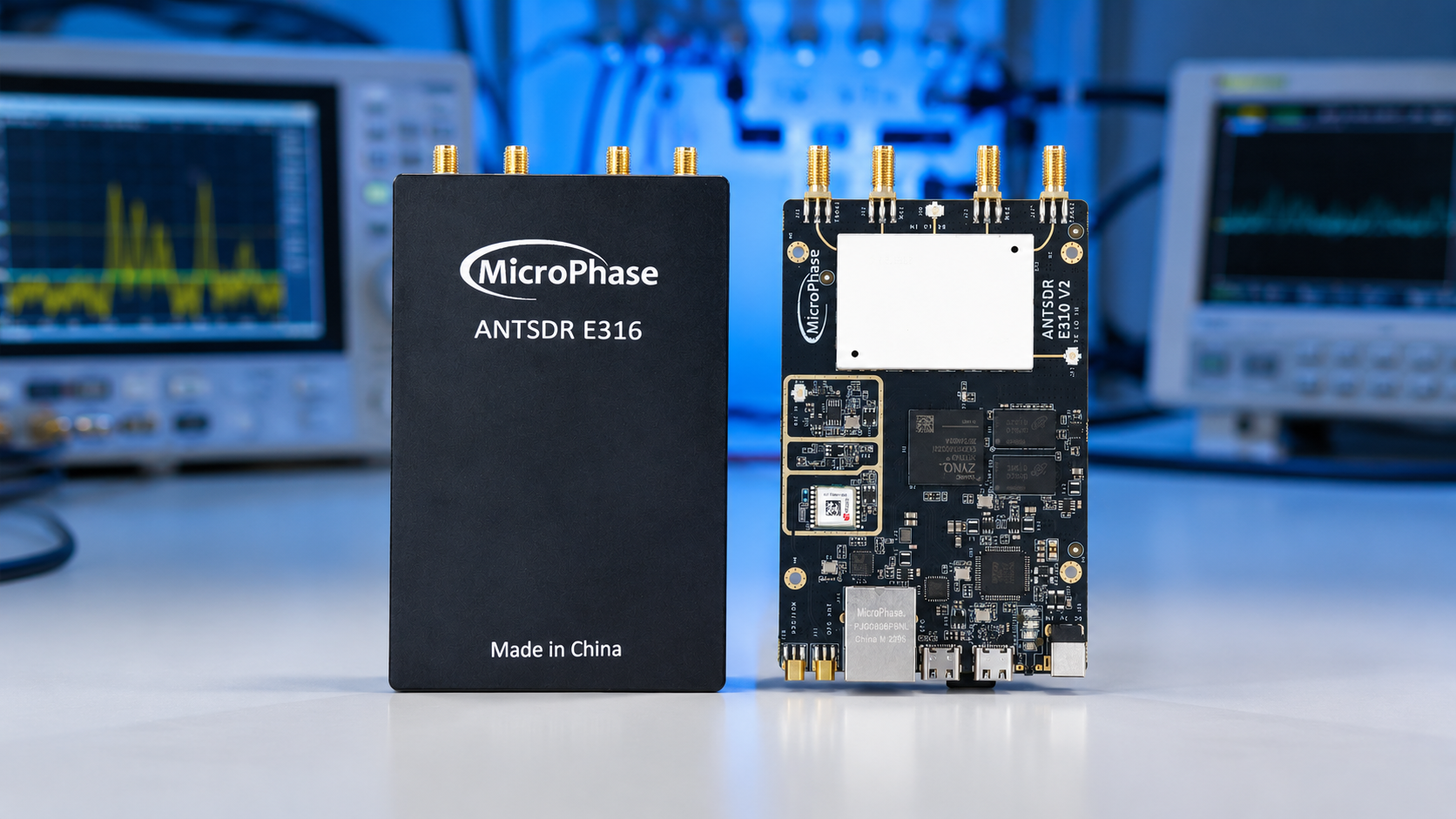
MicroPhase ANTSDR U220 and E316
SDRstore.eu also offers:
These platforms are relevant when buyers want selectable AD9361 or AD9363 direction, 2×2 MIMO experimentation, and different host-interface strategies.
Choose U220 if:
- You want a compact USB 3.0 SDR.
- You want 2×2 MIMO direction.
- You want GNU Radio or srsRAN-oriented prototyping.
- You prefer a high-speed USB workflow.
Choose E316 if:
- You want an embedded Zynq-7020 direction.
- You want Gigabit Ethernet.
- You want MicroSD support.
- You want GPS and PPS direction.
- You are building a remote or embedded research node.
Confirm the selected RFIC option and the exact board specification before ordering.
Official Specification vs Firmware-Expanded Operation
Some SDR boards advertise expanded AD9363 operation outside the official AD9363 specification.
This can be useful for experimentation.
However, a firmware profile does not turn every AD9363-based board into a guaranteed AD9361-equivalent platform.
Expanded operation may depend on:
- RFIC configuration
- Firmware profile
- Board layout
- RF matching
- Front-end components
- Filters
- Clock quality
- Temperature
- Frequency
- Desired transmit quality
- Receiver sensitivity
- Research repeatability
Use firmware-expanded operation for:
- Learning
- Exploration
- Budget-conscious experiments
- Prototyping
- GNU Radio projects
- Non-critical lab work
Prefer an official AD9361 board for:
- Published research
- Repeatable measurements
- Commercial development
- Wideband cellular tests
- Projects below 325 MHz
- Projects above 3.8 GHz
- Projects requiring up to 56 MHz official bandwidth
- Standardized university equipment fleets
- Long-term testbeds
AD9361 vs AD9363 for GNU Radio
Both RFIC families can work well with GNU Radio when used on a supported SDR board.
| GNU Radio Goal | Recommended Direction |
|---|---|
| Learn basic transmitter and receiver flowgraphs | AD9363-based ADALM-PLUTO or PLUTO+ SDR |
| Build affordable student stations | AD9363 Pluto-style hardware |
| Use up to 56 MHz channel bandwidth | AD9361 board |
| Run coherent 2×2 MIMO with UHD | USRP B210 |
| Build embedded Ethernet projects | PLUTO+, GeekRF One, or E316 depending on requirements |
| Standardize a professional research bench | AD9361-based platform |
AD9361 vs AD9363 for University SDR Labs
| University Requirement | Recommended Direction |
|---|---|
| Affordable communications teaching | AD9363-based ADALM-PLUTO-class hardware |
| Pluto-style Ethernet projects | PLUTO+ SDR or expanded Pluto-style board |
| 2×2 MIMO fundamentals | USRP B210 or validated 2T2R Pluto-style board |
| Private 5G research | AD9361-based B210 direction |
| OpenAirInterface | AD9361 board when budget and research requirements justify it |
| srsRAN | USRP B210 for the safest documented entry path |
| Wideband student projects | AD9361 board |
| Low-cost introductory transceiver benches | AD9363 Pluto-style hardware |
Read our guides:
- How to Build a University SDR Lab: Hardware Checklist for Teaching and Research
- SDR Hardware for Universities: Beginner, Intermediate, and Advanced Lab Setups
AD9361 vs AD9363 for 5G Research
Choose AD9361 when the primary goal is serious 5G research.
AD9363 boards can still be useful for learning, experiments, custom waveforms, and selected lower-bandwidth projects.
However, AD9361 gives the laboratory a stronger official bandwidth and RF-range foundation.
Choose AD9361 for:
- USRP B210-based srsRAN labs
- Open5GS private-network testing
- OpenAirInterface experiments
- COTS handset testing in controlled environments
- Wider 5G NR experiments
- University wireless-research projects
- Longer-term cellular-research investment
AD9363 remains useful for:
- Learning OFDM
- Digital-communications teaching
- GNU Radio experimentation
- Custom waveform prototypes
- PlutoSDR development
- Budget-conscious research preparation
Read our guides:
- Best SDR for 5G Research: USRP B210, X310, X410, and Lower-Cost Alternatives
- OpenAirInterface vs srsRAN: Which Open-Source 5G Stack Is Better for Your SDR Lab?
AD9361 vs AD9363 for Wireless-Security Research
Both RFIC directions can be useful for authorized wireless-security research.
AD9363 is useful for:
- Education
- Controlled protocol experiments
- GNU Radio learning
- Portable lab exercises
- Lower-cost isolated test setups
AD9361 is better when you need:
- Wider official tuning range
- Higher official bandwidth
- Broader protocol coverage
- Professional research repeatability
- MIMO
- Private-network testing
- Standardized laboratory hardware
Use only authorized frequencies, shielded environments, conducted RF paths, test devices, systems you own, and systems you have explicit permission to assess.
Which SDR Board Should You Buy?
| Your Goal | Recommended Board Direction |
|---|---|
| Official low-cost SDR learning module | Standard ADALM-PLUTO with AD9363 |
| Affordable Pluto-style board with Ethernet and 2T2R direction | PLUTO+ SDR |
| Pluto-style board with Zynq 7020 and expanded experimentation direction | GeekRF One |
| Coherent 2×2 MIMO, UHD, USB 3.0, and official 70 MHz–6 GHz B210 platform | USRP B210 with AD9361 |
| Compact selectable AD936x USB 3.0 research board | ANTSDR U220 |
| Embedded selectable AD936x board with Ethernet, GPS, and PPS direction | ANTSDR E316 |
| Compact LibreSDR family with selectable configurations | LibreSDR B210 Mini / B220 Mini after verifying the selected option |
| Repeatable wideband research | Official AD9361-based board |
| Budget-conscious learning and experimentation | AD9363-based board |
Buyer Checklist
Before ordering an AD9361 or AD9363 SDR board, confirm:
- Exact RFIC
- Official RFIC specification
- Board-advertised RF range
- Number of physically exposed transmit channels
- Number of physically exposed receive channels
- 1×1 or 2×2 operation
- Filtered bandwidth
- Sample rate
- USB 2.0, USB 3.0, or Ethernet interface
- FPGA model
- RAM
- Flash and MicroSD support
- Reference-clock quality
- External-reference input
- PPS input
- RF connectors
- Driver compatibility
- GNU Radio compatibility
- MATLAB compatibility
- UHD compatibility where required
- libiio compatibility where required
- OpenAirInterface compatibility where required
- srsRAN compatibility where required
- Performance expectations near the edge of the range
- Whether firmware-expanded operation is acceptable for your project
Common Buying Mistakes
Assuming every AD9363 board is 1×1
Standard ADALM-PLUTO exposes one transmitter and one receiver, but some expanded Pluto-style boards expose additional channels.
Assuming every AD9363 firmware unlock is identical to AD9361
Expanded operation can be useful, but it remains a board-specific and firmware-specific capability. Use an official AD9361 board when repeatability outside the official AD9363 range matters.
Comparing only the sample rate
Sample rate is not the same as filtered RF bandwidth or host throughput.
Ignoring the host interface
USB 2.0, USB 3.0, and Gigabit Ethernet create very different practical limits.
Ignoring the FPGA
The FPGA can affect real-time DSP, custom logic, firmware flexibility, and long-term project value.
Ignoring clock stability
Clocking matters for narrow signals, cellular projects, synchronization, repeatability, and MIMO.
Buying only by frequency range
RF range alone does not describe bandwidth, sensitivity, linearity, connectors, MIMO behavior, driver support, or software compatibility.
Using unauthorized frequencies
Transmit only on frequencies and at power levels permitted in your jurisdiction or within shielded and conducted test environments.
Where to Browse AD9361 and AD9363 SDR Boards
- Software-defined radio equipment
- PlutoSDR and PLUTO+ SDR boards
- PLUTO+ SDR AD9363 2T2R transceiver
- GeekRF One PlutoSDR-compatible SDR
- MicroPhase ANTSDR U220
- MicroPhase ANTSDR E316
- USRP SDR devices and boards
- USRP B210 USB SDR with AD9361
- LibreSDR B210 Mini / B220 Mini SDR family
- Antennas and RF accessories
- RF amplifiers, LNAs, and signal boosters
- RF test and measurement equipment
Request a Quote for University, Laboratory, and Business Orders
Universities, research institutes, telecom companies, engineering departments, cybersecurity firms, integrators, and purchasing teams can request a formal quotation directly from SDRstore.eu.
Use the Add to Quote button on product pages or the document icon on product cards.
Use the quote system for:
- AD9361-based SDR boards
- AD9363-based SDR boards
- PlutoSDR-compatible devices
- USRP B210 units
- LibreSDR configurations
- MicroPhase ANTSDR boards
- University SDR labs
- Private 5G research equipment
- Bulk pricing
- Formal purchasing approval
- Antennas
- RF cables
- Attenuators
- Dummy loads
- Filters
- Clocking accessories
- RF test equipment
Read our guide: Request a Quote Online: A Faster Way to Get Custom Pricing from SDRstore.eu.
Related SDRstore.eu Guides
- PLUTO+ SDR Review: AD9363 2T2R SDR Transceiver with Ethernet and 70 MHz–6 GHz Coverage
- PLUTO+ SDR Setup Guide: First Signal with SDRangel, GNU Radio, and Ethernet
- PlutoSDR vs HackRF One: Which SDR Is Better for Transmit, Receive, and Research?
- Best SDR for 5G Research: USRP B210, X310, X410, and Lower-Cost Alternatives
- USRP B210 vs X310: Which SDR Should a Research Lab Buy?
- OpenAirInterface vs srsRAN: Which Open-Source 5G Stack Is Better for Your SDR Lab?
- How to Build a University SDR Lab: Hardware Checklist for Teaching and Research
- SDR Hardware for Universities: Beginner, Intermediate, and Advanced Lab Setups
Official Resources
- Analog Devices AD9361 product page
- Analog Devices AD9363 product page
- Analog Devices ADALM-PLUTO official page
- Analog Devices SDR integrated-transceiver design resources
- Ettus Research USRP B210 official page
Final Verdict: AD9361 vs AD9363
Choose AD9363 when you want an affordable SDR platform for education, PlutoSDR-style development, GNU Radio, SDRangel, moderate-bandwidth digital communications, and budget-conscious experimentation.
Standard ADALM-PLUTO is the clearest official AD9363 reference platform. It provides one transmitter, one receiver, 325 MHz–3.8 GHz official coverage, and up to 20 MHz instantaneous bandwidth in a compact USB-powered learning module.
Expanded Pluto-style boards such as PLUTO+ SDR and GeekRF One add useful board-level capabilities, including additional RF channels, Ethernet, stronger FPGA options, storage, and advertised expanded profiles.
Treat those expanded capabilities as board-specific.
Choose AD9361 when you need the wider official RF range, up to 56 MHz channel bandwidth, professional MIMO research, private 5G projects, OpenAirInterface, srsRAN, standardized laboratory deployments, or repeatable measurements outside the official AD9363 range.
USRP B210 remains one of the strongest AD9361 reference platforms because it uses both AD9361 signal chains for coherent 2×2 MIMO and combines 70 MHz–6 GHz board coverage, up to 56 MHz real-time bandwidth, USB 3.0, UHD, and GNU Radio.
Do not buy an SDR board based only on the chip name.
Compare the exact RFIC, exposed channels, bandwidth, sample rate, interface, FPGA, clock, firmware, drivers, and expected performance at your target frequency.
FAQ
What is the main difference between AD9361 and AD9363?
AD9361 supports a wider official RF range and more channel bandwidth. Analog Devices lists AD9361 receiver LO coverage from 70 MHz–6 GHz, transmitter LO coverage from 47 MHz–6 GHz, and channel bandwidth below 200 kHz to 56 MHz. AD9363 is officially specified for 325 MHz–3.8 GHz with channel bandwidth below 200 kHz to 20 MHz.
Is AD9361 better than AD9363?
AD9361 is better when you need wider official tuning range, higher official bandwidth, professional research flexibility, and a stronger long-term upgrade path. AD9363 remains a strong lower-cost choice for education, PlutoSDR-style development, and moderate-bandwidth experiments.
Does AD9363 support 2×2 MIMO?
AD9363 contains two receive paths and dual transmitters at the RFIC level. However, the SDR board may expose only one transmitter and one receiver. Check the specific board design before purchasing.
Does standard ADALM-PLUTO support 2×2 MIMO?
Standard ADALM-PLUTO exposes one transmitter and one receiver. It is an AD9363-based learning module with up to 20 MHz instantaneous bandwidth.
Does PLUTO+ SDR support 2T2R?
The PLUTO+ SDR product is listed as a 2T2R platform with two transmit channels and two receive channels. Verify the selected version, firmware, and expected board-level RF performance for your project.
What frequency range does AD9361 support?
Analog Devices lists AD9361 receiver LO coverage from 70 MHz–6 GHz and transmitter LO coverage from 47 MHz–6 GHz.
What frequency range does AD9363 support?
Analog Devices lists the official AD9363 operating range as 325 MHz–3.8 GHz.
How much bandwidth does AD9361 support?
AD9361 supports channel bandwidths from below 200 kHz to 56 MHz.
How much bandwidth does AD9363 support?
AD9363 supports channel bandwidths from below 200 kHz to 20 MHz.
Can an AD9363 board be unlocked to 70 MHz–6 GHz?
Some Pluto-style boards advertise firmware-expanded operation. This can be useful for experimentation, but it should not be treated as identical to the official AD9361 specification. Evaluate the selected board at your target frequency and bandwidth.
Does a firmware unlock turn AD9363 into AD9361?
Not in a guaranteed specification sense. Expanded firmware profiles may expose additional operating ranges or bandwidth settings, but board components, RF performance, validation, and official silicon specifications still matter.
What is the best AD9361 SDR board?
USRP B210 is one of the strongest AD9361 reference platforms for many laboratories because it offers coherent 2×2 MIMO, 70 MHz–6 GHz board coverage, up to 56 MHz real-time bandwidth, USB 3.0, UHD, and GNU Radio.
What is the best AD9363 SDR board for beginners?
Standard ADALM-PLUTO is the clearest official AD9363 learning platform. PLUTO+ SDR is useful when buyers want additional board-level features such as Ethernet and 2T2R direction.
Should I buy PLUTO+ SDR or USRP B210?
Choose PLUTO+ SDR for an affordable Pluto-style Ethernet platform and learning projects. Choose USRP B210 when you need a mature AD9361 platform, official wideband direction, coherent 2×2 MIMO, UHD, USB 3.0, and a stronger professional-research path.
Should I buy AD9361 for srsRAN?
AD9361-based USRP B210 is one of the safest starting choices for srsRAN because it has a mature UHD path, 2×2 MIMO, USB 3.0, and official documentation support for practical lab workflows.
Should I buy AD9361 for OpenAirInterface?
AD9361 is a strong choice for OpenAirInterface research because its wider official frequency and bandwidth limits provide more flexibility for cellular experimentation.
Is AD9363 enough for GNU Radio?
Yes. AD9363-based boards are suitable for many GNU Radio projects, including modulation, demodulation, digital links, SDR education, PlutoSDR development, and moderate-bandwidth experiments.
Why does the SDR board matter if the RF chip is the same?
The board determines exposed RF channels, connectors, FPGA, interface, clocking, memory, firmware, RF front-end components, filtering, thermal behavior, and practical performance. Two boards using the same RFIC can behave very differently.
What should I verify before buying an AD9361 or AD9363 SDR board?
Confirm the exact RFIC, number of exposed TX and RX channels, bandwidth, sample rate, interface, FPGA, clock, synchronization, firmware, driver support, GNU Radio compatibility, and expected performance at the intended frequencies.
How can a university or company request a formal quote?
Add the required SDR boards to a quote request directly from SDRstore.eu product pages using the Add to Quote button or from product cards using the document icon. Include quantities, RF ranges, bandwidth, channel requirements, software stack, and accessories.
No posts found
Write a review






We support all major card and digital payment options. More local methods are available and shown during checkout.
You enter into a binding sales contract once you have received an 'order confirmation and sales receipt' email from us, in line with our Sales & Delivery conditions. Therefore, sdrstore.eu has the right to cancel your order in the event of technical problems, delivery failure, Fair use policy and other similar situations.






Your payments are protected by advanced encryption and 3-D Secure authentication for safe online shopping.