





GeekRF One vs PLUTO+: Which Ethernet SDR Should You Buy?
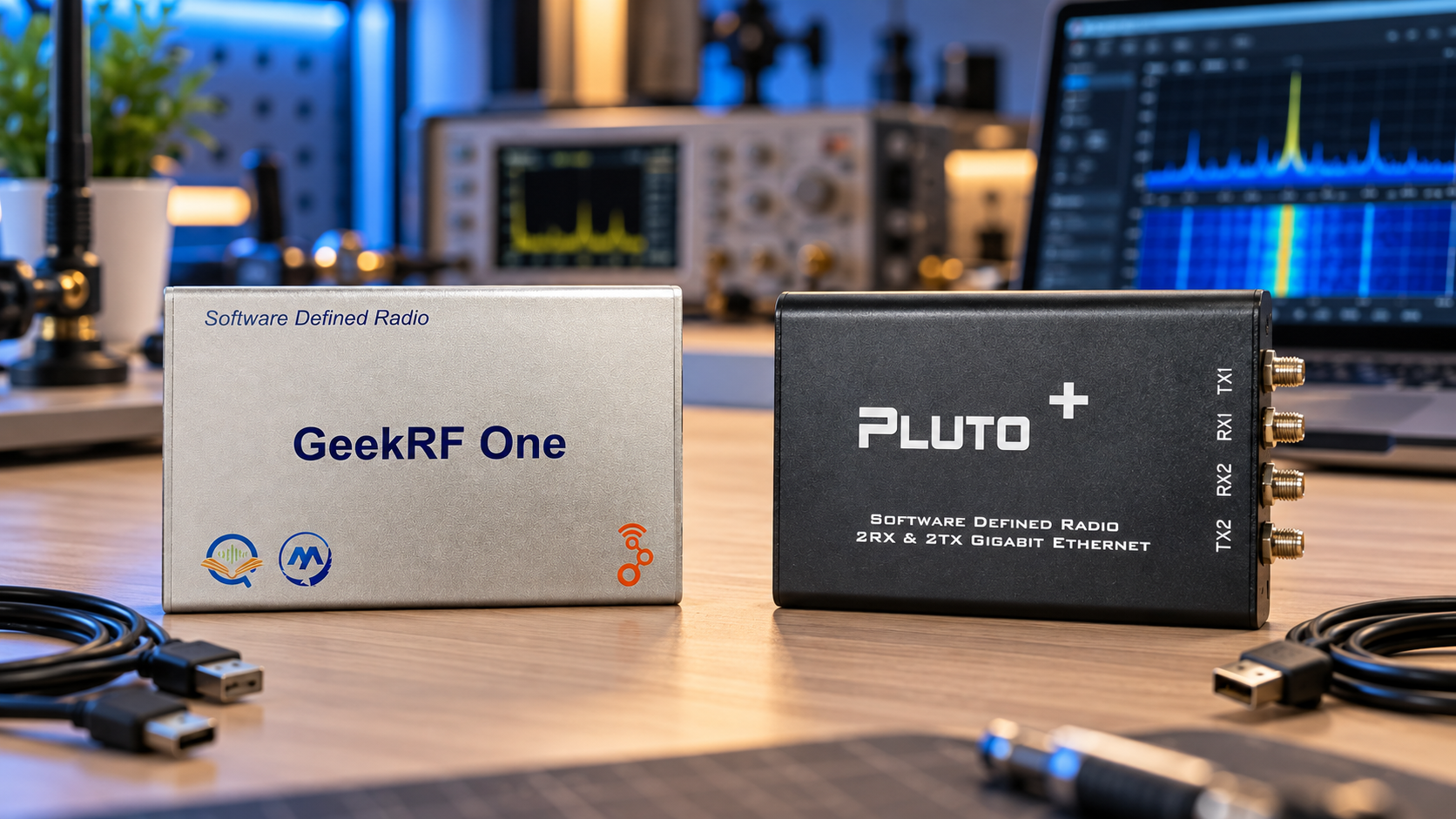
Choose PLUTO+ for Ethernet-connected Pluto-style experiments when its documented firmware and hardware fit your project. Choose GeekRF One when you specifically need the larger Zynq-7020 FPGA and can obtain the development files for the supplied revision. In the GeekRF One vs PLUTO+ decision, the larger FPGA is the main reason to choose GeekRF; it does not establish better RF performance or faster Ethernet streaming.
GeekRF One vs PLUTO+: the differences that matter
The GeekRF One listing and PLUTO+ listing describe third-party Pluto-compatible software-defined radios (SDRs), each with two transmit and two receive channels and Gigabit Ethernet. Treat their board specifications separately from those of the official Analog Devices ADALM-PLUTO.
| Buying factor | GeekRF One | PLUTO+ |
|---|---|---|
| Installed RF transceiver | AD9363; AD9361-like operation enabled through software | AD9363; expanded operating profile advertised |
| Listed RF channels | 2 TX, 2 RX | 2 TX, 2 RX |
| Processor and FPGA | Zynq-7020 | Zynq-7010 |
| Listed memory | 512 MB RAM, 32 MB flash | 512 MB RAM, 32 MB flash |
| Ethernet interface | 1 Gbit/s | 1 Gbit/s |
| Advertised tuning range | 70 MHz–6 GHz; extended AD9363 operation | 70 MHz–6 GHz; extended AD9363 operation |
| Development starting point | Listed USB-JTAG; obtain revision-specific design files | Public project schematics and firmware build instructions |
These are listed specifications, not comparative measurements. The PLUTO+ project repository provides a useful documentation starting point, but confirm that its files match the retail board you receive.
Does GeekRF One actually contain an AD9361?
The SDRstore GeekRF One listing confirms a physically installed AD9363. Its extended frequency range and bandwidth are enabled through software configuration; the chip is not replaced with an AD9361. The wording “AD9363 AD9361” therefore needs to be read alongside that clarification.
Analog Devices specifies the AD9363 for 325 MHz–3.8 GHz operation and channel bandwidth up to 20 MHz. The AD9361 has a specified receive tuning range of 70 MHz–6 GHz and channel bandwidth up to 56 MHz.
Firmware-expanded AD9363 operation can be useful for experimentation, but it does not extend the manufacturer's guaranteed specifications. If your project depends on operation outside the AD9363's specified range, request evidence at your intended frequency, bandwidth and gain settings. A selectable setting alone does not establish sensitivity, linearity or transmit quality.
When the larger GeekRF FPGA is worth buying
A field-programmable gate array (FPGA) can run custom digital processing alongside the embedded processor. According to AMD's Zynq-7000 resource table, the Zynq-7020 has approximately 85,000 logic cells and 220 DSP slices, compared with approximately 28,000 logic cells and 80 DSP slices in the Zynq-7010.
That makes GeekRF One a more promising candidate for a custom filter, correlator or modem implemented in programmable logic. These are potential development uses, not features automatically supplied by the factory image. Available resources also depend on how much of the FPGA the existing design occupies.
Before choosing GeekRF for this purpose, obtain the matching hardware description language (HDL) sources, board constraints, toolchain requirements and a reproducible build procedure. For a project that processes samples entirely on the computer, unused FPGA capacity offers little immediate benefit. Prioritize working software and sufficient transport capacity.
Gigabit Ethernet is not a sample-rate guarantee
Both radios advertise a 1 Gbit/s Ethernet interface. This is the link's nominal bit rate, not a measured rate for usable I/Q data. I/Q samples contain the in-phase and quadrature components of a signal. Their transport rate depends on sample format, sample rate and active channel count.
For an illustrative budget, assume each complex sample uses a 16-bit I value and a 16-bit Q value: four bytes per sample per receive channel. The following figures describe one-way receive payload only, before network overhead.
| Rate per RX channel | Active RX channels | Raw payload |
|---|---|---|
| 10 MSPS | 1 | 40 MB/s; 320 Mbit/s |
| 10 MSPS | 2 | 80 MB/s; 640 Mbit/s |
| 20 MSPS | 2 | 160 MB/s; 1,280 Mbit/s |
MSPS means million samples per second. Two receive channels at 20 MSPS cannot fit through a single Gigabit link in this assumed format, even before overhead. Two channels at 10 MSPS fit the raw budget, but that calculation does not prove either board can sustain them.
Full-duplex Ethernet has separate transmit and receive directions; simultaneous RX and TX should be budgeted separately at the link level. The radio's processor, memory and software can still impose shared limits. Request a sustained test using your channel count, sample format, host and application, including any dropped-sample reporting.
Also distinguish RF bandwidth from sample rate. The RF filter's bandwidth and the amount of spectrum delivered continuously to your computer are separate limits.
Check software support before choosing the board
Analog Devices' libiio supports communication with remote Linux Industrial Input/Output (IIO) devices over Ethernet. This is a useful foundation for Pluto-style software, provided the board's firmware exposes the expected devices and channels.
“Pluto-compatible” does not guarantee that every application exposes two receive and two transmit channels. For example, the pyadi-iio documentation distinguishes its Pluto interface from AD936x interfaces with second-channel controls. Verify the actual interface your application uses.
- For spectrum viewing: confirm the application connects over Ethernet and supports your requested sample rate.
- For GNU Radio: confirm the selected IIO source and sink blocks expose the required channels.
- For MIMO: confirm simultaneous channel access, sample alignment and the calibration your experiment requires. MIMO means multiple-input, multiple-output.
- For custom firmware: use an image and recovery procedure explicitly matched to the board revision.
Do not assume PLUTO+ and GeekRF firmware images are interchangeable. Ethernet, boot configuration and programmable logic must match the hardware. The PLUTO+ setup guide is a useful next step after confirming your supplied firmware.
Compare the complete setup cost
Check current configurations and pricing on both product pages. PLUTO+ has several bundle choices, so compare the selected package with the equipment you actually need rather than comparing an antenna bundle with a different configuration.
Budget for suitable power, Ethernet cabling, band-appropriate antennas and any adapters. For two-channel experiments, plan the antenna and cable arrangement for both channels. Confirm what is included before buying these accessories separately.
If you need an external frequency reference, request the exact clock input specification and routing for the supplied revision. A clock connector or oscillator accuracy figure alone does not establish synchronization between separate radios.
Start with receive-only setup. Before transmitting, check your country's authorization and operating conditions; UK amateur users can consult Ofcom's licensing and technical guidance.
Which Ethernet SDR should you buy?
- Choose PLUTO+ when you want a Pluto-style Ethernet platform and its documented configuration meets your software, channel and bandwidth requirements.
- Choose GeekRF One when a planned FPGA design needs the additional Zynq-7020 resources and you have the files needed to use them.
- Request validation before choosing either when sustained two-channel throughput, operation beyond specified AD9363 limits or synchronization between radios is essential.
For a university, laboratory or multi-unit purchase, use SDRstore's online quotation process. Select the required configuration, use Add to Quote and specify quantities plus your frequency, channel and software requirements. Choose the board that satisfies those requirements with a supported setup.
Frequently asked questions
Is GeekRF One faster than PLUTO+ over Ethernet?
A higher sustained streaming rate has not been established here. Both list Gigabit Ethernet. The larger GeekRF FPGA does not increase that link's nominal speed.
Does firmware turn an AD9363 into a physical AD9361?
No. Firmware can enable an expanded operating profile, but the installed chip remains an AD9363 and its manufacturer-specified limits remain relevant.
Can both radios stream two receive channels?
Both list two receive channels. Using them together requires compatible firmware and application support, plus a sample rate that the complete transport path can sustain.
Can I install ordinary Pluto firmware on either board?
Use firmware explicitly supported for your board revision and required interfaces. Pluto compatibility alone does not establish that a particular image will preserve Ethernet, both RF channels or recovery access.
Is GeekRF One the better choice for FPGA development?
Its Zynq-7020 offers more programmable logic and DSP resources than PLUTO+'s Zynq-7010. That advantage is useful when your design needs those resources and the matching development files are available.
Should I pay more for a larger antenna bundle?
Only when the included antennas and cables suit your intended bands and channel arrangement. Compare the total cost of the equipment you will use, and confirm the selected bundle's contents.
No posts found
Write a review






We support all major card and digital payment options. More local methods are available and shown during checkout.
You enter into a binding sales contract once you have received an 'order confirmation and sales receipt' email from us, in line with our Sales & Delivery conditions. Therefore, sdrstore.eu has the right to cancel your order in the event of technical problems, delivery failure, Fair use policy and other similar situations.






Your payments are protected by advanced encryption and 3-D Secure authentication for safe online shopping.