





bladeRF 2.0 micro xA4 vs xA9: Which SDR Should You Buy?
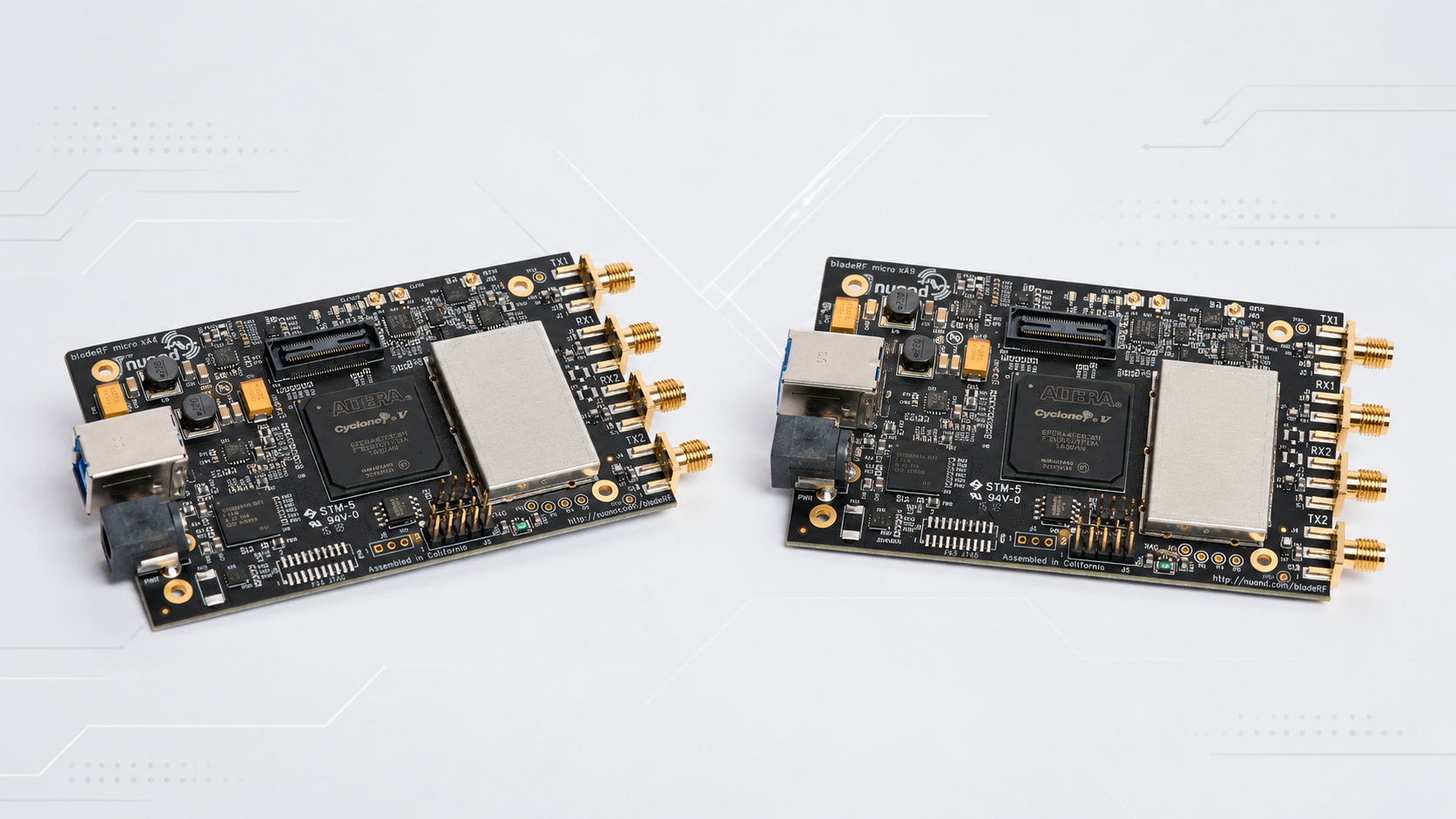
Nuand bladeRF 2.0 micro is a compact USB 3.0 software-defined radio platform designed for wireless research, GNU Radio projects, custom waveform development, FPGA experimentation, and 2×2 MIMO applications.
Buyers commonly face one important decision: should you choose the lower-cost bladeRF 2.0 micro xA4 or invest in the larger bladeRF 2.0 micro xA9?
The answer is simpler than it first appears. Both models use the same core RF platform. The main difference is FPGA capacity. Choose xA4 when most signal processing will run on the host computer or when you are beginning FPGA-oriented SDR development. Choose xA9 when you genuinely need substantially more programmable logic for custom HDL accelerators, advanced modems, filters, correlators, or other hardware signal-processing chains.
Browse the bladeRF SDR devices and accessories category, the bladeRF 2.0 micro xA4, and the bladeRF 2.0 micro xA9.
Quick Answer: Should You Buy bladeRF xA4 or xA9?
| Buyer profile | Recommended model | Reason |
|---|---|---|
| GNU Radio user | bladeRF 2.0 micro xA4 | Most GNU Radio flowgraphs process samples on the host computer, so the smaller FPGA is often sufficient. |
| University teaching lab | bladeRF 2.0 micro xA4 | Strong balance of 2×2 MIMO capability, USB 3.0 connectivity, and cost. |
| Student learning FPGA-based SDR | bladeRF 2.0 micro xA4 | Provides programmable FPGA resources without paying for capacity that may remain unused. |
| Custom modem developer | bladeRF 2.0 micro xA9 | The much larger FPGA provides room for hardware accelerators and more complex HDL processing chains. |
| Research team implementing FFTs, filters, or correlators in FPGA logic | bladeRF 2.0 micro xA9 | xA9 offers substantially more logic elements, memory, DSP blocks, and multipliers. |
| Business deploying SDR hardware in thermally challenging environments | THERMAL variant | Nuand lists improved temperature-grade components while retaining the same core functionality. |
For most buyers, xA4 is the sensible starting point. The xA9 is valuable when you already know why your HDL design needs the additional FPGA capacity.
bladeRF 2.0 micro xA4 vs xA9 Comparison Table
| Feature | bladeRF 2.0 micro xA4 | bladeRF 2.0 micro xA9 |
|---|---|---|
| Core RF platform | bladeRF 2.0 micro | bladeRF 2.0 micro |
| Top-line frequency direction | 47 MHz–6 GHz | 47 MHz–6 GHz |
| Detailed official RX tuning table | 70 MHz–6 GHz | 70 MHz–6 GHz |
| Detailed official TX tuning table | 47 MHz–6 GHz | 47 MHz–6 GHz |
| Standard sample rate | 61.44 MSPS | 61.44 MSPS |
| Filtered bandwidth | Up to 56 MHz | Up to 56 MHz |
| ADC and DAC resolution | 12-bit | 12-bit |
| MIMO direction | 2×2 MIMO streaming | 2×2 MIMO streaming |
| Host interface | USB 3.0 SuperSpeed | USB 3.0 SuperSpeed |
| FPGA | Cyclone V, 49 kLE | Cyclone V, 301 kLE |
| Approximate user-programmable FPGA logic | Approximately 32 kLE | Approximately 292 kLE |
| FPGA memory | 3,383 kbits | 13,917 kbits |
| Variable-precision DSP blocks | 66 | 342 |
| Embedded 18×18 multipliers | 132 | 684 |
| Best use | GNU Radio, SoapySDR, MIMO learning, portable SDR projects, and introductory FPGA work | Custom HDL accelerators, larger DSP chains, FPGA-heavy research, and advanced modem development |
What Is the Same on bladeRF xA4 and xA9?
The two models share the same bladeRF 2.0 micro RF direction. Buying xA9 does not automatically improve RF sensitivity, tuning range, analog bandwidth, USB throughput, or MIMO channel count.
Both models offer:
- Compact bladeRF 2.0 micro form factor
- 2×2 MIMO streaming
- USB 3.0 SuperSpeed connectivity
- Standard 61.44 MSPS sampling rate
- Up to 56 MHz filtered bandwidth
- 12-bit ADC and DAC direction
- Automatic gain control
- Automatic IQ correction
- Automatic DC-offset correction
- Factory-calibrated 38.4 MHz clock
- External clocking direction
- USB bus power
- Optional external 5V DC power
- Software-controlled bias-tee support on RF ports
- Windows, Linux, and macOS support direction
This is why xA4 remains an excellent SDR for many projects. You are not buying a weaker RF front end. You are buying the same RF platform with a smaller FPGA.
The Main Difference: FPGA Capacity
The FPGA is the programmable digital logic device used for real-time hardware processing. It can handle tasks that would otherwise run on the host CPU or that may benefit from deterministic low-latency implementation close to the radio.
Nuand lists a 49 kLE Cyclone V FPGA for xA4 and a 301 kLE Cyclone V FPGA for xA9. The difference is large enough to change the type of HDL project each model can comfortably support.
bladeRF xA4 FPGA direction
- 49 kLE Cyclone V FPGA
- Approximately 32 kLE user-programmable logic direction
- 3,383 kbits of FPGA memory
- 66 variable-precision DSP blocks
- 132 embedded 18×18 multipliers
xA4 is a good choice for developers who want to learn FPGA-oriented SDR concepts, add modest custom logic, or use the radio primarily through host-side software such as GNU Radio.
bladeRF xA9 FPGA direction
- 301 kLE Cyclone V FPGA
- Approximately 292 kLE user-programmable logic direction
- 13,917 kbits of FPGA memory
- 342 variable-precision DSP blocks
- 684 embedded 18×18 multipliers
xA9 is the better choice when substantial parts of the signal-processing chain must be implemented in programmable logic.
What Can the bladeRF xA9 FPGA Be Used For?
Nuand positions xA9 for more demanding HDL workloads, including:
- FFT processing pipelines
- Turbo decoders
- Transmit modulators
- Transmit filters
- Receive acquisition correlators
- Burst-modem logic
- Custom DSP accelerators
- Low-latency hardware signal processing
- Advanced modem research
- Postgraduate and professional FPGA projects
Important buyer note: accelerators are not preinstalled
The larger xA9 FPGA gives your team more room to build hardware accelerators. It does not mean that finished FFT chains, modem blocks, decoders, or filters are automatically included with the device.
Nuand explicitly states that these accelerators and processing chains must be designed by the customer or obtained separately from a third party.
Does bladeRF xA9 Receive Better Signals Than xA4?
No. xA9 should not be purchased only because it appears to be the more powerful model.
The RF architecture is shared. Both models offer the same standard sample rate, filtered bandwidth, tuning direction, USB interface, 2×2 MIMO capability, and clocking direction.
| Question | Answer |
|---|---|
| Does xA9 tune to a wider frequency range? | No. The core RF tuning direction is shared. |
| Does xA9 have more analog bandwidth? | No. Both models list up to 56 MHz filtered bandwidth. |
| Does xA9 have more MIMO channels? | No. Both are 2×2 MIMO platforms. |
| Does xA9 use a faster host interface? | No. Both use USB 3.0 SuperSpeed. |
| Does xA9 provide more programmable digital resources? | Yes. This is the main reason to buy it. |
47 MHz–6 GHz or 70 MHz–6 GHz? Understand the RF Specification
Nuand’s high-level product description presents bladeRF 2.0 micro as a 47 MHz–6 GHz SDR platform. The more detailed official RF table separates the receive and transmit directions:
- RX tuning table: 70 MHz–6 GHz
- TX tuning table: 47 MHz–6 GHz
This distinction matters when comparing SDR boards for a specific low-frequency project. Check the exact receive or transmit requirement rather than relying only on the simplified top-line range.
What About 122.88 MSPS Mode?
Nuand’s baseline specification lists a standard 61.44 MSPS sample rate and up to 56 MHz filtered bandwidth.
Nuand’s 2023.02 software release added an advanced mode capable of reaching 122.88 MSPS IQ sampling through AD9361 overclocking, 8-bit samples, and a multi-sample packing architecture.
Do not confuse advanced mode with the standard specification
- 61.44 MSPS is the normal reference point.
- 56 MHz is the official filtered-bandwidth direction.
- 122.88 MSPS mode uses AD9361 overclocking.
- Nuand states that overclocking may affect system stability.
- 8-bit mode is used to address USB-throughput constraints.
- The advanced mode should be validated for the exact host computer, software stack, and project.
The extended mode is useful for experienced developers, but it should not be the only reason to choose xA9. Nuand added the capability to existing bladeRF 2.0 micro hardware, so it is not an xA9-only advantage.
bladeRF xA4 for GNU Radio and Host-Based Processing
Many SDR projects run most signal processing on the computer rather than inside the FPGA. GNU Radio flowgraphs commonly move IQ samples between the SDR and host system, where blocks perform filtering, demodulation, visualization, decoding, and custom processing.
Choose bladeRF 2.0 micro xA4 when you want:
- GNU Radio development
- SoapySDR workflows
- USB 3.0 streaming
- Portable 2×2 MIMO experiments
- Custom waveform development
- Wireless-protocol research
- University RF laboratory benches
- Introductory FPGA experimentation
- A lower-cost entry into the bladeRF 2.0 micro ecosystem
Read our guide: Best SDR for GNU Radio Projects: RTL-SDR, HackRF, PlutoSDR, bladeRF, and USRP.
bladeRF xA9 for FPGA-Heavy Research
Choose bladeRF 2.0 micro xA9 when programmable-logic capacity is a central project requirement.
xA9 is especially relevant for:
- HDL modem development
- Real-time FPGA acceleration
- FFT pipelines
- Correlators
- Filters implemented in hardware
- Digital upconversion and downconversion research
- Low-latency processing chains
- Custom physical-layer research
- Master’s and PhD projects
- Commercial wireless-development teams
Do not buy xA9 only because it is the higher-tier product. Buy it when your HDL resource estimates, development roadmap, or future expansion plan justify the additional FPGA headroom.
Which bladeRF Is Better for 2×2 MIMO?
Both models support 2×2 MIMO streaming. For many MIMO teaching and GNU Radio projects, xA4 is sufficient because the host computer performs the main processing.
xA9 becomes more attractive when your MIMO project moves substantial processing into FPGA logic, such as real-time channel-processing blocks, custom modem acceleration, or latency-sensitive DSP chains.
Read our guide: 2×2 MIMO SDR Explained: USRP B210, PLUTO+, bladeRF, LimeSDR, and Research Use Cases.
Standard vs THERMAL Variants
Nuand also offers THERMAL versions of bladeRF 2.0 micro xA4 and xA9.
Nuand states that the THERMAL versions are functionally identical to their standard counterparts but use improved temperature-grade components for more thermally challenging environments.
| Model type | Best fit | Important note |
|---|---|---|
| Standard xA4 | Most GNU Radio, education, research, and development benches | Best value for most buyers |
| Standard xA9 | Advanced HDL and FPGA-heavy development | Buy for FPGA capacity |
| xA4 THERMAL | Thermally demanding deployments that do not require xA9 FPGA resources | Same functional direction as standard xA4 |
| xA9 THERMAL | Thermally demanding deployments with substantial FPGA workloads | Same functional direction as standard xA9 |
Browse the bladeRF category for current standard models, THERMAL variants, cases, amplifiers, and accessories. View the bladeRF 2.0 micro xA9 THERMAL for demanding environments.
Software Support
Nuand describes the bladeRF software stack as open source and lists support direction for Windows, Linux, and macOS.
The bladeRF 2.0 micro ecosystem includes:
- libbladeRF
- GNU Radio through compatible integrations
- SoapySDR
- GQRX
- SDR-Radio
- SDR# through compatible bladeRF integration
- gr-fosphor
- MATLAB and Simulink bindings direction
- Open-source firmware
- Open-source platform HDL
- Online schematics
Both xA4 and xA9 use the same main software ecosystem. Buying xA9 does not unlock a separate desktop SDR application. It provides additional programmable logic for developers who need it.
Bias-Tee Amplifiers and Accessories
Nuand states that bladeRF 2.0 micro RF ports can provide software-controlled bias-tee power for compatible amplifiers and preamplifiers.
Useful accessory categories include:
- BT-100 bias-tee TX power amplifier
- BT-200 bias-tee RX low-noise amplifier
- Protective enclosures
- RF cables
- SMA adapters
- DC blocks
- Fixed attenuators
- Dummy loads
- Suitable antennas
Do not add an amplifier automatically. An LNA can help with weak receive signals, but it can also overload the receiver in a strong-signal environment. A TX amplifier also requires careful RF-safety planning and a legal transmission setup.
bladeRF xA4 vs xA9 by Use Case
| Use case | Recommended model | Why |
|---|---|---|
| GNU Radio learning | xA4 | Provides the core bladeRF RF platform without paying for unused FPGA resources. |
| University wireless-communications course | xA4 | Suitable for shared 2×2 MIMO and waveform-development benches. |
| Wireless-security research on authorized systems | xA4 or xA9 | Choose xA9 only when custom FPGA accelerators are part of the research plan. |
| Custom FPGA filters | xA9 | Additional DSP blocks, memory, and logic provide more room for implementation. |
| Custom modem development | xA9 | Better fit for larger HDL processing chains and future expansion. |
| Portable 2×2 MIMO prototyping | xA4 | Shared RF platform makes xA4 the practical value choice. |
| Postgraduate FPGA research | xA9 | Substantially larger programmable-logic capacity reduces the risk of reaching resource limits. |
| Thermally challenging deployment | THERMAL variant | Choose xA4 THERMAL or xA9 THERMAL based on the required FPGA resources. |
Common Buying Mistakes
Buying xA9 for better RF reception
xA9 has a larger FPGA, not a different RF front end. It does not automatically improve receive sensitivity, analog bandwidth, or frequency coverage.
Assuming xA9 includes ready-made modem accelerators
The FPGA space is available for custom work, but Nuand states that accelerators and processing chains must be developed or obtained separately.
Treating 122.88 MSPS as the standard mode
The standard reference point is 61.44 MSPS with up to 56 MHz filtered bandwidth. The extended mode uses overclocking and should be validated carefully.
Choosing xA4 without considering future FPGA requirements
xA4 is the better value for most host-based projects. However, an advanced HDL roadmap may justify xA9 from the beginning to avoid redesigning around resource constraints later.
Ignoring accessories
Budget for suitable antennas, cables, attenuators, dummy loads, and a protected RF test path. A capable SDR board is only one part of a reliable laboratory setup.
Legal and RF-Safety Notes
bladeRF 2.0 micro is a transmit-capable development platform. Use it only on frequencies, power levels, devices, and systems where you are legally permitted and authorized to transmit.
- Start active testing with cabled RF paths where possible.
- Use suitable attenuators and dummy loads.
- Do not connect a transmitter output directly to a sensitive SDR input.
- Verify signal levels before connecting measurement equipment.
- Use shielding where appropriate.
- Follow applicable spectrum regulations.
- Obtain written authorization before wireless-security testing.
Request a Quote for bladeRF Equipment
Universities, laboratories, cybersecurity firms, telecom teams, engineering departments, integrators, and businesses can request a formal quotation directly from SDRstore.eu.
Use the Add to Quote button on product pages or the document icon on product cards. Add the required bladeRF boards, quantities, accessories, cables, antennas, attenuators, amplifiers, and laboratory equipment to one quote request.
A quote request is useful when you need:
- Multiple bladeRF xA4 or xA9 units
- A comparison between standard and THERMAL variants
- Formal pricing for university or business approval
- A mixed equipment package
- Accessories included in the same quotation
- A phased RF laboratory rollout
Read the SDRstore.eu online quote-request guide.
Related SDRstore.eu Guides
- 2×2 MIMO SDR Explained: USRP B210, PLUTO+, bladeRF, LimeSDR, and Research Use Cases
- Best SDR for GNU Radio Projects: RTL-SDR, HackRF, PlutoSDR, bladeRF, and USRP
- USRP B210 Alternatives: Lower-Cost SDR Boards for Universities and RF Labs
- Best SDR Receivers in 2026: RTL-SDR, SDRplay, Airspy, HackRF, PlutoSDR, and More
Official Resources
- Nuand bladeRF 2.0 micro official overview
- Nuand bladeRF 2.0 micro xA4 official product page
- Nuand bladeRF 2.0 micro xA9 official product page
- Nuand bladeRF frequently asked questions
- Nuand 2023.02 release: advanced 122.88 MSPS mode
- Nuand bladeRF open-source repository
Final Verdict: bladeRF xA4 or xA9?
Choose bladeRF 2.0 micro xA4 if you want a capable USB 3.0 2×2 MIMO SDR for GNU Radio, SoapySDR, wireless-protocol research, university labs, portable development, and introductory FPGA projects. It uses the same core RF platform as xA9 and is the best-value choice for most buyers.
Choose bladeRF 2.0 micro xA9 when your project genuinely requires a substantially larger FPGA. It is the better option for custom HDL accelerators, advanced modem development, FFT pipelines, filters, correlators, latency-sensitive DSP chains, and long-term FPGA-heavy research.
Choose a THERMAL variant when the device will operate in a more demanding thermal environment. Select xA4 THERMAL or xA9 THERMAL according to FPGA requirements, not because you expect a different RF front end.
The simplest rule is: buy xA4 unless you can clearly explain which FPGA resources your project needs from xA9.
FAQ
What is the main difference between bladeRF xA4 and xA9?
The main difference is FPGA capacity. Nuand lists a 49 kLE Cyclone V FPGA for xA4 and a 301 kLE Cyclone V FPGA for xA9. The xA9 also has substantially more FPGA memory, DSP blocks, embedded multipliers, and user-programmable logic.
Does bladeRF xA9 have better RF reception than xA4?
No. Both models share the same bladeRF 2.0 micro RF direction, standard sample rate, filtered bandwidth, USB 3.0 interface, and 2×2 MIMO capability. Choose xA9 for FPGA capacity rather than improved RF reception.
Should I buy bladeRF xA4 for GNU Radio?
Yes. bladeRF xA4 is a strong choice for GNU Radio projects because many flowgraphs process IQ samples on the host computer. It provides the core bladeRF 2.0 micro RF platform without the additional cost of the larger xA9 FPGA.
When is bladeRF xA9 worth buying?
Choose xA9 when you need substantial FPGA resources for HDL accelerators, FFT pipelines, filters, transmit modulators, receive correlators, custom modem development, or future FPGA-heavy expansion.
Does bladeRF xA9 include FPGA modem accelerators?
No. Nuand states that accelerators and processing chains must be designed by the customer or obtained separately from a third party. xA9 provides more FPGA capacity for those implementations.
Does bladeRF 2.0 micro support 122.88 MSPS?
Nuand introduced an advanced 122.88 MSPS mode using AD9361 overclocking, 8-bit sampling, and multi-sample packing. The standard reference point remains 61.44 MSPS with up to 56 MHz filtered bandwidth. Validate the extended mode for your exact workflow.
Is 122.88 MSPS mode exclusive to bladeRF xA9?
No. Nuand added the advanced mode to bladeRF 2.0 micro hardware through a software and FPGA release. The larger xA9 FPGA is valuable for custom HDL projects, but the extended sample-rate mode is not the main reason to choose xA9.
What is the bladeRF 2.0 micro frequency range?
Nuand presents bladeRF 2.0 micro as a 47 MHz–6 GHz platform. Its detailed official table lists RX tuning from 70 MHz to 6 GHz and TX tuning from 47 MHz to 6 GHz.
What is the difference between standard and THERMAL bladeRF models?
Nuand states that THERMAL variants are functionally identical to the corresponding standard models but use improved temperature-grade components for more thermally challenging environments.
How can a university or business request a bladeRF quote?
Use the Add to Quote button on SDRstore.eu product pages or the document icon on product cards. Add the required bladeRF boards, quantities, and accessories so the complete setup can be reviewed as one quotation request.
No posts found
Write a review






We support all major card and digital payment options. More local methods are available and shown during checkout.
You enter into a binding sales contract once you have received an 'order confirmation and sales receipt' email from us, in line with our Sales & Delivery conditions. Therefore, sdrstore.eu has the right to cancel your order in the event of technical problems, delivery failure, Fair use policy and other similar situations.






Your payments are protected by advanced encryption and 3-D Secure authentication for safe online shopping.