





LibreVNA vs LibreVNA 2.0: Which Version Is Worth Buying?
Choose the lower-priced LibreVNA when its confirmed hardware revision, software compatibility and measurement performance meet your needs. Pay more for a product called LibreVNA 2.0 only when its specific hardware changes or included accessories justify the difference. The “2.0” name alone is not proof of an official second-generation design or better RF accuracy.
LibreVNA vs LibreVNA 2.0: understand the names first
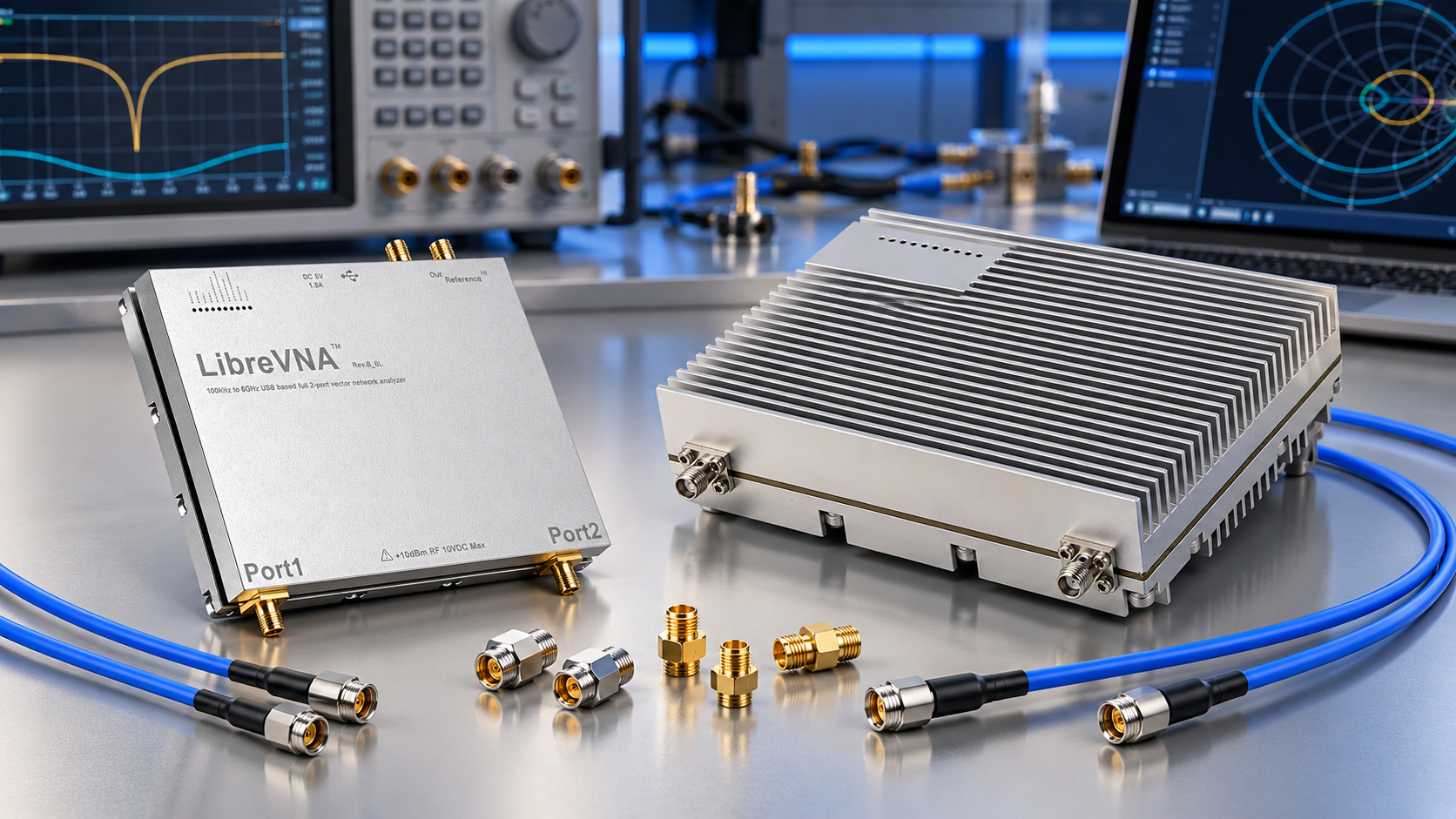
LibreVNA is an open-source, computer-controlled vector network analyzer (VNA) project. The upstream LibreVNA repository describes a 100 kHz–6 GHz instrument with two RF ports and provides hardware, firmware and desktop software resources.
In a statement dated 26 April 2025, project creator Jan, known as jankae, said that products marketed as upgraded LibreVNA 2.0 were not his finished next-generation electronics design. He noted that third-party variants might contain improvements, but he could not verify undisclosed changes.
That statement does not identify every product sold later. It does explain why buyers should distinguish three different things:
- Retail name: the product title used by a manufacturer or seller.
- Hardware revision: the actual circuit board and component design inside the instrument.
- Software version: the installed firmware and LibreVNA desktop application release.
For the listing comparison below, LibreVNA means SDRstore's standard LibreVNA listing, while LibreVNA 2.0 means the separately named calibration-kit package. These names do not independently establish either unit's manufacturer or hardware lineage.
What the SDRstore listings actually show
The published specifications overlap substantially. Both listings describe a USB-controlled full two-port VNA, rather than a handheld analyzer with an integrated measurement screen.
| Listed feature | LibreVNA | LibreVNA 2.0 |
|---|---|---|
| Frequency range | 100 kHz–6 GHz | 100 kHz–6 GHz |
| S-parameters | S11, S21, S12 and S22 | S11, S21, S12 and S22 |
| RF ports | Two SMA female, 50 ohm | Two SMA female, 50 ohm |
| Listed sweep-point range | 2–4,501 | 2–4,501 |
| Quoted fast sweep | 4,000 points in under 500 ms at 50 kHz IF bandwidth | 4,000 points in under 500 ms at 50 kHz IF bandwidth |
| Calibration kit | Not included by default, according to the product-page support answer | Explicitly included in the package contents |
| Exact PCB revision | Confirm before purchase | Confirm before purchase |
These are seller-listed specifications, not results from an independent comparison. Matching headline values do not prove identical internal hardware, but they also do not establish a performance upgrade.
Compare the current LibreVNA product listing and LibreVNA 2.0 calibration-kit package when ordering.
What would make a LibreVNA upgrade worthwhile?
A useful upgrade should solve a measurement problem you can name. Relevant evidence might include documented changes to shielding, thermal construction, port matching, isolation or the receiver noise floor.
For example, improved isolation could matter when measuring a filter's deep rejection. Better thermal stability could matter when comparing repeated measurements over a longer session. Those are reasons to request documentation and comparable measurements; they are not verified advantages of every product carrying the 2.0 name.
Ask which revision is supplied and what changed from the alternative unit. A board photograph, manufacturer revision history and measurements under stated conditions are more useful than the word “upgraded.”
Do not treat full two-port operation, FPGA processing or multiple receiver channels as automatically exclusive to LibreVNA 2.0. The upstream LibreVNA design already documents a source that switches between ports and separate receiver paths supporting forward and reverse measurements.
Compare dynamic range and sweep speed under matching conditions
A vector network analyzer's fastest sweep and its best noise performance normally occur under different settings. Intermediate-frequency bandwidth (IF bandwidth) affects how much receiver noise contributes to the result.
For a meaningful comparison, use the same test frequency, IF bandwidth, averaging, source power, calibration method and measurement direction. A fast-sweep claim at 50 kHz bandwidth should not be combined with a narrow-band dynamic-range figure as if both were achieved simultaneously.
Keysight's dynamic-range guidance explains that measurements approaching the receiver noise floor become less certain. This matters more for deep filter rejection than for a straightforward check of a low-loss cable.
A smooth trace or a precise-looking marker does not, by itself, demonstrate measurement accuracy.
Software updates are different from hardware upgrades
The LibreVNA software ecosystem includes desktop operation and programmatic control. The upstream repository provides installation instructions for Windows, Ubuntu Linux and macOS, alongside links to firmware releases and programming documentation.
The official changelog documents improvements to calibration, plotting, data export and automation across software releases. It also records changes that can affect existing scripts.
Before buying replacement hardware, check whether a supported software update solves your actual limitation. Verify compatibility with your board and operating system, preserve important setup files and follow the release instructions.
A firmware update cannot replace an RF component, improve a physical connector or change the circuit-board layout. Equally, a product named 2.0 does not establish which software version is installed.
Calibration kits and the real purchase cost
On 12 October 2026, SDRstore's EUR listings displayed €545.56 for LibreVNA and €1,128.95 for LibreVNA 2.0. The difference was €583.39, with the 2.0 listing approximately 2.07 times the standard listing's price. Check current prices before making a decision.
The 2.0 package explicitly lists an open standard, a short standard, two load standards, two 30 cm SMA cables, adapters and USB cables. The standard listing's support answer says a calibration kit is not included by default unless specifically listed.
Compare the complete usable setup: analyzer, suitable calibration standards, cables, adapters, power supply and computer. Included accessories can simplify purchasing, but they should be assessed separately from any claimed improvement to the analyzer electronics.
Calibration-standard quality matters at microwave frequencies. A supplied kit makes calibration possible; it does not automatically establish traceable measurement uncertainty for demanding laboratory work.
Which version should you buy?
- Choose the standard LibreVNA listing when its verified revision meets your requirements and the complete setup remains less expensive after adding the accessories you need.
- Choose LibreVNA 2.0 when the supplied revision has documented improvements relevant to your measurements, or its complete package offers value that justifies the premium.
- Keep your existing LibreVNA when it provides adequate results and there is no verified hardware change that addresses your limitation.
For antenna, filter and cable work, start with the measurement requirements rather than the version number. If you need a self-contained handheld tool, read LibreVNA 2.0 versus NanoVNA-F V3 to compare the different workflows.
For a laboratory purchase, contact SDRstore sales with your frequency range, required measurements and quantity. Request confirmation of the manufacturer, PCB revision, software compatibility and package contents before selecting either listing.
Frequently asked questions
Is LibreVNA 2.0 an official second-generation LibreVNA?
The retail name alone does not establish that. In April 2025, LibreVNA's creator said upgraded products using that name were not his finished next-generation electronics design. Check the manufacturer and documentation of the specific unit being offered.
Does the standard LibreVNA measure all four S-parameters?
Yes. The upstream design supports full two-port measurements, and SDRstore's standard listing specifies S11, S21, S12 and S22. That capability is not exclusive to the 2.0 listing.
Is LibreVNA 2.0 automatically more accurate?
No. Accuracy requires evidence about the supplied hardware, calibration and measurement conditions. A newer-looking enclosure or a version number does not establish a quantified improvement.
Can I turn LibreVNA into LibreVNA 2.0 with a firmware update?
A supported update can add software features or fix bugs, but it cannot change the physical hardware. Check whether the advertised difference is a software feature, an accessory package or an actual electronics revision.
Is a calibration kit included with both SDRstore listings?
The LibreVNA 2.0 package explicitly includes calibration standards. The standard LibreVNA listing says the kit is not included by default unless specified. Confirm the selected package before ordering.
Should I replace a working LibreVNA just because a 2.0 model is available?
No. Upgrade when a verified change solves a measurement or workflow problem. Otherwise, suitable calibration standards, better cables or a compatible software update may be the more useful purchase.
No posts found
Write a review






We support all major card and digital payment options. More local methods are available and shown during checkout.
You enter into a binding sales contract once you have received an 'order confirmation and sales receipt' email from us, in line with our Sales & Delivery conditions. Therefore, sdrstore.eu has the right to cancel your order in the event of technical problems, delivery failure, Fair use policy and other similar situations.






Your payments are protected by advanced encryption and 3-D Secure authentication for safe online shopping.