





LILYGO T-SIM7600 vs T-A7670 vs T-SIM7080 vs T-SIM7000
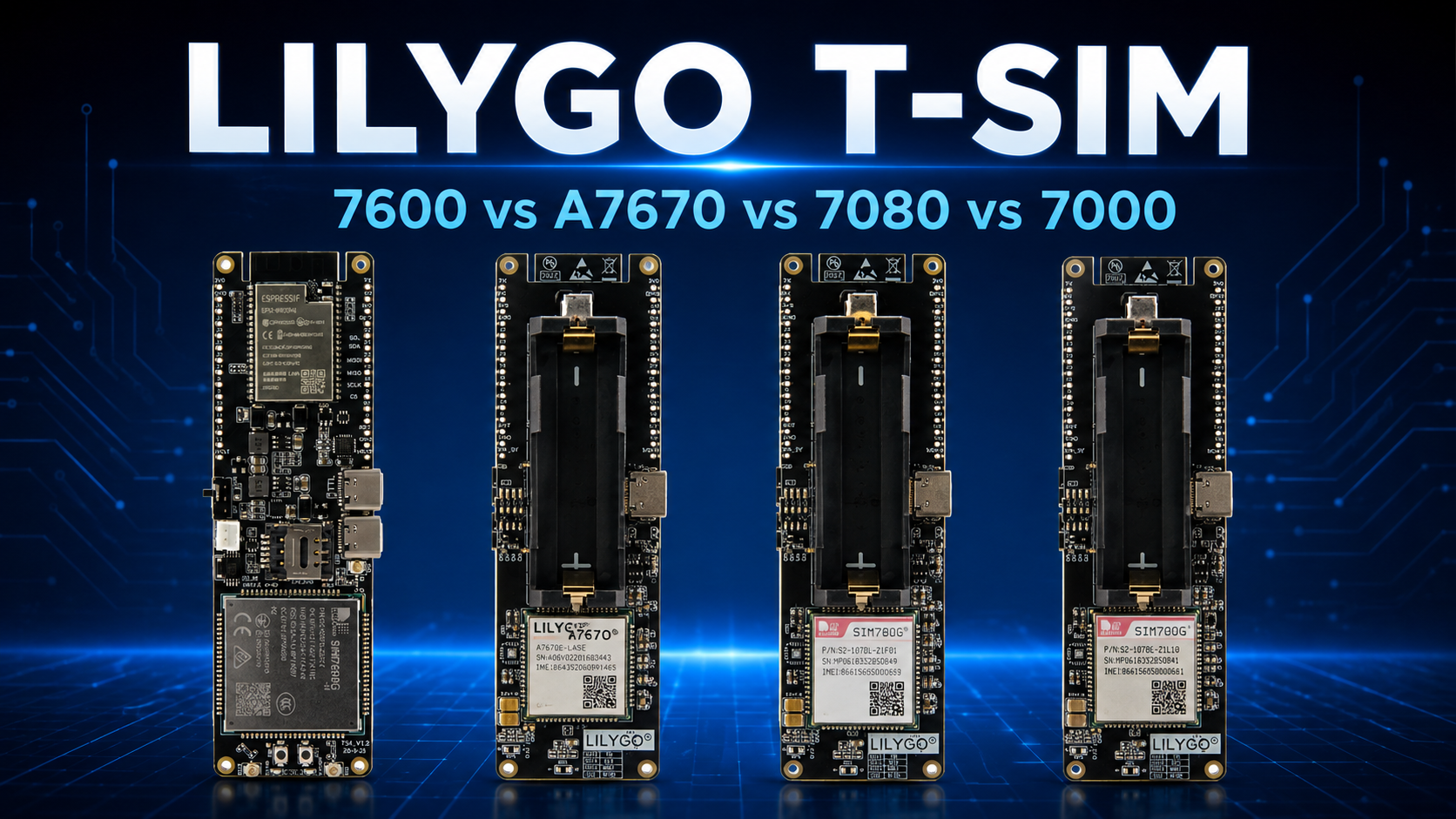
LILYGO offers several ESP32 cellular development boards that can look extremely similar in product listings but target very different IoT applications.
The T-SIM7600, T-A7670, T-SIM7080 and T-SIM7000 all combine an ESP32-family microcontroller with cellular connectivity, and most variants also provide GNSS, battery support and interfaces for sensors.
The important difference is the cellular modem.
One board can provide LTE Cat 4 speeds approaching 150 Mbps. Another is a practical 10 Mbps Cat 1 platform. Two others deliberately trade throughput for LTE-M, NB-IoT and much lower power consumption.
The short recommendation is:
- T-SIM7600: choose it for the highest cellular throughput, Linux/PC USB modem use, gateways, routers and data-heavy projects.
- T-A7670: choose it for general 4G IoT, GPS trackers, telematics and projects that need conventional LTE without Cat 4 cost or power requirements.
- T-SIM7080: choose it for new low-power LTE-M/NB-IoT sensors, trackers and telemetry projects.
- T-SIM7000: choose it when you specifically want LTE-M/NB-IoT plus GSM/GPRS fallback or need compatibility with an existing SIM7000 design.
This comparison explains the differences in cellular technology, speed, GNSS, power consumption, regional bands, 2G/3G fallback and the IoT projects each board is best suited for.
LILYGO T-SIM7600 vs T-A7670 vs T-SIM7080 vs T-SIM7000: Quick Comparison
| Feature | T-SIM7600 | T-A7670 | T-SIM7080G-S3 | T-SIM7000G |
|---|---|---|---|---|
| Primary cellular class | LTE Cat 4 on current SIM7600-H variants | LTE Cat 1 | LTE-M + NB-IoT | LTE-M + NB-IoT + GSM |
| Peak DL | Up to 150 Mbps on SIM7600-H | Up to 10 Mbps | 589 kbps Cat-M / 127 kbps Cat-NB | 300 kbps Cat-M / 34 kbps Cat-NB |
| Peak UL | Up to 50 Mbps on SIM7600-H | Up to 5 Mbps | 1119 kbps Cat-M / 158.5 kbps Cat-NB | 375 kbps Cat-M / 66 kbps Cat-NB |
| LTE-M | No | No | Yes | Yes |
| NB-IoT | No | No | Yes | Yes |
| 2G fallback | Available on relevant SIM7600 variants | Available on relevant A7670 variants | No | Yes on SIM7000G |
| 3G fallback | Available on many SIM7600-H regional variants | No | No | No |
| GNSS | Yes on common variants | Variant/configuration dependent | Yes | Yes |
| Main MCU on common board | ESP32-WROVER generation | ESP32-WROVER-E | ESP32-S3 | ESP32-WROVER-B |
| Typical MCU memory | 4 MB Flash + 8 MB PSRAM on classic board | 4 MB Flash + 8 MB PSRAM | 16 MB Flash + 8 MB PSRAM | 4/16 MB Flash + 8 MB PSRAM depending version |
| USB modem/networking | Major advantage | Supported at modem level; board use depends on configuration | USB available at modem level | USB available at modem level |
| Battery-focused design | Lowest priority | Moderate | High | High |
| Best use | Gateway / high-data cellular | General mobile IoT | Modern low-power IoT | LPWA with 2G fallback |
Which One Should You Buy?
If you only want the fastest answer:
| Your project | Recommended board |
|---|---|
| Cellular router or gateway | T-SIM7600 |
| High-speed telemetry | T-SIM7600 |
| Images / larger files | T-SIM7600 |
| General GPS vehicle tracker | T-A7670 |
| Affordable 4G ESP32 project | T-A7670 |
| Frequent MQTT telemetry | T-A7670 or T-SIM7080 |
| Battery asset tracker | T-SIM7080 |
| Smart meter | T-SIM7080 |
| Remote environmental sensor | T-SIM7080 |
| LTE-M/NB-IoT + 2G fallback | T-SIM7000 |
| Existing SIM7000 project | T-SIM7000 |
| New LPWA project in 2026 | T-SIM7080 |
1. LILYGO T-SIM7600: Best for Maximum Cellular Performance
The LILYGO T-SIM7600 is the high-throughput option in this comparison.
Current versions based on modules such as the SIM7600G-H R2, SIM7600E-H and SIM7600SA-H use LTE Cat 4.
SIMCom officially specifies the SIM7600-H family for up to:
- 150 Mbps downlink;
- 50 Mbps uplink.
That is dramatically faster than the other three boards.
What that extra bandwidth enables
T-SIM7600 is attractive for:
- cellular gateways;
- remote Linux systems;
- industrial routers;
- larger cloud uploads;
- image transmission;
- higher-rate logging;
- remote diagnostics;
- equipment that uses the modem as a USB network interface.
Important: Not Every T-SIM7600 Is Cat 4
The T-SIM7600 family has existed for several generations.
LILYGO specifically notes that its newer T-SIM7600X-H versions increase LTE performance from the older approximately 10 Mbps / 5 Mbps class to approximately:
150 Mbps DL / 50 Mbps UL.
Therefore, when comparing prices, check the actual modem:
- SIM7600G-H R2;
- SIM7600E-H;
- SIM7600SA-H;
- other SIM7600 family variants.
Do not assume every product named T-SIM7600 has the same LTE category.
T-SIM7600 USB Modem Capability
One particularly useful feature of the current T-SIM7600 design is the separate USB connection to the cellular modem.
LILYGO documents two USB interfaces on common current boards:
- one for programming the ESP32;
- one connected to the SIM7600 modem.
The modem USB interface can be connected directly to a computer and used with supported modem drivers.
This makes T-SIM7600 more suitable than the other boards when your project involves:
- Linux;
- Raspberry Pi;
- Windows;
- Android;
- USB cellular networking;
- direct high-rate modem access.
T-SIM7600 GNSS
The SIM7600-H family integrates multi-constellation GNSS support.
Depending on the exact module and configuration, this can include systems such as:
- GPS;
- GLONASS;
- BeiDou;
- Galileo.
This makes T-SIM7600 suitable for vehicle tracking and telematics, although its higher-performance modem generally consumes more energy than a purpose-built LTE-M tracker.
T-SIM7600 Legacy Network Support
Many SIM7600-H variants support combinations of:
- LTE-FDD;
- LTE-TDD;
- HSPA+;
- UMTS;
- GSM;
- GPRS;
- EDGE.
The exact modes depend on the regional modem variant.
However, legacy support is only useful where the mobile operator still operates those networks.
Many countries have already shut down 3G and are progressively retiring 2G. Check the actual deployment country rather than treating 2G/3G support as guaranteed fallback.
T-SIM7600 Advantages
- Fastest cellular connectivity of the four;
- LTE Cat 4 on current H-series models;
- up to 150/50 Mbps;
- integrated GNSS;
- USB modem access;
- good Linux/PC integration;
- excellent for routers and gateways;
- suitable for larger firmware and data transfers.
T-SIM7600 Disadvantages
- higher cost;
- higher active power demand;
- overkill for small telemetry packets;
- not LTE-M;
- not NB-IoT;
- larger data capability may be wasted in sensor applications;
- several historical modem variants make model naming confusing.
2. LILYGO T-A7670: Best General-Purpose 4G IoT Choice
The LILYGO T-A7670 R2 sits neatly between Cat 4 and LPWA hardware.
It uses SIMCom's A7670 LTE Cat 1 family.
Peak throughput is approximately:
- 10 Mbps downlink;
- 5 Mbps uplink.
For most embedded IoT products, this is already a large amount of bandwidth.
Why Cat 1 Is Often Enough
Consider a GPS tracker sending:
- latitude;
- longitude;
- speed;
- battery voltage;
- temperature;
- vehicle data;
Even at frequent update intervals, this represents a tiny amount of network traffic compared with 10 Mbps.
There is therefore little reason to pay the Cat 4 power and cost penalty unless the application genuinely transfers more data.
T-A7670 Regional Versions
LILYGO currently documents several variants.
| Board | Typical region | Important LTE bands |
|---|---|---|
| T-A7670E | Europe / EMEA and selected Asian markets | B1/B3/B5/B8/B20 |
| T-A7670G | Broad/global-oriented variant | Large multi-band FDD/TDD set |
| T-A7670SA | South America / Australia / New Zealand direction | B1/B2/B3/B4/B5/B7/B8/B28/B66 |
The exact modem is therefore much more important than the words “T-A7670” on the PCB.
For Europe, A7670E's support for Band 20 is particularly useful because 800 MHz LTE is widely used for coverage.
T-A7670 and 2G Fallback
A7670 variants support GSM/GPRS/EDGE according to the modem configuration.
This can provide legacy fallback where 2G remains operational.
Again, verify the target operator because 2G shutdown schedules vary by country.
T-A7670 GNSS
LILYGO sells versions with GNSS support, but the exact configuration should be checked when ordering.
The official LILYGO documentation explicitly notes that GPS is optional on some T-A7670 configurations.
For a tracker, make sure you purchase the version that actually includes the required GNSS capability rather than assuming every A7670 board is identical.
T-A7670 Advantages
- 10/5 Mbps is enough for most IoT;
- lower cost than Cat 4;
- normal LTE mobility;
- regional modem choices;
- 2G fallback on supported variants;
- ESP32 Wi-Fi and Bluetooth;
- excellent fit for vehicle tracking and telemetry;
- good balance between bandwidth and complexity.
T-A7670 Disadvantages
- not LTE-M;
- not NB-IoT;
- higher low-power burden than a dedicated LPWA modem;
- GNSS depends on board/modem option;
- regional modem selection must be correct.
3. LILYGO T-SIM7080G-S3: Best New Low-Power IoT Choice
The LILYGO T-SIM7080G-S3 is designed for a completely different type of application.
Instead of Cat 1 or Cat 4, the SIM7080G modem supports:
- LTE-M;
- NB-IoT.
It is specifically designed for low-throughput cellular IoT.
T-SIM7080G Data Rates
SIMCom officially specifies:
| Mode | Downlink | Uplink |
|---|---|---|
| LTE-M / Cat-M | Up to 589 kbps | Up to 1119 kbps |
| NB-IoT / Cat-NB | Up to 127 kbps | Up to 158.5 kbps |
Compared with Cat 1, these numbers look slow.
That is deliberate.
A temperature sensor sending 40 bytes every ten minutes does not need 10 Mbps.
The design priorities are instead:
- low power;
- coverage extension;
- small payloads;
- PSM;
- eDRX;
- low-cost IoT connectivity.
T-SIM7080 Uses ESP32-S3
One major advantage over the classic T-SIM7000 and older T-SIM7600 designs is the microcontroller.
The common T-SIM7080G-S3 combines the modem with an:
ESP32-S3-WROOM-1 with 16 MB Flash and 8 MB PSRAM.
This provides significantly more application memory than many older ESP32-WROVER boards and is useful for:
- TLS;
- larger firmware;
- web interfaces;
- data buffering;
- sensor frameworks;
- GNSS processing;
- OTA updates.
T-SIM7080 GNSS
SIM7080G includes GNSS capability, making the board especially attractive for:
- battery asset trackers;
- cargo tracking;
- low-power location devices;
- remote equipment monitoring.
Remember that GNSS itself can consume significantly more energy than modem PSM, so tracker battery-life estimates must include GNSS acquisition time.
SIM7080G Power Saving
SIMCom specifies approximately:
3.2 µA in PSM at the modem-module level.
That is excellent, but it is not the current draw of the complete LILYGO board.
The complete system also includes:
- ESP32-S3;
- voltage regulation;
- battery circuitry;
- USB circuitry;
- GNSS;
- LEDs;
- external sensors.
Use LILYGO's board-level measurements when estimating a complete product.
T-SIM7080 Protocol Support
SIMCom lists built-in support including:
- TCP;
- UDP;
- HTTP;
- HTTPS;
- FTP;
- TLS;
- DTLS;
- MQTT;
- CoAP;
- LwM2M;
- FOTA.
This makes the module particularly suitable for cloud-connected sensor devices.
T-SIM7080 Advantages
- LTE-M;
- NB-IoT;
- modern ESP32-S3;
- 16 MB Flash / 8 MB PSRAM on common board;
- integrated GNSS;
- excellent modem-level PSM;
- modern IoT protocols;
- good global band coverage;
- best choice here for a new low-power cellular design.
T-SIM7080 Disadvantages
- no GSM fallback;
- much slower than Cat 1;
- not suitable for images or large regular transfers;
- LTE-M/NB-IoT availability must be verified with the operator;
- complete-board sleep power is higher than the modem's headline PSM figure.
4. LILYGO T-SIM7000G: Best If You Need LPWA Plus GSM
The LILYGO T-SIM7000G is the older LPWA platform in this comparison.
Its unique advantage is the combination of:
- LTE Cat-M1;
- NB-IoT;
- GSM/GPRS/EDGE;
- GNSS.
This makes it unusually flexible where legacy 2G remains available.
SIM7000G Data Rates
SIMCom currently specifies:
| Mode | Downlink | Uplink |
|---|---|---|
| Cat-M | 300 kbps | 375 kbps |
| Cat-NB | 34 kbps | 66 kbps |
| EGPRS | 85.6 kbps | 85.6 kbps |
SIM7080G is considerably faster in both LTE-M and NB-IoT.
Therefore, for a new project where 2G fallback does not matter, T-SIM7080 is generally the stronger LPWA platform.
Why T-SIM7000 Still Makes Sense
T-SIM7000 remains useful when:
- you already have working SIM7000 firmware;
- you need GSM/GPRS fallback;
- your target operators still support 2G;
- you need compatibility with an existing installed product;
- you specifically need a proven older ESP32 + SIM7000 design.
T-SIM7000 GNSS
SIM7000G integrates support for multiple GNSS systems including:
- GPS;
- GLONASS;
- BeiDou;
- Galileo.
That makes it suitable for asset-tracking applications, although LTE-M is normally preferable to NB-IoT for regularly moving devices.
T-SIM7000 Power
SIMCom lists approximately:
- 9 µA PSM;
- 1 mA modem sleep;
- 11 mA idle;
under its specified conditions.
Again, these are modem-level numbers.
LILYGO's documented complete-board sleep figures are higher.
T-SIM7000 Advantages
- LTE-M;
- NB-IoT;
- 2G/GPRS fallback;
- integrated GNSS;
- mature module ecosystem;
- extensive TinyGSM and Arduino examples;
- good choice for maintaining existing SIM7000 designs.
T-SIM7000 Disadvantages
- older modem generation;
- slower LTE-M than SIM7080;
- slower NB-IoT than SIM7080;
- older ESP32 architecture;
- higher modem PSM current than SIM7080;
- 2G fallback is becoming less useful as networks shut down.
T-SIM7080 vs T-SIM7000: Which LPWA Board Is Better?
For a new product in 2026, T-SIM7080 is generally the better choice.
| Feature | T-SIM7080G | T-SIM7000G |
|---|---|---|
| LTE-M | Yes | Yes |
| NB-IoT | Yes | Yes |
| Cat-M DL | 589 kbps | 300 kbps |
| Cat-M UL | 1119 kbps | 375 kbps |
| Cat-NB DL | 127 kbps | 34 kbps |
| Cat-NB UL | 158.5 kbps | 66 kbps |
| 2G fallback | No | Yes |
| Module PSM | About 3.2 µA | About 9 µA |
| Modern board MCU | ESP32-S3 | Classic ESP32 |
| Best reason to buy | New LPWA project | GSM fallback / legacy compatibility |
T-SIM7000 wins only when its GSM fallback or existing-software compatibility has real value.
T-SIM7600 vs T-A7670: Cat 4 or Cat 1?
This is primarily a bandwidth decision.
Choose T-SIM7600 when you need:
- high-rate data;
- large uploads/downloads;
- USB cellular networking;
- router-style operation;
- high-speed remote access;
- data rates significantly above 10 Mbps.
Choose T-A7670 when you need:
- GPS tracking;
- normal IoT telemetry;
- MQTT;
- HTTP APIs;
- vehicle data;
- industrial status monitoring;
- lower cost;
- less cellular performance than Cat 4 but still normal LTE.
For most ESP32 IoT applications, 10 Mbps is already more than enough.
T-A7670 vs T-SIM7080: Cat 1 or LTE-M?
This is one of the most useful comparisons.
T-A7670 is better when:
- the device has vehicle or mains power;
- normal LTE coverage is easier to obtain;
- large FOTA packages matter;
- uploads happen frequently;
- latency matters;
- LTE-M availability is uncertain.
T-SIM7080 is better when:
- the device runs from battery;
- it sleeps most of the time;
- payloads are small;
- LTE-M/NB-IoT coverage is verified;
- the device may be installed in difficult RF locations;
- years of battery operation are a real design goal.
For a deeper standards comparison, read LTE Cat 1 vs LTE-M vs NB-IoT: Which Should Your IoT Project Use?.
Which Board Is Best for GPS Tracking?
Vehicle tracker
T-A7670 is our preferred starting point.
Vehicle power means ultra-low PSM is less critical, while Cat 1 provides fast communication and normal LTE mobility.
Battery asset tracker
T-SIM7080 in LTE-M mode is usually more appropriate.
You get:
- mobility;
- GNSS;
- lower-power cellular operation;
- enough bandwidth for location telemetry.
High-data fleet terminal
Choose T-SIM7600 if the device also exchanges large files, diagnostic data or works as an onboard cellular gateway.
Which Board Is Best for Smart Meters?
T-SIM7080 is the strongest choice for a new design.
It supports both LTE-M and NB-IoT and is intended for low-power, low-throughput deployments.
T-SIM7000 remains reasonable if:
- you already use it;
- GSM fallback is required;
- the slower modem is not a problem.
Which Board Is Best for MQTT?
All four can support MQTT-style cloud communication.
The right board depends on the message volume.
| MQTT workload | Best choice |
|---|---|
| Tiny sensor packet every hour | T-SIM7080 |
| GPS packet every minute | T-SIM7080 or T-A7670 |
| Vehicle telemetry every few seconds | T-A7670 |
| Large binary payloads | T-A7670 / T-SIM7600 |
| Gateway aggregating many sensors | T-SIM7600 |
Which Board Is Best for HTTP and HTTPS?
All of them can use HTTP-style services, but TLS and larger responses make bandwidth more important.
For occasional REST requests:
T-SIM7080 is fine.
For frequent HTTPS traffic:
T-A7670 provides a better balance.
For large downloads or gateway workloads:
T-SIM7600 wins.
Which Is Best for Firmware Updates?
FOTA size is often forgotten when choosing an IoT modem.
T-SIM7600
Best for large updates.
T-A7670
Very comfortable for normal ESP32 firmware images.
T-SIM7080
Practical, but updates take longer and consume more radio-on energy.
T-SIM7000
Possible, but significantly slower than the other choices.
Which Board Is Best for Images?
Use:
T-SIM7600 > T-A7670 >> T-SIM7080 > T-SIM7000
T-SIM7600 is the clear winner for camera snapshots or larger media payloads.
T-A7670 can still handle compressed still images reasonably well.
LTE-M should only be considered for small and infrequent images.
NB-IoT is a poor choice for image-heavy applications.
Which Board Is Best for Solar Projects?
The modem with the lowest advertised PSM current is not automatically the lowest-power complete system.
For solar sensors:
- prefer T-SIM7080 for low-data applications;
- minimize ESP32 wake time;
- disable GNSS when unnecessary;
- avoid continuously illuminated LEDs;
- use PSM/eDRX;
- choose efficient regulators;
- measure the complete board with a power analyzer.
LILYGO's newer Standard-series board revisions are particularly interesting because the company has made significant improvements to board-level deep-sleep current.
Board-Level Deep Sleep vs Modem PSM
This distinction is critical.
SIMCom may specify only a few microamps for the cellular module.
LILYGO's complete board may consume considerably more.
LILYGO's current documentation shows that values also vary by board revision.
| Example LILYGO board/revision | Published board-level deep-sleep direction |
|---|---|
| Classic T-A7670X | About 157 µA |
| Classic T-SIM7600G | About 200 µA |
| Classic T-SIM7000G | About 500 µA |
| Earlier T-SIM7080G-S3 | About 1.1 mA |
| New T-SIM7080G-S3 Standard | About 128 µA |
| New T-SIM7600G-S3 Standard | About 128 µA |
These figures are useful for comparison, but your complete project should still be measured directly.
Firmware, sensors, external pull-ups, SD cards and attached peripherals can completely change the result.
Do These Boards Support Arduino?
Yes.
LILYGO provides examples for Arduino and/or PlatformIO across these families.
Typical development options include:
- Arduino IDE;
- PlatformIO;
- ESP-IDF on supported board generations;
- TinyGSM for many modem workflows;
- direct SIMCom AT commands.
TinyGSM Compatibility
TinyGSM is popular because it provides one Arduino-style abstraction across many cellular modems.
However, not every modem function is exposed identically.
If you need features such as:
- PSM configuration;
- eDRX;
- GNSS control;
- network selection;
- LTE-M/NB-IoT mode selection;
- advanced TLS;
- USB networking;
you may still need direct AT commands from the SIMCom manual.
Regional Bands Matter More Than the Board Name
Never purchase cellular hardware from the product-family name alone.
Check:
- deployment country;
- mobile operator;
- LTE bands;
- LTE-M/NB-IoT support;
- modem SKU;
- antenna frequency coverage;
- SIM roaming.
A perfectly functional T-A7670SA can be the wrong choice for a European project if its band configuration does not match the intended operator deployment.
2G and 3G Fallback in 2026
Legacy fallback needs realistic treatment.
T-SIM7000's GSM capability and the GSM/3G modes available on some T-SIM7600 variants can still be useful in countries where those networks remain active.
But 2G and 3G are being retired progressively around the world.
Do not design a new 10-year product around GSM fallback without obtaining a network roadmap from the intended operator.
LTE-M and NB-IoT Availability
The opposite problem affects T-SIM7080 and T-SIM7000.
A country may have excellent normal 4G LTE coverage while your SIM cannot connect using LTE-M or NB-IoT.
Those technologies need to be enabled by:
- the operator;
- the SIM profile;
- the roaming provider;
- the network band configuration.
Always test the intended SIM and operator before committing to a production design.
Which Is Best for Europe?
For conventional LTE IoT in Europe, an appropriate A7670E configuration is often attractive because it supports important European FDD bands including B1, B3, B8 and B20.
For low-power IoT, SIM7080G covers a broad set of LTE-M and NB-IoT bands including commonly used European bands.
T-SIM7600E-H is appropriate when Cat 4 performance is required.
The operator remains the final authority on which technologies and bands are actually available.
Which Is Best for a Global Product?
A global product should prioritize modem and band variants rather than only choosing the fastest board.
Potential starting points are:
- T-SIM7600G-H R2 for high-throughput multi-region designs;
- T-A7670G for broad Cat 1 coverage;
- T-SIM7080G for global-oriented LTE-M/NB-IoT projects;
- T-SIM7000G where LTE-M/NB-IoT plus GSM has value.
Still verify certification and carrier approval for every target market.
Complete Buyer Decision Table
| Priority | Best board |
|---|---|
| Highest cellular speed | T-SIM7600-H |
| 150 Mbps LTE | T-SIM7600-H |
| USB cellular modem | T-SIM7600 |
| Router / gateway | T-SIM7600 |
| Best general 4G IoT board | T-A7670 |
| Affordable GPS vehicle tracker | T-A7670 |
| 10/5 Mbps LTE | T-A7670 |
| Best new LTE-M board | T-SIM7080 |
| Best new NB-IoT board | T-SIM7080 |
| Battery asset tracker | T-SIM7080 |
| Smart meter | T-SIM7080 |
| Remote sensor | T-SIM7080 |
| LPWA + GSM fallback | T-SIM7000 |
| Existing SIM7000 project | T-SIM7000 |
| Large firmware updates | T-SIM7600 / T-A7670 |
| Low-power MQTT | T-SIM7080 |
| Images | T-SIM7600 |
Recommended SDRstore.eu Products
| Product | Best reason to buy |
|---|---|
| LILYGO T-SIM7600 | High-speed LTE Cat 4 / gateway projects |
| LILYGO T-A7670 R2 | General-purpose Cat 1 IoT and tracking |
| LILYGO T-SIM7080G-S3 | Modern LTE-M / NB-IoT development |
| LILYGO T-SIM7000G | LTE-M/NB-IoT with GSM fallback |
Browse the complete LILYGO catalog at SDRstore.eu for cellular, LoRa, Meshtastic and ESP32 development hardware.
For Businesses, Universities and IoT Development Teams
Companies, universities, engineering teams, IoT integrators and research laboratories can request quotations for LILYGO cellular development boards directly through SDRstore.eu.
Use the Add to Quote button on product pages or the document icon on product cards.
A development quote can include multiple:
- T-SIM7600 boards;
- T-A7670 boards;
- T-SIM7080 boards;
- T-SIM7000 boards;
- cellular antennas;
- GNSS antennas;
- RF adapters;
- test equipment;
- other IoT development hardware.
This can be useful when comparing several modem families before selecting hardware for production.
Official Technical Resources
- LILYGO — T-SIM7600
- LILYGO — T-A7670 Documentation
- LILYGO — T-SIM7080G-S3
- LILYGO — T-SIM7000G Documentation
- SIMCom — SIM7600-H Series
- SIMCom — A7670 Series
- SIMCom — SIM7080G
- SIMCom — SIM7000G
Final Verdict
These four LILYGO boards should not really be viewed as four competing versions of the same product.
They represent three different classes of cellular IoT hardware.
T-SIM7600 is the performance option.
Choose a current SIM7600-H version when you genuinely need Cat 4 throughput, USB modem operation, large transfers or gateway-style cellular connectivity.
T-A7670 is the general-purpose option.
Its 10 Mbps / 5 Mbps Cat 1 connection is more than enough for most trackers, telemetry systems and conventional mobile IoT applications, while costing less and demanding less than Cat 4.
T-SIM7080 is the low-power option we would choose for most new LTE-M/NB-IoT designs.
It has the newer LPWA modem, higher Cat-M and Cat-NB throughput than SIM7000, excellent module-level PSM performance and a modern ESP32-S3 board configuration.
T-SIM7000 is the specialist legacy-flexibility option.
Its main advantage over SIM7080 is GSM/GPRS fallback. That can still be valuable where 2G remains available or when maintaining an established SIM7000 product, but it is becoming a weaker reason for a completely new long-life design.
For most buyers, the decision can therefore be reduced to:
High data → T-SIM7600
Normal 4G IoT → T-A7670
Low-power LTE-M/NB-IoT → T-SIM7080
LPWA + 2G fallback → T-SIM7000
FAQ
Which is better, LILYGO T-SIM7600 or T-A7670?
T-SIM7600 is better when you need Cat 4-class throughput, USB cellular networking or large transfers. T-A7670 is usually the more practical choice for normal IoT, GPS tracking and telemetry because its 10 Mbps downlink and 5 Mbps uplink are already more than enough for most embedded applications.
How fast is LILYGO T-SIM7600?
Current T-SIM7600 versions using SIM7600-H modules such as SIM7600G-H R2 support LTE Cat 4 with maximum rates around 150 Mbps downlink and 50 Mbps uplink.
Are all T-SIM7600 boards LTE Cat 4?
No. LILYGO has sold multiple T-SIM7600 modem variants over time. Older versions can have lower throughput, so check whether the board uses a current SIM7600-H Cat 4 modem before purchasing.
How fast is T-A7670?
The A7670 LTE Cat 1 modem family supports approximately 10 Mbps downlink and 5 Mbps uplink.
Does T-A7670 support LTE-M or NB-IoT?
No. T-A7670 is a conventional LTE Cat 1 platform rather than an LTE-M or NB-IoT modem.
Which is better, T-SIM7080 or T-SIM7000?
T-SIM7080 is generally the better choice for a new LTE-M or NB-IoT project because SIM7080G provides higher LPWA data rates and lower modem-level PSM current. T-SIM7000 remains attractive when GSM/GPRS fallback is required.
Does T-SIM7080 support LTE-M?
Yes. SIM7080G supports LTE-M and NB-IoT dual-mode operation.
Does T-SIM7080 support 2G?
No. SIM7080G focuses on LTE-M and NB-IoT and does not provide the GSM/GPRS fallback available on SIM7000G.
Does T-SIM7000 support 2G?
Yes. SIM7000G supports quad-band GSM/GPRS in addition to LTE Cat-M and NB-IoT, although actual 2G network availability depends on the operator and country.
Which LILYGO cellular board is best for GPS tracking?
T-A7670 is an excellent choice for vehicle-powered tracking, while T-SIM7080 in LTE-M mode is generally better for battery-powered asset trackers. T-SIM7600 is appropriate when the tracker also requires high data throughput.
Which LILYGO board is best for NB-IoT?
T-SIM7080G-S3 is our preferred choice for a new NB-IoT project. T-SIM7000G also supports NB-IoT and remains useful when GSM fallback is important.
Which LILYGO board is best for LTE-M?
T-SIM7080G-S3 is generally the strongest current choice because SIM7080G offers higher Cat-M throughput and lower modem-level PSM consumption than SIM7000G.
Which board is best for a cellular router?
T-SIM7600 with a Cat 4 SIM7600-H modem is the best of these four because it provides far higher data rates and direct USB modem/networking capability.
Which board is best for a smart meter?
T-SIM7080 is the strongest starting point because a smart meter normally benefits from LTE-M or NB-IoT, low power and extended coverage rather than Cat 1 or Cat 4 throughput.
Which board is best for MQTT?
All four can be used for MQTT. T-SIM7080 is excellent for low-power telemetry, T-A7670 is ideal for frequent general IoT messaging, and T-SIM7600 is better when the system transfers much larger amounts of data.
Which LILYGO cellular board consumes the least power?
There is no single answer without specifying the board revision and firmware. SIM7080G has very low modem-level PSM current, but complete-board deep-sleep current varies substantially between LILYGO board generations. Measure the exact board configuration before estimating final battery life.
Can I use T-SIM7080 for a vehicle tracker?
Yes. LTE-M is designed to support mobility and is an excellent choice for a low-power tracker, provided the intended mobile operator supports LTE-M on compatible bands.
Can T-SIM7000 still be used in 2026?
Yes. It remains a useful LTE-M/NB-IoT/GSM development platform. For a completely new design, however, SIM7080 is generally the more modern LPWA option unless SIM7000's GSM fallback is specifically required.
Which board should I choose for Europe?
For normal LTE, an appropriate T-A7670E or T-SIM7600E-H variant can be suitable. For low-power IoT, T-SIM7080G supports many European LTE-M and NB-IoT bands. Always verify bands and technology support with the actual operator before purchasing.
Do these boards work with Arduino?
Yes. LILYGO provides Arduino and PlatformIO examples for these cellular board families, and many applications can also use TinyGSM or direct SIMCom AT commands.
No posts found
Write a review






We support all major card and digital payment options. More local methods are available and shown during checkout.
You enter into a binding sales contract once you have received an 'order confirmation and sales receipt' email from us, in line with our Sales & Delivery conditions. Therefore, sdrstore.eu has the right to cancel your order in the event of technical problems, delivery failure, Fair use policy and other similar situations.






Your payments are protected by advanced encryption and 3-D Secure authentication for safe online shopping.