





SV6301A vs NanoVNA-F V3: Is the Larger VNA Worth the Extra Cost?
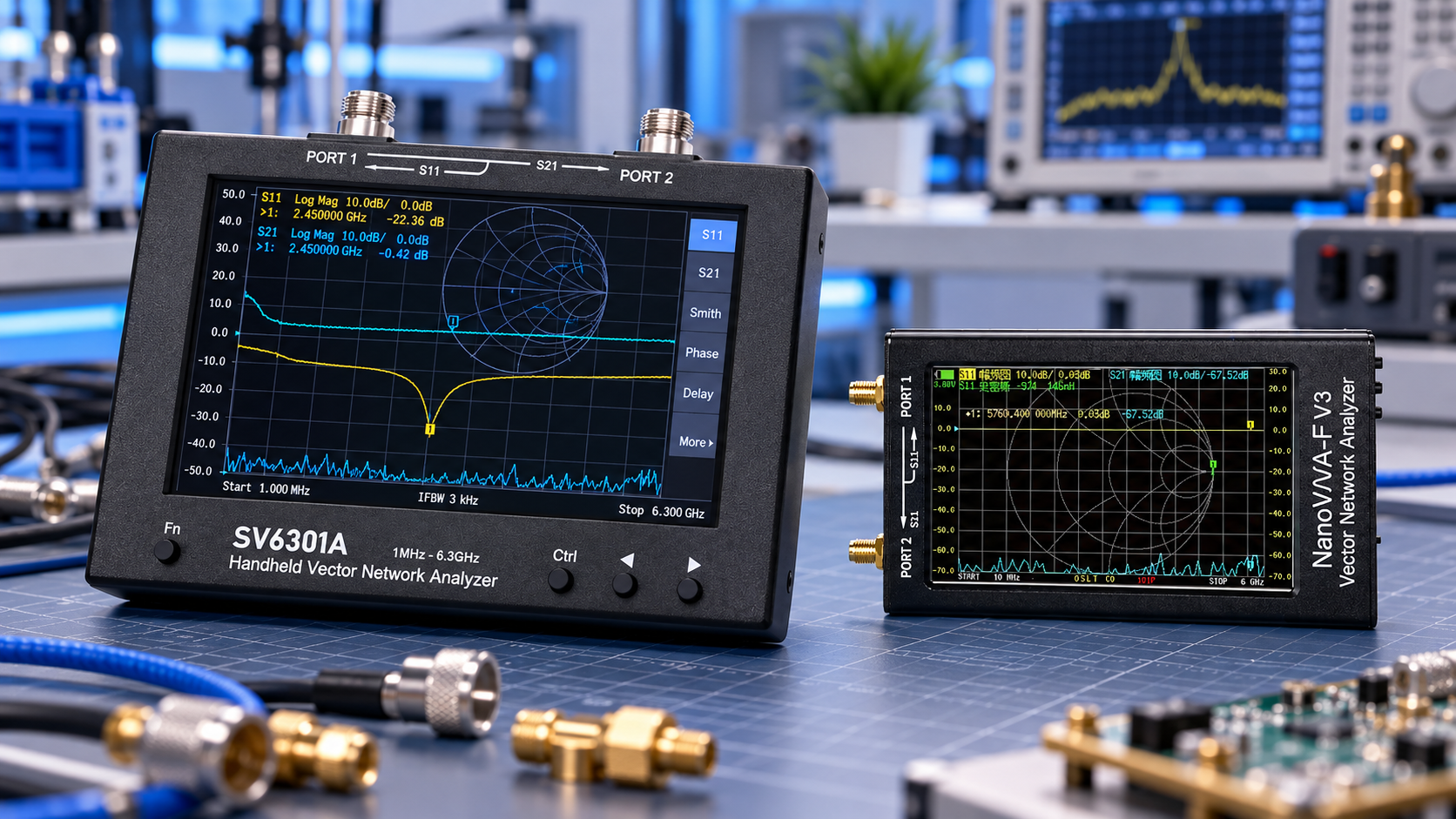
SV6301A is worth considering when frequent RF measurements justify a larger screen, faster specified sweeps, adjustable measurement bandwidth and built-in recording. NanoVNA-F V3 is the more economical choice for occasional antenna, cable and filter checks within 1 MHz–6 GHz. The larger VNA improves the working experience, but its 7-inch display does not automatically make every measurement more accurate.
SV6301A vs NanoVNA-F V3: specifications that affect your purchase
Both are standalone vector network analyzers (VNAs): they generate a test signal and measure a device's response. S11 describes input reflection, while S21 describes forward transmission through a component. Both models support these measurements and time-domain reflectometry (TDR) for cable analysis.
| Feature | SV6301A | NanoVNA-F V3 |
|---|---|---|
| Frequency range | 1 MHz–6.3 GHz | 1 MHz–6 GHz |
| Display | 7-inch IPS, 1024 × 600 | 4.3-inch IPS, 800 × 480 |
| Touch panel | Capacitive | Resistive |
| Maximum sweep points | 1,001 | 801 |
| Specified sweep rate | Up to 500 points/s above 25 MHz | Up to 200 points/s |
| RF connectors | N-type; N-to-SMA adapters supplied | SMA |
| Dimensions | 190 × 130 × 30 mm | 125 × 75 × 20 mm |
| Quoted battery runtime | Approximately 3 hours; datasheet specifies 50% brightness | Up to 5 hours |
| Recording | Built-in 8 GB storage for calibration, measurement files and screenshots | USB workflow; firmware v0.6.0 adds CSV saving |
These are reference specifications from the SV6301A datasheet and SYSJOINT's NanoVNA-F V3 documentation. Sweep rates and battery figures are manufacturer claims, not results from a matched test of the two units.
How much extra are you paying?
On 12 October 2026, SDRstore's EUR product pages displayed €1,078.61 for SV6301A and €307.86 for NanoVNA-F V3. That is a €770.75 difference, making SV6301A approximately 3.5 times the displayed price. Prices can change; check the SV6301A listing and NanoVNA-F V3 listing for current pricing and configurations.
At that premium, a larger screen alone is a difficult justification for an occasional user. A frequent user should consider whether the display, sweep settings and recording tools reduce enough work to justify the purchase.
For illustration, a €770.75 premium equals about 25.7 hours valued at €30 per hour. This is a budgeting calculation, not a claim that SV6301A will save that much time.
What the 7-inch screen changes
A larger display matters when the instrument is your main viewing surface. Comparing traces, following markers and discussing results with another person can be easier when the plot is larger. SV6301A also has a rear stand for desktop use.
The practical benefit is reduced effort interpreting the display. Display size does not improve calibration standards, receiver noise or connector repeatability.
If you mainly inspect results on a computer, some of the screen premium becomes less valuable. Check that your preferred software supports the exact model and installed firmware before relying on a desktop workflow.
Faster sweeps and more points: when they help
The published maximum sweep rates suggest a faster workflow for SV6301A under suitable settings. That can matter when repeatedly adjusting an antenna or matching network and waiting for each new trace. It does not establish a fixed speed advantage for every frequency span, calibration or bandwidth setting.
More points provide closer frequency sampling across an unchanged span. Across an illustrative 100 MHz span, 1,001 equally spaced points give 100 kHz spacing; 801 points give 125 kHz spacing. Narrowing the span around a resonance can be more useful than adding points to an unnecessarily wide sweep.
Use a broad sweep to find the feature, then inspect it with a narrower span and appropriate calibration. Extra points do not automatically improve amplitude accuracy.
Dynamic range and IF bandwidth: the more meaningful upgrade
SV6301A provides selectable intermediate-frequency bandwidth (IF bandwidth), allowing a tradeoff between noise performance and measurement speed. Its datasheet states dynamic-range figures at 12.5 kHz IF bandwidth and one-times averaging, and explains that narrower bandwidth or more averaging improves dynamic range while reducing scan speed.
SYSJOINT's current product tables list S21 dynamic range of 75 dB at 1.5 GHz and 65 dB at 3 GHz for SV6301A, versus 65 dB and 60 dB respectively for NanoVNA-F V3. Those are documented transmission specifications, not a matched independent benchmark.
The same tables give identical S11 dynamic-range values at those frequencies: 50 dB at 1.5 GHz and 40 dB at 3 GHz. The published S21 advantage therefore should not be presented as an equivalent improvement in antenna-reflection measurements.
For filter rejection testing, the ability to adjust measurement bandwidth may be useful. However, a deep notch approaching the receiver noise floor remains uncertain. Keysight's dynamic-range guidance explains why valid measurements need sufficient separation from that floor.
A larger VNA can offer useful controls without becoming a substitute for an instrument with specified uncertainty suited to your application.
Storage and firmware: check more than the hardware
Built-in measurement storage helps when documenting several antennas or comparing a component before and after adjustment. Save measurement files for later analysis and screenshots for a visual record.
SYSJOINT's SV6301A release notes document memory-trace calculations and limit testing in firmware v0.7.3. The v0.7.5 notes document compatibility with SVxx01A Tools v0.2.0. These features strengthen the case for repeated bench work, provided the installed firmware supports them.
NanoVNA-F V3 also has data-saving options. Its documented CSV feature means the purchase decision should consider the complete recording workflow, rather than assuming that only SV6301A can export results.
Portability, connectors and calibration
NanoVNA-F V3's smaller enclosure is easier to accommodate in a compact toolkit. Its quoted runtime is also longer, although the two runtime figures are not from identical test conditions. SV6301A remains portable, but its size favors a workbench or a larger field setup.
SDRstore's SV6301A package lists N-to-SMA adapters, an SMA open/short/load calibration kit, two 60 cm SS405 cables, connectors, a USB Type-C cable and a carrying bag. The NanoVNA-F V3 package lists an SMA calibration kit, two 20 cm RG405 cables, adapters and a USB Type-C cable. Verify the current package before ordering.
- Include the adapters and cables that remain in the measurement path when calibrating.
- Place the calibration reference plane at the connection to the device under test.
- Use standards and connectors suitable for the measurement frequency.
- Disconnect transmitters and external power sources before testing passive antenna systems.
For antenna measurements, follow the NanoVNA SWR testing guide. Good calibration can matter more than changing instruments.
Who should pay for SV6301A?
| Your main use | Suggested choice | Reason |
|---|---|---|
| Occasional antenna tuning | NanoVNA-F V3 | Lower cost for the required S11 workflow |
| Compact portable toolkit | NanoVNA-F V3 | Smaller enclosure |
| Frequent standalone bench measurements | SV6301A | Larger display, stand and recording workflow |
| Repeated filter adjustments | Consider SV6301A | Selectable IF bandwidth and faster specified sweeps |
| Measurements between 6 and 6.3 GHz | SV6301A | Required frequency coverage |
| Automatic full two-port measurements | Compare another architecture | Both models document S11 and S21 |
If you need automatic S11, S21, S12 and S22 measurements, investigate a full two-port instrument. SDRstore's LibreVNA 2.0 versus NanoVNA-F V3 comparison explains that different purchase decision.
Buy SV6301A for specific workflow requirements you will use regularly. If NanoVNA-F V3 already covers your frequencies and delivers adequate repeatability, invest first in suitable cables, adapters and calibration standards. For university or multi-unit purchasing, add the relevant products to a request using Add to Quote and review the quotation cart.
Frequently asked questions
Is SV6301A more accurate because it has a larger screen?
No. Screen size affects readability. Measurement accuracy depends on RF performance, calibration, settings, connectors and the device being measured.
Is SV6301A a worthwhile upgrade from NanoVNA-F V3?
Yes, when you regularly need its larger display, recording tools, bandwidth controls or additional frequency coverage. For occasional measurements that your existing VNA handles adequately, the premium may be difficult to justify.
Can both VNAs test 5.8 GHz antennas?
Yes. That frequency is within both documented ranges. Use suitable cables and standards, and calibrate at the antenna connection.
Does SV6301A automatically measure all four two-port S-parameters?
No. SV6301A documents S11 and S21 measurements. Choose a full two-port analyzer if automatic reverse transmission and output-reflection measurements are required.
Do I need a computer to use SV6301A?
No. SV6301A supports standalone operation. Compatible PC tools can help with remote operation and analysis; match them to the installed firmware.
Can either VNA measure below 1 MHz?
No. Both documented ranges start at 1 MHz. Choose a different analyzer if sub-1 MHz measurements are essential.
No posts found
Write a review





We support all major card and digital payment options. More local methods are available and shown during checkout.
You enter into a binding sales contract once you have received an 'order confirmation and sales receipt' email from us, in line with our Sales & Delivery conditions. Therefore, sdrstore.eu has the right to cancel your order in the event of technical problems, delivery failure, Fair use policy and other similar situations.






Your payments are protected by advanced encryption and 3-D Secure authentication for safe online shopping.