





LILYGO T-Beam V1.2 vs T-Beam Supreme: Which Meshtastic Board Should You Buy?
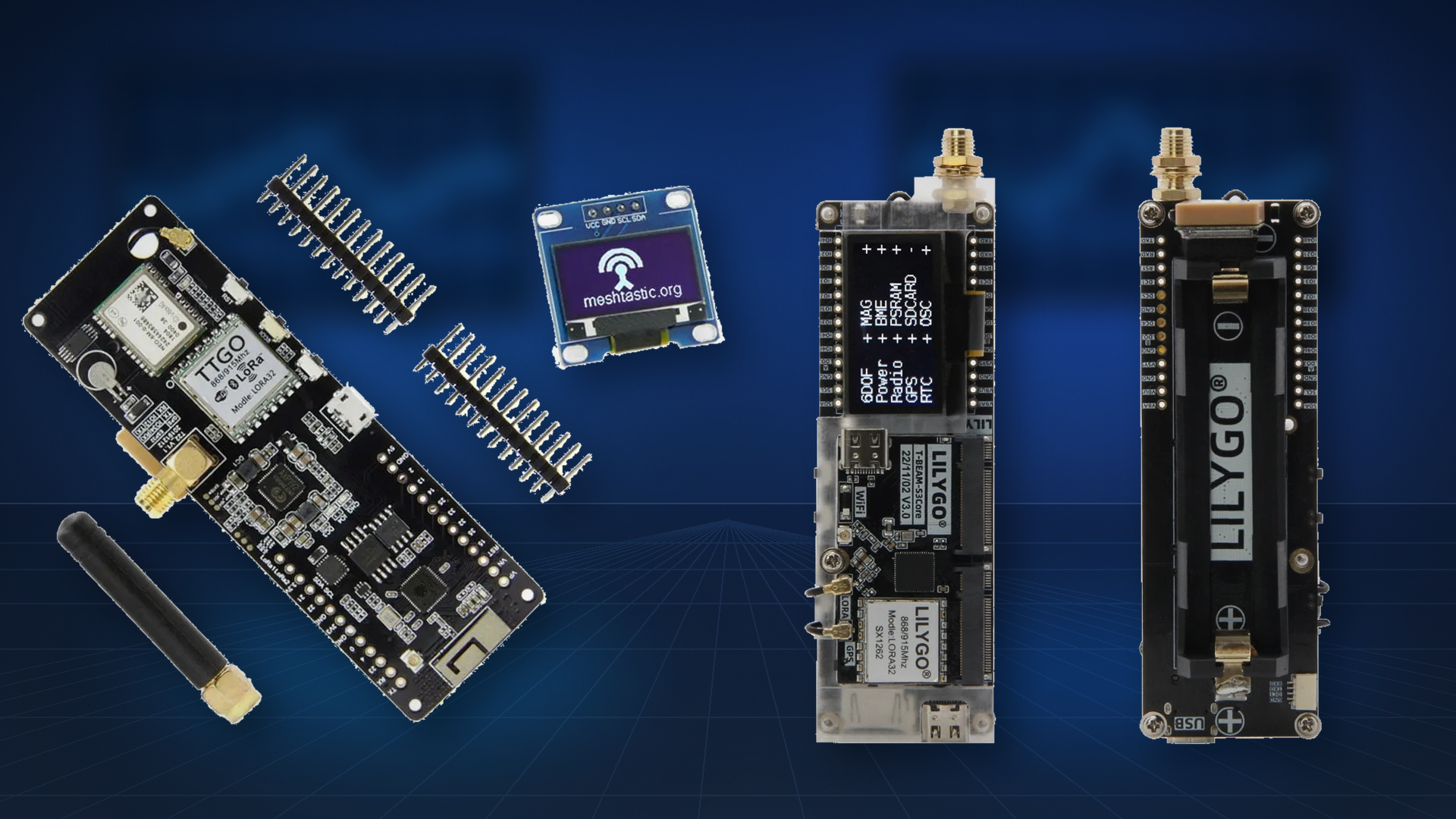
Choose T-Beam Supreme for a new Meshtastic build when you want the SX1262 radio, modern GNSS options, a larger OLED and USB-C. Choose T-Beam V1.2 when its lower price and available frequency variant suit your project, or when you want to keep using an existing classic T-Beam setup. A working V1.2 does not need replacing just to exchange messages with Supreme nodes. First choose hardware that matches your local mesh and region.
T-Beam vs T-Beam Supreme: the practical differences
This comparison covers the SDRstore T-Beam V1.2 listing with SX1276/SX1278 radios and the SDRstore T-Beam Supreme listing with SX1262. Other T-Beam configurations exist, so check the radio chip and board revision rather than relying on the name alone.
| Feature | T-Beam V1.2 listing | T-Beam Supreme listing |
|---|---|---|
| Processor | Classic ESP32 | ESP32-S3FN8 |
| LoRa radio | SX1278 for 433 MHz; SX1276 for listed 868/915/923 MHz versions | SX1262; 433/868/915 MHz options |
| Satellite positioning | u-blox NEO-6M GPS | Quectel L76K or u-blox MAX-M10S-00B GNSS |
| Display | 0.96-inch SSD1306 OLED; check assembly option | 1.3-inch SH1106 OLED, 128 × 64 |
| Flash storage | 4 MB | 8 MB |
| Wireless connection | Wi-Fi and Bluetooth 4.2 | 2.4 GHz Wi-Fi and Bluetooth 5 LE |
| USB | Micro-USB | USB-C |
| Power management | AXP2101 | AXP2101 in the documented Supreme design |
| Battery format | 18650 holder | 18650 holder on the complete Supreme assembly |
| Current flasher category | Community Supported Devices | Supported Devices |
The frequency entries describe the model variants, not guaranteed availability. During the listing check on 12 October 2026, the V1.2 selector exposed a 433 MHz “Soldered OLED” configuration. The Supreme selector offered 433, 868 and 915 MHz choices and two GNSS options. Check the current selection before ordering.
Why the exact V1.2 variant matters
The V1.2 revision is associated with AXP2101 power management; it does not uniquely identify the LoRa chip. LILYGO’s LoRa-series repository includes V1.2 examples for SX1276, SX1278 and SX1262. This article’s radio comparison applies to SDRstore’s advertised SX1276/SX1278 configuration.
Both boards already have Wi-Fi, Bluetooth connectivity and satellite positioning. The Supreme upgrade is therefore about the newer processor and radio platform, positioning options, display and additional hardware, rather than adding those basic functions for the first time.
What the T-Beam Supreme upgrade buys
A newer platform for a fresh build
Supreme combines ESP32-S3, SX1262 and 8 MB of flash. LILYGO also specifies 8 MB of PSRAM for Supreme. Flash stores firmware; PSRAM is additional working memory. Those capacities give developers more resources, but they do not mean that ordinary Meshtastic text messages travel twice as far or twice as fast.
The 1.3-inch display provides a larger viewing area than V1.2’s 0.96-inch OLED, and USB-C can simplify your cable collection. These are useful everyday differences for a portable development project.
A choice of GNSS receiver
GNSS means global navigation satellite system. SDRstore offers Supreme with either L76K or MAX-M10S-00B, while its V1.2 description specifies NEO-6M GPS. Choose the Supreme variant deliberately if satellite positioning is central to your project.
A newer receiver is not a guarantee of accurate fixes inside buildings or every forest. Antenna placement and sky visibility still matter. For a stationary node, the GNSS upgrade may contribute less value than it does for a moving node.
More hardware for experimentation
LILYGO’s Supreme documentation describes motion and environmental sensors, a card slot and expansion interfaces. The SDRstore listing specifically identifies a QMI8658 six-axis inertial measurement unit.
Check the exact hardware revision and firmware support before buying for a particular peripheral. Meshtastic’s T-Beam hardware documentation currently marks the Supreme microSD reader as not implemented in Meshtastic. A physical card slot therefore does not establish working Meshtastic message logging.
Meshtastic support and mixed-board compatibility
At the research date, the official Meshtastic web flasher listed T-Beam Supreme under “Supported Devices” and the classic LILYGO T-Beam under “Community Supported Devices”. Both were selectable. That distinction is relevant when standardizing a new fleet; it does not establish that a working classic board has stopped functioning.
Use the target for your exact board. The Supreme documentation identifies the T-Beam S3 Core firmware family; do not substitute a classic ESP32 T-Beam image. Confirm the installed firmware too: a board sold with SoftRF or factory demonstration software needs Meshtastic installed before joining a Meshtastic mesh.
V1.2 and Supreme nodes can share a Meshtastic mesh when their radio bands and configuration are compatible. They do not need identical processors or identical LoRa chip models. Match the regional configuration, modem settings and messaging channel configuration. An 868 MHz node and a 433 MHz node cannot communicate directly just because both run Meshtastic.
Choose the frequency before choosing the board
For an existing EU_868 mesh, choose suitable 868 MHz hardware and an antenna for that band. For a typical US configuration, choose appropriate 915 MHz hardware. A 433 MHz project needs compatible 433 MHz peers and the correct regional configuration.
The official Meshtastic LoRa configuration guide explains regional settings, power and duty-cycle limits. Check applicable local rules as well. The hardware frequency, antenna and firmware region must all suit the installation; changing a software setting does not make a mismatched radio board a suitable regional variant.
A multi-frequency product title names alternative configurations. It does not promise that the selected board operates equally well across every listed band.
Range and battery life: what the specifications cannot promise
Supreme’s newer radio is a reason to consider it for a new build, but there is no verified distance multiplier for these two SDRstore configurations. Terrain, antenna quality, mounting height, interference and modem settings affect the link. Improving the installation can be more useful than replacing a functioning node. See SDRstore’s Meshtastic range guide for planning advice.
Both boards support battery operation, but no measured runtime comparison is established here. Satellite positioning, display use, wireless connections, traffic and battery capacity all affect consumption. Meshtastic’s power documentation shows that power-saving behavior also changes which interfaces remain available.
For a solar or long-duration unattended installation, compare complete power requirements before choosing either board. For a portable assembly, Meshtastic documents that the T-Beam holder fits an unprotected flat-top 18650 cell; longer protected or button-top cells may not fit. Confirm whether a battery is included.
Is Supreme worth the extra cost?
As a like-for-band example, SDRstore showed €61.86 for the 433 MHz V1.2 with soldered OLED and €84.54 for the 433 MHz Supreme with L76K on 12 October 2026. That is a €22.68 difference. Other frequencies and GNSS selections can have different prices; check your actual configuration.
- Choose Supreme for a new GPS-enabled development node: you value its SX1262 platform, larger display, USB-C and GNSS choices.
- Choose V1.2 for a budget learning project: the available band matches your peers, and the classic platform meets your requirements.
- Keep an existing V1.2: it communicates reliably and you do not need Supreme’s extra hardware.
- Compare a different device type: you need a finished weather-resistant tracker, keyboard-based handheld or purpose-built solar node. These T-Beams are development boards.
Include the battery, enclosure, antenna connections and USB data cable in your budget. Confirm OLED assembly, board revision and included accessories. For first configuration and messaging, follow SDRstore’s Meshtastic beginner setup guide. Attach a suitable LoRa antenna before powering a node that may transmit.
Frequently asked questions
Is T-Beam Supreme better than T-Beam V1.2?
Supreme offers newer processor and radio hardware, a larger OLED, USB-C and modern GNSS options. V1.2 remains a sensible lower-cost choice when its exact variant and firmware support meet your needs.
Can Supreme communicate with an older T-Beam?
Yes, when both run compatible Meshtastic firmware and use compatible radio bands, regional settings, modem settings and messaging channels. The processors and radio chip models can differ.
Does every T-Beam V1.2 use SX1276 or SX1278?
No. LILYGO documents V1.2 configurations with SX1262 as well. SDRstore’s V1.2 listing used for this comparison advertises SX1276/SX1278, so check the actual radio chip before comparing an offer from another seller.
Can I replace a V1.2 board with Supreme and reuse the case?
Do not assume the case will fit. Supreme has a different assembly and USB connector. Check mounting points, dimensions, button access, display opening and antenna connections before reusing an enclosure.
Can Supreme record Meshtastic messages to microSD?
Do not buy it on that assumption. The current Meshtastic hardware documentation marks its microSD reader as not implemented. Custom firmware may use hardware differently, but that is a separate project.
Do these boards need a phone?
They can operate as configured Meshtastic nodes without a phone permanently attached. For convenient message entry and configuration, use a compatible phone or computer client; an OLED and buttons do not provide a full keyboard interface.
Which board should you order?
Supreme is the more capable choice for a fresh build; V1.2 is the economical choice when its available configuration fits the job. Start with the correct radio band, then choose the GNSS option and complete your accessory list. Check the linked SDRstore listings for current configurations and pricing. For multiple nodes or a laboratory purchase, use “Add to Quote” to request matching variants and confirm firmware and accessories.
No posts found
Write a review




We support all major card and digital payment options. More local methods are available and shown during checkout.
You enter into a binding sales contract once you have received an 'order confirmation and sales receipt' email from us, in line with our Sales & Delivery conditions. Therefore, sdrstore.eu has the right to cancel your order in the event of technical problems, delivery failure, Fair use policy and other similar situations.





Your payments are protected by advanced encryption and 3-D Secure authentication for safe online shopping.