





DSTIKE Deauther Watches Compared: X, X II, Y and Deauther32 MINI
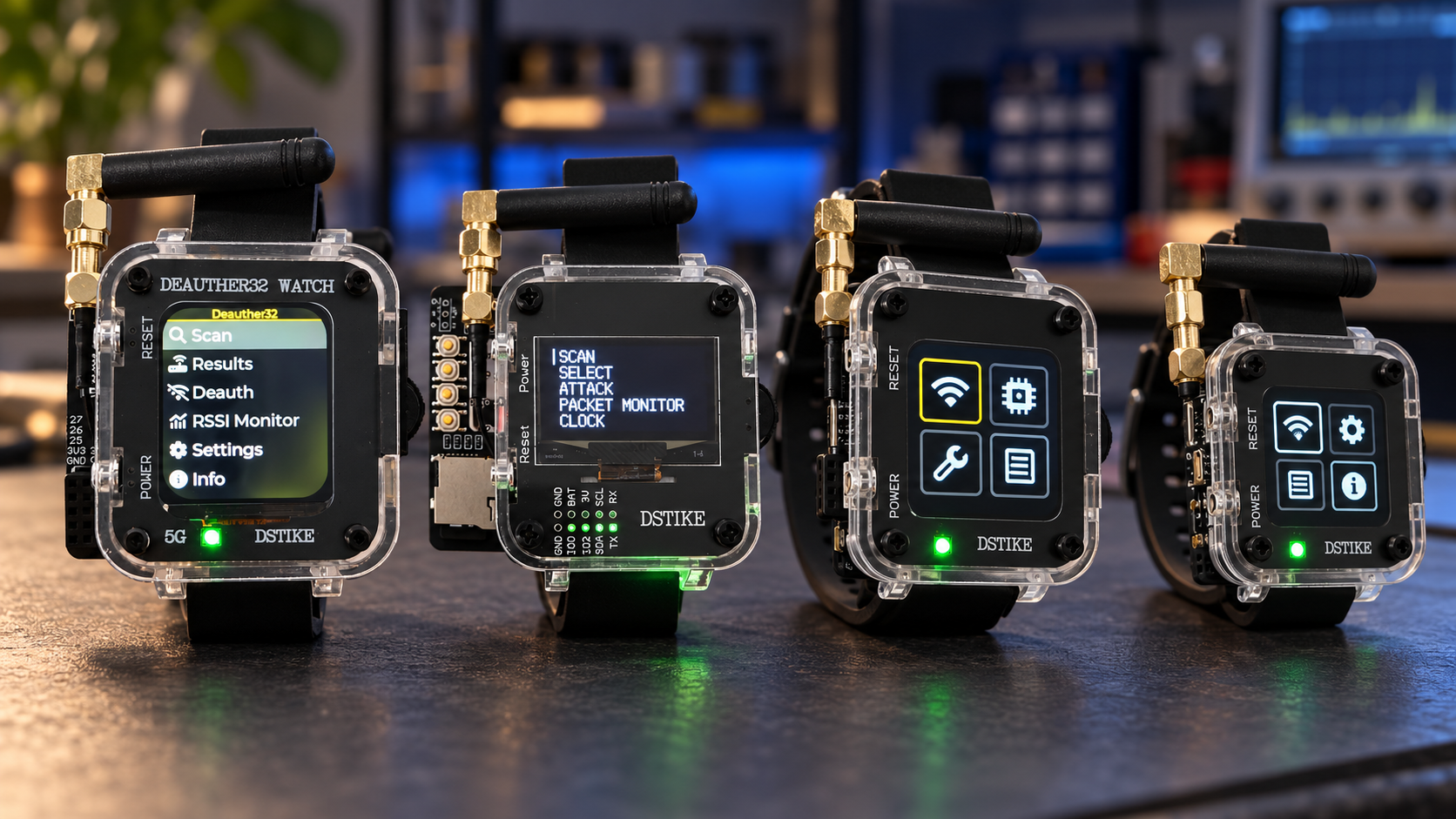
Choose the DSTIKE Watch X II if you want an ESP8266 watch for 2.4 GHz learning and its price is close to the original X. It adds USB-C and a larger battery without changing wireless bands. Choose Watch Y when its 1000mAh battery is your priority within the ESP8266 range. Choose the Deauther32 Watch MINI when you need 5 GHz support or prefer a color display. The original X makes most sense at a meaningful discount or for an existing project built around that model.
In this comparison, Deauther32 MINI means the Deauther32 Watch MINI. DSTIKE also sells a standalone Deauther32 MINI development board, so check that the product name includes “Watch” before ordering.
DSTIKE Watch X, X II, Y and Watch MINI at a glance
| Model | Platform and Wi-Fi bands | Display | Battery and USB |
|---|---|---|---|
| Watch X | ESP8266; 2.4 GHz only | 1.3-inch monochrome OLED | 500mAh; Micro USB |
| Watch X II | ESP8266; 2.4 GHz only | 1.3-inch monochrome OLED | 700mAh; USB-C |
| Watch Y | ESP8266; 2.4 GHz only | 1.3-inch monochrome OLED | 1000mAh; USB-C |
| Deauther32 Watch MINI | ESP32-C5; 2.4 GHz and 5 GHz | 1.54-inch IPS color LCD | 700mAh; USB-C |
The linked SDRstore listings describe the configurations compared here. The manufacturer's Watch MINI specifications confirm its ESP32-C5, dual-band radio and color display. Battery figures are nominal capacities; they do not establish a shared runtime ranking.
Watch X vs X II: a practical refresh for 2.4 GHz use
The original Watch X and X II belong to the same ESP8266 family. Both have a 1.3-inch OLED and support 2.4 GHz Wi-Fi. X II does not add 5 GHz. A firmware update cannot give the original X or X II a radio band their hardware lacks.
The useful everyday changes are the move from Micro USB to USB-C and the increase from 500mAh to 700mAh. The X II listing also documents revised fasteners, RGB LED and power-switch design. These changes make X II worth considering for a first purchase, especially when the two models cost about the same.
For an existing X owner, the upgrade is mainly about charging convenience and battery capacity. Keep the X if it already meets your needs. If your reason for upgrading is access to 5 GHz networks, move your comparison to Watch MINI instead.
Watch Y: choose it for battery capacity within the ESP8266 range
The Watch Y sold in this comparison combines a 1000mAh battery, USB-C and the familiar 1.3-inch OLED. It retains the ESP8266 and its 2.4 GHz limit. It suits a classroom or portable learning setup where battery capacity matters more than gaining another wireless band.
Its larger enclosure is worth considering before choosing it as something to wear throughout a session. The listing gives approximately 80 × 50 × 25 mm, compared with 60 × 50 × 25 mm for the original X. These are published dimensions, rather than measurements from a shared hands-on test.
Check the revision name. SDRstore's listing is Watch Y, also identified as the earlier V3S, while DSTIKE's current range includes Y II. The manufacturer's comparison distinguishes those revisions. Match the listing, photographs and supplied hardware rather than treating Y and Y II as interchangeable names.
Watch MINI: the meaningful upgrade for 5 GHz and a color screen
The Deauther32 Watch MINI changes the platform to ESP32-C5. Its documented radio supports 2.4 GHz and 5 GHz, with Wi-Fi 6 capability, and its 1.54-inch IPS color display offers a different interface from the monochrome ESP8266 watches. It has a 700mAh battery, USB-C, an internal dual-band antenna, a three-way slide control and a power button.
The Watch MINI product documentation describes dual-band scanning and signal observation. That makes it the relevant choice here when learning about networks on both bands. Its RSSI display can help compare received signal levels, but it is not a calibrated distance measurement.
Wi-Fi 6 capability does not mean 6 GHz support. The listed bands are 2.4 GHz and 5 GHz. It also does not mean 5G cellular connectivity, or guarantee that every capability of the chip is available in the supplied application.
Firmware and controls can matter more than the newer chip
X, X II and Y use the ESP8266 Deauther firmware family. Watch MINI uses the newer Deauther32 family. Menus, supported functions and update files differ, so an ESP8266 tutorial should not be assumed to apply to the ESP32-C5 watch.
There is also a control difference to check if you prefer using a phone. DSTIKE documents a local browser interface for supported classic ESP8266 watch firmware, while its current comparison describes Deauther32 watches as operating on the device without the same classic mobile interface. Confirm the installed build if browser control is important to your workflow.
Use DSTIKE's firmware and source-code resources to match the exact model, processor and board revision. A shared brand, connector or screen size does not make firmware files interchangeable. Choose based on documented features available now rather than an expected future update.
Understand the limits of a deauther watch
Supporting a network's band does not guarantee that every assessment function will work against that network. Protected Management Frames, or PMF, protect management traffic including deauthentication and disassociation frames. Espressif's Wi-Fi security documentation explains this protection. A newer watch or Wi-Fi 6 radio does not automatically bypass it.
For detailed packet-analysis work, plan the capture hardware, operating system, drivers and analysis software separately. Our WiFi packet capture hardware guide explains that workflow. Use these watches for learning and assessments within explicit authorization, and follow local radio and interference rules.
What to check before ordering
- Required bands: Choose Watch MINI if 5 GHz is essential. X, X II and Y are limited to 2.4 GHz.
- Exact model and revision: Check X versus X II, original Y versus Y II, and Watch MINI versus the standalone MINI board.
- Power and fit: Compare the connector, nominal battery capacity and case dimensions. Screen brightness, operating mode and battery condition affect endurance.
- Antenna package: Confirm the selected configuration and included parts. An optional expansion board does not establish that an external antenna is supplied.
- Firmware access: Confirm the supplied functions and recovery resources. Have a suitable USB data cable for updates; a charging-only cable will not provide data access.
Compare current prices in the DSTIKE range. If X and X II are close, X II is the more practical 2.4 GHz starting point. Pay more for Y when its larger battery is useful to you, or for Watch MINI when you need its additional band and color interface. For a classroom or multi-unit purchase, see how to request a formal SDRstore quote.
Frequently asked questions
Which of these DSTIKE watches supports 5 GHz?
The ESP32-C5 Deauther32 Watch MINI supports 2.4 GHz and 5 GHz. The ESP8266 Watch X, X II and Y support 2.4 GHz only. None of these four is listed as a 6 GHz model.
Is Watch X II worth buying over the original X?
Usually, when their prices are close and you want a new 2.4 GHz watch. X II offers USB-C and a 700mAh battery instead of Micro USB and 500mAh. It does not add another Wi-Fi band.
Does Watch Y have the best battery life?
Y has the largest listed battery capacity here at 1000mAh. That does not prove the longest runtime under every workload, particularly against the different processor and color display in Watch MINI. Comparable endurance requires a shared test method.
Is Deauther32 MINI the same product as Watch MINI?
No. DSTIKE uses MINI in more than one product name. This comparison covers the wearable Deauther32 Watch MINI. Check the full name and photographs so you do not order the standalone development board instead.
Can I install the same firmware on all four watches?
No. ESP8266 and ESP32-C5 require different firmware. Even within one processor family, use the build and instructions matching the exact board, display and hardware revision.
Will Watch MINI work against every Wi-Fi 6 network?
No. Radio compatibility, firmware functions, channel availability and network protection are separate considerations. PMF can protect management traffic against spoofed disconnect frames. Wi-Fi 6 capability is not a promise that every active assessment function will succeed.
Shop products for this guide
Explore relevant products from our store.
Alternatives considered
Other relevant options for this guide.
-
DSTIKE Deauther32 Watch MINI ESP32-C5 Dual-Band WiFi 6 Security Testing Watch
The article’s Watch MINI listing explicitly confirms a 1.54-inch IPS color display and dual-band support; choose it if verified color is essential, while Watch Max is described as its upgraded successor.
-
DSTIKE Deauther Watch X II ESP8266 2.4GHz WiFi Security Testing Watch
The article’s exact X II model matches its 2.4 GHz comparison and lists USB-C with a 700mAh battery; Watch Z lists 1000mAh and adds TF-card and BadUSB functions.
-
DSTIKE Deauther Watch X ESP8266 2.4GHz WiFi Security Testing Watch
The original X is the article’s older comparison model; Watch Z is listed with USB-C and 1000mAh, rather than the X’s article-stated Micro USB and 500mAh.
-
DSTIKE Deauther Watch Y ESP8266 2.4GHz WiFi Security Testing Watch
The article warns that this Watch Y listing is the earlier V3S revision, not Y II; Watch Z’s listing specifies its 1000mAh battery and USB-C.
-
DSTIKE Deauther MiNi V4 ESP8266 OLED 2.4GHz WiFi Security Testing Board
Deauther MiNi V4 is an ESP8266 development board, not a wearable watch; Watch Z is explicitly a watch.
-
DSTIKE Deauther Monster
Deauther Monster is an ESP8266 board rather than a wearable watch; Watch Z is explicitly a watch with USB-C and a 1000mAh battery.
No posts found
Write a review






We support all major card and digital payment options. More local methods are available and shown during checkout.
You enter into a binding sales contract once you have received an 'order confirmation and sales receipt' email from us, in line with our Sales & Delivery conditions. Therefore, sdrstore.eu has the right to cancel your order in the event of technical problems, delivery failure, Fair use policy and other similar situations.






Your payments are protected by advanced encryption and 3-D Secure authentication for safe online shopping.