





RFID vs NFC: Frequencies, Range, Tags, Readers, and Security Explained
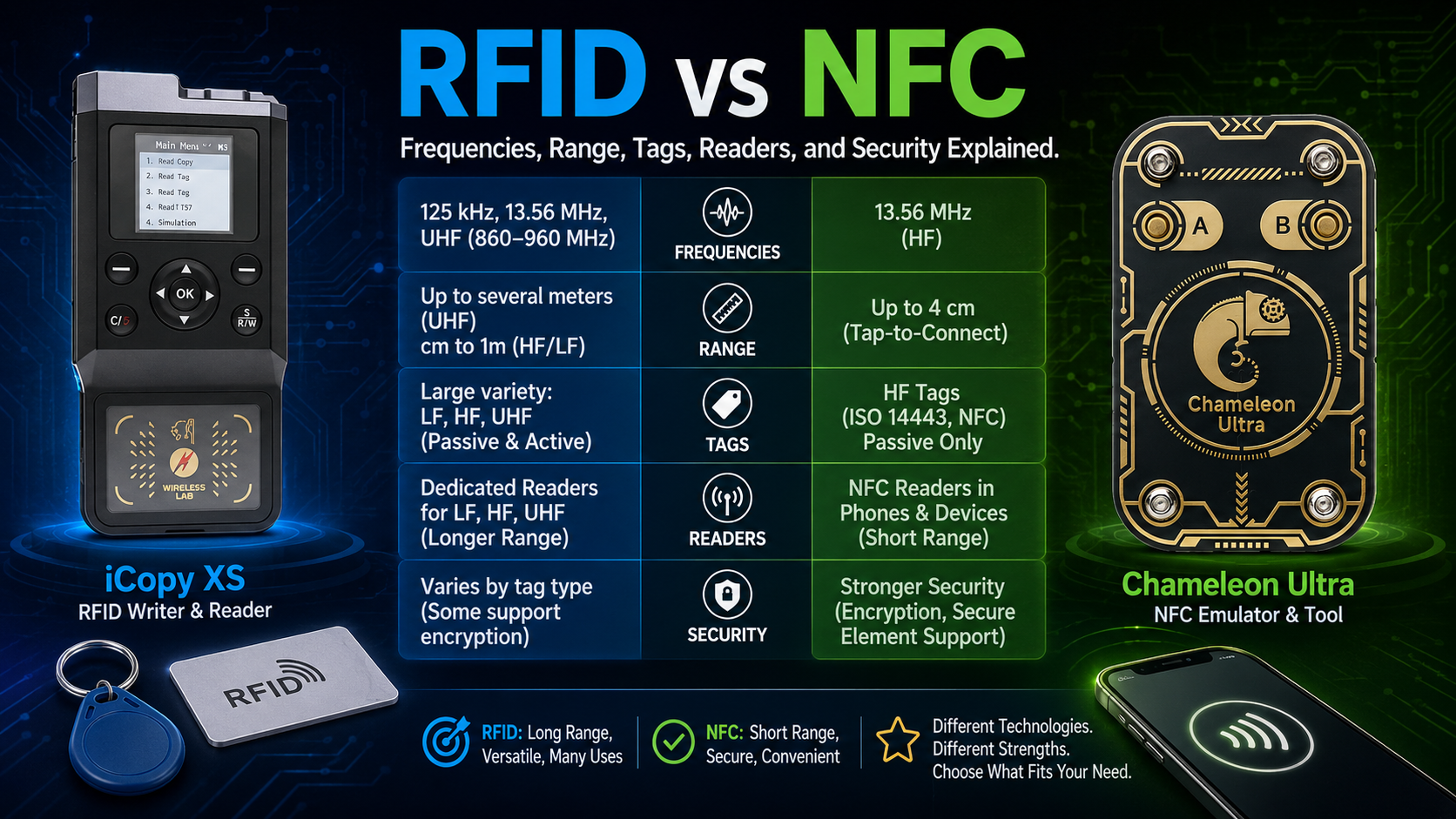
RFID and NFC are often mentioned together, but they are not interchangeable terms. Both technologies use radio signals to identify, read, or exchange data with nearby tags and devices. However, their typical frequencies, read ranges, hardware, use cases, and security models can be very different.
RFID is the broader category. It includes low-frequency access badges, animal microchips, high-frequency smart cards, warehouse inventory labels, long-range asset-tracking tags, and many other systems.
NFC is a specific short-range contactless technology operating at 13.56 MHz. It is commonly used for tap-to-pay, smartphone interactions, digital keys, ticketing, device pairing, and reading NFC tags.
This RFID vs NFC guide explains the differences clearly, including LF, HF, and UHF RFID frequencies, realistic read ranges, passive and active tags, readers, smartphones, access-control cards, inventory tracking, and security.
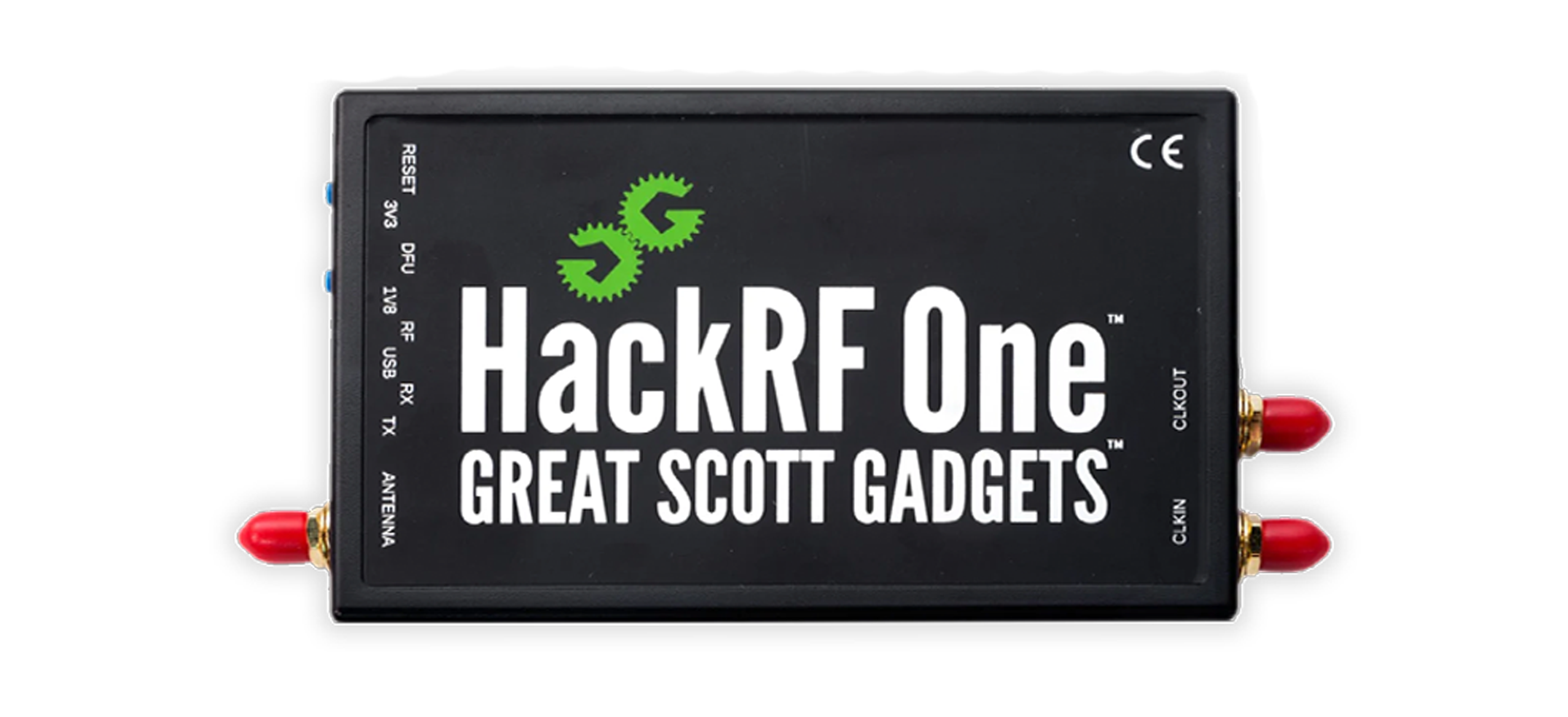
For RFID and NFC testing equipment, browse the RFID and NFC tools available at SDRstore.eu.
Quick Answer: What Is the Difference Between RFID and NFC?
RFID is a broad term for radio-frequency identification technologies. NFC is a specific short-range contactless technology within the wider RFID landscape.
| Feature | RFID | NFC |
|---|---|---|
| Full name | Radio-Frequency Identification | Near Field Communication |
| Technology scope | Broad category with LF, HF, and UHF systems | Specific short-range contactless technology |
| Common frequency | 125 kHz, 134 kHz, 13.56 MHz, and UHF bands around 860–930 MHz | 13.56 MHz |
| Typical range | From a few centimeters to several meters depending on system type | Normally a tap or very close proximity |
| Common devices | Access badges, animal tags, inventory labels, asset trackers, readers, gates, and handheld scanners | Smartphones, payment cards, NFC tags, smart locks, ticketing systems, and contactless terminals |
| Battery required | Not for passive RFID tags; active tags normally use a battery | Not for passive NFC tags |
| Phone compatibility | Depends on frequency and protocol | Commonly supported by modern smartphones |
| Best for | Identification, access control, tracking, logistics, and inventory | Tap-based interactions, payments, pairing, ticketing, and phone-readable tags |
The easiest way to remember the difference is:
- RFID is the larger family of radio-identification systems.
- NFC is the close-range, phone-friendly 13.56 MHz technology used for tap-based interactions.
What Is RFID?
RFID stands for Radio-Frequency Identification. An RFID system uses radio waves to identify or exchange data with a tag.
A basic RFID system normally includes:
- An RFID tag, badge, label, card, key fob, or transponder
- An antenna inside the tag
- An RFID reader or interrogator
- A reader antenna
- Software or a backend system that interprets the data
RFID can be used for simple identification, but more advanced systems may also support authentication, encryption, sensors, memory, access permissions, item tracking, and audit logs.
Common RFID use cases
- Building access badges
- Hotel key cards
- Animal identification
- Warehouse inventory tracking
- Retail stock management
- Supply-chain visibility
- Event wristbands
- Public-transport cards
- Vehicle identification
- Asset tracking
- Library systems
- Contactless payments
What Is NFC?
NFC stands for Near Field Communication. It is a short-range contactless technology operating at 13.56 MHz.
NFC is designed around intentional proximity. In most everyday situations, the user taps or holds a phone, card, or tag very close to another NFC device.
This close-range experience makes NFC useful for interactions where a person deliberately chooses to perform an action.
Common NFC use cases
- Tap-to-pay transactions
- Contactless transport tickets
- Digital car keys
- Smart locks
- Hotel keys
- NFC business cards
- Product authentication
- Device pairing
- Opening a website from a tag
- Launching phone automations
- Reading product information
- Access-control systems
Is NFC a Type of RFID?
NFC belongs to the broader world of RFID and contactless smart-card technologies, but not every RFID tag is an NFC tag.
NFC uses the 13.56 MHz high-frequency band. Other RFID systems may use low frequencies around 125 kHz or 134 kHz, high-frequency protocols that are not intended for normal NFC phone interactions, or UHF bands around 860–930 MHz for longer-range inventory tracking.
Examples
- A 125 kHz building-access badge is RFID, but it is not NFC.
- A passive warehouse label read from several meters away is normally UHF RFID, not NFC.
- A smartphone-readable URL sticker is normally an NFC tag.
- A contactless payment card uses 13.56 MHz technology and can interact with NFC-compatible readers.
RFID Frequencies Explained: LF vs HF vs UHF
The frequency band is one of the most important differences between RFID systems. Frequency affects antenna size, range, speed, interference behavior, reader design, and common applications.
| RFID Type | Common Frequency | Typical Read Range | Common Uses |
|---|---|---|---|
| LF RFID | 125 kHz and 134 kHz | Approximately 10–50 cm | Animal tags, access badges, key fobs, and identification |
| HF RFID | 13.56 MHz | Approximately 10 cm to 1 m depending on protocol and hardware | Access cards, ticketing, payments, e-passports, libraries, and data transfer |
| NFC | 13.56 MHz | Normally a tap or very close proximity, typically up to a few centimeters | Smartphones, payments, tags, pairing, digital keys, and ticketing |
| UHF RFID / RAIN RFID | Approximately 860–930 MHz depending on region | Up to approximately 10 m in suitable environments | Inventory, logistics, retail stock, supply chains, and asset tracking |
These are general ranges rather than guarantees. Real performance depends on the tag, reader, antenna, orientation, materials, output power, protocol, and environment.
What Is LF RFID?
LF RFID normally operates around 125 kHz or 134 kHz. It is widely used for basic identification and proximity-based systems.
LF RFID is commonly used for:
- Older building-access badges
- Key fobs
- Animal microchips
- Industrial identification
- Simple proximity systems
LF systems normally have short read ranges and relatively low data rates. Their behavior can be useful in environments where a deliberate close presentation is preferred.
Many older access-control badges use LF RFID. However, a short range does not automatically mean strong security. A secure access-control system should not rely only on a visible or easily read identifier.
What Is HF RFID?
HF RFID normally operates at 13.56 MHz. This frequency band includes multiple technologies and protocols used for access control, payments, ticketing, e-passports, libraries, data transfer, and smart cards.
NFC also operates at 13.56 MHz, but HF RFID and NFC should not be treated as identical terms. Some HF RFID systems use protocols and read ranges outside the normal tap-based NFC phone experience.
HF RFID is commonly used for:
- Smart access cards
- Public-transport tickets
- Event tickets
- Contactless payments
- Libraries
- E-passports
- Product identification
- Secure credentials
What Is UHF RFID or RAIN RFID?
Passive UHF RFID, also known as RAIN RFID, is commonly used for inventory and logistics. It typically operates in regional frequency bands around 860–930 MHz.
UHF readers can scan compatible passive labels from several meters away under suitable conditions. They can also identify multiple tagged items quickly, making the technology useful in warehouses, retail stores, supply chains, and industrial environments.
UHF RFID is commonly used for:
- Warehouse inventory
- Retail stock counting
- Supply-chain tracking
- Logistics
- Apparel labels
- Asset management
- Shipping and receiving
- Industrial automation
A UHF inventory label is not normally read by tapping it with a standard phone. It requires a compatible UHF RFID reader and antenna system.
RFID vs NFC Range: How Far Can Tags Be Read?
Read range is one of the most visible differences between RFID and NFC.
| Technology | Typical Range | Important Limitation |
|---|---|---|
| LF RFID | Short range, often within tens of centimeters | Depends on reader coil, badge design, and orientation |
| HF RFID | From close proximity to longer short-range applications | HF is a broad category with several standards |
| NFC | Usually a tap or a few centimeters | Designed around intentional close interaction |
| Passive UHF RFID | Several meters in suitable conditions | Metal, liquids, reader placement, and antenna orientation can change results |
| Active RFID | Potentially much longer range | Requires powered tags and depends heavily on the system design |
Do not assume that every tag can be read at the maximum possible distance for its frequency band. Real-world range varies substantially.
Why Is NFC Range So Short?
NFC is intentionally designed for close interactions. A user normally taps a device, card, or tag against a reader or holds it nearby.
This creates a simple user experience:
- The user clearly chooses which object to scan.
- The correct reader is easier to identify.
- Accidental reads are less likely.
- Phone interactions feel fast and deliberate.
- Physical proximity adds a useful layer of control.
However, short range alone is not a complete security system. Secure applications still need appropriate authentication, cryptography, backend validation, and reader configuration.
Passive vs Active RFID Tags
RFID tags can also be classified by how they receive power and communicate.
| Tag Type | Power Source | Communication Style | Common Uses |
|---|---|---|---|
| Passive RFID tag | No battery | Draws energy from the reader and responds using the available RF field | Access cards, labels, tickets, NFC tags, inventory labels, and product tags |
| Battery-assisted passive tag | Battery supports circuitry or sensors | Still communicates using a reader-driven backscatter method | Sensor tags and longer-range specialized tracking |
| Active RFID tag | Normally includes a battery | Uses an onboard transmitter to broadcast information | High-value assets, vehicles, equipment, and long-range industrial tracking |
Are NFC tags passive?
Many everyday NFC tags are passive. They do not need a battery because the NFC reader or phone provides enough energy for the tag to respond.
This makes NFC tags useful for stickers, product labels, cards, key fobs, packaging, and other low-maintenance applications.
RFID Tags vs NFC Tags
| Feature | RFID Tag | NFC Tag |
|---|---|---|
| Meaning | Any compatible tag within the wider RFID family | A tag intended for NFC-compatible 13.56 MHz interactions |
| Phone readable | Not always | Commonly, when the phone and tag format are compatible |
| Range | Varies from close proximity to several meters or more | Normally a tap or close proximity |
| Common form factors | Cards, fobs, labels, stickers, hard tags, wristbands, animal tags, and industrial tags | Stickers, cards, key fobs, wristbands, product labels, and embedded tags |
| Common uses | Tracking, identification, access control, logistics, and inventory | Smartphone actions, payments, ticketing, pairing, and tap-based information sharing |
What Is an RFID Reader?
An RFID reader creates the radio field or receives signals needed to communicate with compatible tags.
Reader hardware varies depending on the system:
- A wall-mounted access-control reader may scan a badge presented at a door.
- A handheld UHF reader may scan warehouse inventory labels.
- A fixed gate reader may detect tagged items moving through a loading area.
- A smartphone can read many NFC tags.
- A specialist research tool can inspect supported LF and HF badge technologies in an authorized lab.
Can a Smartphone Read RFID Tags?
A normal smartphone cannot read every RFID tag.
Most modern smartphones include NFC hardware, so they can interact with supported 13.56 MHz NFC tags and compatible contactless technologies.
A standard phone does not normally read:
- 125 kHz LF RFID badges
- 134 kHz animal-identification tags
- Passive UHF warehouse labels
- Specialized active RFID tracking tags
Those systems require dedicated readers designed for the correct frequency and protocol.
NFC Operating Modes Explained
NFC supports several types of interaction.
| NFC Mode | What It Does | Example |
|---|---|---|
| Reader / Writer mode | An NFC device reads or writes compatible tags | A phone reads a URL from an NFC sticker |
| Card emulation | An NFC device behaves like a contactless card | A phone or wearable is used for an approved payment or ticket |
| Peer-to-peer communication | Two compatible NFC devices exchange information | Tap-based device interaction or connection setup |
| Wireless charging mode | NFC manages low-power wireless charging for supported devices | Small accessories and wearable devices |
RFID vs NFC for Access Control
Both RFID and NFC technologies can be used in access-control systems, but the badge frequency alone does not determine security.
Common access-control technologies include:
- LF RFID proximity badges around 125 kHz
- HF contactless cards at 13.56 MHz
- NFC-compatible smartphone credentials
- Smart cards with cryptographic authentication
- Mobile wallets and digital keys
Older systems may rely heavily on a static identifier. Modern systems should use stronger credential designs, secure readers, diversified keys, mutual authentication, protected communication, monitoring, and backend controls.
Is NFC More Secure Than RFID?
NFC is not automatically more secure than every RFID system. The answer depends on the tag, reader, protocol, application, and backend.
NFC has a useful practical advantage: the user normally needs to bring the device very close to the reader. This reduces accidental reads and makes the intended interaction clearer.
However, proximity is only one security layer. A secure system may also need:
- Cryptographic authentication
- Secure key storage
- Diversified keys
- Encrypted communication
- Backend validation
- Transaction checks
- Reader hardening
- Monitoring and audit logs
- Revocation procedures for lost credentials
Why a UID Alone Is Not Enough for Secure Access Control
Many RFID and NFC tags contain an identifier, often called a UID or serial number. This identifier can be useful for selecting a tag or associating it with a record.
However, a secure access-control system should not rely only on a readable identifier. A static identifier is not the same thing as cryptographic proof that a credential is genuine and authorized.
Better access-control systems use stronger security measures such as mutual authentication, encrypted data exchange, protected keys, and backend verification.
Modern Smart-Card Security
More advanced HF smart cards can support significantly stronger security than simple identifier-based badges.
Depending on the card platform and configuration, modern systems may use:
- AES-based authentication
- Secure messaging
- Diversified keys
- Transaction integrity checks
- Privacy-protecting identifiers
- Anti-relay or proximity-check features
- Backend verification
Security still depends on correct implementation. A capable smart card can be deployed poorly if readers, keys, and backend systems are not managed securely.
RFID vs NFC for Inventory and Logistics
NFC is normally not the first choice for large warehouse inventories. Its close-range tap interaction is useful when the user intentionally scans one object.
Passive UHF RFID is more suitable for scanning multiple items quickly from a greater distance. It is commonly used for stock counting, supply-chain tracking, and logistics.
| Inventory Goal | Better Fit | Why |
|---|---|---|
| Scan many products quickly | UHF RFID / RAIN RFID | Longer range and fast multi-tag identification |
| Let a customer tap a product with a phone | NFC | Easy smartphone interaction |
| Track warehouse items through fixed gates | UHF RFID | Designed for logistics and asset identification |
| Open a product-information page | NFC | Simple tap-based experience |
| Authenticate premium products | Secure NFC tag | Suitable for intentional phone-readable verification workflows |
RFID vs NFC for Payments
NFC is strongly associated with contactless payments because it is designed for close-range, intentional interactions with phones, watches, cards, and payment terminals.
Payment security does not rely on the radio frequency alone. Modern payment systems use secure credential handling, transaction protocols, tokenization or protected card data, reader validation, and backend controls.
RFID vs NFC for Product Authentication
NFC tags can be useful for brand protection and product authentication because customers can tap a product with a compatible phone.
A secure implementation may combine:
- A protected NFC chip
- A unique tag identity
- Cryptographic authentication
- A secure backend
- A product-information page
- Dynamic validation data
- Anti-tamper packaging
A simple NFC sticker containing only a static URL can still be useful for convenience, but it should not automatically be treated as proof that a product is genuine.
RFID vs NFC Reader Comparison
| Reader Type | Frequency | Best For |
|---|---|---|
| LF RFID reader | 125 kHz or 134 kHz | Older access badges, animal tags, and proximity credentials |
| HF RFID reader | 13.56 MHz | Smart cards, ticketing, access-control cards, and contactless applications |
| NFC smartphone | 13.56 MHz | NFC tags, approved payments, pairing, and tap-based interactions |
| UHF RFID reader | Regional bands around 860–930 MHz | Inventory, asset tracking, retail, and logistics |
| Multi-frequency RFID research tool | Supported LF and HF bands depending on hardware | Authorized badge identification, testing, development, and security audits |
Best RFID and NFC Tools for Authorized Testing
RFID and NFC tools should only be used with cards, badges, tags, readers, and systems that you own, manage, or have explicit permission to test.
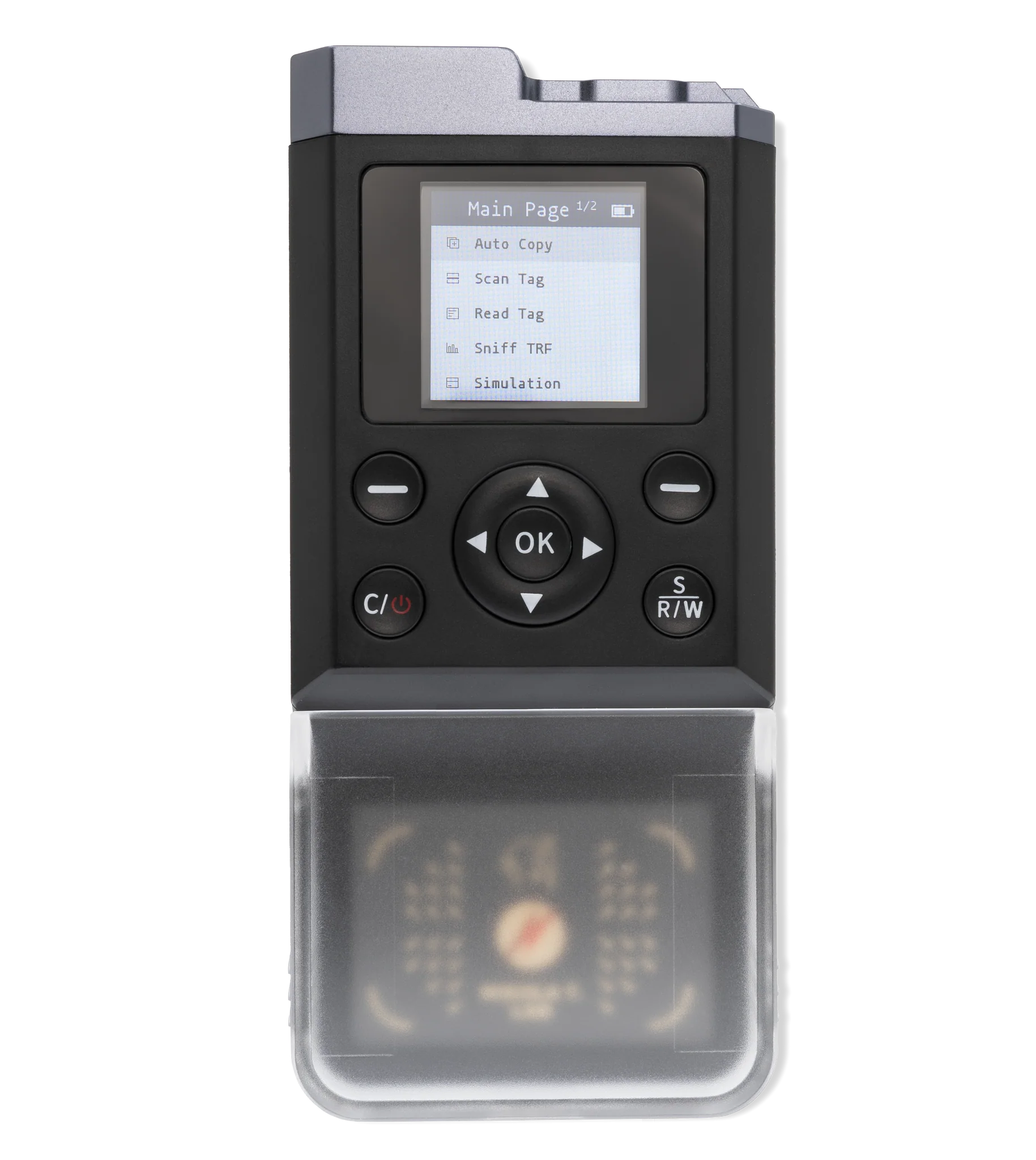
iCopy XS for guided handheld badge testing
The iCopy XS Advanced Version is a portable Proxmark-based RFID and NFC tool designed for field workflows. It supports common LF and HF badge technologies and includes a screen, physical controls, battery-powered operation, and Proxmark mode for more advanced authorized testing.
Read the full guide: iCopy XS Review: Hands-On RFID/NFC Tool for Authorized Badge Testing.
Chameleon Ultra for compact RFID and NFC emulation testing
The Chameleon Ultra is a compact open-source LF and HF RFID tool designed for authorized emulation, reading, writing, development, and controlled testing workflows.
Proxmark3 for deeper RFID and NFC research
A Proxmark3 RFID and NFC research platform is better suited to technical users who want deeper protocol analysis, lab work, and more manual control.
Read the comparison: iCopy XS vs Proxmark3 vs Chameleon Ultra: Which RFID Tool Should You Buy?
Browse RFID and NFC tools
- RFID and NFC tools, readers, and devices
- RFID instruments and research tools
- NFC instruments and tools
Which Technology Should You Choose?
| Your Goal | Best Technology | Reason |
|---|---|---|
| Tap a product with a smartphone | NFC | Phone-friendly and designed for close interactions |
| Contactless payment | NFC-compatible contactless system | Built for intentional tap-based transactions |
| Older proximity badge system | LF RFID | Common in legacy access-control deployments |
| Modern secure access card | HF smart-card technology with appropriate cryptographic security | Supports stronger authentication and protected communication |
| Warehouse inventory | UHF RFID / RAIN RFID | Longer range and multi-tag reading |
| Animal identification | LF RFID | Widely used for animal tags |
| Phone-readable product information | NFC tag | Easy consumer interaction |
| Authorized badge-security testing | Multi-frequency RFID and NFC research tool | Allows controlled analysis of supported systems |
Common RFID and NFC Misconceptions
RFID and NFC are the same thing
NFC operates within the wider RFID and contactless-technology landscape, but RFID includes many systems that NFC phones cannot read.
Every RFID tag can be scanned from far away
Read range depends on the technology. Some tags need to be presented very close to the reader, while passive UHF labels can work from several meters away under suitable conditions.
Every NFC tag is secure
A basic NFC sticker may contain only a readable URL or text record. Strong security requires an appropriate tag, protocol, key-management design, and backend.
A phone can read every access badge
A phone normally supports NFC-compatible 13.56 MHz interactions. It does not automatically read LF proximity badges or UHF inventory labels.
Short range automatically prevents attacks
Short range improves user control and reduces accidental reads, but secure systems still need authentication, cryptography, reader security, and backend validation.
A low SWR antenna or stronger reader always solves range problems
RFID performance also depends on tag orientation, reader antenna position, nearby materials, frequency, protocol, power limits, and the physical environment.
Important Legal and Ethical Note
RFID and NFC tools should only be used with tags, badges, cards, readers, and systems that you own, manage, or have explicit permission to test.
These technologies are valuable for access-control audits, inventory systems, development, troubleshooting, education, and authorized security research. They should not be used to access buildings, credentials, devices, or systems without permission.
Final Verdict: RFID vs NFC
RFID is the broad category. NFC is the close-range, 13.56 MHz, phone-friendly technology designed for deliberate tap-based interactions.
Choose LF RFID for applications such as basic proximity identification and animal tags. Choose HF RFID or a modern smart-card platform for suitable access-control, ticketing, and secure contactless applications. Choose passive UHF RFID for warehouse inventory, logistics, and multi-item tracking. Choose NFC when smartphones, payments, pairing, product information, and easy tap-based interactions matter.
Security should never be judged only by frequency or read range. The strongest systems combine appropriate hardware with cryptographic authentication, secure keys, reader protection, backend validation, monitoring, and careful deployment.
FAQ
What is the difference between RFID and NFC?
RFID is a broad category of radio-frequency identification technologies. NFC is a specific short-range 13.56 MHz contactless technology designed for tap-based interactions with phones, cards, tags, and compatible readers.
Is NFC a type of RFID?
NFC belongs to the wider RFID and contactless-technology landscape, but not every RFID tag is an NFC tag. RFID also includes LF badges and UHF inventory labels that normal NFC phones cannot read.
What frequency does NFC use?
NFC operates at 13.56 MHz.
What frequencies does RFID use?
Common RFID systems use LF frequencies around 125 kHz and 134 kHz, HF at 13.56 MHz, and UHF bands around 860–930 MHz depending on the region and application.
What is the range of NFC?
NFC is designed for close interactions, normally a tap or a few centimeters. The exact range depends on the phone, reader, antenna, tag, and environment.
What is the range of RFID?
RFID range varies widely. LF systems commonly work within tens of centimeters, HF systems can extend farther depending on the protocol, and passive UHF inventory tags can reach several meters in suitable environments.
Can a smartphone read RFID tags?
A smartphone can read many compatible NFC tags at 13.56 MHz. It does not normally read LF access badges, animal microchips, UHF inventory labels, or active RFID tags without additional hardware.
Are NFC tags passive?
Many NFC tags are passive and do not need a battery. They receive enough energy from the NFC reader or phone to respond.
What is the difference between LF, HF, and UHF RFID?
LF RFID commonly uses 125 kHz or 134 kHz for short-range identification. HF RFID normally uses 13.56 MHz for smart cards, ticketing, and contactless applications. UHF RFID uses regional bands around 860–930 MHz for longer-range inventory and logistics.
Is NFC more secure than RFID?
NFC is not automatically more secure than every RFID system. Security depends on the credential chip, protocol, authentication method, key management, reader, backend, and deployment.
Can NFC be read from far away?
NFC is designed for close-range interaction. In normal use, the phone, card, or tag is tapped or held within a few centimeters of the reader.
What is UHF RFID used for?
UHF RFID, also known as RAIN RFID, is commonly used for inventory, retail stock management, logistics, supply-chain tracking, and asset identification.
What is an active RFID tag?
An active RFID tag normally includes a battery and transmitter. It can broadcast information over a longer distance than a passive tag, depending on the system design.
What is a passive RFID tag?
A passive RFID tag does not need a battery. It receives energy from the reader and responds using the available RF field.
Is a UID enough for secure access control?
A UID alone should not be treated as strong proof that a badge is genuine and authorized. Secure systems should use appropriate authentication, protected keys, reader security, and backend validation.
Which RFID tool is best for authorized badge testing?
iCopy XS is useful for guided handheld testing, Chameleon Ultra is useful for compact RFID and NFC emulation-focused workflows, and Proxmark3 is better for deeper technical research.
No posts found
Write a review




We support all major card and digital payment options. More local methods are available and shown during checkout.
You enter into a binding sales contract once you have received an 'order confirmation and sales receipt' email from us, in line with our Sales & Delivery conditions. Therefore, sdrstore.eu has the right to cancel your order in the event of technical problems, delivery failure, Fair use policy and other similar situations.






Your payments are protected by advanced encryption and 3-D Secure authentication for safe online shopping.