





Best Portable Spectrum Analyzer in 2026: TinySA, SA6, SA8, and Other Options
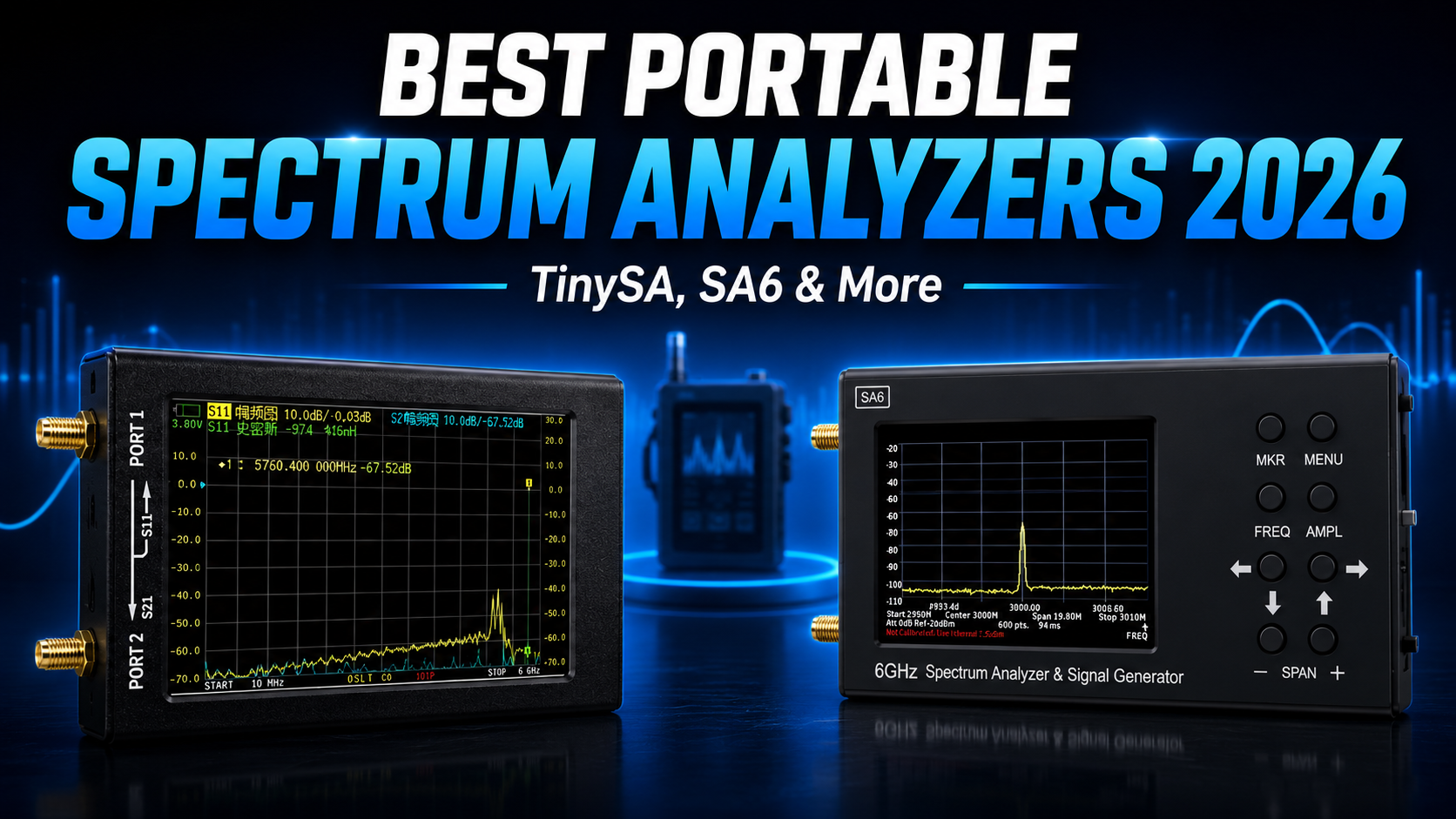
A spectrum analyzer used to mean a large laboratory instrument costing thousands or tens of thousands of euros. In 2026, RF engineers, amateur-radio operators, SDR users, field technicians and university students have far more portable options.
Affordable devices such as tinySA Ultra, tinySA Ultra+ ZS407, SA6 and SA8 can now fit in a small field bag while covering frequencies into the gigahertz range. More advanced USB instruments such as the Signal Hound BB60D add real-time spectrum analysis, while professional handhelds from Rohde & Schwarz and Anritsu bring calibrated field measurements into an entirely different performance class.
The problem is that specifications are easy to misunderstand.
A device advertising “6 GHz” or “7.3 GHz” does not necessarily provide the same sensitivity, dynamic range, resolution bandwidth or measurement accuracy across that entire frequency range. A swept analyzer does not automatically capture short RF bursts like a real-time analyzer. And a product named “SA8” does not necessarily measure to 8 GHz.
This guide compares the best portable spectrum analyzers available in 2026 and explains which one makes sense for ham radio, SDR troubleshooting, Wi-Fi, interference hunting, transmitter testing, RF laboratories and professional field work.
Best Portable Spectrum Analyzer in 2026: Quick Verdict
| Category | Recommended analyzer | Why |
|---|---|---|
| Best affordable portable spectrum analyzer overall | tinySA Ultra+ ZS407 | Official coverage to 7.3 GHz, fine RBW, LNA, attenuation, MicroSD and strong firmware ecosystem |
| Best value if 5 GHz-class coverage is enough | tinySA Ultra | Mature ecosystem, low price and very useful portable RF features |
| Best SA6-style field alternative | SA6 | 35–6200 MHz displayed range, standalone controls and tracking-generator functionality |
| Best alternative SA6/SA8 variant | SA6 Plus / SA8 | Portable RF analysis and tracking generator, but specifications require careful interpretation |
| Best polished 6 GHz standalone alternative | RF Explorer 6G Combo PLUS | Established handheld platform, 50 kHz–6.1 GHz base coverage and dedicated Wi-Fi tools |
| Best portable real-time spectrum analyzer | Signal Hound BB60D | 27 MHz gapless real-time bandwidth and professional PC-based spectrum analysis |
| Best professional standalone handheld | Rohde & Schwarz Spectrum Rider FPH | Professional measurement performance, field durability and models extending far beyond 6 GHz |
For most SDRstore.eu customers, tinySA Ultra+ ZS407 is the best overall portable spectrum analyzer in 2026.
It combines an unusually wide frequency range with substantially more flexible resolution bandwidth than the SA6/SA8 family, plus an active firmware ecosystem and strong community documentation.
But it is not the right answer for every application. If you need gapless real-time capture, traceable measurements, extreme dynamic range or formal compliance testing, you need to move into a different instrument class.
What Does “Portable Spectrum Analyzer” Actually Mean?
There are now three different categories sold under the portable-spectrum-analyzer label.
1. Pocket and handheld swept analyzers
Examples:
- tinySA;
- tinySA Ultra;
- tinySA Ultra+;
- SA6;
- SA8;
- RF Explorer.
These units contain their own:
- display;
- battery;
- controls;
- RF input;
- spectrum-analysis firmware.
You can walk into the field and use them without a laptop.
2. USB portable spectrum analyzers
Examples include Signal Hound BB60-series instruments.
The RF hardware is portable, but the computer performs much of the display and signal processing.
The advantages can include:
- much higher processing power;
- real-time analysis;
- larger displays;
- advanced recording;
- API automation;
- more sophisticated measurements.
3. Professional handheld field analyzers
Examples include:
- Rohde & Schwarz Spectrum Rider FPH;
- Anritsu Field Master-series instruments;
- Keysight FieldFox configurations.
These cost dramatically more because their value is not simply frequency coverage.
You are paying for characteristics such as:
- calibrated amplitude accuracy;
- lower displayed average noise level;
- better phase noise;
- better dynamic range;
- measurement repeatability;
- preselection;
- advanced triggering;
- professional reporting;
- service and calibration support.
Portable Spectrum Analyzer Comparison
| Model | Frequency direction | RBW / instantaneous bandwidth direction | Standalone? | Real-time? |
|---|---|---|---|---|
| tinySA Basic | 100 kHz–350 MHz low input; 240–960 MHz high input | 3 kHz–600 kHz RBW | Yes | No |
| tinySA Ultra ZS405 | 100 kHz–800 MHz normal; approximately 5.3 GHz Ultra mode | 200 Hz–850 kHz RBW | Yes | No |
| tinySA Ultra+ ZS407 | 100 kHz–900 MHz normal; 7.3 GHz Ultra mode | 200 Hz–850 kHz RBW | Yes | No |
| SA6 | 35–6200 MHz displayed range | Varies by revision; verify documentation | Yes | No |
| SA6 Plus / SA8 | 35–6200 MHz display; seller lists measurement to 4500 MHz | Approximately 170–200 kHz listed | Yes | No |
| RF Explorer 6G Combo PLUS | 50 kHz–6.1 GHz, expansion available on supported configuration | Swept handheld architecture | Yes | No |
| Signal Hound BB60D | 9 kHz–6 GHz | 27 MHz instantaneous real-time bandwidth | No, requires PC | Yes |
| R&S Spectrum Rider FPH | Models extending from kHz frequencies to as high as 44 GHz | Professional analyzer architecture | Yes | Configuration-dependent advanced modes |
The important lesson is that maximum frequency alone is a poor way to choose a spectrum analyzer.
1. tinySA Ultra+ ZS407: Best Overall Affordable Portable Spectrum Analyzer
If we had to recommend one affordable handheld spectrum analyzer for a technically curious buyer in 2026, it would be the tinySA Ultra+ ZS407.
The key reason is not simply that the front of the device says 7.3 GHz.
It is the combination of:
- wide frequency coverage;
- fine resolution filters;
- built-in attenuation;
- optional internal LNA;
- high sweep speed for its price class;
- MicroSD storage;
- PC control;
- signal-generation functionality;
- actively maintained documentation;
- a large technical user community.
Official tinySA Ultra+ ZS407 frequency coverage
The official tinySA documentation currently specifies:
- 100 kHz–900 MHz in normal input mode;
- operation to 7.3 GHz with Ultra mode enabled;
- level calibration through the 7.3 GHz Ultra range;
- harmonic observation modes extending higher, but with additional limitations.
This distinction matters.
The instrument architecture is not identical below 900 MHz and above 900 MHz. Ultra mode bypasses parts of the normal low-frequency RF filtering architecture to extend coverage.
That means you should not assume the same measurement quality at 7 GHz that you receive at 100 MHz.
Resolution bandwidth
The tinySA Ultra family provides selectable resolution filtering from approximately:
200 Hz to 850 kHz
This is an enormous advantage over a portable analyzer with only a roughly 200 kHz fixed measurement bandwidth.
Narrow RBW can help when:
- two signals are close together;
- you are looking for weak narrowband carriers;
- you are inspecting spurs;
- you need a lower visible noise floor;
- you are measuring narrow radio signals.
The trade-off is sweep speed. Narrower filters usually require slower sweeps.
Internal LNA and attenuator
tinySA Ultra+ includes:
- optional internal LNA;
- 0–31 dB internal attenuation in 1 dB steps when the LNA is not active.
This gives the operator more control when moving between weak-signal and strong-signal environments.
MicroSD storage
MicroSD support is useful for:
- screenshots;
- measurement storage;
- field documentation;
- configurations.
Who should buy ZS407?
- SDR users;
- ham radio operators;
- RF students;
- electronics technicians;
- Wi-Fi and ISM experimenters;
- IoT developers;
- RF interference hunters;
- university teaching labs;
- people who want one compact analyzer covering sub-GHz through 5.8/6 GHz-class work.
tinySA Ultra+ ZS407 Limitations
ZS407 is exceptionally capable for its price and size, but it remains a low-cost swept analyzer.
It does not provide:
- 27 MHz of gapless real-time spectrum like Signal Hound BB60D;
- professional calibrated dynamic range;
- high-end phase-noise performance;
- formal EMC compliance capability by itself;
- the strong-input robustness of expensive professional analyzers;
- traceable metrology-level accuracy.
Also remember that the higher-frequency Ultra mode involves more compromises than the normal sub-900 MHz signal path.
Read TinySA vs Professional Spectrum Analyzer: What Can a TinySA Ultra Really Do? for a deeper explanation.
2. tinySA Ultra ZS405: Best Value Portable Analyzer
The original tinySA Ultra remains extremely useful in 2026.
Official documentation for the ZS405 generation describes:
- 100 kHz–800 MHz normal input range;
- approximately 5.3 GHz Ultra-mode spectrum analysis;
- 200 Hz–850 kHz selectable resolution filters;
- internal LNA;
- step attenuation;
- 4-inch-class display;
- MicroSD;
- signal generator;
- USB control.
Why buy the older Ultra?
If your work focuses mainly on:
- HF;
- VHF;
- UHF;
- 433 MHz;
- 868 MHz;
- 915 MHz;
- 1090 MHz;
- 2.4 GHz;
- lower microwave experiments;
then the original Ultra can still offer excellent value.
When should you buy ZS407 instead?
Choose ZS407 when you specifically want:
- 5.8 GHz FPV work;
- upper 5 GHz Wi-Fi observation;
- 6 GHz spectrum experimentation;
- Wi-Fi 6E/7 spectrum visibility;
- additional high-frequency margin;
- the latest Ultra+ hardware generation.
Do Not Assume Every “tinySA Ultra” Is the Same
This is becoming increasingly important.
Official documentation currently distinguishes:
| Model | Normal mode | Ultra mode direction |
|---|---|---|
| tinySA Ultra ZS405 | 100 kHz–800 MHz | Approximately 5.3 GHz |
| tinySA Ultra+ ZS406 | 100 kHz–900 MHz | Approximately 5.4 GHz |
| tinySA Ultra+ ZS407 | 100 kHz–900 MHz | 7.3 GHz |
Check the exact hardware revision before comparing prices.
A reseller product titled “tinySA Ultra 6 GHz” is not automatically equivalent to a ZS407.
3. SA6 Portable Spectrum Analyzer
The SA6 is another compact spectrum analyzer and signal-generator platform.
Current product documentation lists a spectrum display range of approximately:
35 MHz–6200 MHz
and includes:
- standalone display;
- touch controls;
- physical controls on common variants;
- rechargeable battery;
- USB PC connectivity;
- signal-generation functionality;
- tracking-generator functionality;
- field-oriented enclosure.
SA6 Advantages
Physical field usability
The SA6 enclosure and controls can appeal to users who prefer a more traditional handheld-tool experience.
Tracking generator
The built-in source can be useful when measuring the frequency response of:
- filters;
- attenuators;
- amplifiers;
- other RF networks.
SWR and return-loss measurements can also be implemented with an appropriate external directional coupler and calibration workflow.
Wide headline frequency range
35 MHz–6.2 GHz covers many common:
- VHF/UHF systems;
- cellular bands;
- GNSS;
- 2.4 GHz;
- 5 GHz Wi-Fi;
- 5.8 GHz FPV.
SA6 Disadvantages
The biggest concern is documentation consistency.
The SA6 name appears on several closely related hardware variants sold through different channels. Public specifications are less standardized than the official tinySA ecosystem.
Before buying, confirm the exact unit's:
- frequency range;
- measurement bandwidth;
- noise floor;
- dynamic range;
- input power limit;
- firmware version;
- battery;
- PC software.
For a buyer who values technical documentation and flexible narrow RBW, we prefer tinySA Ultra+ ZS407.
4. SA6 Plus / SA8: Read the Specifications Carefully
The SA6 Plus / SA8 is another portable analyzer sold in the same general family.
The most important fact is:
“SA8” does not mean the current SDRstore.eu-listed product measures to 8 GHz.
The current listing specifies:
- 35–6200 MHz displayed frequency range;
- 35–4500 MHz measuring range;
- 75 dB listed dynamic range from 35–3000 MHz;
- 70 dB listed dynamic range from 3000–4500 MHz;
- approximately 170–200 kHz bandwidth;
- noise floor below approximately −90 dBm up to 3 GHz;
- 0–30 dB internal attenuation;
- tracking generator;
- USB-C;
- PC software;
- rechargeable battery.
Why the 170–200 kHz Bandwidth Matters
This is a major difference compared with tinySA Ultra.
A roughly 200 kHz measurement bandwidth is fine for many broad signals and general RF-environment checks.
It is much less flexible when you need to separate weak, narrow signals located close together.
Compare:
| Analyzer | Resolution direction |
|---|---|
| tinySA Ultra / Ultra+ | Selectable approximately 200 Hz–850 kHz |
| SA6 Plus / SA8 listing | Approximately 170–200 kHz |
This gives tinySA significantly more control for narrowband RF investigation.
Who Should Buy SA6 / SA8?
Consider SA6-family hardware when you prioritize:
- simple field operation;
- broad RF signal visibility;
- a built-in tracking source;
- physical handheld controls;
- basic Wi-Fi/cellular/ISM signal checks;
- general repair and service work.
Choose tinySA Ultra+ instead when you prioritize:
- narrow resolution bandwidth;
- weak-signal inspection;
- well-documented firmware;
- community support;
- 7 GHz-class upper coverage;
- MicroSD;
- more measurement flexibility.
5. RF Explorer 6G Combo PLUS
RF Explorer is one of the more established names in affordable handheld spectrum analysis.
The current 6G Combo PLUS platform is specified around:
- 50 kHz lower coverage;
- 6.1 GHz upper coverage;
- optional expansion on supported versions;
- standalone handheld operation;
- PC connectivity;
- dedicated Wi-Fi analysis modes.
RF Explorer documentation specifically includes channelized Wi-Fi views for 2.4 GHz and 5 GHz bands on appropriate models.
Why choose RF Explorer?
- mature hardware ecosystem;
- solid enclosure;
- standalone display;
- PC software;
- Wi-Fi tools;
- commercial field-tool orientation.
Why choose tinySA instead?
For many hobby and educational buyers, tinySA provides more experimental flexibility per euro, particularly through its resolution-filter control, signal-generator functions and active open technical community.
6. Signal Hound BB60D: Best Portable Real-Time Analyzer
Signal Hound BB60D is not a pocket analyzer.
It is a compact professional USB spectrum analyzer that uses a laptop or workstation as its display and processing system.
That architecture enables capabilities far beyond inexpensive standalone handhelds.
Signal Hound specifies:
- 9 kHz–6 GHz RF frequency range;
- 27 MHz usable instantaneous bandwidth;
- gapless real-time IF streaming;
- up to 24 GHz/s sweep speed;
- USB 3.0 connection;
- approximately 140 MB/s device-to-host streaming;
- RF recording;
- Spike spectrum-analysis software;
- API access;
- preselector filtering on BB60D;
- improved dynamic range over BB60C.
Why Real-Time Spectrum Analysis Is Different
A swept analyzer tunes across frequencies sequentially.
Imagine scanning:
100 MHz → 200 MHz → 300 MHz → 400 MHz...
If a short RF transmission occurs at 400 MHz while the analyzer is currently measuring 100 MHz, the event may be missed.
A real-time spectrum analyzer continuously digitizes an entire instantaneous bandwidth.
For the BB60D, that instantaneous bandwidth is approximately 27 MHz.
Inside that bandwidth, short events can be captured with a much higher probability of intercept.
Real-time analysis is useful for:
- burst transmitters;
- frequency hopping;
- intermittent interference;
- wireless protocol debugging;
- RF security monitoring;
- transient emissions;
- spectrum occupancy studies.
TinySA vs Signal Hound BB60D
| Feature | tinySA Ultra+ ZS407 | Signal Hound BB60D |
|---|---|---|
| Standalone | Yes | No |
| Battery-powered handheld | Yes | Uses host PC/USB |
| Upper frequency | 7.3 GHz Ultra mode | 6 GHz |
| Real-time bandwidth | No gapless wideband RTSA mode | 27 MHz |
| RF recording | Trace/screenshots | Wideband IF/IQ recording |
| Automation/API | Basic PC control available | Professional API |
| Best use | Portable everyday RF tool | Professional real-time and transient analysis |
7. Rohde & Schwarz Spectrum Rider FPH: Best Professional Handheld
If the requirement is professional field measurement rather than low-cost experimentation, move to an instrument such as the R&S Spectrum Rider FPH.
Current configurations include:
- 2 GHz base models with upgrades;
- 6 GHz models upgradeable to 8 GHz;
- higher-frequency models;
- configurations extending up to 44 GHz.
Rohde & Schwarz specifies:
- DANL down around the −160 dBm-class depending on model/configuration;
- professional RF performance;
- rugged portable enclosure;
- large multitouch display;
- battery operation;
- tracking-generator configurations;
- professional measurement applications.
Who needs an FPH?
- telecom field engineers;
- professional installation teams;
- RF system integrators;
- commercial wireless networks;
- aerospace organizations;
- research laboratories;
- companies producing formal customer reports.
If you only want to inspect a 433 MHz transmitter or troubleshoot an SDR antenna installation, an FPH may be unnecessary.
If measurement confidence affects a commercial deployment worth hundreds of thousands of euros, tinySA may be the wrong instrument class.
What About Anritsu Field Master Pro?
Anritsu's Field Master Pro MS2090A represents another professional portable class.
Current models extend to frequencies far above the low-cost handheld category, with configurations reaching 54 GHz.
These instruments target work such as:
- 5G field analysis;
- microwave systems;
- wideband signals;
- professional interference hunting;
- field validation;
- advanced RF measurements.
They should not be directly compared with a €100–€300 portable analyzer merely by asking which one has the higher maximum frequency.
8. tinySA Basic: Best Budget Analyzer Below 1 GHz
The original tinySA 2.8-inch handheld remains useful if your work stays primarily below 1 GHz.
Official specifications include:
- 100 kHz–350 MHz low input range;
- 240–960 MHz high input range;
- 3 kHz–600 kHz resolution filters;
- internal attenuation;
- signal-generator functions;
- battery operation;
- USB control.
It is particularly useful for:
- FM broadcast;
- airband;
- VHF;
- UHF;
- 315 MHz;
- 433 MHz;
- 868 MHz;
- 915 MHz;
- basic ham radio work.
If you want 2.4 GHz or 5 GHz analysis, buy the Ultra family instead.
Best Portable Spectrum Analyzer for Ham Radio
For most amateur-radio operators, tinySA Ultra or Ultra+ is our preferred choice.
It can help with:
- checking whether a transmitter is on frequency;
- rough harmonic screening;
- interference hunting;
- comparing antennas by received level;
- checking repeater activity;
- examining band occupancy;
- testing RF filters;
- learning spectrum-analysis concepts.
If all of your work is below 1 GHz, tinySA Basic may be sufficient.
Best Portable Spectrum Analyzer for SDR Users
SDR and spectrum analyzers complement each other.
An SDR is excellent for:
- decoding;
- listening;
- IQ recording;
- custom DSP;
- waterfalls;
- protocol research.
A spectrum analyzer is better suited to:
- rapid wide-frequency surveying;
- RF level comparison;
- harmonic checks;
- finding overload conditions;
- testing transmitters;
- field troubleshooting.
For most SDR users, tinySA Ultra+ ZS407 is an excellent companion instrument.
Browse software-defined radio receivers and transceivers.
Best Portable Spectrum Analyzer for 433, 868 and 915 MHz
Almost every analyzer in this guide covers these bands.
Our preference is still tinySA Ultra because its adjustable resolution bandwidth makes it easier to inspect narrow signals.
Common projects include:
- LoRa;
- ISM telemetry;
- remote controls;
- wireless sensors;
- Meshtastic;
- Sub-GHz RF development.
Best Portable Spectrum Analyzer for 2.4 GHz Wi-Fi
Good options include:
- tinySA Ultra;
- tinySA Ultra+ ZS407;
- SA6;
- RF Explorer 6G Combo PLUS;
- Signal Hound BB60D.
RF Explorer has dedicated Wi-Fi display modes.
tinySA provides a highly flexible general-purpose spectrum view.
Signal Hound becomes substantially more powerful if you need to observe transient RF behavior rather than simply channel occupancy.
Best Portable Spectrum Analyzer for 5 GHz Wi-Fi
For general field visibility around 5 GHz:
tinySA Ultra+ ZS407 is our preferred low-cost option.
Its 7.3 GHz upper range provides comfortable frequency margin.
SA6 and RF Explorer 6G models also cover the common 5 GHz Wi-Fi region.
What About Wi-Fi 6E and Wi-Fi 7?
Wi-Fi 6E and Wi-Fi 7 make the 6 GHz region more important.
tinySA Ultra+ ZS407 can tune across this frequency region, making it useful for:
- seeing channel activity;
- comparing received signal levels;
- finding interference;
- general spectrum occupancy checks.
However, do not confuse frequency coverage with instantaneous bandwidth.
A modern Wi-Fi channel can be:
- 20 MHz;
- 40 MHz;
- 80 MHz;
- 160 MHz;
- 320 MHz.
tinySA is a swept analyzer. It does not digitize an entire 320 MHz Wi-Fi channel simultaneously like a very-wideband real-time analyzer.
It can show spectral occupancy through sweeping, but it is not equivalent to a dedicated Wi-Fi 7 vector-signal analyzer.
Best Analyzer for 5.8 GHz FPV and Drone Video
5.8 GHz is a common reason buyers start looking beyond older low-cost spectrum analyzers.
For this application:
- tinySA Ultra+ ZS407 — best affordable choice;
- RF Explorer 6G — strong dedicated alternative;
- SA6 — useful broad field survey tool;
- Signal Hound BB60D — best when transient and real-time behavior matters.
Do not connect a video transmitter directly to the analyzer input unless the complete conducted measurement setup includes enough attenuation.
Best Portable Spectrum Analyzer for Interference Hunting
For basic interference hunting:
tinySA Ultra+ + directional antenna
is an extremely useful low-cost combination.
A typical workflow is:
- identify the interference frequency;
- reduce the span around the signal;
- enable max hold where useful;
- connect a directional antenna;
- walk through the area;
- compare signal levels;
- reduce receiver sensitivity as you approach the source.
For difficult intermittent signals, Signal Hound BB60D's real-time capability is more appropriate.
Read Spectrum Analyzers, Antennas, and RF Bug Detection Tools for a detailed directional-search workflow.
Best Portable Analyzer for Transmitter Harmonics
tinySA Ultra/Ultra+ can be useful for rough harmonic screening.
However, transmitter testing is also where beginners most often destroy spectrum analyzers.
Never connect a normal radio transmitter directly to a tinySA, SA6 or similar analyzer input.
A safe concept is:
Transmitter → rated dummy load / directional coupler → external attenuator → analyzer
The exact attenuation must be calculated from:
- transmitter power;
- coupler coupling factor;
- analyzer safe input level;
- attenuator power rating;
- safety margin.
tinySA Official Input-Level Warning
The official tinySA Ultra specification is more conservative than some reseller descriptions.
Official documentation lists approximately:
- absolute maximum +6 dBm with 0 dB internal attenuation;
- short-duration peak maximum around +20 dBm with 30 dB attenuation;
- recommended maximum around 0 dBm in automatic-attenuation operation;
- best measurement performance at considerably lower input levels.
Use an external attenuator rather than deliberately operating close to an absolute maximum.
SA6 Input Protection
Common SA6 documentation identifies approximately +10 dBm as a maximum RF-input level.
Again, this is not a target operating level.
Use external attenuation and verify the documentation for the exact hardware revision.
Resolution Bandwidth: One of the Most Important Specifications
Many buyers focus entirely on frequency range.
Resolution bandwidth can matter just as much.
Imagine two RF signals only 10 kHz apart.
An analyzer using a 200 kHz resolution filter cannot separate them cleanly.
An analyzer capable of selecting a much narrower RBW can.
Narrow RBW advantages
- separates closely spaced carriers;
- reduces displayed noise bandwidth;
- helps expose weak narrowband signals;
- improves spur investigation.
Narrow RBW disadvantages
- slower sweep;
- higher probability of missing very short events in a swept architecture.
This is one reason tinySA Ultra's selectable 200 Hz–850 kHz filters are such a major advantage over fixed/coarse-bandwidth alternatives.
Sweep Speed vs Real-Time Bandwidth
These specifications are frequently confused.
Sweep speed
Tells you how quickly a swept analyzer can move through its frequency range.
Instantaneous bandwidth
Tells you how much spectrum is digitized at one moment.
Real-time bandwidth
Usually means the analyzer can continuously process the complete instantaneous bandwidth without gaps under specified conditions.
A very fast swept analyzer is still not automatically a real-time analyzer.
When Does Real-Time Analysis Matter?
Real-time analysis becomes important for:
- short RF bursts;
- frequency hopping;
- intermittent interference;
- rare RF faults;
- complex wireless protocols;
- transient emissions;
- RF occupancy recording.
If you only need to:
- find a continuous carrier;
- check a transmitter frequency;
- compare antenna positions;
- look for broad interference;
a swept handheld analyzer may be completely adequate.
Do You Need a Spectrum Analyzer or a VNA?
Do not buy a spectrum analyzer for a problem that actually requires a vector network analyzer.
| Question | Best tool |
|---|---|
| What RF signals exist in this room? | Spectrum analyzer |
| What is my antenna SWR? | VNA |
| What is the antenna impedance? | VNA |
| Does my transmitter have harmonics? | Spectrum analyzer |
| What is the S21 response of a filter? | VNA, or tracking-generator analyzer for scalar response |
| How much coax loss do I have? | VNA |
| Is there interference around 915 MHz? | Spectrum analyzer |
Read NanoVNA vs TinySA: Which RF Tool Do You Actually Need?.
Do You Need a Spectrum Analyzer or an SDR?
| Task | Spectrum analyzer | SDR |
|---|---|---|
| Rapid RF survey | Excellent | Good |
| Approximate/calibrated power measurement | Better suited | Depends heavily on calibration |
| Decode digital signals | Usually no | Excellent |
| IQ recording | Professional RTSA models may | Excellent |
| Listen to radio | Limited | Excellent |
| Harmonic screening | Excellent with safe setup | Possible but less ideal |
| Custom DSP | Limited | Excellent |
The ideal RF bench often contains both.
TinySA vs SA6: Which Should You Buy?
For most buyers, we recommend tinySA Ultra+ ZS407.
Choose tinySA Ultra+ if you want:
- better documented specifications;
- fine selectable RBW;
- 7.3 GHz upper coverage;
- MicroSD;
- active firmware ecosystem;
- internal LNA;
- fine step attenuation;
- large user community.
Choose SA6 if you want:
- the SA6-style enclosure and controls;
- built-in tracking generator;
- a straightforward field-service workflow;
- 35 MHz–6.2 GHz displayed range;
- PC connectivity.
SA6 vs SA8: Which Is Better?
This comparison is more confusing because “SA8” is used on seller listings rather than being a simple indication of maximum frequency.
The current SDRstore.eu SA6 Plus / SA8 listing specifies:
35–6200 MHz display, with specified measuring range only to approximately 4500 MHz.
Therefore, do not assume SA8 is an upgrade to 8 GHz.
Compare the exact seller specification, hardware revision and firmware before purchasing.
TinySA Ultra+ ZS407 vs SA8
| Feature | tinySA Ultra+ ZS407 | SA6 Plus / SA8 listing |
|---|---|---|
| Official / listed upper analysis range | 7.3 GHz Ultra mode | 6.2 GHz display; 4.5 GHz measuring range listed |
| RBW | 200 Hz–850 kHz | Approximately 170–200 kHz |
| LNA | Yes | Configuration-dependent |
| Internal attenuation | 0–31 dB | 0–30 dB listed |
| MicroSD | Yes | Verify exact version |
| Documentation | Strong official wiki | Seller/model dependent |
| Tracking generator | Signal-generator functionality available | Yes, explicitly promoted |
| Recommended for most buyers | Yes | Only when its particular workflow/features are preferred |
Can TinySA Replace a Professional Spectrum Analyzer?
No.
TinySA is extremely useful for:
- education;
- field diagnostics;
- ham radio;
- SDR projects;
- interference hunting;
- rough harmonic checks;
- early product-development screening.
A professional analyzer is better for:
- formal RF verification;
- high dynamic range;
- accurate low-level measurements;
- phase-noise measurement;
- high probability of intercept;
- EMC compliance;
- customer-facing test reports;
- production testing;
- traceable calibration.
Can These Analyzers Be Used for CE, FCC or RED Compliance?
Not by themselves.
Portable spectrum analyzers are useful for pre-compliance screening.
Formal regulatory testing requires the correct:
- calibrated analyzer or receiver;
- detectors;
- resolution bandwidths;
- antennas;
- cables;
- test distances;
- site or chamber;
- standards;
- documentation;
- calibration traceability.
Do not advertise a product as compliant based solely on a clean tinySA trace.
Best Portable Spectrum Analyzer by Use Case
| Use case | Our recommendation |
|---|---|
| First spectrum analyzer | tinySA Ultra |
| Best low-cost overall in 2026 | tinySA Ultra+ ZS407 |
| Sub-1 GHz only | tinySA Basic |
| 5.8 GHz / upper 5 GHz | tinySA Ultra+ ZS407 |
| 6 GHz spectrum visibility | tinySA Ultra+ ZS407 |
| Simple SA6-style field tool | SA6 |
| Wi-Fi channel visualization | RF Explorer 6G Combo PLUS |
| Short intermittent RF events | Signal Hound BB60D |
| IQ / RF recording | Signal Hound or SDR depending on objective |
| Professional field deployment | R&S Spectrum Rider FPH / equivalent professional platform |
| Formal compliance | Calibrated professional laboratory equipment |
What Specifications Matter Most?
Frequency range
Make sure the analyzer covers the band you actually need.
Resolution bandwidth
Critical for separating signals and measuring weak narrowband activity.
Noise floor / DANL
Determines how weak a signal can be before it disappears beneath analyzer noise.
Dynamic range
Important when strong and weak signals exist close together.
Input attenuation
Helps prevent overload in strong RF environments.
Preamplifier / LNA
Can improve weak-signal visibility but also increases overload risk.
Sweep speed
Determines how quickly the analyzer updates across a large span.
Real-time bandwidth
Critical for transient signals.
Amplitude accuracy
Important when the numerical dBm value matters, not just whether a signal exists.
Phase noise
Important when inspecting signals close to strong carriers or measuring oscillator quality.
Preselection
Professional analyzers use filtering to reduce image responses and overload from unrelated strong signals.
Why Cheap Analyzers Sometimes Show Fake Signals
A peak on a spectrum analyzer screen is not automatically an external RF signal.
Low-cost analyzers can generate internal:
- LO leakage;
- mixing products;
- images;
- harmonics;
- spurs.
tinySA includes spur-suppression and related tools partly for this reason.
When investigating a questionable signal:
- change center frequency or span;
- change attenuation;
- disable/enable the LNA;
- disconnect the antenna;
- use spur-suppression functions;
- compare using another receiver where possible.
Why More LNA Gain Is Not Always Better
An internal LNA lowers the effective visible noise floor for weak-signal work.
But it also reduces the amount of strong signal the front end can tolerate before nonlinear behavior begins.
In an urban environment full of:
- FM broadcast;
- cellular base stations;
- Wi-Fi;
- broadcast television;
the LNA may make the trace worse rather than better.
Start without the LNA and add it only when the target signal is genuinely noise limited.
Should You Buy a Used Professional Analyzer Instead?
A used professional analyzer can outperform tinySA dramatically, but there are risks.
Check:
- calibration date;
- frequency options;
- tracking-generator options;
- preamplifier options;
- battery condition;
- display condition;
- input damage;
- software licenses;
- USB/LAN connectivity;
- manufacturer support status.
An old analyzer without working battery, modern data interfaces or calibration support may be less useful in the field than a new inexpensive handheld.
What Accessories Should You Buy With a Spectrum Analyzer?
A spectrum analyzer alone is not a complete RF kit.
RF attenuators
Essential for protecting the input from stronger signals.
50 Ω dummy load
Used for safe conducted transmitter testing.
Directional coupler
Allows a small sample of transmitter power to be measured while most power goes to a proper load.
DC block
Protects the analyzer when a coax line may contain bias-tee voltage.
Directional antenna
Useful for interference hunting.
Broadband antenna
Useful for general spectrum surveys.
Band-specific antenna
Usually provides better sensitivity when investigating a specific frequency range.
Good RF cables and adapters
Cheap adapters become increasingly problematic as frequency rises.
Recommended SDRstore.eu Portable Spectrum Analyzers
| Product | Best for |
|---|---|
| tinySA Ultra+ ZS407 | Best overall low-cost portable analyzer |
| tinySA Ultra | Excellent value for general RF work |
| SA6 | Portable SA6-style analyzer with tracking-generator workflow |
| SA6 Plus / SA8 | Alternative field analyzer; verify exact usable range before purchase |
| tinySA Basic | Budget HF/VHF/UHF/Sub-GHz use |
| Spectrum Analyzer category | Compare current RF analyzers and measurement equipment |
For Universities, RF Labs, Telecom Companies and Businesses
Universities, laboratories, telecom companies, RF engineering teams, cybersecurity firms, field-service organizations and public-sector buyers can request formal quotations directly through SDRstore.eu.
Use the Add to Quote button on individual product pages or the document icon on product cards while browsing.
A complete RF measurement quote can include:
- multiple spectrum analyzers;
- tinySA Ultra+ units;
- SA6/SA8 units;
- SDR receivers;
- VNAs;
- RF power meters;
- dummy loads;
- attenuators;
- directional couplers;
- antennas;
- RF cables and adapters.
This is useful for equipping standardized student benches, RF field teams, cybersecurity laboratories and wireless-development departments.
Safety: Do Not Destroy Your Spectrum Analyzer
Portable spectrum analyzers have sensitive RF inputs.
Before connecting any RF source:
- check the maximum input rating;
- check whether DC voltage is present;
- use a DC block when required;
- calculate external attenuation;
- verify attenuator power ratings;
- use a dummy load for transmitters;
- use a directional coupler where appropriate;
- begin with maximum safe attenuation;
- never assume a handheld radio output is safe for direct connection.
A 5 W handheld transmitter produces approximately +37 dBm.
A 50 W transmitter produces approximately +47 dBm.
These levels are enormously higher than the safe direct input of a pocket spectrum analyzer.
Never connect them directly.
Related SDRstore.eu Guides
- What Is a Spectrum Analyzer? Beginner Guide for RF Testing
- TinySA Ultra Setup Guide
- TinySA vs Professional Spectrum Analyzer
- NanoVNA vs TinySA
- Spectrum Analyzer vs Oscilloscope
- Spectrum Analyzers, Antennas, and RF Bug Detection Tools
- RF Spectrum Monitoring for Facilities, Labs, and Critical Infrastructure
Official Technical Resources
- tinySA Official Documentation
- tinySA Official Model Comparison
- tinySA Ultra / Ultra+ Specifications
- Signal Hound — BB60D
- RF Explorer Spectrum Analyzer User Manual
- Rohde & Schwarz — Spectrum Rider FPH
- Anritsu — Field Master Pro MS2090A
Final Verdict: Which Portable Spectrum Analyzer Should You Buy in 2026?
For most enthusiasts, SDR users, ham operators, students and general RF engineers, we recommend tinySA Ultra+ ZS407.
It provides the strongest combination of:
- frequency coverage;
- resolution bandwidth;
- portability;
- signal-generator functionality;
- firmware;
- community documentation;
- price-to-capability ratio.
Buy the older tinySA Ultra when you do not require 6–7 GHz coverage and want to maximize value.
Buy SA6 if you particularly prefer its enclosure, physical field workflow and tracking-generator implementation.
Do not buy an “SA8” assuming the name guarantees an 8 GHz analyzer. Check the exact specification. The current SDRstore.eu SA6 Plus / SA8 listing specifies a 35–6200 MHz display range and a lower specified measurement range.
Buy RF Explorer 6G Combo PLUS if you prefer its mature commercial handheld interface and Wi-Fi-oriented analysis tools.
Buy Signal Hound BB60D when short transient signals, real-time processing, RF recording and API automation matter more than standalone handheld operation.
Buy an R&S Spectrum Rider, Anritsu Field Master or equivalent professional analyzer when calibration, measurement confidence, dynamic range and professional field reporting justify the additional cost.
The best portable spectrum analyzer is therefore not simply the device with the largest GHz number.
Choose from the actual measurement requirement:
- define the frequency range;
- define the weakest signal you need to see;
- determine the required RBW;
- decide whether signals are continuous or transient;
- decide whether real-time capture is required;
- define amplitude-accuracy requirements;
- determine whether formal calibration matters;
- then choose the analyzer.
FAQ
What is the best portable spectrum analyzer in 2026?
For most low-cost standalone applications, tinySA Ultra+ ZS407 is our preferred option in 2026 because it combines official 7.3 GHz Ultra-mode coverage, selectable 200 Hz–850 kHz resolution filters, internal attenuation, optional LNA, MicroSD storage and an established firmware ecosystem.
Is tinySA Ultra+ better than SA6?
For most technically focused buyers, yes. tinySA Ultra+ offers more flexible resolution bandwidth, better public technical documentation, a large community and ZS407 coverage to 7.3 GHz. SA6 remains useful for field work and its tracking-generator-oriented workflow.
Is SA8 really an 8 GHz spectrum analyzer?
Not necessarily. The current SDRstore.eu SA6 Plus / SA8 product listing specifies a 35–6200 MHz display range and 35–4500 MHz measuring range. Always check the exact hardware specification rather than assuming the model name defines maximum frequency.
What frequency does tinySA Ultra+ ZS407 cover?
Official tinySA documentation specifies 100 kHz–900 MHz in normal input mode and operation up to 7.3 GHz with Ultra mode enabled.
What frequency does tinySA Ultra cover?
The original tinySA Ultra ZS405 is officially documented for 100 kHz–800 MHz normal-mode operation and approximately 5.3 GHz in Ultra mode.
Can tinySA measure 5.8 GHz?
The tinySA Ultra+ ZS407 can. Its official Ultra-mode range extends to 7.3 GHz. Older tinySA Ultra hardware should be checked carefully because its documented upper range is lower.
Can tinySA measure Wi-Fi 6E?
ZS407 can tune through the 6 GHz region and is useful for general spectral visibility and interference checks. It is a swept analyzer, however, and does not capture an entire 160 MHz or 320 MHz Wi-Fi channel continuously like a very-wideband real-time analyzer.
What is the difference between a swept and real-time spectrum analyzer?
A swept analyzer measures different frequencies sequentially. A real-time analyzer continuously processes an entire instantaneous bandwidth without gaps under specified conditions, making it much better for brief and intermittent RF events.
Is Signal Hound BB60D portable?
Yes, but it is PC-based rather than a standalone handheld. It connects through USB 3.0 and uses Signal Hound Spike software on a computer for display, processing and recording.
How much real-time bandwidth does Signal Hound BB60D have?
Signal Hound specifies approximately 27 MHz of usable instantaneous real-time bandwidth.
Is tinySA good for ham radio?
Yes. tinySA is useful for frequency checks, interference hunting, spectrum visibility, rough harmonic screening and RF education. Transmitter testing requires appropriate dummy loads, couplers and external attenuation.
Can I connect a transmitter directly to tinySA?
No. Normal radio transmitters can produce far more power than the analyzer input can tolerate. Use a correctly rated dummy load, directional coupler or sampler, and sufficient external attenuation.
Can tinySA replace a NanoVNA?
No. tinySA measures RF spectrum and signal power versus frequency. NanoVNA measures S-parameters such as S11 and S21 and is the correct tool for antenna SWR, impedance, return loss and cable/filter network measurements.
Can tinySA replace an SDR?
No. An SDR is better for demodulation, decoding, IQ recording and custom DSP. tinySA is better suited to portable spectrum surveying and RF measurement tasks. The tools complement each other.
Can tinySA be used for EMC compliance testing?
It can assist with early pre-compliance screening, but formal EMC, CE, RED or FCC compliance requires the appropriate calibrated equipment, detectors, antennas, test environment, procedures and documentation.
What is the best professional handheld spectrum analyzer?
Professional options include platforms such as the Rohde & Schwarz Spectrum Rider FPH, Anritsu Field Master Pro and Keysight FieldFox. The correct model depends on required frequency, bandwidth, measurement applications and budget.
Which portable analyzer is best for short RF bursts?
A real-time instrument such as Signal Hound BB60D is substantially better suited to short intermittent events than low-cost swept handheld analyzers.
Which portable spectrum analyzer is best for 5 GHz Wi-Fi?
tinySA Ultra+ ZS407 is our preferred affordable general-purpose choice. RF Explorer 6G Combo PLUS is also attractive for its dedicated Wi-Fi-oriented modes. Professional real-time analysis requires a higher-performance instrument.
No posts found
Write a review






We support all major card and digital payment options. More local methods are available and shown during checkout.
You enter into a binding sales contract once you have received an 'order confirmation and sales receipt' email from us, in line with our Sales & Delivery conditions. Therefore, sdrstore.eu has the right to cancel your order in the event of technical problems, delivery failure, Fair use policy and other similar situations.






Your payments are protected by advanced encryption and 3-D Secure authentication for safe online shopping.