





Spectrum Analyzers, Antennas, and RF Bug Detection Tools
A suspicious wireless transmitter can be much harder to find than the small handheld “bug detector” advertisements often suggest. Modern buildings are already filled with Wi-Fi, Bluetooth, cellular, IoT, wireless microphones, alarm sensors, remote controls and other legitimate RF signals.
Finding an unknown transmitter therefore requires more than watching a row of LEDs. A useful defensive RF sweep combines spectrum analysis, the correct antennas, signal-strength comparison, directional searching, repeated monitoring and physical inspection.
Spectrum analyzers, software-defined radios and directional antennas can help security teams locate active RF transmitters, but they have an important limitation: they can only detect radio energy that is actually being transmitted and is detectable by the equipment during the survey.
This guide explains which spectrum analyzers, antennas and RF bug detection tools are useful, what each tool can and cannot detect, how professional RF source hunting works, and what organizations should consider when building an authorized technical surveillance countermeasures or defensive RF inspection kit.
RF Bug Detection Tools: Quick Comparison
| Tool | What it does | Best use | Main limitation |
|---|---|---|---|
| Spectrum analyzer | Shows RF power versus frequency | Finding unexpected carriers, bursts, interference and unusual RF activity | A swept analyzer can miss very short or infrequent transmissions |
| Real-time spectrum analyzer | Continuously processes a defined instantaneous bandwidth | Transient, bursty and frequency-agile signal investigation | Professional equipment can be expensive |
| Wideband SDR | Receives IQ samples for software-based analysis | Waterfalls, recording, signal characterization and long-term monitoring | Usually not a calibrated replacement for a spectrum analyzer |
| Omnidirectional antenna | Receives signals from many directions | Initial room or facility survey | Provides little directional information |
| Directional antenna | Favors signals arriving from a particular direction | Narrowing down the location of a transmitter | Indoor reflections can create misleading peaks |
| Near-field probe | Detects very local electromagnetic fields | Final close-range investigation around electronics and objects | Very short detection range |
| RF attenuator | Reduces received signal level | Close-range homing when a nearby transmitter overwhelms the receiver | Reduces weak signals as well |
| Receive-only monitoring node | Records RF activity over time | Detecting intermittent transmissions that may not appear during one sweep | Limited by receiver range, bandwidth and dynamic range |
| Physical inspection tools | Inspect objects, wiring and spaces directly | Finding non-transmitting or wired devices | Requires time, access and inspection expertise |
What Is RF Bug Detection?
RF bug detection is the defensive process of searching for unexpected radio transmitters that may be present in a room, vehicle, office, laboratory or facility.
Possible sources of unexpected RF activity can include:
- unauthorized wireless microphones;
- wireless cameras;
- unknown Wi-Fi devices;
- Bluetooth or BLE devices;
- cellular transmitters;
- Sub-GHz telemetry devices;
- unauthorized IoT hardware;
- misconfigured legitimate equipment;
- temporary wireless devices left in a sensitive area;
- RF interference that initially appears suspicious.
The phrase bug detector is commonly used for consumer products, but professional investigations are more accurately described as RF surveys, transmitter searches, spectrum monitoring or technical surveillance countermeasures.
Can a Spectrum Analyzer Find a Hidden Transmitter?
Yes, if the transmitter is active, within the analyzer's usable frequency range, strong enough to be detected and not hidden by stronger RF activity.
A spectrum analyzer displays signal power across frequency. During a security survey, this lets an operator look for:
- unexpected narrowband carriers;
- unusual broadband emissions;
- signals that appear only inside a particular room;
- periodic transmissions;
- signals that become stronger as the operator moves;
- new RF activity compared with an established baseline;
- transmissions appearing when specific equipment is powered.
If you are new to this type of instrument, first read What Is a Spectrum Analyzer? Beginner Guide for RF Testing.
You can also browse current spectrum analyzers and RF analysis tools at SDRstore.eu.
The Biggest Limitation: No RF Signal Does Not Mean No Device
This is the most important limitation of RF bug detection equipment.
A spectrum analyzer or SDR cannot detect a radio transmission that is not present.
A device may avoid RF detection because it:
- records locally instead of transmitting;
- uses a wired connection;
- is powered off;
- is sleeping between transmissions;
- transmits only after a trigger event;
- sends very short bursts;
- uses frequency hopping;
- operates outside the frequency coverage of the detector;
- uses very low transmit power;
- is shielded or attenuated by the building;
- blends into normal Wi-Fi, Bluetooth or cellular traffic.
For this reason, a professional survey normally combines RF measurements with physical inspection and other appropriate inspection techniques.
A clean spectrum display should never be interpreted as proof that a room is free of surveillance equipment.
Swept Spectrum Analyzer vs Real-Time Spectrum Analyzer
Not all spectrum analyzers observe signals in the same way.
Swept spectrum analyzer
A traditional swept analyzer examines different frequency points sequentially. It is excellent for many stable RF signals and general field surveys, but a transmitter may switch on and off while the analyzer is looking somewhere else.
That creates a probability-of-intercept problem for extremely short or infrequent signals.
Real-time spectrum analyzer
A real-time spectrum analyzer continuously processes the spectrum inside its available real-time bandwidth.
Professional manufacturers such as Tektronix specifically position real-time analysis for finding transient and intermittent signals that conventional sweeps can miss.
Real-time spectrum analyzers are therefore particularly valuable when searching for:
- short RF bursts;
- frequency-hopping activity;
- intermittent interference;
- signals triggered only occasionally;
- brief transmissions hidden among stronger signals.
Does that make a handheld swept analyzer useless?
No.
A handheld spectrum analyzer is extremely useful for:
- initial RF surveys;
- checking known frequency bands;
- comparing signal strength between locations;
- finding continuously transmitting sources;
- interference hunting;
- portable field inspection;
- training security and RF teams;
- following up on a signal already identified by another monitoring system.
The important point is to understand the instrument's limitations rather than expecting it to behave like high-end real-time monitoring equipment.
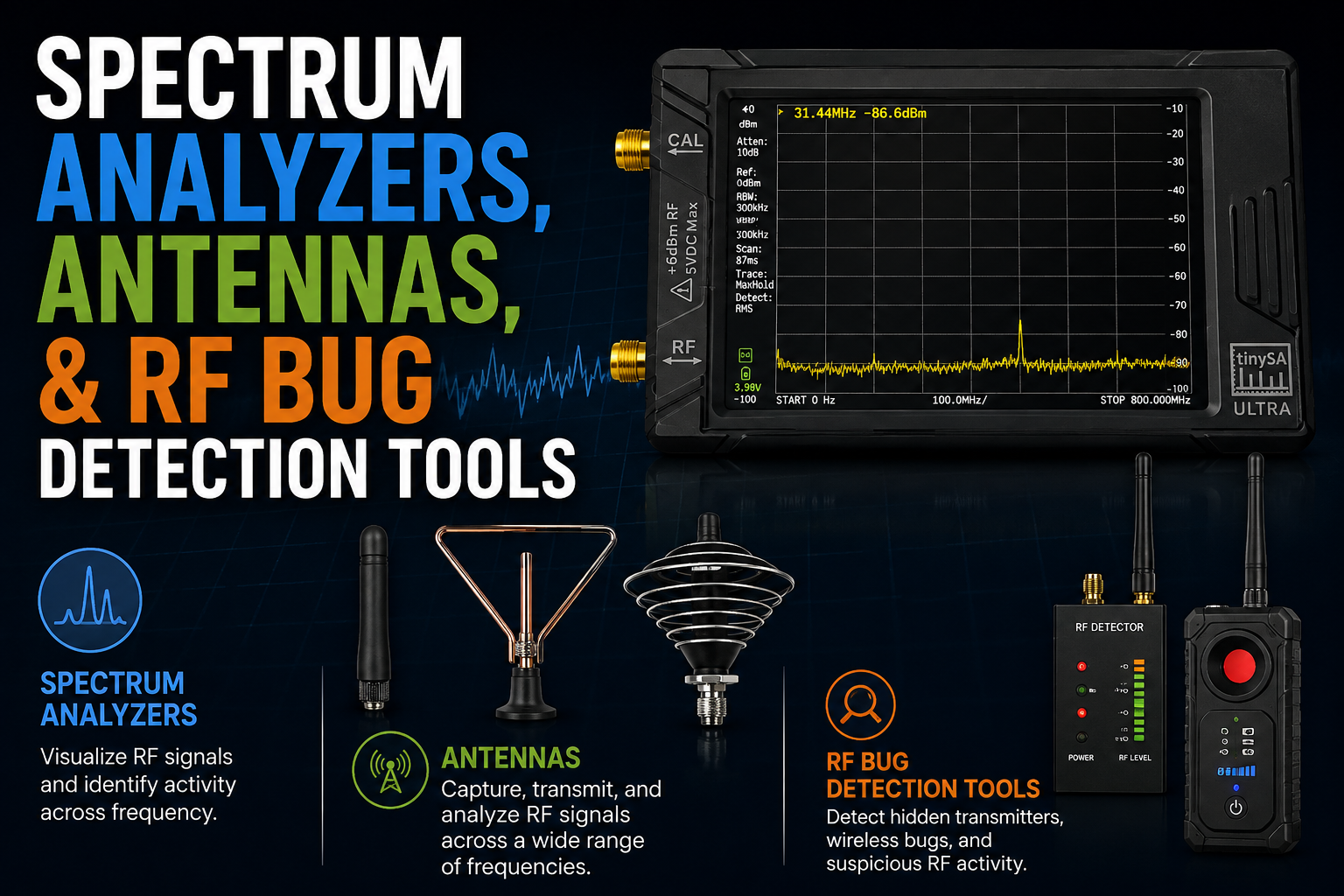
TinySA Ultra for Portable RF Surveys
The TinySA Ultra is a compact handheld spectrum analyzer that is practical for portable RF inspection, signal discovery and interference investigation.
The official tinySA documentation describes the Ultra architecture as a swept heterodyne spectrum analyzer. The Ultra-class units also provide adjustable resolution bandwidth, internal attenuation and an optional LNA, which can be useful when changing between strong-signal and weak-signal investigations.
For defensive surveys, TinySA Ultra is useful for:
- walking around a facility while watching signal level;
- checking Sub-GHz activity;
- checking common VHF and UHF bands;
- investigating continuously active transmitters;
- using max-hold to observe signals that reappear during a scan;
- quickly checking whether a suspicious RF source is present.
Read the TinySA Ultra Setup Guide before relying on the instrument for field measurements.
TinySA Ultra+ ZS407 for wider coverage
The TinySA Ultra+ ZS407 extends the portable platform further.
The official tinySA documentation lists the ZS407 for 100 kHz–900 MHz operation in its normal range and up to 7.3 GHz with Ultra mode enabled, with level calibration specified to 7.3 GHz.
That wider range can be valuable when a field team needs one portable instrument covering Sub-GHz activity as well as higher microwave bands.
However, frequency coverage alone does not make a handheld analyzer equivalent to professional TSCM or real-time spectrum-monitoring equipment.
Why an SDR Is Useful for RF Bug Detection
A software-defined radio complements a spectrum analyzer rather than replacing it.
While a spectrum analyzer is optimized for measuring spectral activity, an SDR can capture IQ samples and let software perform:
- waterfall visualization;
- long-duration monitoring;
- signal recording;
- demodulation where lawful and appropriate;
- custom signal detection;
- frequency occupancy logging;
- automated alerts;
- comparison with known RF baselines.
This becomes particularly useful when a suspicious transmitter is intermittent.
HackRF Pro for Wideband RF Monitoring
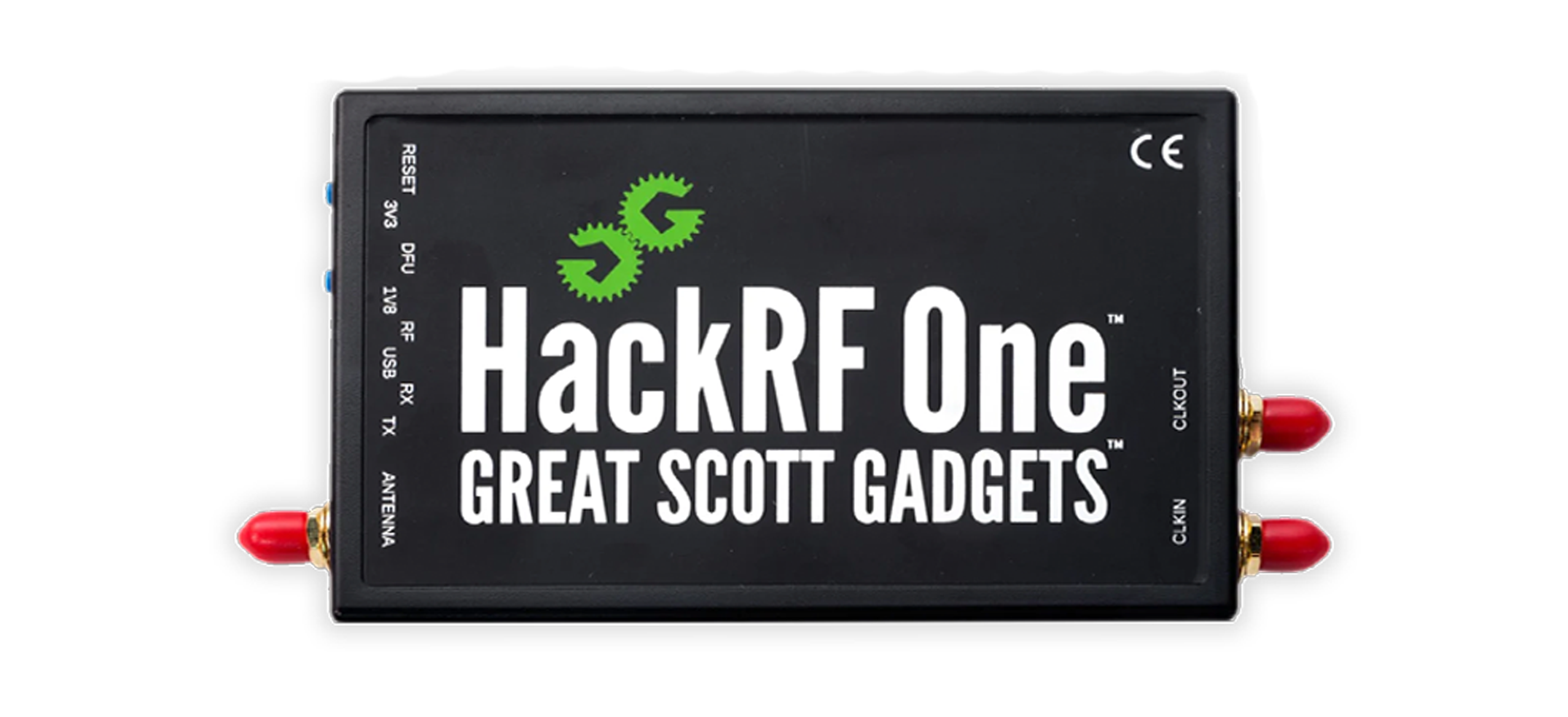
The HackRF Pro Development Board is a flexible SDR option for wideband receive-side investigation.
Great Scott Gadgets officially specifies:
- 100 kHz–6 GHz operating frequency;
- tuning from 0 Hz to 7.1 GHz;
- up to 20 million samples per second;
- 8-bit quadrature samples in its normal operating mode;
- software-configurable receive gain;
- GNU Radio compatibility;
- USB-C connectivity.
For defensive monitoring, HackRF Pro can support:
- wideband RF surveys;
- GNU Radio monitoring workflows;
- SDR++ or other waterfall applications;
- IQ capture of signals of interest;
- longer monitoring sessions;
- custom spectrum alerting;
- portable security research kits.
HackRF Pro is an SDR, not a calibrated professional spectrum analyzer. Its measurement results should not be represented as traceable laboratory spectrum-analyzer measurements unless the complete measurement system has been characterized accordingly.
For setup instructions, see the HackRF Pro Setup Guide.
RTL-SDR for Low-Cost Continuous Monitoring
A lower-cost option is the RTL-SDR Blog V3 USB-C.
The SDRstore.eu listing specifies approximately 500 kHz–1.7 GHz tuner coverage, with HF direct sampling support and up to 3.2 MHz selectable sample bandwidth, with approximately 2.4 MHz commonly used as a stable operating rate.
It cannot replace a wideband spectrum analyzer, and it does not cover common 2.4 GHz or 5 GHz wireless bands.
Its strength is cost.
Organizations can deploy several receive-only RTL-SDR nodes around a facility and log selected portions of spectrum continuously. That can provide evidence of transmissions that occur outside a short manual inspection window.
Antennas Are Just as Important as the Analyzer
A high-quality receiver connected to the wrong antenna can miss a signal that a simpler receiver with the correct antenna detects easily.
RF survey kits therefore need more than one antenna.
Browse RF antennas for SDR, wireless and monitoring applications.
Omnidirectional antennas
An omnidirectional antenna is useful during the first stage of a survey because it receives signals arriving from many directions.
Use it for:
- general room sweeps;
- wide-area spectrum surveys;
- baseline measurements;
- continuous monitoring nodes;
- detecting that a signal exists before attempting localization.
Band-specific antennas
A broadband antenna is convenient, but an antenna optimized for a known frequency range can often provide better sensitivity.
Once a suspicious frequency has been identified, switching to a suitable band-specific antenna can improve the investigation.
Directional antennas
A directional antenna is one of the most important tools for locating a transmitter.
Professional interference-hunting equipment from Rohde & Schwarz and Tektronix combines receivers or spectrum analyzers with directional antennas specifically for transmitter and interference-source location.
A directional antenna lets the operator compare received power while changing orientation.
If the signal repeatedly becomes stronger in one direction, the search area can be reduced.
Why Indoor Direction Finding Is Difficult
RF energy does not travel through buildings in a perfectly straight line.
Signals reflect from:
- walls;
- metal furniture;
- windows;
- ducting;
- elevators;
- cabling;
- computer equipment;
- structural steel.
A reflected signal can therefore appear stronger from the wrong direction.
Professional interference-hunting guidance notes that indoor environments can be particularly reflective. Close-range homing is often more effective than assuming that a single directional reading points directly at the transmitter.
For a serious search:
- take measurements from several positions;
- change antenna orientation;
- compare signal strength repeatedly;
- move closer in small increments;
- reduce receiver sensitivity as the signal becomes stronger;
- confirm the result from another angle.
Why an RF Attenuator Helps Find Nearby Transmitters
As you approach a strong transmitter, the received signal can become so strong that almost every direction appears to produce a maximum reading.
This makes localization harder.
An RF attenuator intentionally reduces signal level before it reaches the analyzer or receiver.
During close-range homing, progressively increasing attenuation can reduce the detection radius and help distinguish between objects only a short distance apart.
The principle is simple:
- start sensitive enough to detect the signal;
- move toward the strongest region;
- reduce sensitivity or add attenuation;
- continue searching;
- repeat until the search area becomes very small.
Always verify that an attenuator covers the required frequency range and connector type.
Near-Field Probes for the Final Search
Near-field probes are useful when the search has already been narrowed to a desk, wall section, electronic device or other small area.
Unlike a normal antenna designed to receive distant radiated signals, a near-field probe is intended for very close-range electromagnetic investigation.
This makes near-field probes useful around:
- electronic assemblies;
- power supplies;
- cables;
- small wireless modules;
- suspected enclosures;
- PCB-level RF sources.
They are not a substitute for the initial wide-area survey because their useful detection range is deliberately short.
Recommended Defensive RF Sweep Workflow
Step 1: Establish a baseline
Before treating every peak as suspicious, understand what normally exists in the environment.
Document expected:
- Wi-Fi networks;
- Bluetooth devices;
- cellular equipment;
- wireless microphones;
- building automation;
- alarm sensors;
- Sub-GHz devices;
- IoT gateways;
- authorized radios.
This reduces false alarms.
For larger facilities, see RF Spectrum Monitoring for Facilities, Labs, and Critical Infrastructure.
Step 2: Perform a broad spectrum survey
Use an appropriate wideband antenna and spectrum analyzer or SDR to identify strong and unusual RF activity.
Do not immediately assume that an unknown signal is malicious. Record:
- frequency;
- approximate bandwidth;
- signal level;
- time observed;
- location;
- whether the signal is continuous or intermittent.
Step 3: Narrow the frequency span
Once a signal of interest is identified, reduce the analyzer span around it.
This can provide better visibility and allows more suitable resolution settings.
Step 4: Compare several locations
Move through the authorized inspection area and record how signal level changes.
A source that becomes dramatically stronger in one section of a building deserves further investigation.
Step 5: Change to a directional antenna
Use directional measurements from more than one position.
Do not rely on one bearing indoors because reflections can produce misleading results.
Step 6: Reduce sensitivity as you approach
Lower receiver gain, disable an LNA where appropriate or add RF attenuation as the signal becomes stronger.
This prevents the receiver from remaining saturated across the entire room.
Step 7: Use close-range tools
Once the source area is small, near-field probes and careful physical inspection become more useful than continuing a wide-area scan.
Step 8: Repeat the survey over time
Intermittent transmitters may not appear during the first inspection.
Long-term SDR logging or repeated surveys at different times can reveal activity that a single walk-through misses.
What Frequency Ranges Should an RF Security Kit Cover?
There is no single magic frequency range for surveillance detection.
A practical security-monitoring kit may need visibility across several areas:
| Frequency area | Why it may matter |
|---|---|
| HF/VHF | Legacy radio systems and specialized RF equipment |
| UHF/Sub-GHz | Telemetry, sensors, remote controls and embedded wireless devices |
| 2.4 GHz | Wi-Fi, Bluetooth, BLE, Zigbee, Thread and many IoT devices |
| 5 GHz | Wi-Fi and other microwave wireless systems |
| 6 GHz+ | Newer Wi-Fi spectrum and specialized microwave equipment |
| Cellular bands | Phones, modems and cellular-connected embedded equipment |
This is why professional systems use different receivers and antenna modules rather than claiming that one inexpensive detector covers every possible surveillance technology equally well.
RF Bug Detector vs Spectrum Analyzer
A simple consumer RF detector and a spectrum analyzer answer very different questions.
| Feature | Basic RF detector | Spectrum analyzer |
|---|---|---|
| Shows frequency | Often no | Yes |
| Shows spectrum shape | No | Yes |
| Resolution bandwidth control | Usually no | Yes |
| Can separate nearby signals | Limited | Much better |
| Useful for signal classification | Limited | Yes |
| Simple proximity indication | Yes | Yes, with suitable setup |
| Useful for professional documentation | Limited | Much better |
A basic detector may still be useful as a fast proximity tool, but a spectrum analyzer provides much more information about what the RF environment actually contains.
Do Not Confuse a VNA with a Bug Detector
A vector network analyzer such as a NanoVNA measures connected RF components. It is excellent for measuring antennas, cables, filters, return loss, S11, S21 and impedance.
It is not the correct primary instrument for discovering unknown over-the-air transmitters.
For security teams building a complete RF kit:
- spectrum analyzer: find and measure RF activity;
- SDR: capture, log and process signals;
- directional antenna: help localize a source;
- near-field probe: close-range investigation;
- VNA: validate your antennas, cables and filters.
Best RF Bug Detection Tool Setups by Budget
Entry-level RF visibility kit
- TinySA Ultra
- basic wideband antenna;
- band-specific antennas;
- SMA cable and adapter set;
- fixed RF attenuators;
- RTL-SDR Blog V3 USB-C for logging.
Best for: RF education, facility RF awareness, interference investigation and basic authorized transmitter searches.
Portable cybersecurity and facility survey kit
- TinySA Ultra+ ZS407;
- HackRF Pro;
- laptop running SDR software;
- omnidirectional antenna set;
- directional antenna appropriate for the investigated bands;
- RF attenuator kit;
- near-field probes;
- short low-loss RF cables and adapters.
Best for: cybersecurity firms, corporate security teams, RF engineers and facilities that need portable defensive RF investigation.
Professional TSCM and high-security environment
- professional real-time spectrum analyzer or monitoring receiver;
- wideband and band-specific antennas;
- professional directional antenna system;
- near-field probes;
- long-duration spectrum recording;
- appropriate physical-inspection equipment;
- documented RF baseline;
- trained operators.
Best for: high-risk corporate environments, government work, sensitive meetings and professional technical surveillance countermeasures.
Buyer Advice: What Matters Most?
Frequency coverage
The analyzer and antennas must cover the frequencies you intend to investigate.
Sensitivity
Weak transmitters require sufficient sensitivity, but simply adding maximum gain can make the receiver overload in a strong RF environment.
Dynamic range
A security survey may contain extremely strong Wi-Fi, cellular and broadcast signals alongside a much weaker signal of interest. Dynamic range therefore matters significantly.
Sweep speed and probability of intercept
Fast, intermittent signals are much more difficult to detect with a slow swept analyzer.
Spectrogram and waterfall history
A time-history display makes it easier to recognize signals that appear periodically.
Logging
For professional work, the ability to record measurements, timestamps and screenshots is far more valuable than simply seeing a peak once.
Antenna ecosystem
A receiver without suitable antennas is an incomplete survey system. Budget for multiple antennas, cables, adapters and attenuators.
Recommended SDRstore.eu Tools
| Tool | Recommended use | Important note |
|---|---|---|
| TinySA Ultra | Portable RF survey and signal-level investigation | Swept handheld analyzer; understand transient-signal limitations |
| TinySA Ultra+ ZS407 | Portable surveys requiring wider frequency coverage | Official tinySA documentation lists Ultra mode to 7.3 GHz |
| HackRF Pro | Wideband SDR monitoring, waterfall analysis and IQ capture | SDR rather than a calibrated spectrum analyzer |
| RTL-SDR Blog V3 USB-C | Low-cost receive-only monitoring nodes | Limited bandwidth and does not cover 2.4/5 GHz |
| RF antennas | Wideband, band-specific and monitoring antenna requirements | Select by actual frequency range and connector |
| RF Test & Measurement | Complete RF lab and security-monitoring equipment | Choose instruments according to measurement requirement |
For Cybersecurity Firms, Laboratories and Businesses
Cybersecurity firms, corporate security teams, universities, RF laboratories, telecom organizations, system integrators and public-sector buyers can request a formal quotation for multi-item RF monitoring and security equipment directly from SDRstore.eu.
Use the Add to Quote button on an individual product page or the document icon on product cards while browsing categories.
A complete quote can include:
- spectrum analyzers;
- HackRF Pro units;
- RTL-SDR monitoring receivers;
- antennas;
- RF cables and adapters;
- attenuators;
- VNAs and additional RF measurement equipment.
This is particularly useful for organizations building standardized field kits, university wireless-security laboratories or multi-location RF monitoring systems.
Legal and Privacy Considerations
RF monitoring laws, communications-privacy rules and interception restrictions vary by jurisdiction.
- Use RF detection equipment only where you have permission to conduct the survey.
- Passive spectrum observation and communications interception are not necessarily treated the same under local law.
- Do not decode, record or intercept private communications unless legally permitted.
- Do not transmit interference or attempt to jam a suspicious device.
- Do not use transmit-capable SDR equipment to disrupt Wi-Fi, cellular, GNSS, Bluetooth or other radio services.
- Preserve evidence appropriately if an unauthorized device is discovered in a corporate or legal investigation.
- For high-risk cases, involve qualified security, legal and professional TSCM personnel.
Related SDRstore.eu Guides
- What Is a Spectrum Analyzer? Beginner Guide for RF Testing
- TinySA Ultra Setup Guide
- TinySA vs Professional Spectrum Analyzer
- RF Spectrum Monitoring for Facilities, Labs, and Critical Infrastructure
- RF Cybersecurity Lab Equipment Checklist
- SDR for Cybersecurity Research
- Sub-GHz Security Testing Tools
Official Technical Resources
- tinySA Official Documentation
- Great Scott Gadgets — HackRF Pro
- Keysight — Interference Hunting
- Rohde & Schwarz — Interference Hunting
- Tektronix — Spectrum Management and Interference Hunting
Final Recommendation
For affordable defensive RF surveys, start with a portable spectrum analyzer such as TinySA Ultra or TinySA Ultra+ ZS407, a documented set of antennas, a directional antenna, RF attenuators and a receive-only SDR for longer monitoring.
Add HackRF Pro when you need wider SDR coverage, IQ recording, GNU Radio workflows and custom spectrum-monitoring software.
For high-risk environments where detecting short, intermittent or deliberately difficult signals matters, move beyond a basic swept analyzer to professional real-time spectrum-monitoring equipment and trained TSCM personnel.
Most importantly, do not treat any RF detector as a magic “room is clean” device. A reliable security survey combines RF detection, localization, baselining, repeated monitoring and physical inspection.
FAQ
Can a spectrum analyzer detect hidden microphones?
A spectrum analyzer can detect an active wireless microphone if its transmission falls within the analyzer's frequency range and is strong enough to be observed. It cannot detect a microphone that records locally, uses a wire or is not transmitting during the survey.
What is the best RF bug detector?
There is no single best detector for every situation. A practical defensive kit combines a spectrum analyzer, several antennas, a directional antenna, RF attenuators and often an SDR for recording and long-term monitoring. Professional high-risk surveys may require real-time spectrum analyzers and specialized TSCM equipment.
Can TinySA Ultra be used for RF bug detection?
TinySA Ultra can be useful for authorized RF surveys, signal discovery, signal-strength comparison and locating continuously active transmitters. It is a swept handheld analyzer, so brief or intermittent signals may be harder to detect than with professional real-time equipment.
Is HackRF Pro a bug detector?
HackRF Pro is a software-defined radio rather than a dedicated bug detector. Its wide receive coverage and software support make it useful for defensive RF monitoring, waterfall analysis, IQ capture and custom signal-detection workflows.
Why do I need a directional antenna?
A spectrum analyzer tells you that RF energy is present, but a directional antenna can help determine where it is coming from. Comparing received signal strength from multiple positions and directions can progressively narrow the search area.
Can an RF detector find a device that is turned off?
No. RF detection relies on radio emissions. A powered-off device, wired device or local recorder may produce no useful RF transmission for a spectrum analyzer or SDR to detect.
Can a hidden device avoid an RF sweep by transmitting only occasionally?
An intermittent device may be missed during a short manual sweep. Long-duration monitoring, spectrogram recording, repeated surveys and real-time spectrum analysis can improve the chances of observing intermittent RF activity.
Can a phone be mistaken for a surveillance transmitter?
Yes. Phones, Wi-Fi access points, Bluetooth devices, laptops, smart watches and IoT equipment create legitimate RF activity. Creating an inventory and baseline of expected wireless devices helps reduce false conclusions.
Do I need a spectrum analyzer and an SDR?
For serious RF monitoring they complement each other. A spectrum analyzer is designed to measure RF activity across frequency, while an SDR provides flexible software processing, IQ recording, waterfalls and long-term monitoring.
Does finding an unknown RF signal prove there is a bug?
No. An unknown signal could come from legitimate equipment, neighboring wireless systems, interference or an unidentified authorized device. It should be documented, localized and investigated before drawing conclusions.
No posts found
Write a review






We support all major card and digital payment options. More local methods are available and shown during checkout.
You enter into a binding sales contract once you have received an 'order confirmation and sales receipt' email from us, in line with our Sales & Delivery conditions. Therefore, sdrstore.eu has the right to cancel your order in the event of technical problems, delivery failure, Fair use policy and other similar situations.






Your payments are protected by advanced encryption and 3-D Secure authentication for safe online shopping.