





Spectrum Analyzer vs Oscilloscope: Which Tool Do You Need?
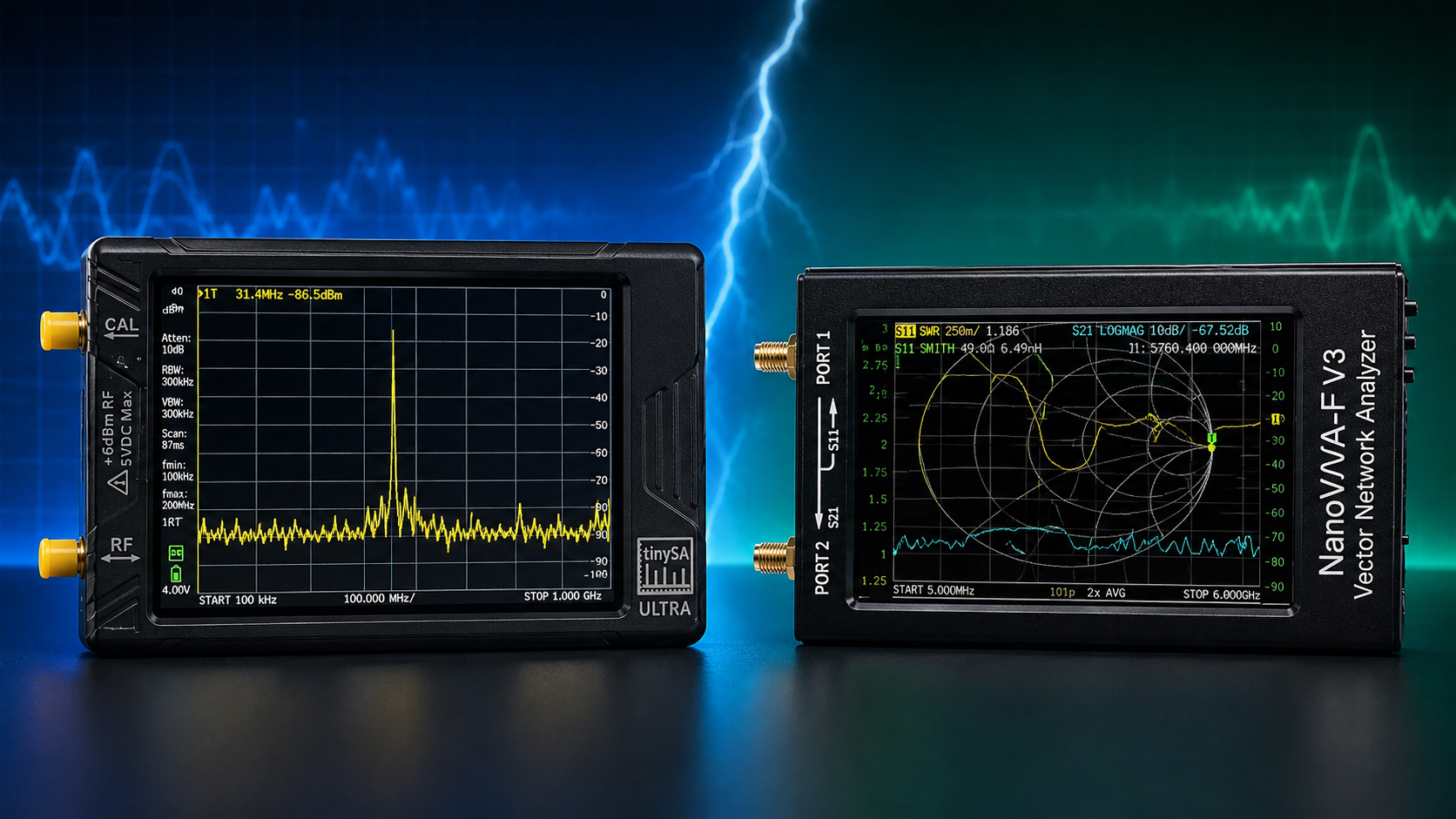
A spectrum analyzer and an oscilloscope are two of the most important test instruments in electronics and RF work, but they answer different questions. An oscilloscope shows how a signal changes over time. A spectrum analyzer shows how signal power is distributed across frequency.
If you are debugging a microcontroller pin, checking a pulse, measuring rise time, or looking at a voltage waveform, you usually need an oscilloscope. If you are checking RF interference, transmitter harmonics, signal bandwidth, occupied spectrum, noise floor, or unwanted emissions, you usually need a spectrum analyzer.
This beginner guide explains spectrum analyzer vs oscilloscope differences in practical RF testing language. It covers time domain vs frequency domain, what each tool measures, when TinySA Ultra is enough, when a professional spectrum analyzer is needed, when an oscilloscope FFT can help, and which tool you should buy for SDR, ham radio, RF labs, IoT product testing, and university teaching.
Browse spectrum analyzers and RF analysis tools, the TinySA Ultra handheld spectrum analyzer, RF signal generators, RF power meters, RF dummy loads, RF test and measurement equipment, and request a formal quote from SDRstore.eu.
Quick Answer: Spectrum Analyzer vs Oscilloscope
| Question | Best tool | Why |
|---|---|---|
| What does the voltage waveform look like over time? | Oscilloscope | It shows time-domain voltage behavior. |
| What RF signals are present across frequency? | Spectrum analyzer | It shows signal power versus frequency. |
| Is my transmitter on the correct frequency? | Spectrum analyzer | It shows carrier frequency and bandwidth. |
| Does my digital circuit have ringing or overshoot? | Oscilloscope | It shows waveform shape, rise time, fall time, and timing. |
| Does my transmitter have harmonics or spurs? | Spectrum analyzer | It shows unwanted frequency components. |
| Is my power supply creating ripple or switching noise? | Oscilloscope first, spectrum analyzer for RF noise | The oscilloscope shows ripple in time; the analyzer helps find frequency components. |
| Is my antenna matched? | NanoVNA, not oscilloscope or spectrum analyzer | A VNA measures SWR, impedance, return loss, and S11. |
The simple rule: use an oscilloscope for voltage over time. Use a spectrum analyzer for power over frequency.
Time Domain vs Frequency Domain
The difference between these tools starts with two ways of looking at a signal.
Time domain
The time domain shows how a signal changes over time. This is what an oscilloscope is built for.
Use the time domain to see:
- Pulse width
- Rise time and fall time
- Voltage level
- Timing between signals
- Clock behavior
- Serial data waveform shape
- Power-supply ripple
- Overshoot and ringing
- Glitches and dropouts
Frequency domain
The frequency domain shows how much signal energy exists at each frequency. This is what a spectrum analyzer is built for.
Use the frequency domain to see:
- Carrier frequency
- Signal bandwidth
- Noise floor
- Interference
- Harmonics
- Spurious emissions
- Adjacent-channel energy
- Band occupancy
- RF product emissions
Many modern instruments overlap, but the basic idea stays the same. Oscilloscopes are strongest in time-domain waveform analysis. Spectrum analyzers are strongest in frequency-domain RF analysis.
What Is an Oscilloscope?
An oscilloscope is an instrument that shows voltage versus time. It is one of the first tools most electronics engineers buy because it helps you see what is happening inside a circuit.
Oscilloscopes are best for
- Microcontroller signals
- Clock lines
- SPI, I2C, UART, CAN, USB, and digital buses
- Power-supply ripple
- Switching regulator waveforms
- Audio signals
- PWM signals
- Pulse timing
- Rise time, fall time, overshoot, and ringing
- Triggering on rare glitches
Oscilloscope example
If a microcontroller output should switch from 0 V to 3.3 V, an oscilloscope shows whether it actually reaches 3.3 V, how fast it rises, whether it overshoots, and whether the timing is correct.
A spectrum analyzer is not the right first tool for that job.
What Is a Spectrum Analyzer?
A spectrum analyzer shows signal power versus frequency. Instead of showing the exact voltage waveform, it shows which frequencies are present and how strong they are.
Spectrum analyzers are best for
- RF signal presence checks
- Carrier frequency checks
- Signal bandwidth checks
- Harmonics
- Spurs
- Out-of-band energy
- Interference hunting
- Noise floor monitoring
- RF product pre-compliance screening
- SDR troubleshooting
- Wireless lab testing
Spectrum analyzer example
If a 433 MHz transmitter should send a signal, a spectrum analyzer can show whether a peak appears near 433 MHz, how wide the signal looks, whether there are strong harmonics, and whether nearby interference exists.
An oscilloscope is not the right first tool for that RF spectrum job.
Side-by-Side Comparison
| Feature | Oscilloscope | Spectrum analyzer |
|---|---|---|
| Main view | Voltage versus time | Power versus frequency |
| Main domain | Time domain | Frequency domain |
| Best for | Waveforms, timing, pulses, digital signals, ripple | RF signals, interference, harmonics, spurs, bandwidth |
| Typical vertical unit | Volts | dBm or dB |
| Typical horizontal unit | Seconds | Hz |
| Good beginner use | Check voltage and timing in a circuit | Check whether RF signals are present |
| RF interference hunting | Limited | Very useful |
| Digital circuit debugging | Very useful | Limited |
| Formal RF emissions work | Not the main tool | Professional analyzer or EMI receiver required |
| Antenna SWR and impedance | No | No, use NanoVNA or VNA |
When Do You Need an Oscilloscope?
You need an oscilloscope when the question is about voltage, timing, pulse shape, or circuit behavior.
Buy or use an oscilloscope for
- Electronics repair
- Microcontroller development
- Power-supply debugging
- Checking signal rise time and fall time
- Finding glitches
- Serial bus debugging
- Audio circuit testing
- Switching regulator testing
- Digital logic troubleshooting
- Checking whether a circuit output is physically correct
Example: if a LoRa module does not respond over SPI, an oscilloscope or logic analyzer is the right tool to check clock, MOSI, MISO, chip select, voltage levels, and timing.
When Do You Need a Spectrum Analyzer?
You need a spectrum analyzer when the question is about RF energy, frequency, bandwidth, harmonics, spurs, or interference.
Buy or use a spectrum analyzer for
- Checking whether a transmitter is active
- Finding RF interference
- Checking harmonics and spurs
- Testing RF modules
- Comparing filters
- Checking receiver overload conditions
- RF product pre-compliance screening
- SDR troubleshooting
- Wireless security monitoring
- Facility RF spectrum monitoring
Example: if an SDR receiver performs badly around 1090 MHz, a spectrum analyzer can show whether the ADS-B signal is weak, whether the band has interference, or whether strong nearby signals may be overloading the receiver.
Can an Oscilloscope Replace a Spectrum Analyzer?
Sometimes an oscilloscope can show frequency content using FFT, but it does not fully replace a spectrum analyzer for RF testing.
Oscilloscope FFT can help with
- Low-frequency noise analysis
- Switching regulator frequency components
- Audio spectrum checks
- Clock harmonic inspection
- Quick engineering clues
Oscilloscope FFT is usually not ideal for
- Wide RF scans
- Interference hunting
- Accurate RF level measurements
- Very high dynamic range RF work
- Pre-compliance emissions checks
- Professional RF reports
- Microwave frequency analysis
An oscilloscope with FFT is useful, but if your main problem is RF spectrum visibility, a spectrum analyzer is still the better tool.
Can a Spectrum Analyzer Replace an Oscilloscope?
Usually no. A spectrum analyzer can sometimes show time-domain behavior, especially on advanced real-time models, but it is not a general replacement for an oscilloscope.
A spectrum analyzer can help with
- RF burst timing
- Band occupancy over time
- Transient RF events
- Signal frequency changes
- Power versus time in RF-specific views
A spectrum analyzer is not ideal for
- Microcontroller pin voltage checks
- Power rail ripple in volts
- Digital bus timing
- Rise time and fall time measurements
- Analog waveform shape debugging
- Triggering on circuit-level glitches
If you are debugging electronics hardware, keep an oscilloscope. If you are debugging RF emissions and signals, use a spectrum analyzer.
What About SDR?
An SDR can act like a flexible RF receiver and can show a waterfall or spectrum display in software. It is very useful for learning, decoding, IQ capture, and custom signal processing.
However, an SDR is not always a calibrated spectrum analyzer. Gain settings, overload, sample rate, front-end limits, dynamic range, and software scaling can make SDR level readings less trustworthy than a proper analyzer.
| Question | Best tool |
|---|---|
| Do I want to decode FM, ADS-B, AIS, ACARS, or digital signals? | SDR |
| Do I want a calibrated RF level measurement? | Professional spectrum analyzer or RF power meter |
| Do I want to see whether RF interference exists? | Spectrum analyzer or SDR for early visibility |
| Do I want to debug a microcontroller waveform? | Oscilloscope |
For many SDR users, the ideal bench is an SDR for decoding, a TinySA Ultra or spectrum analyzer for RF visibility, and a NanoVNA for antennas and filters.
Where TinySA Ultra Fits
The TinySA Ultra is a useful beginner spectrum analyzer because it makes RF signals visible at a much lower cost than professional lab analyzers. It is useful for learning, field checks, signal presence, interference hunting, and rough harmonic screening.
TinySA Ultra is useful for
- Learning spectrum analyzer basics
- Checking whether a transmitter is active
- Finding local RF interference
- Rough harmonic and spur checks
- SDR troubleshooting
- RF education
- Facility RF checks
- Quick product-development screening
TinySA Ultra does not replace
- A professional calibrated spectrum analyzer
- An oscilloscope
- A NanoVNA
- An RF power meter
- A certified EMC/RED/FCC test lab
- A professional RF signal generator for clean calibrated signals
Read: TinySA vs Professional Spectrum Analyzer: What Can a TinySA Ultra Really Do?.
Where NanoVNA Fits
A NanoVNA is not an oscilloscope and not a spectrum analyzer. It is a vector network analyzer. It measures how RF components behave.
Use NanoVNA for
- Antenna SWR
- Impedance
- Return loss
- Smith Chart
- Coax cable loss
- Filter insertion loss
- S11 and S21 measurements
- Antenna tuning
Browse the NanoVNA-H4 and read NanoVNA vs TinySA: Which RF Tool Do You Actually Need?.
Which Tool Do You Need by Project?
| Project | Best first tool | Helpful second tool |
|---|---|---|
| Microcontroller debugging | Oscilloscope | Logic analyzer |
| Power supply ripple | Oscilloscope | Spectrum analyzer for switching noise frequency |
| SDR reception problem | Spectrum analyzer or SDR spectrum display | NanoVNA for antenna and cable checks |
| LoRa or Meshtastic antenna tuning | NanoVNA | Spectrum analyzer for RF signal check |
| RF transmitter harmonic check | Spectrum analyzer | RF power meter and dummy load |
| Digital serial bus issue | Oscilloscope | Logic analyzer |
| Filter testing | NanoVNA | Spectrum analyzer for real signal before/after comparison |
| RF product pre-compliance | Spectrum analyzer | Oscilloscope, NanoVNA, RF power meter, SDR |
| Interference hunting | Spectrum analyzer | Directional antenna, SDR logging |
| RF cyber range | Spectrum analyzer and SDR | Oscilloscope for hardware-level timing |
Beginner Buying Advice
Buy an oscilloscope first if you mostly work with electronics circuits
If your projects involve microcontrollers, power supplies, sensors, audio circuits, digital buses, PWM, timing, or board repair, an oscilloscope should usually come first.
Buy a spectrum analyzer first if you mostly work with RF signals
If your projects involve SDR, antennas, transmitters, RF modules, LoRa, GNSS, interference, harmonics, or wireless product testing, a spectrum analyzer such as TinySA Ultra is usually more useful than an oscilloscope for the first RF visibility tool.
Buy NanoVNA if your problem is antennas, cables, or filters
If you need to measure SWR, impedance, return loss, filter response, or coax loss, buy NanoVNA before buying an oscilloscope or spectrum analyzer for that specific task.
Buy both if you build RF products
RF product teams usually need both. The oscilloscope checks the circuit. The spectrum analyzer checks RF emissions and interference. NanoVNA checks the RF path. RF power meters, attenuators, and dummy loads keep the bench safe.
Common Beginner Mistakes
Using an oscilloscope for every RF problem
An oscilloscope is excellent for time-domain circuit signals, but it is not the best tool for wide RF spectrum visibility, interference hunting, or harmonic checks.
Using a spectrum analyzer for every electronics problem
A spectrum analyzer will not show a microcontroller pin’s real voltage waveform the way an oscilloscope does.
Thinking oscilloscope FFT is the same as a spectrum analyzer
FFT is useful, but a dedicated spectrum analyzer is usually better for RF scans, level measurements, dynamic range, interference hunting, and emissions work.
Forgetting input limits
Do not connect transmitters directly to a spectrum analyzer or oscilloscope input unless you know the signal level and have proper attenuation. RF outputs can damage instruments.
Ignoring probe and cable effects
Oscilloscope probes, coax cables, adapters, and antenna cables all affect measurements. Use the correct probe, cable, termination, and calibration method.
Buying only one tool for every job
RF and electronics testing usually needs several tools. A practical bench may include oscilloscope, spectrum analyzer, NanoVNA, SDR, RF power meter, signal generator, dummy loads, attenuators, and good cables.
Safe RF Testing Rules
- Know the output power before connecting a transmitter to any instrument.
- Use attenuators for conducted RF tests.
- Use dummy loads when radiation is not needed.
- Use an RF power meter when power is uncertain.
- Use DC blocks when bias voltage may be present.
- Do not transmit over the air unless legal and authorized.
- Use shield boxes or cabled RF paths for controlled RF tests.
- Document frequency, power, attenuation, cable path, and instrument settings.
Browse RF dummy loads and RF power meters.
Recommended SDRstore.eu Hardware Packages
Package 1: Beginner RF visibility kit
- TinySA Ultra
- Basic antennas
- Attenuator set
- Dummy load
- Short SMA cables and adapters
Best for: RF beginners, SDR users, ham radio users, students, and interference checks.
Package 2: SDR troubleshooting kit
- TinySA Ultra
- RTL-SDR Blog V4 or V3 USB-C
- NanoVNA-H4
- Band-specific antennas
- Filters, attenuators, dummy loads, and cables
Best for: checking whether SDR problems come from antenna match, cable loss, interference, receiver overload, filters, or software settings.
Package 3: Electronics and RF learning bench
- Oscilloscope
- TinySA Ultra
- NanoVNA-H4
- RF signal generator or TinySA generator mode for basic checks
- RTL-SDR receiver
- Attenuators, dummy loads, probes, cables, and adapters
Best for: students, makers, universities, and mixed electronics/RF learning.
Package 4: RF product-testing bench
- Professional or handheld spectrum analyzer depending on measurement needs
- Oscilloscope for circuit timing and power integrity
- NanoVNA-H4 or higher-grade VNA
- SDR receiver such as RTL-SDR, HackRF Pro, PLUTO+, bladeRF, or USRP
- RF power meter
- Signal generator
- Attenuators, dummy loads, filters, DC blocks, shield box, and near-field probes
Best for: IoT companies, RF product teams, telecom labs, universities, and pre-compliance preparation.
Purchase-Order Justification Examples
Spectrum analyzer justification
A spectrum analyzer is required to inspect RF signals in the frequency domain, identify interference, check transmitter harmonics and spurious emissions, validate signal bandwidth, and support RF product pre-compliance screening.
Oscilloscope justification
An oscilloscope is required to inspect time-domain voltage waveforms, pulse timing, rise time, fall time, power-supply ripple, digital bus behavior, and circuit-level signal integrity.
TinySA Ultra justification
TinySA Ultra is required as a portable beginner spectrum analyzer for RF visibility, signal presence checks, interference hunting, SDR troubleshooting, RF education, and early-stage product debugging.
NanoVNA complementary justification
NanoVNA-H4 is required to complement oscilloscope and spectrum-analyzer measurements by testing antennas, SWR, impedance, return loss, filter response, and coax cable loss.
RF safety accessory justification
RF power meters, attenuators, dummy loads, DC blocks, and known-good cables are required to protect test equipment, verify conducted power, prevent overload, and create safe repeatable RF test setups.
Request a Quote for RF Test Equipment
Universities, RF labs, electronics teams, SDR users, cybersecurity teams, IoT developers, telecom labs, product-testing teams, and public-sector buyers can request a formal quotation directly from SDRstore.eu.
Use the Add to Quote button on product pages or the document icon on product cards. Add TinySA Ultra, NanoVNA-H4, spectrum analyzers, signal generators, RF power meters, dummy loads, attenuators, SDRs, antennas, filters, cables, adapters, and project notes to one quote request.
A quote request is useful when you need:
- Beginner RF testing kits
- Spectrum analyzer and NanoVNA bundles
- SDR troubleshooting equipment
- RF product pre-compliance benches
- University electronics and RF teaching kits
- Interference hunting kits
- Formal pricing for company, university, or public-sector procurement
Read the SDRstore.eu quote-request guide.
Related SDRstore.eu Guides
- TinySA vs Professional Spectrum Analyzer: What Can a TinySA Ultra Really Do?
- TinySA Ultra Setup Guide: Spectrum Scanning, Signal Generator, LNA, and Attenuator
- NanoVNA vs TinySA: Which RF Tool Do You Actually Need?
- SDR Hardware for RF Product Testing
- RF Spectrum Monitoring for Facilities, Labs, and Critical Infrastructure
- RF Cybersecurity Lab Equipment Checklist
- RF Cyber Range Hardware
- How to Test RF Filters with a NanoVNA
- How to Test Coax Cable Loss with a NanoVNA
- SWR vs Impedance vs Return Loss
Official and Technical Resources
- Keysight: Frequency Domain Measurements: Spectrum Analyzer or Oscilloscope
- Keysight: Spectrum Analyzer vs Oscilloscope
- Keysight: Spectrum Analysis and the Frequency Domain
- Rohde & Schwarz: RF Pulse Measurements in Time and Frequency Domains
- Rohde & Schwarz: Signal and Spectrum Analyzers
- Tektronix: Real-Time Spectrum Analyzer Fundamentals
- Tektronix: What Is a Spectrum Analyzer?
Final Recommendation
Choose an oscilloscope if your main problem is voltage over time: pulses, timing, digital signals, power-supply ripple, waveform shape, rise time, fall time, and circuit debugging.
Choose a spectrum analyzer if your main problem is signal power over frequency: RF signals, interference, transmitter frequency, harmonics, spurs, occupied bandwidth, noise floor, and RF product pre-compliance screening.
Choose NanoVNA if your main problem is antenna matching, impedance, SWR, return loss, filters, or coax cable loss.
For a serious RF bench, do not choose only one tool. Use an oscilloscope for the circuit, a spectrum analyzer for the RF spectrum, NanoVNA for the RF path, SDR for decoding and IQ capture, and RF power meters, dummy loads, and attenuators for safe measurement.
FAQ
What is the difference between a spectrum analyzer and an oscilloscope?
An oscilloscope shows voltage versus time, while a spectrum analyzer shows signal power versus frequency. Use an oscilloscope for waveform and timing problems. Use a spectrum analyzer for RF spectrum, interference, harmonics, and bandwidth problems.
Which is better for RF testing?
For most RF spectrum testing, a spectrum analyzer is better. For circuit-level voltage and timing around an RF product, an oscilloscope is also important. RF product teams usually need both.
Can an oscilloscope show frequency?
Yes, many oscilloscopes can use FFT to show frequency content. However, a dedicated spectrum analyzer is usually better for RF scans, dynamic range, interference hunting, and frequency-domain measurements.
Can a spectrum analyzer show time-domain signals?
Some spectrum analyzers and real-time spectrum analyzers include time-domain views, but they do not replace a general-purpose oscilloscope for circuit waveform debugging.
Do I need a spectrum analyzer if I already have an SDR?
It depends. SDR is excellent for receiving, decoding, and IQ capture, but a spectrum analyzer is better for RF visibility, harmonics, interference checks, and measurement confidence, especially when calibrated.
Do I need an oscilloscope for SDR projects?
Not always. For pure receive-only SDR listening, an oscilloscope may not be needed. For building RF hardware, debugging power supplies, checking clocks, or testing digital interfaces, an oscilloscope is very useful.
Is TinySA Ultra an oscilloscope?
No. TinySA Ultra is a handheld spectrum analyzer with signal-generator functionality. It does not replace an oscilloscope for voltage waveforms, digital bus debugging, or circuit timing.
Can a spectrum analyzer test antennas?
A spectrum analyzer can show received signal behavior with an antenna, but it does not directly measure antenna SWR or impedance. Use NanoVNA or another VNA-style antenna analyzer for antenna matching.
Which tool should a beginner buy first?
If the beginner mainly works with electronics circuits, buy an oscilloscope first. If the beginner mainly works with RF, SDR, antennas, interference, or transmitters, buy a spectrum analyzer or TinySA Ultra first. If the main problem is antennas and filters, buy NanoVNA first.
Can SDRstore.eu quote a complete RF testing setup?
Yes. Use the Add to Quote button on product pages or the document icon on product cards. Add TinySA Ultra, NanoVNA-H4, SDRs, signal generators, RF power meters, dummy loads, attenuators, antennas, filters, and project notes so the complete RF testing setup can be quoted together.
No posts found
Write a review




We support all major card and digital payment options. More local methods are available and shown during checkout.
You enter into a binding sales contract once you have received an 'order confirmation and sales receipt' email from us, in line with our Sales & Delivery conditions. Therefore, sdrstore.eu has the right to cancel your order in the event of technical problems, delivery failure, Fair use policy and other similar situations.





Your payments are protected by advanced encryption and 3-D Secure authentication for safe online shopping.