





USRP N310 vs X410: 4×4 MIMO, Bandwidth, FPGA, and Networking Compared
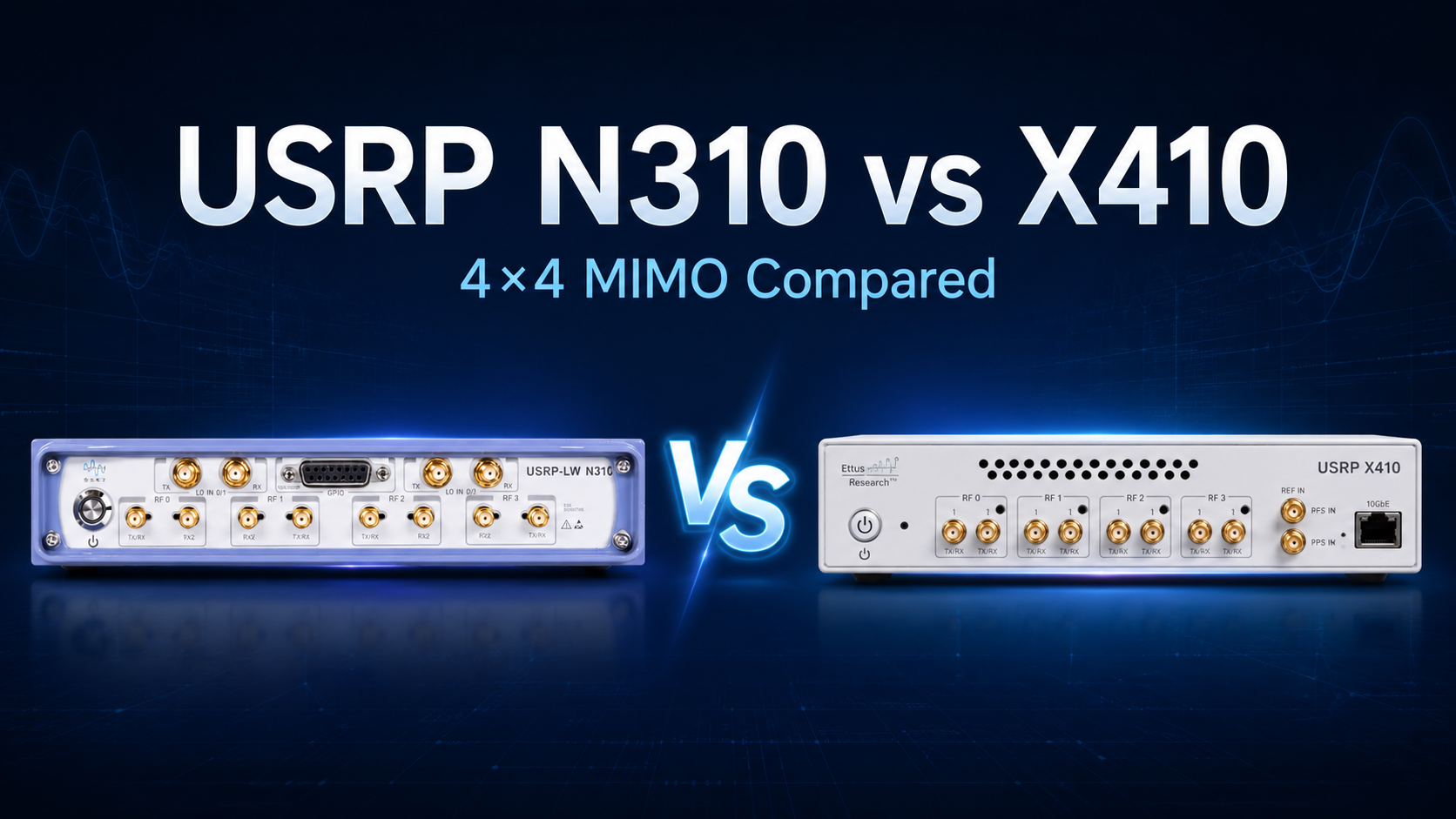
USRP N310 and USRP X410 both offer four transmit and four receive channels, which can make them look surprisingly similar on a specification sheet.
They are not.
The USRP N310 is a mature networked 4×4 SDR built around two AD9371 RF transceivers, up to 100 MHz of instantaneous bandwidth per channel, a Zynq-7100 SoC and dual SFP+ networking.
The USRP X410 is a substantially newer high-performance RFSoC platform with four independent transmit and receive channels, up to 400 MHz of instantaneous bandwidth per channel, 100 Gigabit Ethernet connectivity and much greater FPGA and onboard-processing capability.
That does not automatically make X410 the correct purchase for every research laboratory. For many 4×4 MIMO, distributed-radio, spectrum-monitoring and sub-6 GHz research projects, N310 already provides the required channel count and can be considerably easier to integrate into an existing 10 Gigabit Ethernet laboratory.
X410 becomes compelling when the experiment genuinely requires hundreds of megahertz of bandwidth, extremely high IQ throughput, RFSoC processing, advanced FPGA development, AI-enhanced PHY research or a long-term 5G/6G research platform.
USRP N310 vs X410: Quick Comparison
| Specification | USRP N310 | USRP X410 |
|---|---|---|
| TX channels | 4 | 4 |
| RX channels | 4 | 4 |
| Operation | Full duplex | Full duplex |
| Frequency range | 10 MHz–6 GHz specified operating range | 1 MHz–7.2 GHz specified operating range, tunable up to 8 GHz |
| Maximum instantaneous / analog bandwidth | Up to 100 MHz per channel | Up to 400 MHz per channel |
| RF architecture | 2× AD9371 RFICs | 2× ZBX RF daughterboards with RFSoC-based conversion/processing architecture |
| ADC resolution | 16 bit | 12 bit |
| DAC resolution | 14 bit | 14 bit |
| Digital core | Xilinx Zynq-7100 / XC7Z100 | AMD/Xilinx Zynq UltraScale+ ZU28DR RFSoC |
| Embedded CPU | Dual-core ARM Cortex-A9 at 800 MHz | Quad-core ARM Cortex-A53 up to 1.2 GHz plus real-time processing subsystem |
| High-speed networking | 2× SFP+ | 2× QSFP28 |
| Ethernet | 1 GbE / 10 GbE depending on FPGA image | 10 GbE / 100 GbE depending on FPGA image |
| Management Ethernet | RJ45 Gigabit Ethernet | RJ45 Gigabit Ethernet for management |
| RFNoC | Yes | Yes |
| Embedded Linux | Yes | Yes |
| Built-in GPSDO | Yes | Yes |
| 10 MHz / PPS synchronization | Yes | Yes |
| External RF LO inputs | Yes | No |
| Best fit | Practical 4×4 networked SDR and distributed research | Extreme-bandwidth, FPGA, AI/ML, advanced 5G/6G research |
The simplest buying recommendation is:
- Choose USRP N310 when you need four full-duplex RF channels, 100 MHz-class bandwidth, 10 Gigabit Ethernet, external LO capability and a mature networked USRP platform.
- Choose USRP X410 when 100 MHz per channel is no longer enough and your research genuinely benefits from 200–400 MHz-class channel bandwidth, 100 Gigabit Ethernet, RFSoC resources and substantially greater onboard processing headroom.
Browse the USRP SDR category at SDRstore.eu or view the current USRP N310 4×4 MIMO SDR.
Both Are 4×4 MIMO SDRs — But That Does Not Make Them Equivalent
Both radios provide:
- four transmit channels;
- four receive channels;
- full-duplex operation;
- networked SDR architecture;
- embedded Linux;
- UHD support;
- GNU Radio compatibility;
- FPGA processing;
- external timing references;
- rack-oriented laboratory deployment.
That makes both platforms relevant to:
- 4×4 MIMO research;
- channel estimation;
- spatial multiplexing;
- multi-antenna waveform experiments;
- direction finding;
- channel sounding;
- spectrum monitoring;
- private wireless research;
- 5G research;
- university communications laboratories.
However, channel count is only one dimension of an SDR architecture.
The differences in bandwidth, FPGA architecture, host data rate, RF synchronization and networking are large enough that N310 and X410 should normally be purchased for different classes of project.
For a broader explanation of four-channel research systems, read MIMO Testbed Hardware: 2×2, 4×4, Synchronization, Clocks, and Antennas.
USRP N310 Architecture
USRP N310 is based around two Analog Devices AD9371 RF transceiver ICs.
Each AD9371 provides two RF channels, giving the complete N310:
- 4 RX channels;
- 4 TX channels;
- 10 MHz–6 GHz specified frequency coverage;
- up to 100 MHz instantaneous bandwidth per channel;
- 16-bit ADC conversion;
- 14-bit DAC conversion.
Ettus describes the platform as a fully integrated networked SDR. Unlike an X310, N310 does not use user-swappable RF daughterboards.
Instead, its RF subsystem is integrated around two internally installed Magnesium daughterboards using the AD9371.
Zynq-7100 digital processing
The N310 uses a Xilinx Zynq XC7Z100 device combining:
- dual-core ARM Cortex-A9 processing;
- Kintex-7-class programmable logic;
- embedded Linux;
- RFNoC FPGA processing;
- high-speed sample handling;
- network interfaces;
- device-management functions.
Ettus documents four RX DDC chains and four TX DUC chains in the FPGA for N310.
This gives the platform substantial flexibility for custom DSP, filtering, routing and RFNoC research without requiring every operation to occur on the host computer.
USRP X410 Architecture
X410 represents a generational change rather than a simple higher-bandwidth N310.
It uses an AMD/Xilinx Zynq UltraScale+ ZU28DR RFSoC.
RFSoC integrates high-speed data converters directly with FPGA fabric and embedded processing resources, reducing the boundaries between converters, programmable logic and processor subsystems.
Ettus specifies X410 with:
- 4 independent transmit channels;
- 4 independent receive channels;
- 1 MHz–7.2 GHz operating frequency range;
- tuning up to 8 GHz;
- up to 400 MHz analog bandwidth per channel;
- 12-bit ADCs;
- 14-bit DACs;
- IQ sample clock rates up to 500 MS/s;
- built-in digital upconversion and downconversion resources;
- hardware SD-FEC resources;
- RFNoC support;
- embedded Linux.
The X410's RF path uses two ZBX RF daughterboards internally. Like N310, it is sold as an integrated radio rather than a user-swappable daughterboard platform.
Bandwidth: 100 MHz vs 400 MHz Per Channel
This is the most obvious performance difference.
USRP N310
Up to 100 MHz instantaneous bandwidth per RF channel.
USRP X410
Up to 400 MHz analog bandwidth per RF channel.
On paper, that is a fourfold increase per channel.
For four channels, the potential difference in raw IQ throughput becomes enormous.
When Does 400 MHz Bandwidth Actually Matter?
X410's bandwidth advantage becomes relevant for projects such as:
- very wideband channel sounding;
- wideband waveform capture;
- advanced spectrum sensing;
- high-throughput RF dataset generation;
- AI/ML receiver training datasets;
- wideband radar research;
- integrated sensing and communications;
- future cellular waveform research;
- carrier aggregation experimentation;
- wideband custom OFDM;
- advanced electronic-test research;
- high-speed physical-layer development.
If your experiment only needs 20, 40, 80 or 100 MHz of spectrum, buying X410 exclusively for its 400 MHz headline specification may not provide a useful advantage.
N310 remains a strong platform when the actual experiment fits inside its RF and host-bandwidth limits.
Important: 400 MHz Does Not Mean Every PC Can Stream Four Channels at Full Rate
This is one of the most important details when comparing N310 and X410.
The analog bandwidth of the RF hardware and the amount of data that can be continuously moved into a host computer are related, but they are not the same specification.
Current UHD documentation lists several FPGA image configurations for X410.
| X410 FPGA image | Channels | Bandwidth per channel | High-speed interface direction |
|---|---|---|---|
| X4_200 | 4 | 200 MHz | 4× 10 GbE lanes on QSFP28 port 0 |
| UC_200 | 4 | 200 MHz | 100 GbE |
| CG_400 | 4 | 400 MHz | 100 GbE + 100 GbE |
Ettus currently states that 400 MHz-per-channel host streaming with four full-duplex channels requires dual 100 Gigabit Ethernet connections.
A single 100 GbE connection supports two full-duplex channels in that configuration.
This means an X410 purchase should be planned together with the host network.
For a serious X410 workstation, consider:
- 100 Gigabit Ethernet NIC capability;
- available PCIe lanes;
- NUMA topology;
- CPU performance;
- RAM bandwidth;
- GPU interconnect requirements;
- NVMe storage speed;
- Linux network tuning;
- packet-buffer configuration;
- RFNoC processing strategy;
- whether all raw IQ data actually needs to leave the FPGA.
Buying X410 without designing the host architecture can leave a laboratory with a radio capable of producing much more data than its workstation can consume.
N310 Networking: Dual SFP+ and 10 Gigabit Ethernet
N310 has two SFP+ interfaces.
The exact behavior depends on the FPGA image.
| N310 FPGA image | SFP+ Port 0 | SFP+ Port 1 |
|---|---|---|
| HG | 1 GbE | 10 GbE |
| XG | 10 GbE | 10 GbE |
| HA | 1 GbE | Aurora |
| XA | 10 GbE | Aurora |
| AA | Aurora | Aurora |
| WX | White Rabbit | 10 GbE |
For many research laboratories, dual 10 GbE is considerably easier and less expensive to deploy than dual 100 GbE.
A workstation can be built with mainstream server or workstation NICs, SFP+ DAC cables or optical modules and standard 10 GbE infrastructure.
X410 Networking: QSFP28 and 100 Gigabit Ethernet
X410 provides two QSFP28 interfaces.
Depending on the loaded FPGA image, these can support configurations using:
- 10 Gigabit Ethernet;
- 100 Gigabit Ethernet;
- Aurora;
- multiple 10 GbE lanes.
This is one of the main reasons X410 can support workloads that are unrealistic on N310.
It is also one of the reasons the complete X410 laboratory costs considerably more than the radio itself.
Do not budget only for the SDR
An X410 project may also require:
- 100 GbE NIC;
- QSFP28 cables or optics;
- server-class PCIe connectivity;
- high-performance CPU;
- large RAM capacity;
- high-speed NVMe storage;
- GPU acceleration;
- proper cooling;
- clocking equipment;
- RF attenuators and loads;
- suitable antennas and filters.
FPGA: Zynq-7100 vs ZU28DR RFSoC
For FPGA-intensive research, X410 is in a substantially different class.
N310 FPGA direction
N310's XC7Z100 combines Kintex-7 programmable logic with a dual-core ARM Cortex-A9 processor.
It supports:
- RFNoC;
- custom FPGA processing;
- timed commands;
- timed sampling;
- digital upconversion and downconversion;
- high-speed network handling;
- embedded Linux applications.
This remains useful for custom DSP and networked-radio research.
X410 FPGA direction
X410's ZU28DR RFSoC represents a newer generation of programmable logic and integrated RF data conversion.
Ettus states that X410 provides more than twice the FPGA programmable-logic resources of previous-generation X-series USRPs.
It also includes hardware resources particularly relevant to communications research, including:
- integrated ADCs and DACs;
- digital upconverters;
- digital downconverters;
- SD-FEC hardware IP;
- RFNoC processing;
- large high-speed data paths;
- embedded application processors.
What Does the RFSoC Change in Practice?
For ordinary GNU Radio use, an RFSoC does not automatically make every flowgraph faster.
The advantage appears when researchers deliberately move appropriate real-time processing into programmable hardware.
Examples include:
- high-speed channelization;
- FFT processing;
- custom packet detection;
- decimation before host transfer;
- waveform preprocessing;
- PHY acceleration;
- real-time feature extraction;
- AI/ML preprocessing;
- high-rate recording pipelines;
- custom RFNoC blocks.
Moving processing closer to the converters can also reduce the amount of raw data that needs to cross the host network.
This is particularly valuable on a platform capable of generating several hundred megahertz of IQ data across four channels.
ADC Resolution: Do Not Compare 16 Bit vs 12 Bit in Isolation
N310 lists a 16-bit ADC while X410 uses 12-bit ADC conversion.
It would be incorrect to conclude from those numbers alone that N310 has a universally “better” receiver.
ADC bit depth is only one part of complete RF-system performance.
Other factors include:
- analog front-end design;
- noise figure;
- linearity;
- effective number of bits;
- sample rate;
- clock quality;
- filtering;
- gain architecture;
- RF frequency;
- converter architecture;
- digital processing.
X410 is engineered around dramatically higher converter and signal-processing rates.
Compare complete RF specifications for the exact experiment rather than ranking SDRs from nominal ADC resolution alone.
4×4 MIMO: What Both Radios Can Do
Both devices can provide four transmit and four receive chains from one chassis.
This makes them relevant to:
- 4×4 spatial multiplexing;
- multi-user MIMO research;
- beamforming experiments;
- channel sounding;
- multi-antenna OFDM;
- direction finding;
- spatial diversity;
- RF sensing;
- ISAC research;
- multi-channel dataset collection.
However, 4×4 MIMO does not automatically mean phase coherence across every configuration or across multiple radios.
Synchronization: This Is Where the Comparison Gets More Nuanced
Both platforms support external timing and frequency references.
Both can therefore participate in synchronized laboratory systems.
N310 synchronization options
Ettus documents N310 support for:
- built-in GPSDO;
- external PPS input/output;
- external 10 MHz reference input/output;
- 20 MHz and 25 MHz external reference inputs where supported;
- White Rabbit timing with an appropriate FPGA image;
- external RX local oscillator input;
- external TX local oscillator input.
The N310 contains two AD9371 daughterboards.
Ettus provides one external RX LO input and one external TX LO input for each daughterboard, giving four external LO inputs in total.
X410 synchronization options
X410 provides:
- built-in GPSDO;
- 10 MHz reference;
- PPS reference;
- trigger input/output;
- timed sampling;
- multi-radio clock and timing synchronization.
Important X410 Limitation: Multi-Radio Phase Coherence
Ettus explicitly states that while multiple X410 radios can be synchronized in clock and time, multi-radio phase-aligned and phase-coherent operation is not supported.
The reason is that X410 does not provide RF-chain LO import/export functionality.
This distinction matters for laboratories planning:
- large coherent antenna arrays;
- distributed beamforming;
- multi-radio phase-sensitive direction finding;
- coherent radar arrays;
- phase-coherent channel sounding across multiple chassis.
Do not interpret “10 MHz + PPS synchronization” as automatically equivalent to RF phase coherence.
Which Is Better for a Single-Chassis 4×4 MIMO Testbed?
For a single four-channel chassis, both radios are viable.
Choose N310 when:
- 100 MHz per channel is enough;
- 10 MHz–6 GHz covers the research band;
- 10 GbE networking is preferable;
- you need four channels without X410-level throughput;
- external LO access is useful;
- the project emphasizes distributed networked radios;
- budget needs to remain below X410-class infrastructure.
Choose X410 when:
- you need substantially more than 100 MHz instantaneous bandwidth;
- the project needs frequencies above 6 GHz but below the X410's supported range;
- RFSoC development is central to the research;
- 100 GbE networking is justified;
- you need very high-rate multi-channel datasets;
- AI/ML PHY work requires large RF bandwidth;
- the platform will support several years of advanced 5G/6G work.
USRP N310 vs X410 for 5G Research
Both radios can be relevant to 5G research, but neither should be purchased simply because the project description contains the word “5G.”
Read Best SDR for 5G Research: USRP B210, X310, X410, and Lower-Cost Alternatives for the broader platform comparison.
N310 for 5G
N310 is attractive when a laboratory needs:
- four RF channels;
- networked operation;
- sub-6 GHz coverage;
- up to 100 MHz-class channels;
- distributed radio deployment;
- GNU Radio and UHD;
- external timing;
- custom RFNoC processing.
It can be a strong choice for multi-channel sub-6 GHz testbeds where 100 MHz per channel satisfies the research objective.
X410 for 5G
X410 is more appropriate when the laboratory needs:
- wider 5G waveform capture;
- high-rate RF datasets;
- advanced OpenAirInterface research;
- neural receiver research;
- AI-enhanced PHY algorithms;
- high-bandwidth channel sounding;
- GPU-connected pipelines;
- advanced MIMO;
- large FPGA processing pipelines.
For many simple private 5G SA laboratories, however, either radio may be unnecessary. A smaller USRP such as B210 can be a more economical starting point.
USRP N310 vs X410 for 6G Research
6G research increasingly involves topics beyond conventional cellular base-station implementation.
Examples include:
- AI-native PHY research;
- AI-RAN;
- integrated sensing and communication;
- distributed MIMO;
- large RF datasets;
- neural receivers;
- semantic communications;
- wideband channel characterization;
- advanced synchronization;
- new spectrum research.
For these projects, X410's RFSoC architecture, 400 MHz-per-channel capability and 100 GbE connectivity provide considerably more research headroom.
N310 can still be excellent for sub-6 GHz 6G-oriented algorithm work that does not require extreme instantaneous bandwidth.
Read SDR for 6G Research: AI-RAN, O-RAN, MIMO, ISAC, and FR3 Experimentation for a complete laboratory architecture discussion.
What About FR3?
Neither N310 nor X410 directly covers the complete spectrum commonly discussed for FR3 research.
N310 reaches 6 GHz.
X410's specified operating range reaches 7.2 GHz, with tuning documented up to 8 GHz.
Research substantially above those frequencies requires appropriate external RF conversion or a different SDR/RF frontend.
Do not describe X410 as a direct 7–24 GHz FR3 radio.
USRP N310 vs X410 for O-RAN
O-RAN hardware selection depends on where in the architecture the SDR will be used.
An SDR used for a Split 8 research setup has very different requirements from an O-RU implementing Split 7.2x fronthaul.
N310 can be valuable for networked radio research, distributed testbeds and custom RFNoC development.
X410 provides much more headroom for high-bandwidth PHY processing, custom FPGA development and advanced experimental radio-unit work.
Neither should automatically be described as a drop-in commercial O-RAN radio unit without verifying the exact fronthaul software, PTP/SyncE architecture and project implementation.
Read O-RAN Research Lab Hardware: USRP, Compute, Networking, Timing, and RF Test Equipment.
USRP N310 vs X410 for AI and Neural Receiver Research
This is one of the strongest cases for X410.
Machine-learning research often requires capturing large amounts of real RF data and transferring it efficiently to:
- GPU memory;
- NVMe storage;
- TensorFlow or PyTorch pipelines;
- custom inference systems;
- offline dataset-processing frameworks.
Four channels at hundreds of megahertz of bandwidth can create extremely large datasets.
X410's networking and RFSoC architecture are much better aligned with this workload.
N310 can still collect valuable multi-channel datasets, but its 100 MHz-per-channel RF bandwidth and 10 GbE-class networking establish a lower throughput ceiling.
Does X410 Replace N310?
No.
X410 is more capable in several major specifications, but N310 retains important advantages for the right project.
N310 advantages
- 4 TX and 4 RX channels;
- 100 MHz/channel is enough for many real experiments;
- simpler 10 GbE infrastructure;
- external RX/TX LO input capability;
- mature AD9371 architecture;
- lower complete-system infrastructure requirements;
- strong fit for distributed networked SDR deployments.
X410 advantages
- up to 400 MHz bandwidth per channel;
- higher upper operating frequency;
- modern RFSoC architecture;
- substantially more FPGA resources;
- 100 GbE;
- high-rate multi-channel dataset capability;
- integrated converter/FPGA architecture;
- built-in SD-FEC resources;
- greater long-term headroom for advanced wireless research.
Host Computer Requirements
The radio should never be purchased independently of the host-compute plan.
Typical N310 host direction
A practical N310 workstation may include:
- modern multi-core x86 processor;
- Linux;
- 10 GbE NIC;
- SFP+ DAC or optical link;
- 32–64 GB or more RAM depending on the workload;
- NVMe SSD for IQ capture;
- GPU if machine learning is required.
Typical X410 host direction
A high-bandwidth X410 workstation can require:
- server/workstation-class CPU;
- large PCIe lane budget;
- 100 GbE NIC or NICs;
- QSFP28 cabling;
- large RAM bandwidth;
- high-capacity NVMe storage;
- GPU or accelerator where required;
- NUMA-aware tuning;
- careful CPU affinity;
- Linux networking optimization.
The exact hardware should be calculated from the channel count, sample format, sample rate and processing pipeline rather than copied from a generic “high-end PC” recommendation.
Storage Requirements Can Become Huge
Wideband IQ recording generates data quickly.
A laboratory planning to record multiple X410 channels should calculate:
- sample rate;
- bits per sample;
- I and Q components;
- channel count;
- recording duration;
- file format overhead;
- whether samples are compressed or decimated.
This can turn a short RF experiment into hundreds of gigabytes or several terabytes of data.
Using RFNoC to filter, decimate, channelize or extract features before the host can therefore be more valuable than simply streaming everything at maximum rate.
Which Is Easier to Deploy?
N310 is normally easier.
A laboratory familiar with SFP+ and 10 Gigabit Ethernet can build a stable N310 workstation without moving into 100 GbE infrastructure.
X410 is manageable, but using its full capabilities requires more planning around:
- FPGA image selection;
- master clock rates;
- QSFP28 interfaces;
- NICs;
- host tuning;
- data movement;
- FPGA development;
- storage.
If a laboratory purchases X410 but operates only narrow channels through a low-throughput host, much of the hardware investment remains unused.
Which Is Better for GNU Radio?
Both use UHD and are compatible with GNU Radio.
For ordinary GNU Radio development, N310 can be easier because:
- the data rates are more manageable;
- 10 GbE infrastructure is common;
- 100 MHz/channel already exceeds the requirements of many flowgraphs;
- host CPU load is easier to control.
X410 is better when the GNU Radio project requires:
- very wide instantaneous bandwidth;
- RFNoC acceleration;
- custom FPGA blocks;
- large multi-channel pipelines;
- very high sample rates;
- GPU-connected processing.
Which Is Better for FPGA Research?
X410 is the clear choice when FPGA development itself is a major research objective.
The ZU28DR provides a more modern and much larger programmable platform, and RF data conversion is integrated into the RFSoC architecture.
N310 remains capable of:
- RFNoC development;
- FPGA DSP;
- custom routing;
- filters;
- custom data-processing blocks;
- hardware-timed operations.
However, X410 provides substantially greater headroom for large modern pipelines.
Which Is Better for a University?
The answer depends heavily on the research grant.
Buy N310 when the project justification says:
- we require 4×4 MIMO;
- we require four simultaneous RF channels;
- 100 MHz instantaneous bandwidth is sufficient;
- we need a networked SDR;
- we need external clock and LO capabilities;
- we want 10 GbE infrastructure;
- the radio will support several distributed research projects.
Buy X410 when the justification says:
- the project explicitly requires more than 100 MHz instantaneous bandwidth;
- we need RFSoC development;
- the research involves neural receivers or AI-enhanced PHY;
- we need very high-rate multi-channel RF datasets;
- we have a 100 GbE host architecture;
- the project includes advanced FPGA acceleration;
- the investment is intended for long-term 5G/6G research infrastructure.
Read How to Build a University SDR Lab: Hardware Checklist for Teaching and Research before planning a full department deployment.
For grant and purchasing justification, also see How to Choose SDR Hardware for a Research Grant or University Purchase Order.
Do You Need X410 If N310 Already Has 4×4 MIMO?
Only if your project needs capabilities beyond N310.
Do not upgrade solely because X410 is newer.
Upgrade because your experiment requires one or more of these:
- more than 100 MHz instantaneous bandwidth;
- frequencies above the N310's 6 GHz specified range;
- 100 Gigabit Ethernet;
- much larger FPGA resources;
- RFSoC processing;
- high-rate AI/ML datasets;
- advanced hardware acceleration;
- higher-throughput multi-channel capture.
If none of those requirements exists, N310 may be the more efficient laboratory purchase.
Important Cost Difference: Compare Complete Systems, Not Only Radios
A fair N310 vs X410 purchasing comparison should include infrastructure.
| Required item | N310 direction | X410 direction |
|---|---|---|
| High-speed NIC | 10 GbE commonly sufficient depending on configuration | 100 GbE may be required for high-bandwidth operation |
| Cabling | SFP+ DAC / optical | QSFP28 / 100 GbE infrastructure |
| Host CPU | High-performance workstation | High-end workstation/server for maximum throughput |
| Storage | Fast NVMe recommended | Very high sustained storage throughput may be required |
| FPGA development complexity | Advanced | Advanced to very advanced |
| Network tuning | Important | Critical at extreme data rates |
| RF accessories | Required | Required |
The X410 radio may therefore represent only part of the total project budget.
Recommended RF Accessories
A research laboratory purchasing either platform should also budget for:
- 50 Ω RF cables;
- fixed attenuators;
- variable attenuation where required;
- 50 Ω dummy loads;
- DC blocks;
- directional couplers;
- band-pass filters;
- suitable antennas;
- power measurement equipment;
- spectrum analyzer;
- VNA;
- external clock distribution where required;
- shielded RF test equipment where appropriate.
Browse RF test and measurement equipment for supporting laboratory hardware.
RF Safety for N310 and X410 Labs
High-end SDRs should be treated as laboratory RF instruments rather than consumer receivers.
- Never connect TX directly to RX without appropriate attenuation.
- Use 50 Ω dummy loads for conducted transmitter tests.
- Verify input-power limits before connecting signal generators or other transmitters.
- Use calibrated attenuation in loopback experiments.
- Verify antenna and cable power ratings.
- Confirm legal authorization before transmitting over the air.
- Use shielded or conducted RF setups when testing private cellular networks where appropriate.
Ettus specifically warns that X410 loopback configurations require substantial attenuation and publishes maximum RF input levels in the official X4x0 documentation.
Always use the current hardware manual for the exact unit and frequency before applying RF power.
USRP N310 vs X410 Buyer Decision Table
| Research requirement | Better choice |
|---|---|
| Affordable relative path to four USRP RF channels | USRP N310 |
| 4×4 MIMO with ≤100 MHz/channel | USRP N310 |
| Existing 10 GbE laboratory | USRP N310 |
| External RF LO inputs | USRP N310 |
| Distributed networked SDR | USRP N310 |
| 200–400 MHz/channel research | USRP X410 |
| 100 Gigabit Ethernet | USRP X410 |
| RFSoC development | USRP X410 |
| Large FPGA processing pipelines | USRP X410 |
| AI-enhanced PHY / neural receiver research | USRP X410 |
| High-rate RF datasets | USRP X410 |
| Long-term premium 5G/6G platform | USRP X410 |
| Multi-radio phase coherence through shared RF LO | Do not assume X410; design synchronization architecture carefully |
Recommended Buying Strategy
Buy N310 if you can define the project like this:
“We need four full-duplex sub-6 GHz RF channels, up to 100 MHz instantaneous bandwidth, 10 Gigabit Ethernet, UHD, RFNoC, embedded Linux and external synchronization without the infrastructure requirements of a 100 GbE RFSoC system.”
Buy X410 if you can define the project like this:
“We need four wideband RF channels, 200–400 MHz-class instantaneous bandwidth, RFSoC FPGA processing, high-rate multi-channel data movement and 100 Gigabit Ethernet for advanced wireless research.”
If you cannot yet identify why 100 MHz per channel is insufficient, N310 may be the more rational four-channel platform.
Buy USRP Hardware at SDRstore.eu
The USRP N310 currently available through SDRstore.eu provides four TX/RX channels, 10 MHz–6 GHz operation, up to 100 MHz bandwidth per channel, AD9371 RF front ends, Zynq-7100 processing and SFP+ networking.
For current availability of other professional USRP platforms, browse the USRP SDR devices and accessories category.
Request a Quote for Universities, Labs and Telecom Companies
USRP N310 and X410-class systems are normally purchased as part of a larger research infrastructure rather than as isolated radios.
Universities, research institutes, telecom companies, cybersecurity firms, engineering departments, system integrators and public-sector organizations can request a formal quotation from SDRstore.eu.
Use the Add to Quote button on product pages or the document icon on product cards to build a quotation request.
A complete 4×4 research quote can include:
- USRP hardware;
- multiple units;
- high-speed networking accessories;
- antennas;
- RF cables;
- attenuators;
- dummy loads;
- filters;
- clocking equipment;
- RF test instruments;
- other equipment required for the complete laboratory.
Read Request a Quote Online: A Faster Way to Get Custom Pricing from SDRstore.eu.
Related SDRstore.eu Guides
- MIMO Testbed Hardware: 2×2, 4×4, Synchronization, Clocks, and Antennas
- Best SDR for 5G Research: USRP B210, X310, X410, and Lower-Cost Alternatives
- SDR for 6G Research: AI-RAN, O-RAN, MIMO, ISAC, and FR3 Experimentation
- O-RAN Research Lab Hardware: USRP, Compute, Networking, Timing, and RF Test Equipment
- How to Build a University SDR Lab: Hardware Checklist for Teaching and Research
- How to Choose SDR Hardware for a Research Grant or University Purchase Order
Official Technical Resources
- Ettus Research — USRP N310 Official Product Page
- Ettus UHD Manual — USRP N3xx Series
- Ettus Research — USRP X410 Official Product Page
- Ettus UHD Manual — USRP X4x0 Series
- Ettus Knowledge Base — X410/X440 Getting Started Guide
Final Verdict: USRP N310 or X410?
USRP N310 is the better value-oriented professional choice when your laboratory needs four full-duplex channels, up to 100 MHz bandwidth per channel, 10 Gigabit Ethernet, external LO access and mature networked USRP operation.
USRP X410 is the better high-end research platform when your project requires hundreds of megahertz of instantaneous bandwidth, RFSoC processing, substantially larger FPGA resources, 100 Gigabit Ethernet and extreme multi-channel data throughput.
The X410 is not simply an N310 with four times the bandwidth. Its RFSoC, FPGA and networking architecture changes how the complete research system must be designed.
Likewise, N310 should not be treated as obsolete simply because X410 is faster. If a project requires four sub-6 GHz channels at 100 MHz or less, N310 may provide everything the laboratory actually needs with considerably simpler network infrastructure.
Choose the radio from the experiment backward:
- define frequency range;
- define usable bandwidth;
- define channel count;
- define synchronization requirements;
- decide whether RF phase coherence matters;
- calculate IQ throughput;
- choose the FPGA processing split;
- design the host network;
- calculate storage requirements;
- then choose N310 or X410.
FAQ
Is USRP X410 better than N310?
X410 is substantially more powerful for wideband and FPGA-intensive research, offering up to 400 MHz of analog bandwidth per channel, a ZU28DR RFSoC and 100 Gigabit Ethernet. N310 remains a strong choice when four channels and up to 100 MHz bandwidth per channel are sufficient and a simpler 10 GbE infrastructure is preferred.
Are USRP N310 and X410 both 4×4 MIMO?
Yes. Both platforms provide four transmit and four receive channels and support full-duplex multi-channel operation. However, 4×4 channel count alone does not mean the two radios provide the same bandwidth, networking, FPGA resources or synchronization capabilities.
How much bandwidth does USRP N310 have?
Ettus specifies up to 100 MHz of instantaneous bandwidth per channel for the N310.
How much bandwidth does USRP X410 have?
Ettus specifies up to 400 MHz of analog bandwidth per channel for X410. The host interface and FPGA image must also support the required data rate.
Can X410 stream four 400 MHz channels to a PC?
Current UHD documentation states that the CG_400 configuration requires dual 100 Gigabit Ethernet connections for four full-duplex channels at 400 MHz per channel. A single 100 GbE connection supports two full-duplex channels in that configuration.
Does N310 support 10 Gigabit Ethernet?
Yes. N310 has two SFP+ interfaces. With the appropriate FPGA image, both ports can operate as 10 Gigabit Ethernet interfaces.
Does X410 support 100 Gigabit Ethernet?
Yes. X410 provides two QSFP28 interfaces that can be configured for 100 Gigabit Ethernet with appropriate FPGA images.
Which has the better FPGA, N310 or X410?
X410 provides significantly greater FPGA capability. It uses a Zynq UltraScale+ ZU28DR RFSoC, while N310 uses an XC7Z100 Zynq-7000 SoC. Ettus states that X410 provides more than twice the programmable-logic resources of previous-generation X-series USRPs.
Does X410 support RF phase coherence between multiple radios?
Ettus states that multiple X410 radios can be synchronized in clock and time, but multi-radio phase-aligned and phase-coherent operation is not supported because X410 does not provide RF-chain LO import/export.
Does N310 have external LO inputs?
Yes. N310 provides external RX and TX local-oscillator inputs for each of its two AD9371 daughterboards, giving four external LO inputs in total.
Which is better for 5G research?
N310 is a strong four-channel networked platform for sub-6 GHz research where up to 100 MHz per channel is sufficient. X410 is better suited to advanced wideband 5G, OpenAirInterface, AI-enhanced PHY and high-rate multi-channel research.
Which is better for 6G research?
X410 generally provides more long-term headroom for advanced 6G-oriented work because of its wider bandwidth, RFSoC architecture, FPGA resources and 100 GbE interfaces. N310 remains useful for many sub-6 GHz MIMO, sensing and algorithm-development projects.
Which is better for a university lab?
Choose N310 when the university specifically needs four channels and 100 MHz-class bandwidth without building 100 GbE infrastructure. Choose X410 when a funded project has a clear requirement for extreme bandwidth, RFSoC development, neural receiver research, high-rate RF datasets or advanced 5G/6G experimentation.
Can N310 or X410 be used with GNU Radio?
Yes. Both use the USRP Hardware Driver ecosystem and support GNU Radio through UHD.
Should I buy X410 just because it is newer?
No. Choose X410 only when its additional bandwidth, FPGA resources, frequency coverage or networking capability is useful to the project. For many four-channel experiments, N310 remains a more practical and easier-to-integrate choice.
No posts found
Write a review






We support all major card and digital payment options. More local methods are available and shown during checkout.
You enter into a binding sales contract once you have received an 'order confirmation and sales receipt' email from us, in line with our Sales & Delivery conditions. Therefore, sdrstore.eu has the right to cancel your order in the event of technical problems, delivery failure, Fair use policy and other similar situations.






Your payments are protected by advanced encryption and 3-D Secure authentication for safe online shopping.