





HackRF Pro vs bladeRF 2.0 micro: Which SDR Platform Should You Choose?
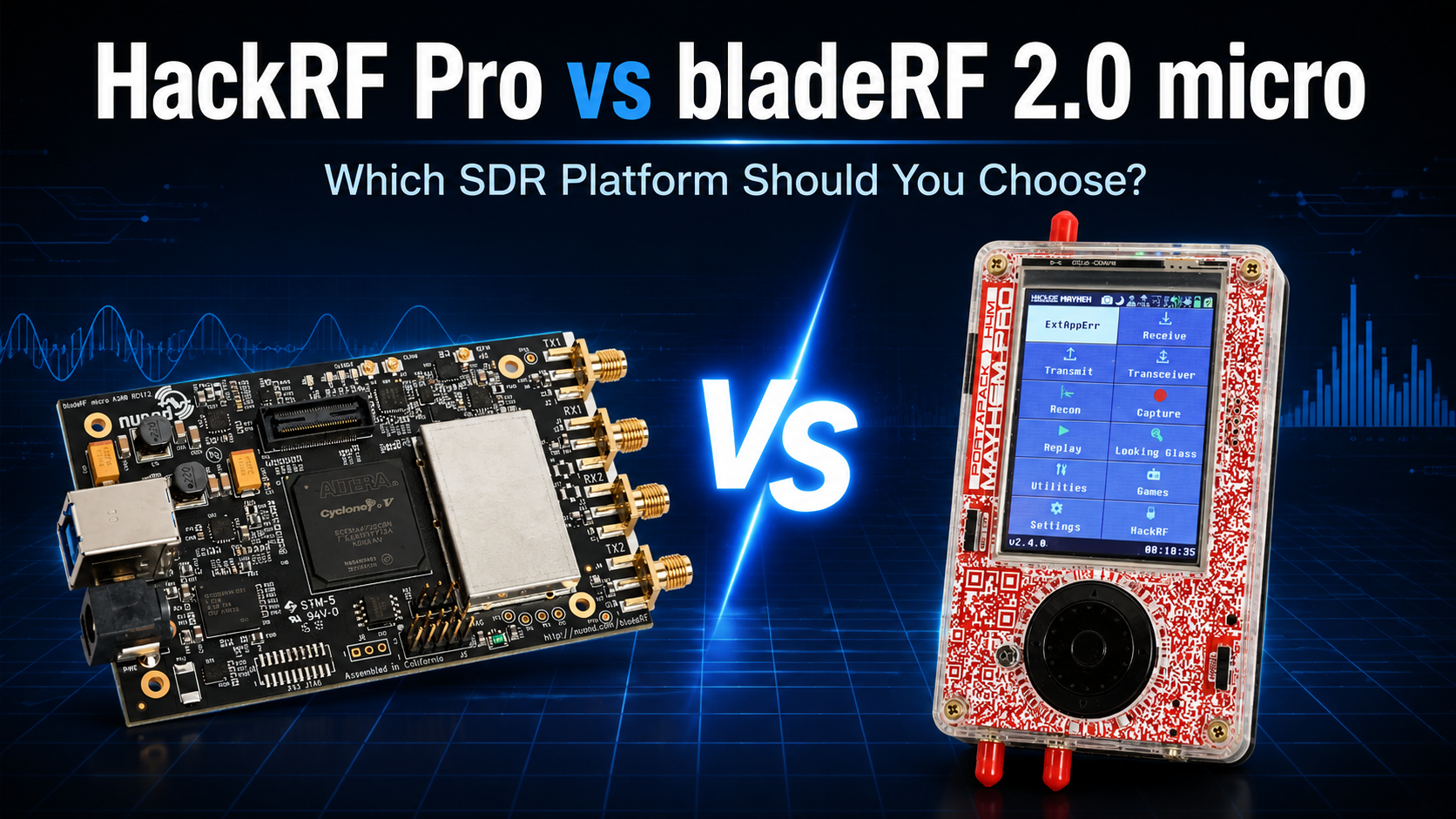
HackRF Pro and bladeRF 2.0 micro are both powerful open software-defined radio platforms covering much of the RF spectrum up to 6 GHz, but they are designed for very different types of users.
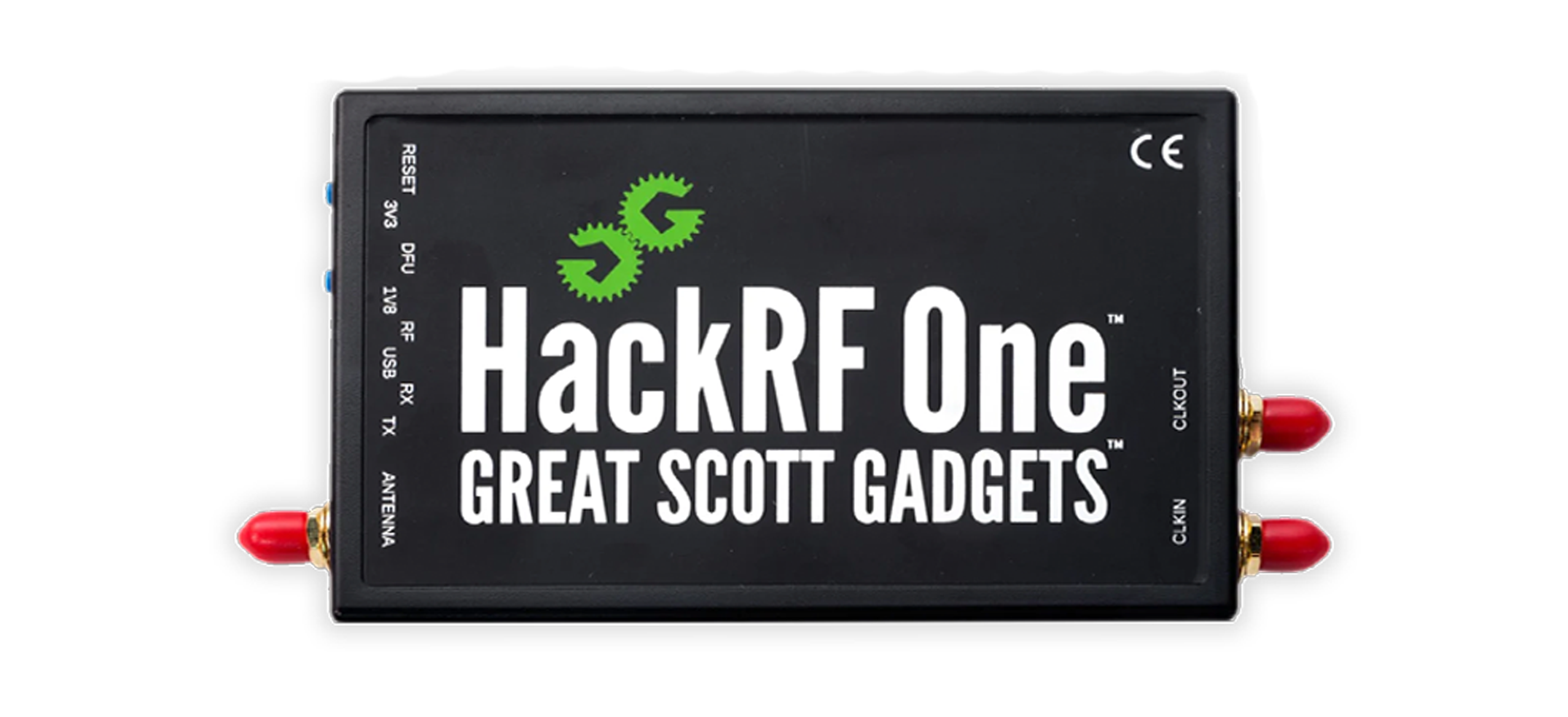
The HackRF Pro is the easier platform for broad-frequency RF experimentation, spectrum exploration, protocol research, GNU Radio projects, portable SDR setups, and users who value the large HackRF software and hardware ecosystem.
The bladeRF 2.0 micro is the stronger platform when the project requires 2×2 MIMO, simultaneous multi-channel operation, substantially higher sample rates, USB 3.0 throughput, 12-bit conversion, or serious FPGA development.
This is therefore not simply a question of which SDR has the larger specification numbers. HackRF Pro is often the better general-purpose wideband experimentation platform. bladeRF 2.0 micro is often the better wireless-development and research platform.
This guide compares HackRF Pro vs bladeRF 2.0 micro xA4 and xA9 for frequency range, sample rate, bandwidth, ADC/DAC resolution, MIMO, transmit and receive architecture, USB throughput, FPGA resources, synchronization, GNU Radio, SDR++, SoapySDR, custom modem development, university labs, wireless research, RF cybersecurity, and product development.
Browse the HackRF Pro Development Board, bladeRF 2.0 micro xA4, bladeRF 2.0 micro xA9, bladeRF devices and accessories, HackRF devices and accessories, and request a formal SDR lab quote from SDRstore.eu.
Quick Answer: HackRF Pro or bladeRF 2.0 micro?
| User or project | Recommended platform | Why |
|---|---|---|
| First serious transmit-capable SDR | HackRF Pro | Simpler single-channel architecture and large HackRF ecosystem. |
| Wide frequency exploration | HackRF Pro | 100 kHz–6 GHz normal operating range reaches much lower than bladeRF. |
| 2×2 MIMO | bladeRF 2.0 micro | Two RX and two TX channels are built into the platform. |
| Simultaneous TX and RX research | bladeRF 2.0 micro | HackRF Pro is explicitly half-duplex. |
| High-rate USB streaming | bladeRF 2.0 micro | USB 3.0 SuperSpeed and 61.44 MSPS standard operation. |
| GNU Radio beginner/intermediate experiments | HackRF Pro | Very broad community support and straightforward single-channel workflows. |
| Advanced GNU Radio MIMO work | bladeRF 2.0 micro | 2×2 channels and higher standard sampling bandwidth. |
| FPGA learning | bladeRF xA4 | Dedicated Cyclone V FPGA development ecosystem without paying for xA9 capacity. |
| FPGA-heavy research | bladeRF xA9 | 301 kLE Cyclone V provides substantially more logic for custom HDL. |
| PortaPack-style portable ecosystem | HackRF Pro | HackRF has extensive compatibility with HackRF/PortaPack-oriented hardware and software. |
| Custom modem development | bladeRF 2.0 micro | Better fit for multi-channel RF and FPGA-based modem processing. |
| Graduate wireless communications lab | bladeRF 2.0 micro | MIMO, 12-bit conversion, higher sample rate and FPGA resources. |
The shortest recommendation is:
- Choose HackRF Pro for wideband RF exploration, single-channel GNU Radio work, HackRF ecosystem compatibility, portable projects and general experimentation.
- Choose bladeRF 2.0 micro xA4 for 2×2 MIMO, higher-rate GNU Radio projects and moderate FPGA development.
- Choose bladeRF 2.0 micro xA9 when substantial FPGA resources are a real requirement.
HackRF Pro vs bladeRF 2.0 micro Specifications
| Feature | HackRF Pro | bladeRF 2.0 micro |
|---|---|---|
| Normal operating frequency | 100 kHz–6 GHz | RX approximately 70 MHz–6 GHz; TX approximately 47 MHz–6 GHz |
| Simplified platform frequency claim | 100 kHz–6 GHz | 47 MHz–6 GHz |
| RF architecture | Single-channel half-duplex | 2×2 MIMO |
| Simultaneous TX/RX | No | Supported by platform architecture |
| Standard maximum sample rate | 20 MSPS | 61.44 MSPS |
| Alternative high-rate mode | 4-bit mode up to 40 MSPS | Advanced 8-bit overclocked mode up to 122.88 MSPS |
| Normal sample resolution | 8-bit I + 8-bit Q | 12-bit ADC/DAC |
| Alternative precision mode | 16-bit samples at lower rates with typical ENOB around 9–11 | 8-bit streaming mode available for advanced high-rate operation |
| Filtered RF bandwidth | Sample-rate/baseband-filter dependent; normal streaming to 20 MSPS | Up to approximately 56 MHz |
| Host interface | High-Speed USB 2.0 via USB-C | USB 3.0 SuperSpeed |
| Main RF connectors | 1 SMA RF port | 4 SMA RF ports for 2 TX + 2 RX |
| FPGA | Integrated FPGA architecture | Intel/Altera Cyclone V |
| FPGA options | One HackRF Pro hardware platform | 49 kLE xA4 or 301 kLE xA9 |
| Built-in frequency reference | TCXO | Factory-calibrated 38.4 MHz VCTCXO |
| External synchronization | Clock input/output and hardware triggering | External clocking supported |
| USB bus powered | Yes | Yes |
| Optional external power | Normally USB powered | 5 V external DC option |
| GNU Radio | Yes | Yes |
| SoapySDR | Available through compatible software stack | Supported |
| Best overall use | Wideband experimentation and general SDR development | MIMO, high-rate wireless and FPGA research |
The Biggest Difference: Half-Duplex vs 2×2 MIMO
This is the specification that should drive the purchase more than almost anything else.
HackRF Pro is half-duplex
HackRF Pro can transmit or receive, but it does not perform normal simultaneous transmit and receive through independent RF chains.
Conceptually:
HackRF Pro

RX mode:
Antenna → HackRF Pro → computer

or

TX mode:
computer → HackRF Pro → antenna
You switch between the two modes.
This architecture is excellent for:
- Receiving signals
- Generating controlled laboratory signals
- Protocol experimentation
- Spectrum exploration
- Replay-style research on authorized systems
- RF education
- Single-channel custom waveforms
It is not the natural choice for a true simultaneous multi-channel radio system.
bladeRF 2.0 micro is a 2×2 MIMO platform
bladeRF 2.0 micro exposes:
- RX1
- RX2
- TX1
- TX2
This allows much more advanced experiments involving two receive and two transmit paths.
Potential use cases include:
- 2×2 MIMO
- Spatial diversity
- Beamforming fundamentals
- Channel estimation
- Wireless channel sounding
- Multi-antenna receivers
- Multi-antenna transmitters
- Full-duplex research architectures with appropriate RF isolation
If your project documentation contains the words “2×2 MIMO,” bladeRF should immediately move ahead of HackRF Pro on the shortlist.
2×2 MIMO Does Not Mean Four Independent Frequencies
One important detail is that the bladeRF 2.0 micro uses an AD9361 transceiver architecture.
The two transmit channels share a transmit LO and the two receive channels share a receive LO.
Conceptually:
RX1 ─┐
     ├─ shared RX tuning domain
RX2 ─┘

TX1 ─┐
     ├─ shared TX tuning domain
TX2 ─┘
This is exactly what many coherent MIMO experiments require.
But it is not the same as owning four completely independent radios that can all operate on unrelated center frequencies.
Read: 2×2 MIMO SDR Explained: USRP B210, PLUTO+, bladeRF, LimeSDR, and Research Use Cases.
Frequency Coverage: HackRF Pro Wins Clearly at the Low End
HackRF Pro's normal operating specification begins at approximately:
100 kHz
bladeRF's detailed Nuand RF table lists approximately:
- RX: 70 MHz–6 GHz
- TX: 47 MHz–6 GHz
This is a major difference.
HackRF Pro is better for:
- HF experimentation
- AM broadcast-band projects
- Shortwave
- Low-VHF experimentation
- Wide-spectrum demonstrations spanning HF through microwave
bladeRF is designed more strongly around modern wireless bands
Its range comfortably covers:
- FM broadcast receive
- VHF/UHF
- 315/433 MHz
- 868/915 MHz
- 1090 MHz
- GNSS bands
- 2.4 GHz
- Cellular bands
- 5 GHz WiFi
- 5.8 GHz ISM
If your project needs significant operation below roughly 50–70 MHz, HackRF Pro is the more straightforward platform.
Sample Rate: bladeRF Has the Major Advantage
HackRF Pro supports standard operation to approximately 20 million complex samples per second.
bladeRF 2.0 micro supports a standard maximum of:
61.44 MSPS
This is more than three times the normal HackRF Pro maximum sample rate.
Why sample rate matters
A higher sample rate can allow:
- More instantaneous spectrum
- Wider digital waveforms
- Higher symbol-rate experiments
- Wideband recording
- Faster frequency-domain processing
It also creates heavier:
- USB load
- CPU load
- Storage requirements
- DSP workload
A bigger number is only useful if the computer and application can actually process the resulting stream.
HackRF Pro's New 40 MSPS Mode
HackRF Pro is more flexible than the traditional 20 MSPS HackRF specification suggests.
Great Scott Gadgets added a half-precision mode that can use 4-bit samples and reach up to approximately:
40 MSPS
This is useful when sample-rate coverage matters more than sample precision.
It should not be compared directly with bladeRF's normal 12-bit 61.44 MSPS mode as though they were equivalent.
| Mode | Sample precision | Maximum direction |
|---|---|---|
| HackRF Pro normal | 8-bit I/Q | 20 MSPS |
| HackRF Pro half-precision | 4-bit | Up to 40 MSPS |
| bladeRF standard | 12-bit ADC/DAC | 61.44 MSPS |
| bladeRF advanced overclock | 8-bit streaming mode | Up to 122.88 MSPS |
bladeRF's 122.88 MSPS Mode
Nuand introduced an advanced mode that overclocks the AD9361 and uses 8-bit sample packing to reach approximately 122.88 MSPS.
This is technically impressive, but it requires context.
Important limitations
- It is an overclocked mode.
- Nuand states that overclocking may affect system stability.
- It uses 8-bit sample streaming to overcome USB-throughput constraints.
- It should be tested carefully with the exact host computer and application.
For ordinary comparison purposes, treat:
61.44 MSPS and 56 MHz filtered bandwidth
as the normal bladeRF baseline.
Do not purchase bladeRF only because a listing says 122.88 MSPS unless you understand how that mode works.
Instantaneous Bandwidth
Nuand lists approximately 56 MHz of filtered bandwidth for bladeRF 2.0 micro.
HackRF Pro's normal architecture provides up to 20 MSPS sample streaming, with configurable analog baseband filtering.
This makes bladeRF a much stronger choice for genuinely wideband modern wireless research.
bladeRF is better suited to:
- Wide OFDM experiments
- Large spectrum captures
- Wideband channel sounding
- High-rate custom modems
- Broad multi-carrier experiments
HackRF Pro remains excellent for:
- FM
- ADS-B
- AIS
- LoRa/Sub-GHz
- GNSS-band monitoring
- Many digital protocols
- Spectrum discovery
- General-purpose GNU Radio experiments
8-bit vs 12-bit: Why Resolution Matters
HackRF Pro's conventional compatible mode uses 8-bit I and 8-bit Q samples.
bladeRF 2.0 micro uses a 12-bit ADC/DAC RF architecture.
Higher converter resolution can provide more digital amplitude levels and may help in challenging signal environments.
However, ADC bit depth alone does not define complete receiver performance.
Real-world RF performance also depends on:
- Noise figure
- Gain distribution
- RF filtering
- Linearity
- Clock quality
- ADC effective number of bits
- Strong nearby signals
Do not choose an SDR based only on the number of ADC bits.
HackRF Pro Extended-Precision Mode
HackRF Pro also introduces a 16-bit sample mode at lower sample rates.
Great Scott Gadgets specifies a typical effective number of bits around:
9–11 ENOB
in this mode.
This is an important improvement because it lets HackRF Pro move beyond its traditional fixed 8-bit workflow when lower sampling rates are acceptable.
The correct comparison is therefore more nuanced than simply “HackRF is 8-bit and bladeRF is 12-bit.”
USB 2.0 vs USB 3.0
HackRF Pro
HackRF Pro uses:
High-Speed USB 2.0 through a USB-C connector
USB-C describes the physical connector. It does not mean the radio suddenly has USB 3.x throughput.
At high sampling rates, HackRF can consume a large share of one USB 2.0 bus.
bladeRF 2.0 micro
bladeRF uses:
USB 3.0 SuperSpeed
This is necessary for its much heavier sample streams and simultaneous multi-channel operation.
Why this matters
A bladeRF research workstation should ideally provide:
- Native USB 3.x controller
- Quality SuperSpeed cable
- Fast CPU
- Sufficient RAM
- Fast storage for IQ recording
The host computer is part of the SDR system.
Raw IQ Storage Becomes Huge Quickly
High sample rates generate enormous files.
Even without considering file headers or application overhead, wideband multi-channel IQ recording can consume gigabytes very quickly.
This matters especially for bladeRF because users may attempt:
- 61.44 MSPS captures
- Two receive channels
- Long experiments
For research projects, plan the storage system before enabling maximum-rate recording.
FPGA Architecture: bladeRF Has the Clear Development Advantage
HackRF Pro is an important upgrade over HackRF One because Great Scott Gadgets replaced the old CPLD-oriented architecture with an FPGA and added more RAM and flash for future firmware and standalone development.
However, bladeRF 2.0 micro is built much more explicitly around user FPGA development.
Nuand offers two principal FPGA capacities:
| Model | FPGA | Approximate total logic | Best fit |
|---|---|---|---|
| bladeRF xA4 | Cyclone V | 49 kLE | Host-side GNU Radio plus moderate FPGA development |
| bladeRF xA9 | Cyclone V | 301 kLE | Advanced custom HDL and FPGA DSP |
What Can bladeRF FPGA Logic Be Used For?
Nuand specifically positions the larger xA9 FPGA for signal-processing workloads such as:
- FFT pipelines
- Transmit modulators
- Transmit filters
- Receive acquisition correlators
- Turbo-decoder-style processing
- Custom modem logic
- Low-latency hardware DSP
This can reduce the amount of raw sample processing that must cross USB and run on the host computer.
It can also enable deterministic low-latency processing close to the RF transceiver.
Important: xA9 Does Not Include Those Accelerators
The larger xA9 FPGA gives you room to build advanced processing.
It does not mean the board automatically includes ready-to-use:
- 5G modem
- FFT accelerator
- Turbo decoder
- Custom correlator
- Wireless PHY
Nuand explicitly states that these processing chains must be designed by the customer or obtained separately.
Read: bladeRF 2.0 micro xA4 vs xA9: Which SDR Should You Buy?.
Which bladeRF Should Compete with HackRF Pro?
HackRF Pro vs bladeRF xA4
This is the most sensible comparison for many buyers.
Choose HackRF Pro for:
- Lower-frequency coverage
- General-purpose experimentation
- HackRF software ecosystem
- Portable HackRF/PortaPack workflows
- Simpler development
Choose bladeRF xA4 for:
- 2×2 MIMO
- USB 3.0
- 61.44 MSPS
- 12-bit RF data path
- FPGA learning
- Advanced GNU Radio projects
HackRF Pro vs bladeRF xA9
The xA9 should be considered when FPGA development itself is part of the project.
The added cost is difficult to justify for a user who simply plans to:
- Listen to signals
- Use SDR++
- Run ordinary GNU Radio blocks on the computer
- Record IQ
Buy xA9 because you need FPGA headroom, not because you expect better RF reception than xA4.
GNU Radio Comparison
Both platforms work well with GNU Radio.
HackRF Pro with GNU Radio
HackRF is especially approachable for:
- FM receivers
- AM receivers
- Digital modulation experiments
- Spectrum analysis
- Single-channel waveform generation
- Protocol research
The basic model is simple:
HackRF Source
→ DSP blocks
→ decoder / GUI / file
or:
signal generation
→ DSP chain
→ HackRF Sink
Read the HackRF Pro Setup Guide.
bladeRF with GNU Radio
bladeRF is more attractive when the flowgraph contains:
- Two receive channels
- Two transmit channels
- MIMO processing
- Wideband signals
- FPGA-assisted signal processing
Read the bladeRF 2.0 micro Setup Guide.
Which Is Better for SDR++?
HackRF Pro is generally the more natural choice when your main use is conventional graphical SDR software such as SDR++.
Why?
- Most desktop SDR applications are built around one receive stream.
- HackRF's architecture fits that workflow well.
- Its software ecosystem is extremely mature.
- Its main advantages do not require writing FPGA logic.
bladeRF can also be used with graphical SDR applications, but buying a 2×2 MIMO FPGA platform purely for basic waterfall browsing often leaves much of its capability unused.
Software Ecosystem
HackRF ecosystem
HackRF supports or integrates with software such as:
- GNU Radio
- SDR++
- SDR#
- GQRX
- HackRF Tools
- SoapySDR-based applications
- Numerous custom research utilities
It also benefits from more than a decade of HackRF educational material, experiments and community development.
bladeRF ecosystem
Nuand lists support for:
- libbladeRF
- GNU Radio through compatible integrations
- SoapySDR
- GQRX
- SDR-Radio
- SDR# integration
- gr-fosphor
- MATLAB
- Simulink
- Open-source FPGA HDL
bladeRF has a strong ecosystem, but it is more developer-oriented.
Portability and the PortaPack Ecosystem
HackRF has a major advantage in portable community hardware.
Great Scott Gadgets designed HackRF Pro for backward compatibility with much of the HackRF ecosystem, including compatibility direction with most PortaPacks and other existing HackRF add-ons.
This creates workflows that are difficult to reproduce with bladeRF:
- Screen-equipped portable operation
- Physical controls
- Battery-based handheld systems
- Standalone HackRF applications
bladeRF is compact, but its design philosophy is closer to a development module attached to a computer, embedded system or custom FPGA application.
Clocking and Synchronization
HackRF Pro
HackRF Pro includes configurable SMA clock and trigger connections.
Multiple HackRF devices can share:
- 10 MHz frequency reference
- Hardware trigger
Great Scott Gadgets documents triggered sampling with start alignment to less than one sample period.
This can support advanced multi-device experimentation.
bladeRF
bladeRF includes a factory-calibrated VCTCXO and external clocking support.
Its integrated 2×2 design means many two-channel coherent experiments do not require purchasing and synchronizing two separate SDR units.
This is an important practical advantage.
One bladeRF vs Two HackRF Pro Devices
A tempting idea is to compare one 2×2 bladeRF with two HackRF Pro units.
Two synchronized HackRFs can be useful for:
- Dual-channel receiving
- Direction finding
- Experimental beamforming
- Multi-device synchronized capture
But the setup becomes more complicated.
You need to manage:
- Two USB devices
- Clock distribution
- Trigger distribution
- Two serial numbers
- Two gain chains
- USB bandwidth
- Phase calibration
For an experiment designed from the beginning around two coherent channels, bladeRF is usually cleaner.
Which Is Better for Wireless Communications Research?
bladeRF generally wins.
Wireless communications research often needs:
- MIMO
- Wide channel bandwidth
- Simultaneous TX/RX
- High sample rates
- Custom modulation
- FPGA processing
Those requirements align closely with bladeRF 2.0 micro.
HackRF Pro remains very valuable for:
- Protocol exploration
- Signal capture
- Single-channel waveform prototyping
- Spectrum observation
- Low-cost supporting radios in a larger testbed
Which Is Better for 5G Research?
Neither platform should automatically be purchased simply because a product description mentions 5G.
A private 5G or physical-layer testbed can require:
- 100 MHz-class channels
- 2×2 or 4×4 MIMO
- Specific UHD or driver integration
- Strict timing
- High continuous throughput
Between these two, bladeRF is more appropriate for experimental wideband and MIMO PHY development.
However, research teams planning conventional srsRAN or OpenAirInterface workflows should also evaluate USRP-class hardware because those ecosystems often have stronger direct integration and documentation.
Which Is Better for RF Cybersecurity Research?
Both can be useful in authorized RF cybersecurity laboratories, but for different reasons.
HackRF Pro advantages
- 100 kHz–6 GHz coverage
- Large security-research ecosystem
- Simple single-channel TX/RX experiments
- Portable workflows
- Broad protocol experimentation
bladeRF advantages
- 2×2 MIMO
- Higher sample rates
- Wider bandwidth
- FPGA signal processing
- Custom modem research
- Simultaneous receive/transmit architectures
Use transmit-capable SDRs only on systems and frequencies where you are authorized to transmit and test.
Which Is Better for RF Fingerprinting?
bladeRF has technical advantages when the goal is collecting high-quality research datasets.
Reasons include:
- 12-bit converter architecture
- Higher standard sample rate
- Wider bandwidth
- Two receive channels
This can be useful for:
- Transient analysis
- IQ imbalance studies
- Emitter classification
- Multi-antenna fingerprinting
- Machine-learning datasets
HackRF remains attractive when a much wider frequency span or lower purchase complexity matters more than multi-channel depth.
Which Is Better for Spectrum Monitoring?
The answer depends on the monitoring target.
HackRF Pro
Better when:
- The frequency may be anywhere from HF through 6 GHz.
- You need a flexible general-purpose monitoring node.
- 20 MHz-class capture is enough.
bladeRF
Better when:
- You need wider instantaneous capture.
- You need two antenna channels.
- You plan custom FPGA pre-processing.
- Your monitoring bands are above the bladeRF low-frequency cutoff.
Which Is Better for FPGA Students?
bladeRF is the more obvious teaching platform when FPGA development is part of the curriculum.
A student can move through several stages:
- Receive through libbladeRF.
- Build GNU Radio flowgraphs.
- Understand the hosted FPGA image.
- Modify simple HDL.
- Add custom DSP.
- Move latency-sensitive processing from host to FPGA.
xA4 is usually enough for learning.
xA9 becomes useful when postgraduate or research projects need significantly more FPGA resources.
Which Is Better for a University Teaching Lab?
The answer depends on the class level.
Introductory SDR lab
HackRF Pro can be easier to teach because students deal with one RF stream and can focus on:
- Sampling
- Spectrum
- Filters
- Modulation
- Demodulation
- GNU Radio
Advanced communications lab
bladeRF is more useful when courses include:
- MIMO
- Spatial diversity
- Custom modems
- FPGA DSP
- Wideband communications
Best mixed lab
A university does not need to choose only one family.
A strong structure is:
- RTL-SDR for beginner receive-only benches
- HackRF Pro for general wideband TX/RX experiments
- bladeRF xA4 for MIMO and FPGA teaching
- bladeRF xA9 for advanced FPGA research
- USRP for projects requiring mature telecom/UHD infrastructure
Read: Best SDR for GNU Radio Projects.
Which Is Easier to Set Up?
HackRF Pro generally wins.
The common workflow is:
- Install HackRF Tools.
- Check
hackrf_info. - Update firmware if required.
- Open SDR++ or GNU Radio.
bladeRF involves more components:
- libbladeRF
- bladeRF-cli
- FX3 firmware
- Correct FPGA image
- xA4 vs xA9 image selection
- GNU Radio or SoapySDR integration
This complexity is not necessarily bad. It reflects a platform that exposes more programmable architecture.
Which Platform Is Better for Developers?
Choose HackRF Pro if your development is mainly:
- Host-side C/C++ software
- Python experiments
- GNU Radio flowgraphs
- RF tools
- Firmware experimentation
- Single-channel radio applications
Choose bladeRF if your development includes:
- libbladeRF applications
- Multi-channel SDR
- Custom HDL
- FPGA accelerators
- Custom physical layers
- MIMO modems
RF Output Power Should Not Decide This Comparison
Neither board should be selected because you expect it to behave like a high-power transmitter.
Nuand lists typical bladeRF CW output around +8 dBm under its stated conditions.
HackRF output varies substantially with frequency and gain configuration.
For both platforms, external RF amplification should be considered a separate engineering problem.
When using amplifiers:
- Check drive requirements.
- Check harmonics.
- Use appropriate filters.
- Check output power with an RF power meter.
- Use rated dummy loads.
Bias-Tee and Active RF Accessories
Both platforms can support powered RF accessories.
HackRF Pro provides software-controlled RF port power.
bladeRF 2.0 micro provides software-controlled bias-tee support on its RF ports and Nuand sells accessories such as:
- BT-100 transmit power amplifier
- BT-200 receive low-noise amplifier
Never enable bias power unless the connected accessory is designed to receive it.
Can Either Replace a Spectrum Analyzer?
No.
Both radios can display spectrum and capture IQ, but neither should automatically be treated as a calibrated professional spectrum analyzer.
For RF product development, combine the SDR with:
- Spectrum analyzer
- RF power meter
- NanoVNA or professional VNA
- Attenuators
- Dummy loads
Safe Transmit Testing
Both HackRF Pro and bladeRF 2.0 micro are transmit-capable SDRs.
For first laboratory tests, use a conducted path instead of transmitting over the air.
A basic test setup is:
SDR TX
→ fixed attenuator
→ additional attenuator
→ DC block if required
→ receiving SDR or spectrum analyzer
or:
SDR TX
→ correctly rated 50-ohm dummy load
Check the receiving instrument's maximum input power before connecting the devices.
Do Not Connect TX Directly to RX
A very short cable does not automatically make an SDR-to-SDR connection safe.
Before creating a cabled link, calculate:
- TX power in dBm
- Attenuation
- Cable loss
- Maximum safe receiver input
Read: dBm to Watts Explained: RF Power Conversion Table and Calculator.
Common Buying Mistakes
Buying HackRF Pro for 2×2 MIMO
HackRF Pro is a single-channel half-duplex platform. Multiple units can be synchronized, but that is different from an integrated 2×2 MIMO radio.
Buying bladeRF xA9 because it must receive better
xA9 has a much larger FPGA. It does not use a fundamentally better RF front end than xA4.
Assuming USB-C means USB 3.0
HackRF Pro uses USB-C physically, but the host interface is High-Speed USB 2.0.
Assuming 122.88 MSPS is bladeRF's ordinary specification
It is an advanced overclocked mode. The normal baseline remains 61.44 MSPS and up to 56 MHz filtered bandwidth.
Buying bladeRF for HF
Check the exact RX/TX frequency requirement. HackRF Pro reaches much lower in frequency.
Buying only by ADC bit depth
Converter resolution is only one part of RF performance.
Ignoring software support
The best SDR is useless if the required software stack does not support your planned workflow.
HackRF Pro Advantages
- 100 kHz–6 GHz normal operating range
- Extremely broad frequency coverage
- Simple single-channel architecture
- Mature HackRF ecosystem
- GNU Radio compatibility
- SDR++ compatibility
- USB-C connector
- Built-in TCXO
- Clock input/output
- Hardware triggering
- New FPGA architecture
- Extended-precision sample mode
- 40 MSPS 4-bit mode
- Compatibility direction with existing HackRF software and accessories
HackRF Pro Limitations
- Half-duplex
- Single primary RF channel
- 20 MSPS standard limit
- 8-bit normal streaming mode
- USB 2.0 throughput
- Not designed as an integrated 2×2 MIMO platform
bladeRF 2.0 micro Advantages
- 2×2 MIMO
- Simultaneous multi-channel architecture
- 61.44 MSPS standard sampling
- 56 MHz filtered bandwidth
- 12-bit ADC/DAC
- USB 3.0 SuperSpeed
- xA4 and xA9 FPGA options
- Open FPGA HDL
- libbladeRF
- GNU Radio
- SoapySDR
- MATLAB/Simulink support direction
- Advanced 122.88 MSPS mode
bladeRF 2.0 micro Limitations
- Does not cover HF like HackRF Pro
- More complicated setup
- FPGA image management
- More demanding USB and host requirements
- xA9 cost is wasted if large FPGA resources are never used
- Advanced 122.88 MSPS mode relies on overclocking
Decision Table by Project
| Project | HackRF Pro | bladeRF 2.0 micro |
|---|---|---|
| General SDR learning | Excellent | Good but more complex |
| GNU Radio learning | Excellent | Excellent for advanced users |
| HF experimentation | Excellent | Not the natural choice |
| 2×2 MIMO | No integrated 2×2 | Excellent |
| Wideband modern wireless | Good | Excellent |
| FPGA learning | Developing opportunity | Excellent |
| Large custom FPGA design | Not primary strength | xA9 recommended |
| Portable HackRF ecosystem | Excellent | Limited |
| RF cybersecurity lab | Excellent general platform | Excellent advanced platform |
| RF fingerprinting datasets | Good | Stronger for high-rate/multi-channel work |
| Custom modem development | Good for host-based prototypes | Excellent |
| University graduate lab | Excellent supporting platform | Excellent primary research platform |
Recommended HackRF Pro Setup
- HackRF Pro
- Wideband or band-specific antennas
- Short shielded USB-C data cable
- SDR++
- GNU Radio
- Fixed attenuator kit
- 50-ohm dummy load
- NanoVNA
- TinySA or spectrum analyzer
Best for: general SDR development, RF learning, wideband receive/transmit experiments, portable research and protocol exploration.
Recommended bladeRF xA4 Setup
- bladeRF 2.0 micro xA4
- Reliable USB 3.0 cable
- Linux development workstation
- libbladeRF and bladeRF-cli
- Correct xA4 FPGA image
- GNU Radio
- 2 or 4 matched antennas depending experiment
- Attenuators and dummy loads
- Spectrum analyzer
Best for: GNU Radio, 2×2 MIMO, university research, custom waveforms and introductory FPGA projects.
Recommended bladeRF xA9 Setup
- bladeRF 2.0 micro xA9
- High-performance USB 3.x workstation
- libbladeRF development environment
- Intel FPGA development tools
- xA9 hosted FPGA image
- GNU Radio and SoapySDR
- Matched MIMO antennas
- RF test equipment
- Controlled cabled RF paths
Best for: FPGA-heavy postgraduate research, custom modems, low-latency DSP, hardware accelerators and advanced wireless development.
Purchase-Order Justification Examples
HackRF Pro justification
HackRF Pro is required as a wideband 100 kHz–6 GHz software-defined radio platform for GNU Radio development, RF signal analysis, protocol experimentation, controlled transmit/receive research, spectrum monitoring and wireless laboratory education.
bladeRF 2.0 micro xA4 justification
bladeRF 2.0 micro xA4 is required as a USB 3.0 2×2 MIMO software-defined radio for advanced GNU Radio experiments, multi-channel wireless communications, waveform development, channel estimation and introductory FPGA signal-processing research.
bladeRF 2.0 micro xA9 justification
bladeRF 2.0 micro xA9 is required for advanced 2×2 MIMO and FPGA-based SDR development, including custom HDL accelerators, modem processing, FFTs, filters, correlators and low-latency digital signal-processing research.
RF safety accessory justification
RF attenuators, dummy loads, DC blocks, spectrum-analysis equipment and RF power meters are required to create controlled transmit paths, protect SDR receiver inputs, validate output levels and perform repeatable laboratory measurements.
Request a Quote for HackRF Pro or bladeRF
Universities, RF laboratories, wireless research teams, cybersecurity companies, product developers, telecom groups, engineering departments and public-sector organizations can request a formal quotation directly from SDRstore.eu.
Use the Add to Quote button on product pages or the document icon on product cards. Add HackRF Pro, bladeRF xA4, bladeRF xA9, antennas, cables, amplifiers, attenuators, dummy loads, NanoVNA, spectrum analyzers, RF power meters and project requirements to one quote request.
A quote request is especially useful for:
- University SDR laboratories
- Multiple HackRF Pro units
- 2×2 MIMO bladeRF testbeds
- FPGA research projects
- RF cybersecurity laboratories
- Wireless product-development benches
- Formal company or public-sector procurement
Read the SDRstore.eu quote-request guide.
Related SDRstore.eu Guides
- HackRF Pro Setup Guide: Firmware, Drivers, GNU Radio, SDR++, and First Signal
- bladeRF 2.0 micro Setup Guide: Drivers, libbladeRF, FPGA Image, and GNU Radio
- bladeRF 2.0 micro xA4 vs xA9: Which SDR Should You Buy?
- 2×2 MIMO SDR Explained
- bladeRF 2.0 micro vs USRP B210
- Best SDR for GNU Radio Projects
- HackRF Pro vs PortaPack H4M
- SDR Hardware for RF Product Testing
Official and Technical Resources
- Great Scott Gadgets HackRF Pro
- Official HackRF Pro Documentation
- HackRF Sampling Rate and Baseband Filters
- HackRF Hardware Triggering
- HackRF External Clock Interface
- Nuand bladeRF 2.0 micro
- Nuand bladeRF 2.0 micro xA4
- Nuand 122.88 MSPS Advanced Mode
- Nuand bladeRF Open-Source Repository
Final Recommendation
Choose HackRF Pro if your priority is broad RF coverage, general-purpose experimentation, a straightforward single-channel workflow, GNU Radio and SDR++ compatibility, HackRF ecosystem support, portable applications and operation below the bladeRF frequency range.
Choose bladeRF 2.0 micro xA4 if your priority is 2×2 MIMO, simultaneous multi-channel wireless experimentation, 61.44 MSPS standard streaming, USB 3.0, 12-bit conversion, or learning FPGA-based SDR development.
Choose bladeRF 2.0 micro xA9 only when you can identify a real requirement for substantially more FPGA resources. It is the best of these platforms for custom HDL accelerators, advanced modem development, large FPGA DSP chains and postgraduate wireless research, but its larger FPGA does not make the RF front end inherently better than xA4.
The key distinction is therefore not simply HackRF vs bladeRF. It is wideband 1×1 half-duplex experimentation vs integrated 2×2 MIMO and FPGA-oriented wireless development.
For a general SDR enthusiast, RF experimenter or wideband GNU Radio user, HackRF Pro is often the better purchase. For a communications researcher, MIMO developer or FPGA engineer, bladeRF 2.0 micro is usually the stronger platform.
FAQ
What is the main difference between HackRF Pro and bladeRF 2.0 micro?
HackRF Pro is a single-channel half-duplex SDR covering 100 kHz–6 GHz. bladeRF 2.0 micro is a 2×2 MIMO USB 3.0 platform with higher standard sample rates, 12-bit ADC/DAC operation and much stronger user-FPGA development options.
Which is better, HackRF Pro or bladeRF?
HackRF Pro is better for broad-frequency general experimentation, simpler GNU Radio projects and the HackRF ecosystem. bladeRF is better for MIMO, high-rate wireless development, simultaneous multi-channel operation and FPGA research.
Does HackRF Pro support 2×2 MIMO?
No. HackRF Pro is a single-channel half-duplex platform. Multiple HackRF units can be synchronized for some multi-channel experiments, but this is more complex than using an integrated 2×2 MIMO radio.
Does bladeRF support 2×2 MIMO?
Yes. bladeRF 2.0 micro provides two transmit and two receive RF paths and is designed as a 2×2 MIMO SDR platform.
Which has the wider frequency range?
HackRF Pro at the low end. It operates from approximately 100 kHz to 6 GHz. Nuand's detailed bladeRF specification lists receive tuning from approximately 70 MHz and transmit tuning from approximately 47 MHz to 6 GHz.
Which has the higher sample rate?
bladeRF. Its standard sample rate reaches 61.44 MSPS, compared with 20 MSPS for standard HackRF Pro operation. Both platforms also provide alternative sample modes beyond those baseline figures.
Does HackRF Pro really support 40 MSPS?
Yes. Great Scott Gadgets lists a half-precision mode using 4-bit samples at up to 40 MSPS. Normal backward-compatible HackRF operation remains 8-bit I/Q at up to 20 MSPS.
Does bladeRF really support 122.88 MSPS?
Nuand provides an advanced 122.88 MSPS mode using AD9361 overclocking and 8-bit sample packing. Nuand warns that overclocking may affect stability, so 61.44 MSPS remains the better baseline specification for normal use.
Which is better for GNU Radio?
Both are strong GNU Radio platforms. HackRF Pro is easier for general single-channel projects. bladeRF is more capable when the flowgraph needs 2×2 MIMO, wider sample streams or FPGA-oriented processing.
Which is better for FPGA development?
bladeRF 2.0 micro. The xA4 uses a 49 kLE Cyclone V FPGA, while xA9 uses a much larger 301 kLE FPGA. The bladeRF ecosystem exposes FPGA HDL specifically for custom signal-processing development.
Should I buy bladeRF xA4 or xA9?
Choose xA4 for most GNU Radio, MIMO and introductory FPGA projects. Choose xA9 when your HDL design genuinely requires significantly more programmable logic for accelerators, filters, FFTs, correlators or custom modem processing.
Does xA9 receive better than xA4?
No. The main xA4 vs xA9 difference is FPGA capacity. They share the same core bladeRF 2.0 micro RF architecture, sample-rate direction, bandwidth and MIMO capabilities.
Which is better for RF cybersecurity research?
HackRF Pro is excellent for broad-spectrum single-channel protocol experimentation and portable workflows. bladeRF is stronger when authorized research requires 2×2 MIMO, wider bandwidth, simultaneous TX/RX architecture or custom FPGA signal processing.
Which is better for a university lab?
HackRF Pro is easier for general SDR and RF teaching. bladeRF xA4 is stronger for advanced communications, MIMO and FPGA courses. xA9 is most appropriate for postgraduate FPGA-heavy projects.
Can SDRstore.eu quote HackRF Pro and bladeRF equipment for a laboratory?
Yes. Use the Add to Quote button on product pages or the document icon on product cards. Add HackRF Pro, bladeRF xA4 or xA9, antennas, attenuators, dummy loads, cables, amplifiers, spectrum analyzers, NanoVNA and other RF lab equipment so the complete setup can be quoted together.
No posts found
Write a review






We support all major card and digital payment options. More local methods are available and shown during checkout.
You enter into a binding sales contract once you have received an 'order confirmation and sales receipt' email from us, in line with our Sales & Delivery conditions. Therefore, sdrstore.eu has the right to cancel your order in the event of technical problems, delivery failure, Fair use policy and other similar situations.






Your payments are protected by advanced encryption and 3-D Secure authentication for safe online shopping.