





bladeRF 2.0 micro vs USRP B210: Which 2×2 MIMO SDR Is Better for Research?
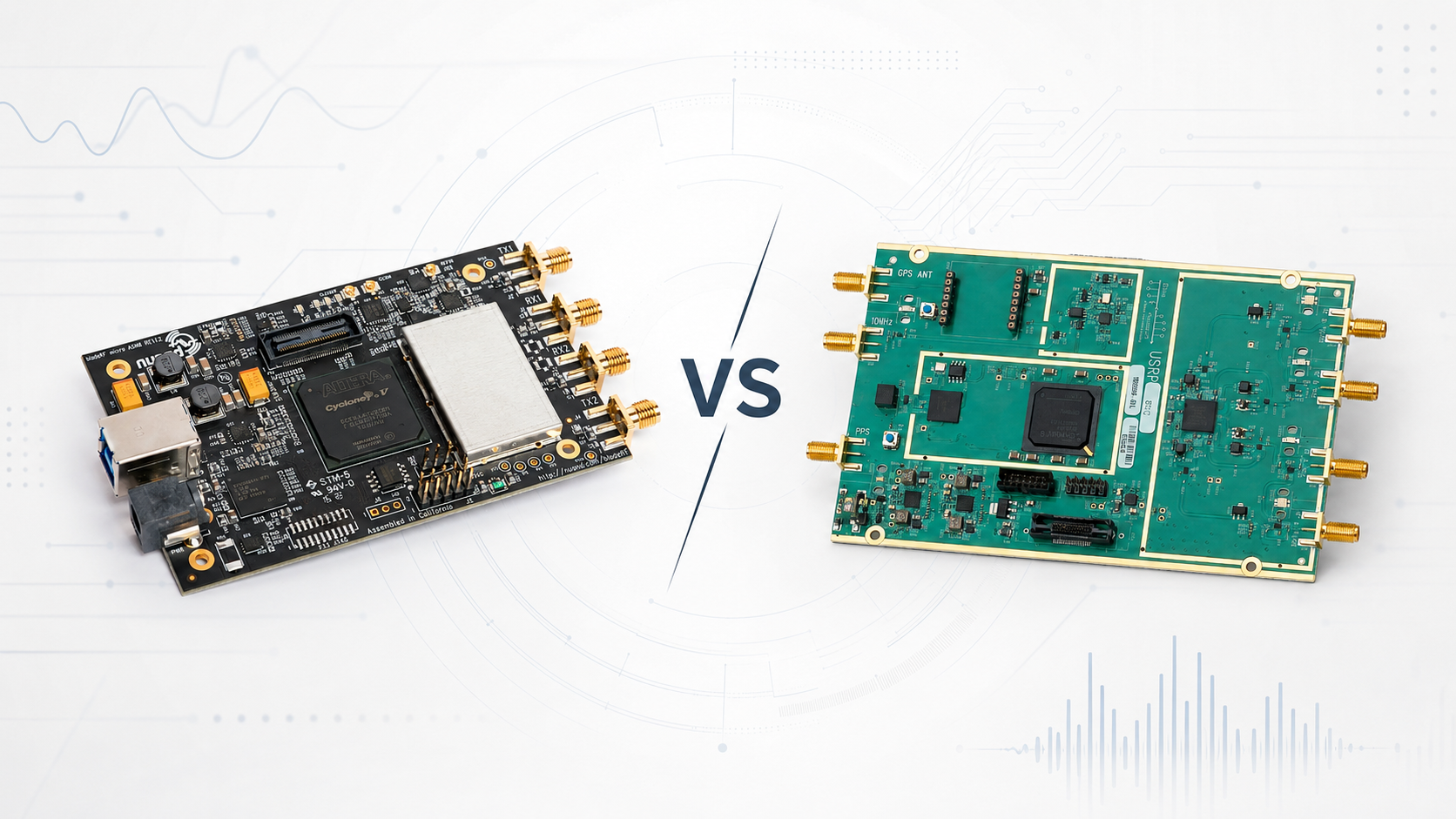
bladeRF 2.0 micro and USRP B210 are two of the most interesting compact 2×2 MIMO software-defined radios for research labs. Both are USB-connected, both can handle serious wireless experimentation, and both are suitable for GNU Radio, MIMO learning, waveform development, and advanced RF projects.
However, they are not the same kind of research tool. USRP B210 is usually the safer choice when your laboratory wants a mature UHD workflow, official USRP documentation, and strong alignment with existing telecom and university examples. bladeRF 2.0 micro is usually the better choice when your project values libbladeRF, FPGA experimentation, portable development, and the option to choose a larger xA9 FPGA for custom HDL work.
This guide compares bladeRF 2.0 micro and USRP B210 for universities, RF laboratories, cybersecurity firms, telecom researchers, GNU Radio users, private 5G labs, and wireless-product development teams.
Browse the bladeRF SDR devices and accessories category, the USRP SDR devices category, the bladeRF 2.0 micro xA4, the bladeRF 2.0 micro xA9, and the USRP B210 USB SDR.
Quick Answer: bladeRF 2.0 micro or USRP B210?
| Research need | Better choice | Why |
|---|---|---|
| UHD-first GNU Radio lab | USRP B210 | It is an official USRP platform with mature UHD support and many existing examples. |
| libbladeRF, SoapySDR, and open bladeRF ecosystem | bladeRF 2.0 micro | It is designed around Nuand’s libbladeRF workflow and open development ecosystem. |
| FPGA-heavy DSP or custom HDL development | bladeRF 2.0 micro xA9 | The xA9 variant has a much larger Cyclone V FPGA than the xA4 and is better for custom accelerators. |
| Standardized university communications course | USRP B210 | Usually easier to standardize when the teaching material already uses UHD or USRP examples. |
| Portable 2×2 MIMO experimentation | bladeRF 2.0 micro xA4 | Good value when host-side processing is enough and xA9 FPGA headroom is not required. |
| srsRAN and private 5G learning | USRP B210 | B210 is commonly documented in srsRAN and USRP-based cellular workflows. |
| Custom modem and waveform development | bladeRF 2.0 micro xA9 or USRP B210 | Choose xA9 for FPGA-heavy custom work. Choose B210 for UHD-first reference workflows. |
| Lowest integration risk for institutional procurement | USRP B210 | Official USRP documentation and UHD ecosystem reduce uncertainty for many labs. |
The simple rule: choose USRP B210 for the safest official UHD research path. Choose bladeRF 2.0 micro when the bladeRF ecosystem, FPGA development, or xA9 logic capacity is central to the project.
bladeRF 2.0 micro vs USRP B210 Specification Comparison
| Feature | bladeRF 2.0 micro | USRP B210 |
|---|---|---|
| Main vendor ecosystem | Nuand bladeRF and libbladeRF | Ettus Research USRP and UHD |
| Top-line frequency direction | 47 MHz–6 GHz | 70 MHz–6 GHz |
| Detailed tuning nuance | Nuand’s detailed table separates RX and TX direction; check RX/TX requirements for low-frequency projects | Continuous 70 MHz–6 GHz direction |
| MIMO | 2×2 MIMO streaming | 2×2 MIMO |
| Standard sample-rate direction | 61.44 MSPS | Up to 56 MHz real-time bandwidth direction |
| Filtered or real-time bandwidth direction | 56 MHz filtered bandwidth | Up to 56 MHz real-time bandwidth |
| Host interface | USB 3.0 SuperSpeed | USB 3.0 SuperSpeed |
| FPGA direction | Cyclone V xA4 or xA9 variant | Spartan-6 FPGA direction |
| Software stack | libbladeRF, GNU Radio, SoapySDR, GQRX, SDR-Radio, SDR#, gr-fosphor direction | UHD, GNU Radio, USRP tools, and many USRP-based research examples |
| Best buyer fit | FPGA development, portable MIMO, custom waveform research, libbladeRF projects | UHD-first research, standardized labs, private 5G examples, documented USRP workflows |
What bladeRF 2.0 micro Does Better
1. Better FPGA choice flexibility
The biggest bladeRF advantage is that you can choose between xA4 and xA9 variants. The RF platform is shared, but the FPGA capacity is very different.
- bladeRF 2.0 micro xA4 is the better value option for GNU Radio, host-side DSP, university benches, and introductory FPGA work.
- bladeRF 2.0 micro xA9 is the stronger option when a project needs substantially more FPGA room for HDL accelerators, filters, correlators, FFT pipelines, or custom modem work.
Read the dedicated comparison: bladeRF 2.0 micro xA4 vs xA9: Which SDR Should You Buy?
2. Strong fit for custom modem and waveform development
bladeRF 2.0 micro is attractive when the research goal is to build and modify waveforms rather than only follow existing UHD examples. The libbladeRF ecosystem, open-source tooling, and FPGA options make it a flexible development platform for teams that want to experiment deeply with the radio chain.
Choose bladeRF when your project includes:
- Custom waveform development
- GNU Radio experimentation
- SoapySDR workflows
- FPGA and HDL education
- Custom modem prototyping
- Low-latency DSP experiments
- Portable 2×2 MIMO research
- Wireless-security research on authorized systems
3. xA9 is more attractive for FPGA-heavy research
If the laboratory already knows that major signal-processing blocks must run in FPGA logic, bladeRF 2.0 micro xA9 becomes much more attractive. It is not better because it receives signals more clearly than xA4 or B210. It is better because it gives the developer substantially more programmable logic for custom work.
This matters for postgraduate research, commercial modem development, low-latency prototyping, and projects where moving processing from host CPU to FPGA is part of the research objective.
What USRP B210 Does Better
1. Stronger UHD-first research path
USRP B210 is the better default when the lab wants a mature official UHD workflow. UHD is widely used in research, university examples, GNU Radio tutorials, and USRP-based development environments.
Choose B210 when the project needs:
- Official USRP compatibility
- UHD examples and documentation
- GNU Radio source/sink blocks through UHD
- Standardized teaching images
- Lower integration risk for institutional labs
- Easy comparison with academic and telecom examples
2. Better fit for many srsRAN and private 5G examples
For private 5G, LTE, and cellular learning, USRP B210 is usually the safer compact choice because many open-source cellular examples and research notes are written around USRP hardware and UHD.
That does not mean B210 can run every advanced cellular experiment. Complex multi-cell, handover, wider-bandwidth, low-latency, and scalable testbeds may require USRP X310, X410, or other higher-end platforms. But between bladeRF 2.0 micro and B210, the B210 is normally the easier first choice for srsRAN and OpenAirInterface-oriented learning.
Read our related guides:
- Best SDR for 5G Research: USRP B210, X310, X410, and Lower-Cost Alternatives
- OpenAirInterface vs srsRAN: Which Open-Source 5G Stack Is Better?
- USRP B210 vs X310: Which SDR Should a Research Lab Buy?
3. Better institutional standardization
Universities and laboratories often care about repeatability more than maximum flexibility. If the course material, Docker image, GNU Radio exercises, driver installation guide, and student documentation all use UHD, USRP B210 can reduce support time.
For a teaching lab, that predictability can be more valuable than FPGA capacity that students may never use.
GNU Radio: Which Board Is Better?
Both bladeRF 2.0 micro and USRP B210 can be good GNU Radio platforms. The better choice depends on which source/sink ecosystem the lab prefers.
| GNU Radio workflow | Recommended board | Reason |
|---|---|---|
| UHD-based examples and classroom material | USRP B210 | Best fit when the flowgraphs, documentation, or research group already use UHD. |
| libbladeRF and SoapySDR experimentation | bladeRF 2.0 micro | Best fit when the team wants bladeRF-specific tools or SoapySDR flexibility. |
| Host-based DSP and visualization | Either | Both can stream IQ samples to GNU Radio for host-side processing. |
| Future HDL acceleration | bladeRF 2.0 micro xA9 | The larger FPGA provides more headroom for custom logic. |
| Private 5G and USRP tutorial alignment | USRP B210 | More existing examples are written around UHD and USRP hardware. |
Read more: Best SDR for GNU Radio Projects: RTL-SDR, HackRF, PlutoSDR, bladeRF, and USRP.
2×2 MIMO Research: Which Is Better?
Both boards are valid 2×2 MIMO SDR platforms, but they encourage different research styles.
Choose bladeRF for MIMO when:
- You want a compact 2×2 MIMO development platform.
- Your team is comfortable with libbladeRF or SoapySDR.
- The project includes custom DSP or FPGA work.
- You are comparing host-side processing against FPGA acceleration.
- You want xA9 headroom for larger MIMO-related HDL experiments.
Choose USRP B210 for MIMO when:
- You want the strongest official UHD path.
- Your teaching material already uses USRP examples.
- You need a documented default research board for students.
- Your project is connected to srsRAN, OpenAirInterface, or USRP-based telecom workflows.
- You value integration predictability over FPGA expansion.
For a broader MIMO buyer guide, read 2×2 MIMO SDR Explained: USRP B210, PLUTO+, bladeRF, LimeSDR, and Research Use Cases.
Private 5G, LTE, and Telecom Research
USRP B210 is usually the better first choice for compact private-5G and LTE learning because more official and community workflows are written around USRP hardware and UHD.
Use USRP B210 for:
- srsRAN learning labs
- Open5GS and COTS UE experiments
- UHD-based cellular examples
- Telecom teaching benches
- Introductory private-network research
Use bladeRF 2.0 micro for telecom research when:
- Your team specifically wants libbladeRF support.
- You are building custom physical-layer experiments.
- You need FPGA capacity for custom modem components.
- You are not relying on a USRP-specific tutorial.
Important note: neither board should be treated as a universal private-5G platform. Advanced use cases may require stronger synchronization, higher throughput, modular RF, higher-end FPGA resources, or a different USRP series.
FPGA Development: bladeRF xA9 Has the Advantage
If FPGA work is central to the research, bladeRF 2.0 micro xA9 is the more compelling option. Its larger FPGA makes it more suitable for custom HDL blocks, accelerators, and advanced signal-processing projects.
Choose bladeRF xA9 if you plan to work on:
- Custom modem logic
- Hardware filters
- FFT pipelines
- Correlators
- Transmit modulators
- Receive acquisition blocks
- Low-latency hardware DSP
- FPGA-heavy postgraduate projects
Choose USRP B210 if the FPGA is not the focus and the goal is to use a mature SDR platform from software through UHD.
Software Ecosystem: libbladeRF vs UHD
| Question | bladeRF 2.0 micro | USRP B210 |
|---|---|---|
| Main low-level API | libbladeRF | UHD |
| GNU Radio support | Yes, through compatible integrations | Yes, commonly through UHD |
| SoapySDR direction | Strong fit | Possible through supported workflows, but UHD is the normal default |
| Best documentation match | Nuand and bladeRF community documentation | Ettus, UHD, USRP, and many research examples |
| Best for institutional standardization | Good when the lab standardizes on bladeRF | Usually easier when the lab already uses USRP/UHD material |
This difference should drive the purchase. A technically strong SDR can still be the wrong purchase if the software ecosystem does not match the lab’s planned workflow.
Which Board Should a University Buy?
For most universities, the best answer is not always one board or the other. A balanced lab may use both.
| University use case | Recommended SDR |
|---|---|
| Introductory 2×2 MIMO teaching | USRP B210 or bladeRF xA4 |
| UHD-focused communications course | USRP B210 |
| FPGA and HDL-focused course | bladeRF xA4 for learning or xA9 for advanced work |
| Private 5G learning lab | USRP B210 first |
| Custom waveform and modem research | bladeRF xA9 or USRP B210 depending on ecosystem |
| Procurement with minimal driver uncertainty | USRP B210 |
| Student projects with portable 2×2 hardware | bladeRF xA4 |
For complete lab planning, read How to Build a University SDR Lab and SDR Hardware for Universities.
Which Board Should a Cybersecurity or RF Research Team Buy?
For authorized wireless-security research, both platforms can be useful, but they serve different roles.
Choose bladeRF 2.0 micro when you need:
- Custom signal-processing experiments
- Portable wideband 2×2 development
- FPGA-oriented research
- libbladeRF or SoapySDR workflows
- Custom protocol or waveform experimentation
Choose USRP B210 when you need:
- A standardized official research platform
- UHD-based GNU Radio work
- Cellular and private-network examples
- Repeatable lab benches
- Documentation that is easier to justify in formal procurement
Read more: SDR for Cybersecurity Research: Hardware for Authorized Wireless Security Testing.
Common Buying Mistakes
Buying bladeRF xA9 only because it is the top model
xA9 is valuable when FPGA capacity matters. It does not automatically provide better RF reception than xA4 or B210.
Choosing B210 when the project is really about FPGA development
If your research roadmap depends on custom HDL accelerators, bladeRF xA9 may be a better fit than a UHD-first B210 workflow.
Choosing bladeRF when every tutorial uses UHD
If the course or research project is written around USRP devices, B210 can save time and reduce integration risk.
Ignoring host-computer and USB performance
Both boards rely on high-speed host connectivity. Sustained streaming depends on the host PC, USB controller, operating system, driver stack, sample format, and application.
Forgetting the RF accessories
Budget for antennas, SMA cables, adapters, attenuators, dummy loads, filters, and measurement tools. The SDR board is only one part of a reliable research bench.
Accessories to Buy with Either SDR
- Suitable antennas for the intended frequency bands
- Short high-quality SMA cables
- SMA adapters
- Fixed attenuators
- 50-ohm dummy loads
- DC blocks where required
- Receive-side filters where useful
- USB 3.0 cable suitable for reliable streaming
- External clocking accessories if required by the experiment
- Spectrum analyzer or VNA for lab validation
For measurement planning, read NanoVNA vs TinySA and RF Cybersecurity Lab Equipment Checklist.
Legal and RF-Safety Notes
bladeRF 2.0 micro and USRP B210 are transmit-capable SDR platforms. Use them only on frequencies, devices, systems, and power levels where you are legally permitted and authorized to transmit.
- Start with cabled tests where possible.
- Use suitable attenuation before connecting SDR inputs.
- Use dummy loads when radiation is unnecessary.
- Do not connect transmitter output directly to a receiver input.
- Verify signal levels before connecting test equipment.
- Use shielding where appropriate.
- Follow local spectrum regulations.
- Obtain written authorization before wireless-security testing.
Request a Formal Quote for Research SDR Hardware
Universities, laboratories, cybersecurity firms, telecom teams, product-development groups, and businesses can request a formal quote directly from SDRstore.eu.
Use the Add to Quote button on product pages or the document icon on product cards. Add the required bladeRF boards, USRP devices, antennas, attenuators, cables, clocking accessories, test instruments, and quantities to one quote request.
A quote request is useful when you need:
- A bladeRF vs USRP comparison for internal approval
- Multiple SDR devices for a lab rollout
- Formal pricing for university procurement
- Accessories included in the same offer
- A phased research-lab equipment plan
- Custom pricing for business or institutional orders
Read the SDRstore.eu quote-request guide.
Related SDRstore.eu Guides
- bladeRF 2.0 micro xA4 vs xA9: Which SDR Should You Buy?
- 2×2 MIMO SDR Explained: USRP B210, PLUTO+, bladeRF, LimeSDR, and Research Use Cases
- Best SDR for GNU Radio Projects: RTL-SDR, HackRF, PlutoSDR, bladeRF, and USRP
- USRP B210 Alternatives: Lower-Cost SDR Boards for Universities and RF Labs
- AD9361 vs AD9363 SDR Boards: Bandwidth, MIMO, Use Cases, and Buyer Advice
- Best SDR for 5G Research: USRP B210, X310, X410, and Lower-Cost Alternatives
Official Resources
- Nuand bladeRF 2.0 micro official overview
- Nuand bladeRF 2.0 micro xA4 official product page
- Nuand bladeRF 2.0 micro xA9 official product page
- Nuand bladeRF open-source repository
- Ettus Research USRP B210 official product page
- Ettus UHD and USRP user manual
- Ettus Research UHD open-source repository
- srsRAN CU/DU split tutorial using USRP B210
Final Verdict: Which 2×2 MIMO SDR Is Better for Research?
Choose USRP B210 if you want the safest compact 2×2 MIMO SDR for official UHD workflows, GNU Radio teaching, private 5G learning, srsRAN examples, institutional standardization, and lower integration risk.
Choose bladeRF 2.0 micro xA4 if you want a strong-value 2×2 MIMO SDR for portable research, GNU Radio, SoapySDR, libbladeRF development, and host-based signal processing.
Choose bladeRF 2.0 micro xA9 if your research depends on substantial FPGA headroom for HDL accelerators, custom modem development, real-time signal-processing blocks, filters, correlators, or advanced physical-layer experimentation.
The best board is not the one with the highest headline specification. It is the one that matches your software ecosystem, teaching material, FPGA requirements, and research roadmap.
FAQ
Is bladeRF 2.0 micro better than USRP B210?
Not universally. bladeRF 2.0 micro is better when FPGA development, libbladeRF, SoapySDR, and custom waveform work matter most. USRP B210 is usually better when UHD, USRP documentation, srsRAN examples, and institutional standardization matter most.
Is USRP B210 better for GNU Radio?
USRP B210 is often the easier GNU Radio choice when the lab uses UHD-based examples. bladeRF 2.0 micro is also suitable for GNU Radio, especially when the team wants libbladeRF or SoapySDR workflows.
Which SDR is better for private 5G research?
USRP B210 is usually the better first choice for compact private 5G learning because many srsRAN and USRP-based workflows use UHD and B210-style hardware. Advanced cellular experiments may still require higher-end SDR platforms.
Which SDR is better for FPGA development?
bladeRF 2.0 micro xA9 is the stronger choice for FPGA-heavy work because it provides much more programmable logic than xA4. Choose it for HDL accelerators, custom modems, filters, correlators, and real-time DSP experiments.
Does bladeRF xA9 receive better than USRP B210?
No. bladeRF xA9 should be chosen for FPGA capacity, not because it automatically receives better than USRP B210. RF performance depends on the full setup, including gain, filtering, antennas, cables, clocking, and software configuration.
Do bladeRF 2.0 micro and USRP B210 both support 2×2 MIMO?
Yes. Both platforms are suitable for 2×2 MIMO research, but the software ecosystem and development workflow are different. bladeRF uses the Nuand bladeRF ecosystem, while USRP B210 normally uses UHD.
Which is better for university labs?
USRP B210 is usually better for UHD-first standardized courses. bladeRF xA4 is a strong value choice for portable 2×2 MIMO and GNU Radio benches. bladeRF xA9 is best for advanced FPGA-focused university research.
Can bladeRF 2.0 micro replace USRP B210?
It can replace B210 in some MIMO, GNU Radio, and waveform-research workflows, but not when the project specifically requires UHD, USRP documentation, or a B210-based tutorial. Test the exact workflow before replacing hardware in a lab.
Which board should a cybersecurity research lab buy?
Choose bladeRF when custom waveforms, FPGA experimentation, and libbladeRF matter. Choose USRP B210 when the lab wants a standardized UHD platform for repeatable research. Many advanced labs benefit from having both.
How can a university or company request a quote?
Use the Add to Quote button on SDRstore.eu product pages or the document icon on product cards. Add the bladeRF, USRP B210, accessories, quantities, and project notes so the full setup can be reviewed as one quotation request.
No posts found
Write a review






We support all major card and digital payment options. More local methods are available and shown during checkout.
You enter into a binding sales contract once you have received an 'order confirmation and sales receipt' email from us, in line with our Sales & Delivery conditions. Therefore, sdrstore.eu has the right to cancel your order in the event of technical problems, delivery failure, Fair use policy and other similar situations.






Your payments are protected by advanced encryption and 3-D Secure authentication for safe online shopping.