





Drone RF Detection with SDR: Legal Spectrum Monitoring for Sensitive Sites
Drones are now common around industrial sites, data centers, ports, warehouses, airports, prisons, campuses, energy facilities, events, and research locations. Most flights are legal, but sensitive sites still need situational awareness: what RF activity is present, whether a drone may be nearby, whether Remote ID messages are visible, and whether unusual 2.4 GHz or 5.8 GHz activity should be escalated to security staff or local authorities.
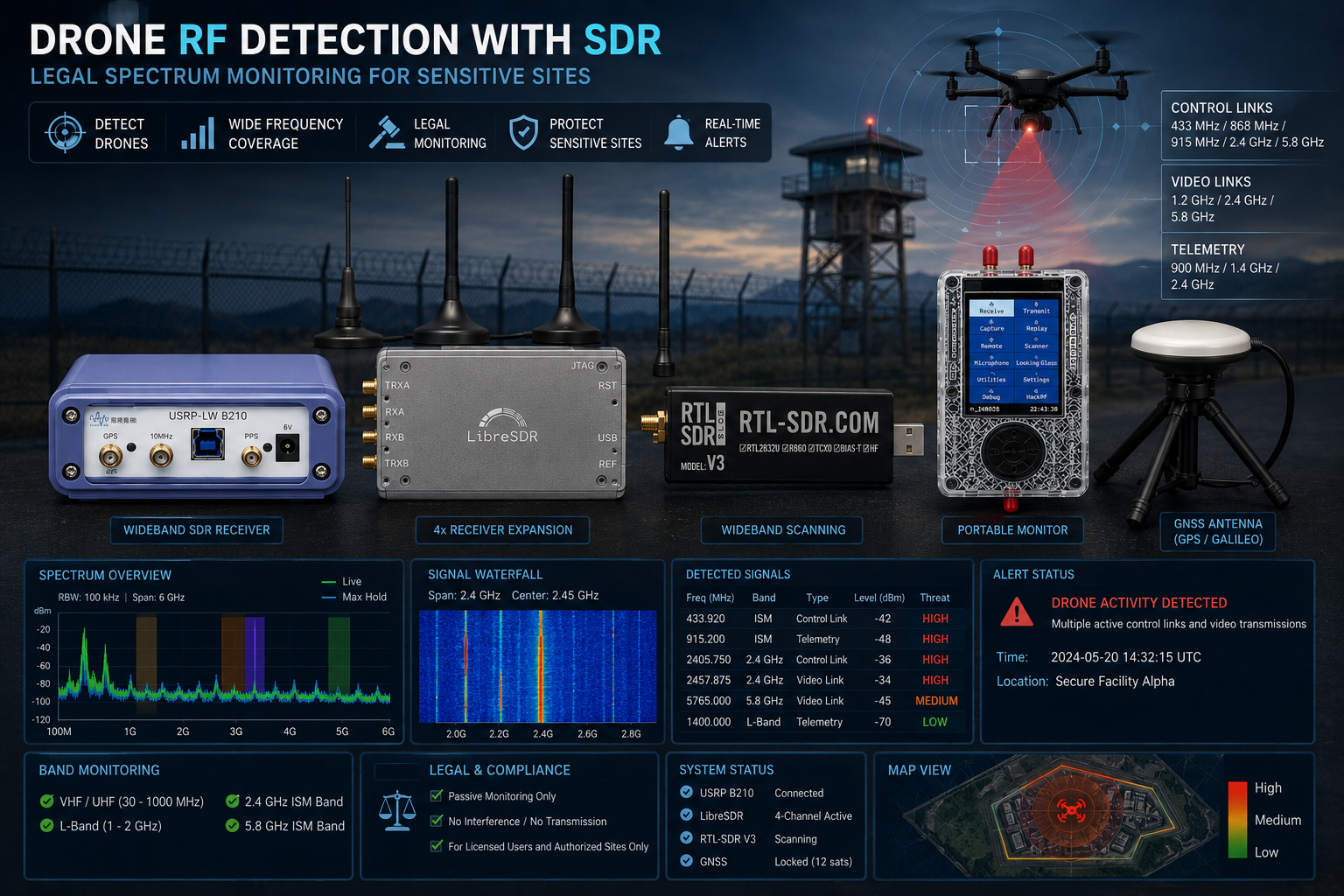
Software-defined radio can help with legal drone RF detection and spectrum monitoring. An SDR can passively observe RF activity, log spectrum changes, receive or help monitor Remote ID-related signals, support direction-finding research, and provide evidence for follow-up investigation. It should not be used for jamming, spoofing, takeover, or any other active counter-drone action unless performed by authorized entities under the correct legal framework.
This guide explains how to build a legal drone RF monitoring setup with SDR hardware, Remote ID awareness, antennas, spectrum analyzers, logging, direction finding, and site-level workflows for sensitive locations.
Browse software-defined radio hardware, RTL-SDR receivers, HackRF SDR devices, KrakenSDR direction-finding systems, spectrum analyzers, and request a formal quote from SDRstore.eu.
Quick Answer: What Hardware Do You Need for Legal Drone RF Detection?
| Monitoring goal | Recommended hardware | Why it matters |
|---|---|---|
| Entry-level spectrum monitoring | RTL-SDR Blog V3 USB-C, antennas, logging PC or Raspberry Pi | Useful for low-cost receive-only monitoring, baseline logging, and training. |
| 2.4 GHz and 5.8 GHz drone-link awareness | HackRF Pro, spectrum analyzer, directional antennas | Useful for observing drone-control, video, telemetry, and general ISM-band activity. |
| Remote ID monitoring | Bluetooth/Wi-Fi-capable receiver tools, Remote ID receiver software, SDR support for wider RF context | Remote ID can provide drone identification and location data when compliant drones broadcast it. |
| Direction finding and spatial awareness | KrakenSDR, coherent antenna array, stable mount, calibration workflow | Helps research signal direction and locate RF activity sources when configured correctly. |
| Portable RF checks | TinySA Ultra or handheld spectrum analyzer | Useful for fast field scans and checking whether a band is unusually active. |
| Professional sensitive-site monitoring | Multi-sensor system: Remote ID receiver, RF SDR nodes, cameras/radar where legal, logging server, SOPs | Drone detection is stronger when RF data is combined with other lawful sensors and procedures. |
The simple rule: use SDR for passive monitoring and evidence collection. Do not jam, spoof, interfere with, or attempt to take control of a drone.
Legal Boundary: Detection Is Not Mitigation
Drone RF detection means observing signals. Counter-drone mitigation means interfering with or physically stopping a drone. These are very different legally and technically.
| Activity | Typical legal status for normal site operators | Example |
|---|---|---|
| Passive spectrum monitoring | Usually the safest technical approach, subject to local law and privacy rules | Receiving and logging RF activity around a site. |
| Remote ID reception | Designed to be received by nearby observers where applicable | Receiving broadcast identification and location data from compliant drones. |
| Direction finding | Passive receive-only direction estimation, subject to local law and site policy | Using multiple antennas to estimate where a signal may be coming from. |
| Jamming | Generally illegal for normal operators and can disrupt public communications | Blocking control, GNSS, Wi-Fi, Bluetooth, or video links. |
| Spoofing or takeover | Not appropriate for normal defensive monitoring | Attempting to inject control signals, fake navigation, or false Remote ID data. |
| Physical interdiction | Restricted and jurisdiction-dependent | Capturing or disabling a drone. |
For most private companies, universities, event organizers, and site operators, the correct workflow is detect, document, assess, and escalate. If a drone appears to be in a restricted area or creating a safety issue, involve the appropriate authority or law-enforcement channel.
What Drone RF Detection Can and Cannot Do
RF monitoring is useful, but it has limits. Not every drone emits a strong, easy-to-detect signal. Not every RF signal around 2.4 GHz or 5.8 GHz is a drone. Not every drone will be Remote ID-compliant in every location or scenario.
| Can help detect | Cannot reliably guarantee |
|---|---|
| Drone controller and video-link activity | That every drone nearby will be detected |
| Remote ID broadcasts from compliant drones | That non-compliant or silent drones will identify themselves |
| Unusual RF activity near a sensitive site | That the signal is definitely a drone without further evidence |
| Possible signal direction using antenna arrays | Perfect location without calibration and geometry |
| Historical logs for incident review | Legal authority to stop or interfere with the drone |
| Evidence for escalation | Official identification beyond what Remote ID or authorities can confirm |
A serious sensitive-site workflow should combine RF monitoring with visual confirmation, Remote ID checks, security procedures, local drone zone awareness, and lawful escalation.
Which Drone Signals Can SDR Monitor?
Consumer and commercial drones may use multiple RF paths depending on model, region, payload, and controller. Defensive monitoring usually focuses on common control, telemetry, video, and Remote ID-related activity.
| Signal type | Common monitoring area | Monitoring notes |
|---|---|---|
| Remote ID | Bluetooth and Wi-Fi broadcast methods | Use Remote ID-capable receiver software or devices. SDR can provide wider RF context. |
| Control and telemetry | Often 2.4 GHz or other ISM bands | Detection may require wideband receiver, antennas, and classification logic. |
| Video downlink | Often 2.4 GHz, 5.8 GHz, or model-specific systems | Can appear as strong wideband activity; classification is model-dependent. |
| GNSS activity | GPS/Galileo bands | Used for defensive GNSS interference monitoring, not drone control detection by itself. |
| Cellular-connected drones | LTE/5G bands | Harder to distinguish from normal mobile traffic without operator-side data or legal authority. |
For most legal SDR monitoring projects, begin with Remote ID awareness, 2.4 GHz and 5.8 GHz spectrum logging, and site-specific baselining.
Remote ID Monitoring: The First Layer
Remote ID is often described as a digital license plate for drones. In many jurisdictions, compliant drones broadcast identification and location-related data so nearby observers and authorities can identify drone activity more easily.
Remote ID monitoring can help a sensitive site answer:
- Is a compliant drone broadcasting nearby?
- What drone identifier is visible?
- Where does the broadcast report the drone position?
- Where does it report the controller or takeoff location, if available?
- Does the flight appear close to a restricted or sensitive zone?
- Do RF observations match the Remote ID report?
Remote ID should not be treated as complete drone detection. Some drones may not broadcast, older models may not support it, some flights may be exempt, and signal reception depends on range, environment, receiver hardware, and protocol support.
SDR Hardware for Drone RF Detection
RTL-SDR Blog V3 USB-C: Low-cost receive-only monitoring
The RTL-SDR Blog V3 USB-C is useful for low-cost receive-only monitoring, training, and spectrum baselining. It is not enough for all drone bands because it does not cover the full 2.4 GHz and 5.8 GHz range directly, but it is still useful in a drone-monitoring toolkit.
Use RTL-SDR for:
- General RF awareness
- Lower-frequency monitoring around a site
- Baseline logging
- Training security and engineering teams on SDR basics
- Remote monitoring nodes for non-2.4 GHz tasks
- Supporting GNSS interference awareness when paired with the correct antenna
For direct 2.4 GHz and 5.8 GHz drone-link monitoring, choose wider-frequency hardware such as HackRF Pro or a suitable spectrum analyzer.
HackRF Pro: Wideband receive-side drone RF monitoring
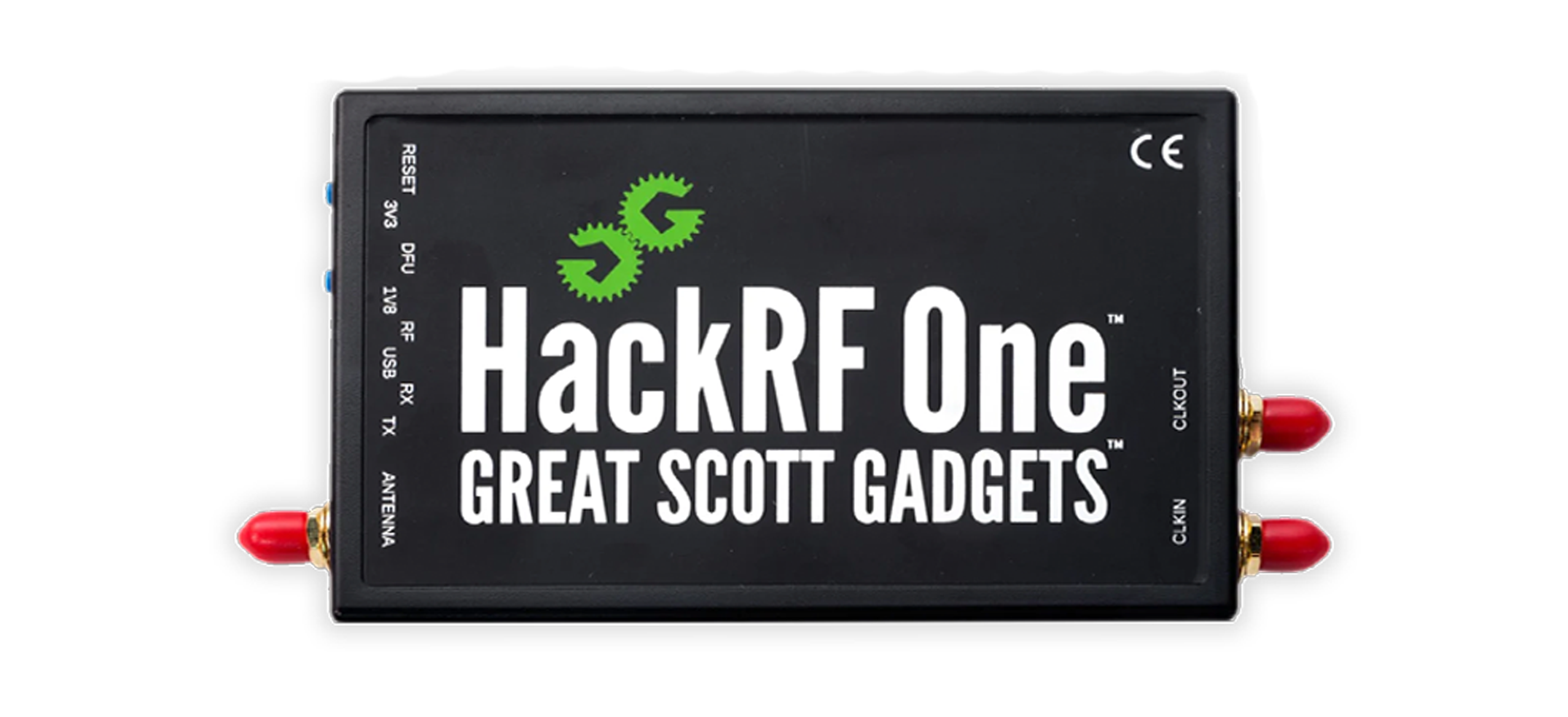
The HackRF Pro is a strong SDR choice for drone RF monitoring because it can receive across common drone-related bands such as 2.4 GHz and 5.8 GHz. It is useful for wideband observation, GNU Radio workflows, RF research, and defensive signal analysis.
Use HackRF Pro for:
- 2.4 GHz drone-link monitoring
- 5.8 GHz drone-link monitoring
- Wideband RF spectrum observation
- GNU Radio classification experiments
- Field logging with a laptop
- Training and RF lab demonstrations
- Comparing drone-related signals against normal site RF activity
Important note: HackRF Pro is transmit-capable, but drone detection workflows should use it receive-only. Do not transmit, jam, spoof, or interfere with drones or other RF systems.
KrakenSDR: Direction finding and multi-antenna monitoring
KrakenSDR is a coherent multi-channel receiver platform useful for direction-finding and spatial RF research. It can help estimate where certain RF sources may be coming from when the antenna array is properly designed and calibrated.
Use KrakenSDR for:
- Direction-finding research
- Multi-antenna site monitoring
- Detecting the bearing of supported signals
- Training security teams on RF direction finding
- Building multi-sensor monitoring stations
- Researching drone-controller or telemetry signal direction
Limitations: direction finding is not magic. It requires suitable frequency coverage, proper antennas, known antenna geometry, calibration, line-of-sight where possible, and careful interpretation. Reflections around buildings, fences, vehicles, and metal structures can distort results.
TinySA Ultra and spectrum analyzers: Fast field checks
A handheld spectrum analyzer such as TinySA Ultra or higher-range portable analyzer is useful when a security or RF team needs a quick look at local RF activity.
Use a spectrum analyzer for:
- Checking whether 2.4 GHz or 5.8 GHz activity is elevated
- Comparing normal and abnormal site conditions
- Finding interference sources
- Validating antennas and filters
- Fast field troubleshooting
- Supporting SDR data with independent spectrum snapshots
A spectrum analyzer helps show RF energy. It does not automatically identify the signal as a drone without additional context or classification.
Antennas for Drone RF Monitoring
Antenna choice is often more important than the SDR itself. A poor antenna can miss activity that a good antenna would show clearly.
| Antenna type | Best use | Notes |
|---|---|---|
| Omnidirectional antenna | General site monitoring | Good for detecting activity from any direction, but not ideal for locating the source. |
| Directional antenna | Checking a known approach direction or narrowing down source bearing | Useful for perimeter checks and manual RF sweeps. |
| Antenna array | Direction finding with coherent receivers | Requires spacing, calibration, and stable mounting. |
| 2.4 GHz antenna | Common drone control, telemetry, video, and Wi-Fi activity | Should match the monitoring hardware and expected signal type. |
| 5.8 GHz antenna | Common video and drone-link monitoring | Requires SDR or analyzer that covers the band. |
| GNSS antenna | GNSS interference awareness | Useful for monitoring GPS/Galileo interference near drone-sensitive sites. |
Antenna placement checklist
- Place monitoring antennas with a clear view of likely approach paths.
- Keep antennas away from noisy electronics, metal cabinets, and power supplies.
- Use low-loss coax for longer cable runs.
- Weatherproof outdoor antennas where needed.
- Document antenna height, location, orientation, and cable type.
- Use multiple sensors for large or complex sites.
- Validate antenna and cable condition before investigating alerts.
Monitoring Architecture for Sensitive Sites
Layer 1: Remote ID receiver
Use a Remote ID receiver or software tool that can decode relevant Bluetooth and Wi-Fi broadcast methods. This layer provides direct information when a compliant drone broadcasts nearby.
Layer 2: SDR spectrum monitor
Use SDR receivers such as HackRF Pro or other suitable hardware to monitor bands of interest. Log waterfalls, power levels, channel activity, and signal features.
Layer 3: Direction-finding node
Use KrakenSDR or another coherent receiver platform where bearing estimation is useful. This is most valuable when combined with a known antenna layout and trained operators.
Layer 4: Visual and operational confirmation
RF alerts should be correlated with visual observation, security cameras, Remote ID data, site logs, and operational context. RF alone should not be the only decision source for serious incidents.
Layer 5: Escalation workflow
Create a written procedure for what happens when a drone is detected near a sensitive area. Define who checks logs, who confirms visually, who contacts site security, and when authorities are contacted.
Baseline Monitoring: Know What Normal Looks Like
Drone RF detection works best when the site has a baseline. Without a baseline, normal Wi-Fi, Bluetooth, industrial IoT, wireless cameras, access points, radios, or nearby equipment may look suspicious.
Baseline these items:
- Normal 2.4 GHz activity during work hours
- Normal 5.8 GHz activity during work hours
- Weekend and night RF levels
- Known Wi-Fi access points and channel use
- Known Bluetooth and IoT devices
- Known security camera or wireless bridge activity
- Nearby public roads, parks, or drone-friendly areas
- Expected Remote ID activity from authorized flights
- Construction, events, or maintenance that may change RF conditions
A good monitoring program starts by learning normal site RF behavior before treating every spike as a threat.
Detection Methods for SDR-Based Drone Monitoring
| Method | What it detects | Strength | Limitation |
|---|---|---|---|
| Remote ID reception | Compliant drone broadcasts | Can provide identity and location-related information | Only works when Remote ID is present and received. |
| Spectrum thresholding | Unusual RF power in monitored bands | Simple and fast | False alarms from Wi-Fi, Bluetooth, cameras, or other emitters. |
| Signal fingerprinting | Drone-controller or video-link patterns | More specific than power monitoring | Requires training data and regular updates. |
| Spectrogram classification | RF patterns converted into time-frequency images | Useful for research and AI-based detection | Can fail with new drone models, interference, or adversarial conditions. |
| Direction finding | Approximate bearing of supported RF sources | Helps localize activity | Needs calibrated antenna array and careful interpretation. |
| Multi-sensor correlation | RF plus visual, Remote ID, logs, and security observations | Most reliable operational approach | Requires planning and staff training. |
Example Legal Monitoring Workflow
- Continuously monitor Remote ID broadcasts near the site.
- Continuously log RF power and spectrogram data in selected bands.
- Compare current activity against a site-specific baseline.
- Trigger an alert if Remote ID enters a geofenced area or if RF activity is abnormal.
- Check whether the signal matches known site Wi-Fi, Bluetooth, camera, or IoT equipment.
- Use directional antennas or KrakenSDR-style direction finding if location context is needed.
- Confirm visually or through approved security cameras where possible.
- Record time, frequency, signal characteristics, Remote ID data, operator notes, and screenshots.
- Escalate according to site policy and local aviation/security rules.
- Do not jam, spoof, interfere, or attempt to take control.
Hardware Packages for Drone RF Monitoring
Package 1: Entry-level legal RF awareness kit
- RTL-SDR Blog V3 USB-C
- General-purpose antenna set
- Raspberry Pi or mini PC
- SDR++ or other receive-only SDR software
- Logging workflow
Best for: education, RF awareness, baseline logging, and beginner site monitoring where wide 2.4 GHz/5.8 GHz coverage is not the first requirement.
Package 2: Wideband drone RF monitoring kit
- HackRF Pro
- 2.4 GHz antenna
- 5.8 GHz antenna
- Directional antenna for manual sweeps
- Laptop or mini PC
- GNU Radio, SDRangel, or spectrum-logging software
Best for: 2.4 GHz and 5.8 GHz monitoring, RF research, security-team training, and wideband receive-side site surveys.
Package 3: Direction-finding research kit
- KrakenSDR 5-channel coherent RTL-SDR
- Matched antennas for the target band
- Stable antenna array mount
- Known geometry and calibration workflow
- Linux host or Raspberry Pi-class controller
- Site map and logging process
Best for: direction-finding education, RF localization research, multi-antenna monitoring, and sensitive-site studies where passive bearing estimation is useful.
Package 4: Professional sensitive-site monitoring bench
- Remote ID receiver layer
- HackRF Pro or wider-band SDR receivers
- KrakenSDR or other coherent receiver for direction-finding research
- TinySA Ultra or spectrum analyzer
- Multiple antennas for 2.4 GHz, 5.8 GHz, and site-specific bands
- Logging server
- Security dashboard
- Written escalation workflow
- Integration with lawful visual confirmation tools
Best for: sensitive facilities, industrial sites, universities, event venues, logistics sites, RF labs, and organizations that need lawful detection and documentation.
RF Test Tools for Drone Monitoring
| Tool | Use in drone RF monitoring | SDRstore.eu link |
|---|---|---|
| TinySA Ultra or spectrum analyzer | Quick field scan, spectrum snapshots, checking unusual band activity | Spectrum analyzers |
| NanoVNA | Checking antennas, cables, filters, and matching | NanoVNA-H4 |
| RF power meter | Lab validation of known RF paths and equipment checks | RF power meters |
| Filters | Reducing overload and isolating bands of interest | RF test and measurement equipment |
| Antennas | Band-specific monitoring, directional sweeps, array setups | Antennas |
Common False Alarms
| False alarm source | Why it looks like drone activity | How to reduce confusion |
|---|---|---|
| Wi-Fi access points | Strong 2.4 GHz and 5 GHz activity | Create a site Wi-Fi baseline and inventory known APs. |
| Bluetooth devices | Frequent 2.4 GHz bursts | Track known BLE devices and compare timing patterns. |
| Wireless cameras | Continuous video-like RF activity | Document site security equipment and channels. |
| Industrial IoT | Periodic telemetry bursts | Coordinate with facility engineering teams. |
| Nearby public Wi-Fi or events | Sudden increase in RF activity | Use time-of-day and event logs. |
| Reflections and multipath | Direction finding points to unstable bearings | Use multiple sensors and avoid relying on one bearing. |
Where Drone RF Monitoring Is Useful
- Airports and aviation training facilities
- Ports and maritime facilities
- Data centers
- Energy and utility sites
- Prisons and secure facilities
- Industrial plants
- Warehouses and logistics hubs
- Universities and research campuses
- Public events and stadiums
- Military-adjacent research labs, where authorized
- Drone test ranges
- Critical infrastructure and telecom sites
For highly sensitive environments, SDR monitoring should be one layer in a broader security plan, not the only detection method.
Privacy and Data Handling
Drone RF monitoring may collect identifiers, location information, signal metadata, or operator-related information where Remote ID is visible. Treat this data carefully.
- Collect only what the monitoring purpose requires.
- Limit access to logs.
- Define retention periods.
- Follow local privacy law and site policy.
- Do not publish drone or operator identifiers unnecessarily.
- Keep evidence intact when escalating incidents.
- Separate training data from incident evidence.
Purchase-Order Justification Examples
HackRF Pro monitoring justification
HackRF Pro is required as a wideband receive-side SDR platform for legal drone RF monitoring, 2.4 GHz and 5.8 GHz spectrum observation, site RF baselining, and defensive signal-analysis workflows.
KrakenSDR direction-finding justification
KrakenSDR is required for passive multi-channel direction-finding research and sensitive-site RF monitoring, enabling bearing estimation and spatial analysis of supported RF signals when used with a calibrated antenna array.
RTL-SDR training and baseline justification
RTL-SDR receivers are required for low-cost RF awareness training, receive-only spectrum monitoring, baseline logging, and distributed monitoring nodes around the site.
Spectrum analyzer justification
A portable spectrum analyzer is required to validate RF activity in monitored bands, compare normal and abnormal site conditions, troubleshoot interference, and support incident documentation.
Antenna and RF accessory justification
Band-specific antennas, low-loss cables, filters, mounts, and RF accessories are required to create repeatable drone RF monitoring coverage and reduce false alarms caused by poor antenna placement or receiver overload.
Request a Quote for Drone RF Monitoring Hardware
Universities, cybersecurity firms, industrial facilities, telecom teams, event operators, RF laboratories, drone test ranges, and sensitive-site security teams can request a formal quotation directly from SDRstore.eu.
Use the Add to Quote button on product pages or the document icon on product cards. Add SDR receivers, HackRF Pro, KrakenSDR, TinySA Ultra, NanoVNA, antennas, filters, cables, adapters, and project notes to one quote request.
A quote request is useful when you need:
- Legal drone RF monitoring hardware
- Remote ID and spectrum monitoring support equipment
- 2.4 GHz and 5.8 GHz receive-side monitoring kits
- Direction-finding research hardware
- Multiple monitoring nodes for a sensitive site
- RF test tools included in one offer
- Formal pricing for university, company, or public-sector purchasing
- A phased monitoring rollout
Read the SDRstore.eu quote-request guide.
Related SDRstore.eu Guides
- RF Cybersecurity Lab Equipment Checklist
- GNSS Spoofing Detection with SDR: Defensive Monitoring for GPS and Galileo Interference
- SDR Hardware for RF Product Testing
- MIMO Testbed Hardware
- SDR Hardware for Wireless Communications Courses
- Best SDR for GNU Radio Projects
- OpenWebRX vs No-SDR vs BrowSDR
- How to Choose SDR Hardware for a Research Grant or University Purchase Order
Official and Technical Resources
- FAA Remote ID
- FAA Remote ID for Industry and Standards Bodies
- EASA: Remote identification mandatory for drones across Europe
- EASA drone FAQs
- FCC Jammer Enforcement
- Open Drone ID overview
- OpenDroneID Android receiver implementation
- IETF DRIP architecture for drone Remote ID
- SDR-based drone detection and classification research
- Low-cost RF drone detection and classification research
Final Recommendation
For a small sensitive site, start with legal receive-only monitoring: Remote ID receiver software, HackRF Pro for 2.4 GHz and 5.8 GHz spectrum observation, RTL-SDR for training and supporting monitoring, TinySA Ultra for quick field checks, and clear logging procedures.
For larger sites, add multiple monitoring nodes, directional antennas, KrakenSDR-style direction-finding research hardware, visual confirmation workflows, and written escalation procedures. Build a baseline first, because normal Wi-Fi, Bluetooth, cameras, and IoT devices can look suspicious without context.
The best drone RF detection setup is not a jammer or a “takeover” tool. It is a legal monitoring system that combines Remote ID, passive RF spectrum data, antennas, direction finding, logs, trained staff, and lawful escalation.
FAQ
Can SDR detect drones?
Yes, SDR can help detect drone-related RF activity such as control links, video links, telemetry, and Remote ID context. Detection is not guaranteed for every drone, and RF alerts should be correlated with Remote ID, visual confirmation, logs, and site procedures.
Is drone RF detection with SDR legal?
Passive receive-only monitoring is generally the safest approach, but laws vary by country and site type. Do not jam, spoof, interfere with, or attempt to take control of drones. Sensitive sites should follow local aviation, privacy, and communications rules.
Can I use HackRF Pro for drone detection?
Yes. HackRF Pro is useful for receive-side monitoring around common drone-related bands such as 2.4 GHz and 5.8 GHz. Use it for passive monitoring only in this context, not transmission or interference.
Can RTL-SDR detect drones?
RTL-SDR can help with low-cost RF awareness and monitoring in its supported frequency range, but it does not directly cover all common drone bands such as 2.4 GHz and 5.8 GHz. It is best used as a beginner, support, or training receiver.
What is Remote ID?
Remote ID is a drone identification system where compliant drones broadcast identification and location-related information. It is useful for legal monitoring, but it does not detect every drone and should be combined with other lawful sensors.
Can KrakenSDR locate drones?
KrakenSDR can support passive direction-finding research for supported RF signals when used with a calibrated antenna array. It can help estimate bearing, but it does not automatically identify every drone or provide perfect location in complex environments.
What frequencies should a drone monitor watch?
Common areas include Remote ID broadcast methods, 2.4 GHz, 5.8 GHz, and site-specific bands. The correct monitoring plan depends on local drones, environment, antennas, receiver hardware, and legal constraints.
Can I jam a drone near my site?
No. Normal site operators should not use jammers. Jamming can interfere with authorized communications and is illegal in many jurisdictions. Use passive monitoring, documentation, and lawful escalation instead.
What hardware is best for a sensitive-site drone monitoring kit?
A practical kit includes HackRF Pro, Remote ID receiver tools, directional and omnidirectional antennas, TinySA Ultra, KrakenSDR for direction-finding research, logging software, and a written escalation workflow.
Can SDRstore.eu quote a drone RF monitoring setup?
Yes. Use the Add to Quote button on product pages or the document icon on product cards. Add SDR receivers, HackRF Pro, KrakenSDR, TinySA Ultra, antennas, filters, cables, adapters, and project notes so the complete monitoring setup can be quoted together.
No posts found
Write a review






We support all major card and digital payment options. More local methods are available and shown during checkout.
You enter into a binding sales contract once you have received an 'order confirmation and sales receipt' email from us, in line with our Sales & Delivery conditions. Therefore, sdrstore.eu has the right to cancel your order in the event of technical problems, delivery failure, Fair use policy and other similar situations.




Your payments are protected by advanced encryption and 3-D Secure authentication for safe online shopping.