





GNSS Spoofing Detection with SDR: Defensive Monitoring for GPS and Galileo Interference
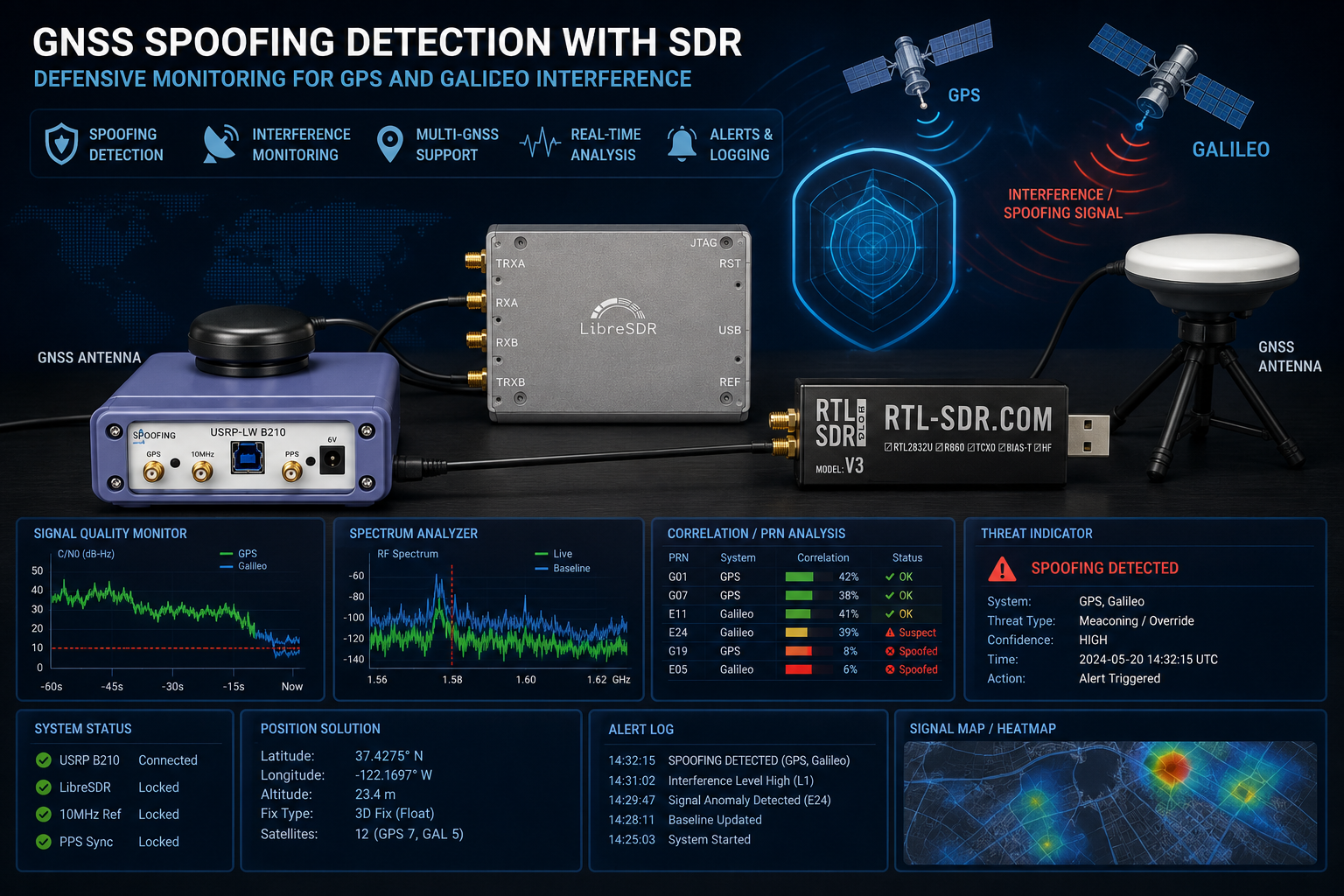
GPS and Galileo are critical for navigation, timing, logistics, aviation, maritime operations, telecom synchronization, drones, surveying, agriculture, finance, and industrial automation. When GNSS signals are jammed or spoofed, the result can be wrong position, wrong time, navigation loss, false tracks, unstable timing, or unreliable logs.
Software-defined radio can help universities, cybersecurity teams, RF engineers, maritime operators, drone labs, telecom teams, and critical-infrastructure researchers monitor the GNSS spectrum defensively. An SDR cannot magically “protect” a receiver by itself, but it can provide visibility: spectrum activity, power changes, suspicious signal behavior, multi-antenna clues, logging, and early warning that something around GPS L1 or Galileo E1 does not look normal.
This guide explains GNSS spoofing detection with SDR from a defensive monitoring perspective. It covers GPS and Galileo interference, SDR hardware, antennas, filters, GNSS-SDR, OSNMA, multi-antenna monitoring, RF test tools, and safe workflows. It does not explain how to generate spoofed GNSS signals.
Browse RTL-SDR receivers and accessories, HackRF SDR devices, KrakenSDR coherent receivers, RF test and measurement equipment, and the SDRstore.eu request-a-quote guide.
Quick Answer: What Hardware Do You Need for Defensive GNSS Monitoring?
| Monitoring goal | Recommended hardware | Why it matters |
|---|---|---|
| Entry-level GPS L1 / Galileo E1 observation | RTL-SDR Blog V3 USB-C or similar receiver, active L-band antenna, bias tee where required | Good for learning, spectrum observation, raw IQ logging, and low-cost monitoring around 1575.42 MHz. |
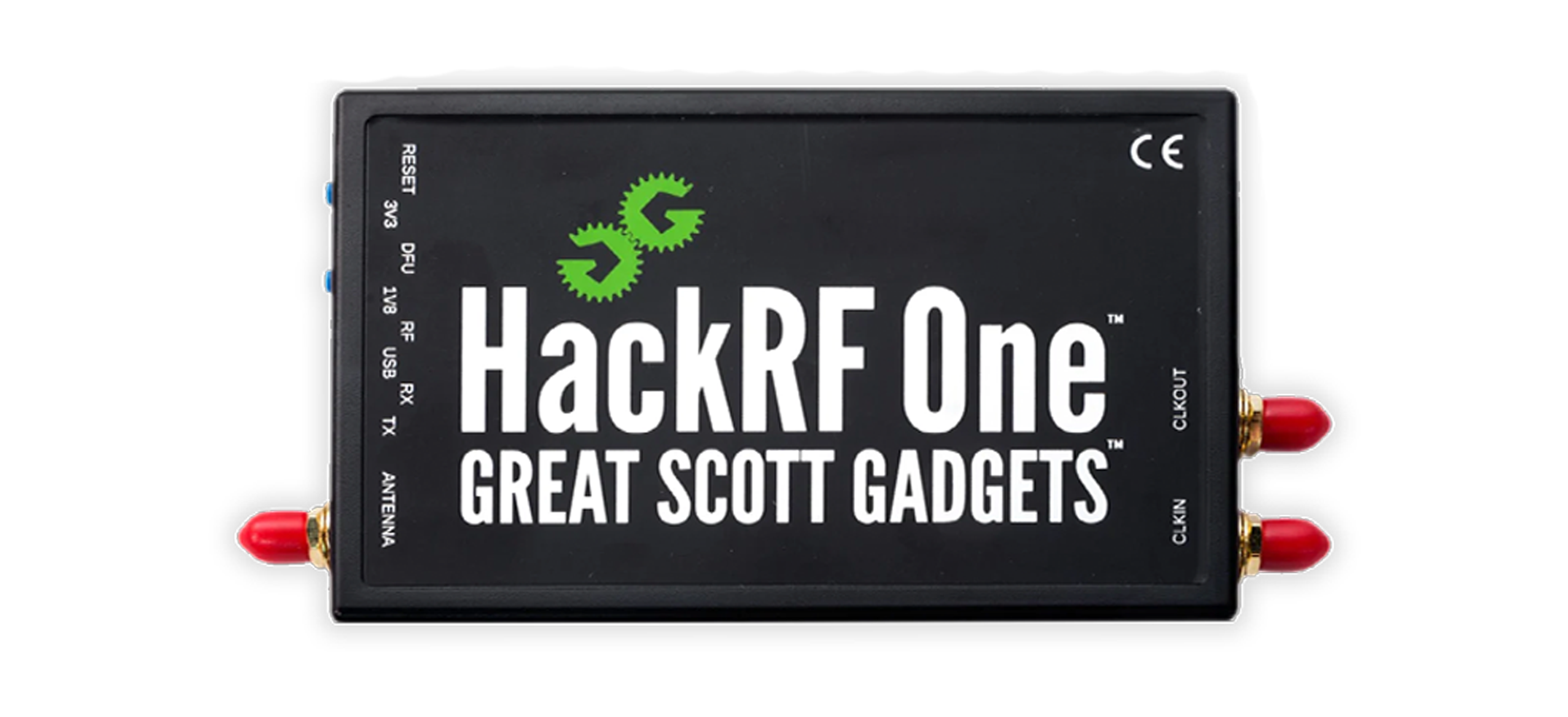
| Wideband interference monitoring | HackRF Pro or wider-band SDR | Useful for observing broader RF behavior, nearby interference, and lab validation across more bands. |
| Multi-antenna spoofing clues | KrakenSDR or coherent multi-channel receiver | Useful for direction-of-arrival and spatial-consistency research, where a single spoofing source may differ from real satellite geometry. |
| GNSS software receiver research | GNSS-capable SDR front end, GNSS-SDR, stable clock, active GNSS antenna | Allows acquisition, tracking, observables, C/N0 logging, navigation message analysis, and research-grade defensive detection. |
| Field interference checks | TinySA Ultra or portable spectrum analyzer, GNSS antenna, SDR logger | Helps identify whether the GNSS band is unusually noisy or blocked. |
| Antenna and cable validation | NanoVNA, known-good cables, active/passive antenna checks | Prevents false alarms caused by bad cables, poor antenna placement, or broken bias power. |
| Critical timing or infrastructure monitoring | Commercial multi-frequency GNSS receiver plus SDR monitor and independent timing reference | SDR is useful for visibility, but critical PNT systems should use certified, hardened, multi-layer protection. |
The simple rule: start by monitoring the GNSS band defensively, log what normal looks like, and use anomalies as alerts for investigation. Do not rely on a single low-cost SDR as the only protection for safety-critical navigation or timing.
Jamming vs Spoofing: What Are You Trying to Detect?
GNSS interference can appear in different ways. A defensive monitoring setup should distinguish between broad interference, jamming, spoofing, receiver faults, antenna problems, and local multipath.
| Problem | What happens | Typical SDR clue |
|---|---|---|
| Jamming | GNSS reception is blocked or degraded by strong interference in or near GNSS frequencies. | Raised noise floor, wideband energy, chirps, pulses, or loss of satellite tracking. |
| Spoofing | A receiver is misled by counterfeit GNSS-like signals. | Abnormal power increase, suspiciously similar satellite signal behavior, impossible position/time changes, or spatial inconsistency. |
| Multipath | Real GNSS signals reflect from buildings, vehicles, water, or metal structures. | Distorted correlation behavior, unstable C/N0, location-dependent anomalies. |
| Antenna/cable fault | The monitor loses signal because of hardware failure, poor placement, or missing bias power. | Sudden loss of all satellites or lower band power without matching external evidence. |
| Receiver overload | Strong nearby RF drives the receiver into compression. | Unexpected wideband artifacts, false peaks, poor sensitivity, or inconsistent gain behavior. |
Why SDR Is Useful for Defensive GNSS Monitoring
Normal GNSS receivers usually output position, velocity, time, satellite status, and sometimes C/N0. An SDR can capture more of the RF layer, which is useful for research and defensive monitoring.
SDR can help with:
- Monitoring GPS L1 and Galileo E1 spectrum activity
- Logging raw IQ samples for later analysis
- Detecting sudden noise-floor increases
- Comparing signal power and C/N0 trends
- Checking whether many “satellites” behave suspiciously similarly
- Observing time, frequency, and correlation anomalies
- Building multi-antenna direction-of-arrival experiments
- Training defensive classifiers on recorded interference events
- Creating independent RF evidence when a GNSS receiver reports bad data
SDR is especially valuable when it is used as a parallel monitor beside normal GNSS receivers, not as the only source of truth.
Important Safety and Legal Boundary
This guide is for defensive monitoring only. It does not provide instructions for generating, replaying, transmitting, or simulating GNSS spoofing signals.
- Do not transmit on GPS, Galileo, GLONASS, BeiDou, or other radionavigation satellite service frequencies.
- Do not test spoofing or jamming outside authorized, shielded, licensed, and legally approved environments.
- Do not interfere with aviation, maritime, telecom, emergency, rail, drone, timing, surveying, or public navigation systems.
- Use receive-only SDR monitoring for normal field work.
- Use professional certified equipment for safety-critical PNT protection.
- Report serious GNSS interference through the correct national authority, aviation/maritime channel, or institutional security process.
GPS L1 and Galileo E1: The Main Monitoring Band
For many defensive monitoring projects, the first band to watch is 1575.42 MHz, where GPS L1 C/A and Galileo E1 are located. This is the most practical starting point because many low-cost SDRs can tune there, and many GNSS receivers use this band.
| Signal family | Common monitoring band | Why it matters |
|---|---|---|
| GPS L1 | 1575.42 MHz | Most familiar civil GPS signal; common target for monitoring and interference studies. |
| Galileo E1 | 1575.42 MHz | European GNSS open-service signal and OSNMA authentication direction. |
| GNSS L-band around L1/E1 | Nearby L-band spectrum | Useful for detecting interference, front-end overload, and nearby-band emissions. |
For more advanced monitoring, teams may also look at GPS L2/L5, Galileo E5, GLONASS, BeiDou, and multi-frequency GNSS receivers. However, L1/E1 is the best starting point for SDR education and defensive monitoring.
Recommended SDR Hardware
RTL-SDR Blog V3 USB-C: Entry-level GNSS band observation
The RTL-SDR Blog V3 USB-C is a practical low-cost receiver for observing spectrum activity around GPS L1 and Galileo E1. It is not a professional GNSS receiver, but it is useful for education, monitoring, waterfall observation, basic IQ recording, and low-cost alerting experiments.
Use RTL-SDR for:
- GNSS interference awareness
- GPS L1 / Galileo E1 spectrum observation
- Raw IQ capture at modest bandwidth
- Comparing normal vs abnormal signal conditions
- Student labs and cybersecurity awareness training
- Low-cost remote monitors with Raspberry Pi or mini PCs
Limitations: RTL-SDR has limited dynamic range and bandwidth. It is useful for monitoring and learning, but serious GNSS signal processing should use a GNSS-capable SDR front end, stable clocking, proper antennas, and validated software.
HackRF Pro: Wider-band defensive RF monitoring
The HackRF Pro is useful when the lab needs wider frequency coverage, RF validation, signal analysis, and controlled receive-side monitoring across many bands.
Use HackRF Pro for:
- Wideband RF monitoring
- Interference hunting around GNSS and nearby bands
- Research capture workflows
- RF lab education
- Defensive signal analysis
- Comparing GNSS-band activity with other RF bands
Important note: HackRF is transmit-capable, but defensive GNSS monitoring should be receive-only. Do not transmit in GNSS bands.
KrakenSDR: Multi-antenna defensive direction-finding research
KrakenSDR is a five-channel coherent RTL-SDR platform. It is relevant for defensive GNSS research because spoofing signals may come from one terrestrial direction, while real GNSS satellites arrive from different sky directions.
Use KrakenSDR-style coherent hardware for:
- Direction-of-arrival research
- Spatial-consistency checks
- Multi-antenna interference monitoring
- Passive RF sensing
- Academic spoofing-detection research
- GNSS interference localization experiments where legal and practical
Limitations: Multi-antenna GNSS detection is harder than normal direction finding because GNSS signals are weak, spread-spectrum, and require careful antennas, geometry, calibration, and processing. Treat this as a research path, not a plug-and-play protection product.
USRP, bladeRF, and higher-end SDRs
For serious GNSS-SDR research, higher-end SDRs can be useful because they offer better clocking, wider bandwidth, better host integration, and more research flexibility.
| Hardware | Use in defensive GNSS research |
|---|---|
| USRP B210 / X310 / higher-end USRP | GNSS-SDR research, stable capture workflows, external timing, multi-frequency or wider-band experiments depending on front end. |
| bladeRF 2.0 micro | Custom SDR workflows, external reference research, GNU Radio, multi-channel experiments. |
| PLUTO+ SDR | AD9363-based monitoring and research experiments, Ethernet workflows, educational SDR projects. |
For critical monitoring, choose hardware based on the actual detection method: power monitoring, C/N0 tracking, multi-frequency observation, multi-antenna direction analysis, or full software GNSS receiver processing.
Antennas, Filters, and Bias Power
GNSS signals are extremely weak when they reach the Earth. The antenna and front-end chain matter more than many beginners expect.
Recommended antenna setup
- Use an active GNSS or L-band antenna for L1/E1 monitoring.
- Mount it with clear sky visibility where possible.
- Keep it away from laptops, monitors, power supplies, switching regulators, and metal structures.
- Use low-loss coax where practical.
- Provide correct bias voltage if the antenna requires it.
- Use filters carefully to reduce out-of-band overload.
- Document antenna location, height, cable, bias power, and environment.
For a practical L-band accessory, see the RTL-SDR Active L-Band 1525–1660 MHz Patch Antenna Set.
Common antenna mistakes
- Using a random VHF/UHF antenna for GNSS L1/E1
- Forgetting bias power for active antennas
- Placing the antenna indoors beside noisy electronics
- Using long lossy coax with no LNA planning
- Interpreting cable faults as spoofing
- Moving the antenna without updating the monitoring baseline
Detection Methods: What Can a Defensive SDR Monitor Look For?
No single indicator proves spoofing in every case. Defensive monitoring should combine multiple checks.
| Indicator | What it may show | Useful hardware/software |
|---|---|---|
| Noise-floor increase | Possible jamming or strong interference | RTL-SDR, HackRF Pro, TinySA Ultra, spectrum analyzer |
| Sudden received-power jump | Possible interference, spoofing, or receiver overload | SDR power logging, GNSS receiver AGC metrics |
| C/N0 anomalies | Satellite signal quality changes that do not match normal sky geometry | GNSS receiver logs, GNSS-SDR observables |
| All satellites change similarly | Possible common-source behavior rather than real satellites | GNSS-SDR, multi-satellite metric logging |
| Correlation distortion | Possible multipath, spoofing, or abnormal signal structure | Software GNSS receiver research tools |
| Position/time jump | Receiver-level symptom of spoofing or bad input data | GNSS receiver logs, PTP/NTP comparison, independent references |
| Spatial inconsistency | Signals appear to come from the same direction instead of satellite geometry | KrakenSDR, antenna array, direction-of-arrival research |
| Galileo OSNMA status | Navigation message authentication support where receiver and signal conditions allow it | OSNMA-capable GNSS receiver or software receiver research |
A practical defensive system should combine RF-layer monitoring, receiver observables, independent time/position checks, and operational context.
GNSS-SDR for Research Monitoring
GNSS-SDR is an open-source software-defined GNSS receiver. It can process raw GNSS signals through acquisition, tracking, navigation message decoding, observable generation, and position computation.
Use GNSS-SDR for:
- Research-grade GNSS signal processing
- GPS and Galileo signal observation
- Logging acquisition and tracking behavior
- Generating observables for anomaly detection
- Comparing normal and abnormal RF captures
- Teaching GNSS receiver architecture
- Testing defensive detection algorithms on recorded data
GNSS-SDR is powerful, but it is not a one-click spoofing detector. The hardware, antenna, sampling setup, configuration, clock quality, and baseline data all matter.
Galileo OSNMA and Authentication-Aware Monitoring
Galileo OSNMA adds navigation message authentication to the Galileo Open Service. For defensive monitoring, this is important because it gives compatible receivers a way to verify that Galileo navigation message data is authentic.
Important practical points:
- OSNMA helps with navigation message authentication.
- OSNMA does not make a receiver immune to all jamming or spoofing.
- Receivers must support OSNMA to benefit from it directly.
- OSNMA status should be logged alongside RF and GNSS receiver metrics.
- For critical systems, combine OSNMA with multi-frequency GNSS, inertial sensors, antenna checks, interference monitoring, and operational procedures.
For SDR research, OSNMA is useful because it shows where GNSS authentication is heading and why signal-level monitoring should be combined with data-authentication checks.
Defensive Monitoring Architectures
Architecture 1: Low-cost local monitor
- RTL-SDR Blog V3 USB-C
- Active L-band/GNSS antenna
- Raspberry Pi or mini PC
- Basic spectrum logger
- Optional GNSS receiver for position/time comparison
- Alerts when band power or receiver metrics change abnormally
Best for: education, awareness, lab monitoring, and low-cost experiments.
Architecture 2: Research GNSS-SDR station
- GNSS-capable SDR front end
- Stable active GNSS antenna
- GNSS-SDR
- Large storage for IQ samples and logs
- Known-good timing reference
- Receiver observables and C/N0 logging
- Comparison with OSNMA-capable or multi-frequency receiver where possible
Best for: universities, GNSS cybersecurity research, algorithm development, and defensive dataset creation.
Architecture 3: Multi-antenna spatial monitor
- KrakenSDR or coherent multi-channel receiver
- Multiple matched L-band antennas
- Stable antenna geometry
- Calibration workflow
- Direction-of-arrival processing
- Independent GNSS receiver logs
Best for: direction-of-arrival research and spatial-consistency checks. This requires careful calibration and is not beginner plug-and-play.
Architecture 4: Critical infrastructure monitoring layer
- Commercial multi-frequency GNSS timing receiver
- OSNMA-capable or authentication-aware receiver where relevant
- SDR spectrum monitor
- Independent time source such as PTP, NTP, rubidium, or holdover system
- Operational alarm workflow
- Logs integrated into a security or operations center
Best for: telecom, data centers, ports, airports, energy, timing networks, and safety-sensitive environments. Use certified equipment and professional engineering support.
Recommended SDRstore.eu Hardware Packages
Starter defensive GNSS monitoring kit
- RTL-SDR Blog V3 USB-C
- Active L-band 1525–1660 MHz patch antenna set
- Raspberry Pi or mini PC
- Short low-loss SMA cable
- Bias tee support where required
- Basic logging software
Best for: students, RF cybersecurity awareness, GNSS band observation, and low-cost GPS/Galileo interference monitoring.
Wideband RF interference kit
- HackRF Pro
- Active GNSS or L-band antenna
- TinySA Ultra or spectrum analyzer
- Filters and attenuators where appropriate
- RF logging workstation
Best for: RF engineers, interference hunters, cybersecurity labs, and research teams that need wider RF visibility beyond only L1/E1.
Multi-antenna spoofing research kit
- KrakenSDR 5-channel coherent RTL-SDR
- Matched L-band antennas
- Stable antenna mount
- Known antenna geometry
- Linux host or Raspberry Pi-class controller
- Calibration workflow
Best for: academic direction-of-arrival research, spatial anomaly detection, and receive-only coherent monitoring experiments.
Professional research monitoring kit
- USRP, bladeRF, or GNSS-capable SDR front end
- High-quality active GNSS antenna
- External reference clock where needed
- GNSS-SDR
- Multi-frequency GNSS receiver for comparison
- Large storage for IQ captures and logs
- Spectrum analyzer, NanoVNA, RF power meter, filters, and cables
Best for: universities, GNSS cybersecurity research, critical-infrastructure studies, and defensive detection algorithm development.
RF Test Tools for GNSS Monitoring
| Tool | Use in GNSS monitoring | SDRstore.eu link |
|---|---|---|
| TinySA Ultra or spectrum analyzer | Checks whether the GNSS band is unusually noisy, blocked, or affected by nearby-band interference. | Spectrum analyzers |
| NanoVNA | Checks antennas, cables, filters, and matching networks before blaming spoofing or jamming. | NanoVNA-H4 |
| RF power meter | Useful for lab validation of known test paths and safe RF checks, not for over-the-air GNSS signal measurement. | RF power meters |
| Dummy loads and attenuators | Used for safe lab signal-path validation and protecting instruments. | RF dummy loads |
Baseline First: Know What Normal Looks Like
Defensive GNSS monitoring is only useful if you know what normal looks like at your location.
Record baseline data for:
- Normal L1/E1 band power
- Normal time-of-day variation
- Normal satellite visibility
- Normal C/N0 ranges
- Normal receiver AGC behavior
- Normal antenna orientation and cable setup
- Weather, building, and multipath conditions
- Nearby RF equipment and transmitters
- Known maintenance or construction activity
Without a baseline, a monitor may confuse normal multipath, antenna faults, or local RF noise with a GNSS attack.
Defensive Detection Workflow
Step 1: Verify the hardware chain
- Check antenna placement.
- Check bias power for active antennas.
- Check cable and connector condition.
- Check SDR gain settings.
- Confirm that the receiver is not overloaded.
Step 2: Monitor RF spectrum
- Watch the GPS L1 / Galileo E1 region.
- Log noise floor and received power over time.
- Compare against the local baseline.
- Flag sudden broadband, pulsed, chirped, or narrowband changes.
Step 3: Compare GNSS receiver metrics
- Track satellite count.
- Track C/N0 values.
- Track AGC if available.
- Track position and time jumps.
- Compare multiple receivers if possible.
Step 4: Add authentication-aware checks
- Use Galileo OSNMA-capable receivers where possible.
- Log OSNMA status alongside RF metrics.
- Do not treat OSNMA as a complete replacement for RF monitoring.
Step 5: Escalate safely
- Preserve logs and IQ captures.
- Compare against other receivers or sites.
- Check for local hardware faults first.
- Report serious suspected interference through the correct authority or institutional process.
Common False Alarms
| False alarm source | Why it looks suspicious | How to reduce risk |
|---|---|---|
| Bad antenna cable | Sudden signal drop or unstable levels | Use known-good cable and document installation. |
| Missing bias power | Active antenna stops working | Verify bias tee and antenna voltage. |
| Indoor multipath | C/N0 and correlation behavior become unstable | Use outdoor or sky-facing antenna placement. |
| Local electronics noise | Noise floor rises near GNSS frequencies | Move antenna away from power supplies, displays, USB hubs, and computers. |
| Receiver gain changes | Power logs shift suddenly | Use fixed gain settings or log gain changes. |
| Construction or vehicle reflections | Multipath changes over time | Record environment notes and compare with a second antenna. |
Who Needs Defensive GNSS Monitoring?
- Universities researching GNSS security
- Cybersecurity labs studying RF threats defensively
- Telecom teams relying on GNSS timing
- Drone and robotics labs
- Ports and maritime operators
- Aviation research and training teams
- Surveying and precision agriculture teams
- Critical infrastructure operators
- Fleet and logistics companies
- RF product testing labs
For safety-critical or regulated operations, SDR monitoring should support professional GNSS resilience planning. It should not replace certified navigation or timing equipment.
Purchase-Order Justification Examples
RTL-SDR monitoring kit justification
RTL-SDR receivers and active L-band antennas are required to build low-cost defensive GNSS monitoring stations for GPS L1 and Galileo E1 spectrum observation, baseline logging, interference awareness, and student cybersecurity training.
KrakenSDR research justification
KrakenSDR is required for multi-channel coherent receive-only research into spatial GNSS interference detection, direction-of-arrival methods, and defensive spoofing-detection experiments based on antenna-array observations.
HackRF Pro monitoring justification
HackRF Pro is required as a wideband SDR platform for defensive RF monitoring, GNSS-band interference observation, spectrum logging, and controlled receive-side research across multiple RF bands.
RF measurement tools justification
NanoVNA, TinySA Ultra, RF power meters, filters, attenuators, and cables are required to validate the RF monitoring chain, check antennas, identify interference, prevent receiver overload, and avoid false alarms caused by faulty hardware.
Request a Quote for GNSS Monitoring Hardware
Universities, cybersecurity firms, RF laboratories, telecom teams, maritime operators, drone labs, timing-network operators, and critical-infrastructure teams can request a formal quotation directly from SDRstore.eu.
Use the Add to Quote button on product pages or the document icon on product cards. Add SDR receivers, HackRF Pro, KrakenSDR, active L-band antennas, TinySA Ultra, NanoVNA, filters, cables, adapters, RF tools, and project notes to one quote request.
A quote request is useful when you need:
- Low-cost GPS/Galileo monitoring stations
- Multi-site GNSS interference logging kits
- GNSS cybersecurity lab hardware
- Receive-only coherent monitoring equipment
- RF test tools included in the same offer
- Formal pricing for university or company purchasing
- A phased defensive monitoring rollout
Read the SDRstore.eu quote-request guide.
Related SDRstore.eu Guides
- RF Cybersecurity Lab Equipment Checklist
- SDR Hardware for RF Product Testing
- OpenWebRX vs No-SDR vs BrowSDR: Best Remote SDR Setup in 2026
- SDR Hardware for Wireless Communications Courses
- MIMO Testbed Hardware
- How to Choose SDR Hardware for a Research Grant or University Purchase Order
- Best SDR for GNU Radio Projects
- NanoVNA vs TinySA
Official and Technical Resources
- GPS.gov: Spectrum and Interference Issues
- CISA: GPS Interference
- EUSPA: Galileo OSNMA
- European GNSS Service Centre: Galileo OSNMA
- GNSS-SDR official website
- GNSS-SDR GitHub repository
- RTKLIB official website
- Recent Advances on Jamming and Spoofing Detection in GNSS
- GNSS Jamming and Spoofing Monitoring Using Low-Cost COTS Receivers
Final Recommendation
For a low-cost defensive GNSS monitoring station, start with RTL-SDR Blog V3 USB-C, an active L-band antenna, stable placement, fixed gain settings, and long-term logging around GPS L1 and Galileo E1. Add a normal GNSS receiver so RF observations can be compared with satellite count, C/N0, position, and time behavior.
For research, add GNSS-SDR, better SDR hardware, external timing, and controlled data storage. For spatial detection research, consider KrakenSDR or another coherent multi-channel receiver with a carefully calibrated antenna array. For critical infrastructure, use commercial multi-frequency GNSS protection, OSNMA-capable receivers where appropriate, independent timing references, and SDR monitoring as an additional visibility layer.
The strongest defensive setup combines multiple signals of evidence: RF spectrum monitoring, receiver observables, OSNMA/authentication status where available, independent time checks, multi-antenna clues, and a clear escalation process.
FAQ
Can SDR detect GNSS spoofing?
SDR can help detect signs of possible GNSS spoofing, especially when combined with GNSS receiver metrics, C/N0 logs, power monitoring, correlation analysis, OSNMA status, and multi-antenna observations. A basic SDR alone should not be treated as a guaranteed spoofing detector.
Can RTL-SDR monitor GPS and Galileo interference?
Yes. RTL-SDR can tune around GPS L1 and Galileo E1 at 1575.42 MHz and is useful for low-cost spectrum observation, IQ logging, and interference awareness. Serious GNSS signal processing may require better front-end hardware, stable timing, and dedicated GNSS software.
What antenna do I need for GNSS monitoring?
Use an active GNSS or L-band antenna with good sky visibility, correct bias power, short low-loss cable, and stable placement. A random VHF/UHF antenna is usually not a good GNSS monitoring antenna.
What is the difference between GNSS jamming and spoofing?
Jamming blocks or degrades GNSS reception by adding interference. Spoofing attempts to mislead the receiver with counterfeit GNSS-like signals, causing wrong position, time, or navigation output.
Does Galileo OSNMA stop spoofing?
Galileo OSNMA adds navigation message authentication and makes some spoofing scenarios harder, but it does not stop all jamming, signal blocking, multipath, or every possible spoofing technique. It should be combined with other resilience measures.
Is KrakenSDR useful for GNSS spoofing detection?
KrakenSDR can be useful for defensive research into multi-antenna direction-of-arrival and spatial consistency. It is not a plug-and-play GNSS protection product, and GNSS work requires careful antennas, geometry, calibration, and processing.
Can HackRF Pro be used for GNSS monitoring?
Yes, HackRF Pro can be used as a wideband receive-side monitoring platform for GNSS-band interference and RF research. For defensive GNSS monitoring, use it receive-only and do not transmit in GNSS bands.
What software can process GNSS SDR captures?
GNSS-SDR is a major open-source software-defined GNSS receiver for processing raw signal samples. RTKLIB is also useful for GNSS positioning and analysis workflows, especially when working with receiver observables.
Can SDRstore.eu quote a GNSS interference monitoring kit?
Yes. Use the Add to Quote button on product pages or the document icon on product cards. Add SDR receivers, active L-band antennas, KrakenSDR, HackRF Pro, TinySA Ultra, NanoVNA, cables, filters, and project notes so the complete defensive monitoring setup can be quoted together.
Is this enough for aviation, maritime, or critical infrastructure protection?
No. A low-cost SDR monitor is useful for awareness and research, but safety-critical GNSS protection should use certified, hardened, multi-frequency, multi-sensor, professionally engineered systems with formal operational procedures.
No posts found
Write a review





We support all major card and digital payment options. More local methods are available and shown during checkout.
You enter into a binding sales contract once you have received an 'order confirmation and sales receipt' email from us, in line with our Sales & Delivery conditions. Therefore, sdrstore.eu has the right to cancel your order in the event of technical problems, delivery failure, Fair use policy and other similar situations.





Your payments are protected by advanced encryption and 3-D Secure authentication for safe online shopping.