





AI-RAN Explained: SDR Hardware for AI-Native 5G and 6G Research
AI-RAN is one of the most important research directions for 5G-Advanced and 6G networks. Instead of treating artificial intelligence as an external optimization tool, AI-RAN brings AI closer to the radio access network: into the RAN stack, onto shared RAN infrastructure, and into the edge compute layer where real-time wireless decisions are made.
For universities, telecom labs, cybersecurity research groups, RF engineers, and grant-funded 6G projects, AI-RAN is not only a software topic. It also needs the right hardware: SDR radios, GPU or accelerator compute, O-RAN-compatible software stacks, timing references, networking, RF test equipment, antennas, attenuators, dummy loads, and safe lab procedures.
This guide explains AI-RAN in practical terms and shows which SDR hardware is useful for AI-native 5G and 6G research. It covers AI-for-RAN, AI-and-RAN, AI-on-RAN, USRP, bladeRF, PLUTO+, HackRF Pro, RTL-SDR, GPU compute, O-RAN RIC, neural receivers, RF testing, and university purchase-order planning.
Browse software-defined radio devices, USRP SDR devices, RF test and measurement equipment, and the SDRstore.eu request-a-quote guide.
Quick Answer: What Is AI-RAN?
AI-RAN means applying artificial intelligence to the radio access network and, in more advanced architectures, sharing infrastructure between AI workloads and RAN workloads. It is especially important for 6G because future networks are expected to use AI for optimization, automation, signal processing, resource allocation, energy efficiency, sensing, digital twins, and edge services.
| AI-RAN area | Meaning | Research example |
|---|---|---|
| AI-for-RAN | Use AI to improve the RAN itself | AI-based channel estimation, scheduling, beam management, interference mitigation, anomaly detection, or energy optimization |
| AI-and-RAN | Run AI and RAN workloads on shared infrastructure | GPU or accelerator resources shared between real-time RAN processing and AI inference at the edge |
| AI-on-RAN | Run AI applications on RAN infrastructure | Edge AI services, video analytics, industrial AI, robotics, XR, or inference workloads hosted near the cell site |
For a research lab, AI-RAN usually starts with an SDR-based 5G or O-RAN testbed, then adds AI models, GPU acceleration, RIC/xApp control, telemetry collection, and RF measurement tools.
Why SDR Hardware Matters for AI-RAN
AI-RAN research needs real wireless data. Simulations are useful, but they cannot fully replace over-the-air signals, receiver impairments, timing drift, nonlinear RF behavior, interference, multipath, antenna detuning, real UE behavior, and hardware bottlenecks.
SDR hardware helps researchers:
- Collect real IQ samples for AI/ML training
- Test neural receivers and AI-assisted physical-layer algorithms
- Compare simulated channels against real RF channels
- Run private 5G experiments with srsRAN or OpenAirInterface
- Prototype O-RAN RIC/xApp optimization workflows
- Validate scheduling, beam selection, interference mitigation, and anomaly detection
- Measure latency, throughput, packet loss, and RF behavior under controlled conditions
- Build repeatable AI-native wireless research datasets
The key is choosing SDR hardware that matches the level of AI-RAN research. A receive-only RTL-SDR is useful for monitoring and data collection, but not for a full 5G base-station testbed. USRP B210 is a strong starter for private 5G research. X310, N310, X410, and similar higher-end platforms are better for larger O-RAN and 6G research labs.
AI-RAN vs O-RAN: What Is the Difference?
O-RAN and AI-RAN are related but not identical.
| Topic | O-RAN | AI-RAN |
|---|---|---|
| Main goal | Open, disaggregated, programmable RAN architecture | AI-native, AI-optimized, and AI-capable RAN infrastructure |
| Key components | O-CU, O-DU, O-RU, SMO, Non-RT RIC, Near-RT RIC, xApps, rApps, Open Fronthaul | AI-for-RAN, AI-and-RAN, AI-on-RAN, AI lifecycle, edge inference, shared AI/RAN compute |
| Research focus | Open interfaces, interoperability, RIC, fronthaul, disaggregation | AI models, GPU acceleration, neural PHY, AI orchestration, edge AI services |
| Hardware need | SDR/O-RU, compute, fronthaul networking, timing | All O-RAN hardware plus GPU/AI acceleration, telemetry, datasets, and model deployment tools |
| Best lab direction | Start with private 5G or O-RAN CU/DU/RU testbed | Add AI models, GPU inference, RIC control, data pipelines, and AI workload orchestration |
In simple terms: O-RAN gives you programmable network architecture. AI-RAN adds AI-native intelligence, AI workloads, and accelerated compute to that architecture.
Best SDR Hardware for AI-RAN Research
USRP B210: Best starter SDR for private 5G and AI-RAN learning
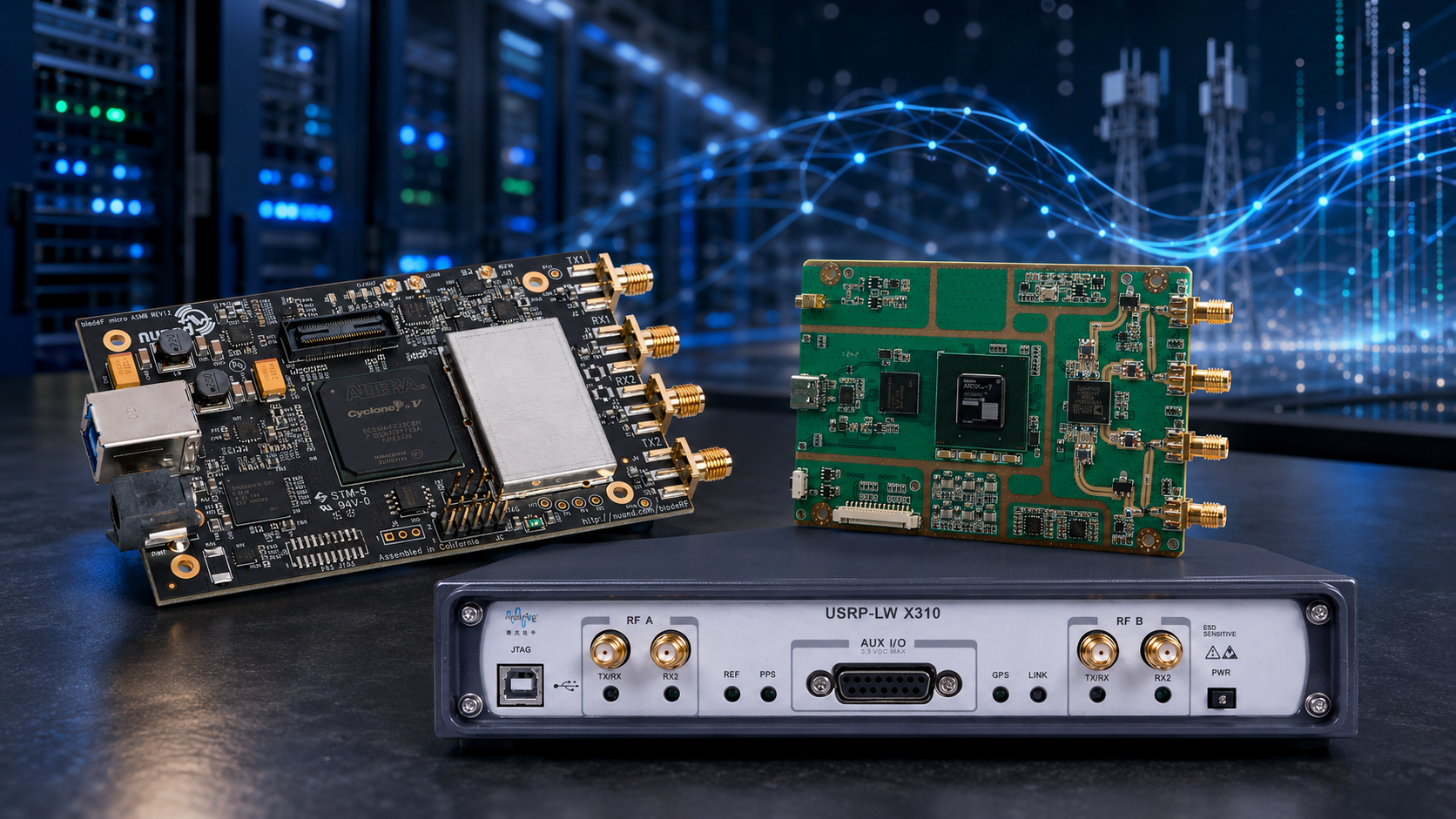
USRP B210 is one of the best first SDRs for AI-RAN-adjacent research because it supports UHD, GNU Radio, 2×2 MIMO direction, and common open-source private 5G workflows.
Choose USRP B210 when the lab needs:
- srsRAN or OpenAirInterface starter testbed
- Open5GS private 5G learning
- COTS UE experiments in a controlled lab
- AI/ML data collection from a real RF link
- Neural receiver experiments at a manageable scale
- Student-friendly 5G SDR research platform
- Lower-cost entry point before X310 or X410-class hardware
Important limitation: USRP B210 is not a complete AI-RAN system by itself. It is the RF frontend. You still need compute, software stack, timing, safe RF path, and data pipeline.
USRP X310: Better for higher-bandwidth and networked research
USRP X310 is a stronger research platform when B210’s USB-based workflow becomes limiting. It is more suitable for higher bandwidth, 10GbE workflows, external timing, FPGA resources, and advanced wireless experiments.
Choose USRP X310 when the lab needs:
- Higher-bandwidth IQ capture
- 10GbE networked SDR operation
- External 10 MHz and PPS timing
- More serious MIMO experiments
- Repeatable university research infrastructure
- Advanced GNU Radio, UHD, and RFNoC workflows
USRP N310/N320/X410-class radios: Best for advanced AI-RAN and 6G labs
For larger AI-RAN labs, networked USRP platforms such as N310/N320/N321 and X410-class hardware become more relevant. These platforms are better suited to distributed testbeds, synchronized radios, high-throughput IQ streaming, and infrastructure-grade research.
Choose higher-end USRP hardware when the grant requires:
- Distributed AI-RAN testbeds
- Multi-cell or multi-node experiments
- High-rate data collection for AI training
- External timing and synchronization
- O-RAN fronthaul and networked radio experiments
- Long-term 6G research infrastructure
bladeRF 2.0 micro: Good for MIMO, FPGA, and custom waveform research
bladeRF 2.0 micro is useful when the AI-RAN research plan includes custom waveforms, compact 2×2 MIMO, libbladeRF, SoapySDR, FPGA experiments, and lower-cost alternatives to USRP-class platforms.
Choose bladeRF 2.0 micro xA4 for general 2×2 MIMO learning and host-side DSP. Choose bladeRF 2.0 micro xA9 when the research specifically needs more FPGA capacity.
Read: bladeRF 2.0 micro xA4 vs xA9.
PLUTO+ SDR: Useful for AD9363-based prototyping
PLUTO+ SDR is useful for lower-cost AD9363-based research, Ethernet SDR workflows, 2TX/2RX experiments, and teaching labs that need a step above receive-only SDRs.
Choose PLUTO+ when the lab needs:
- AD9363-based experimentation
- Transmit/receive learning
- Ethernet-connected SDR work
- GNU Radio, SDRangel, or custom DSP workflows
- Lower-cost RF prototyping before moving to USRP-class systems
HackRF Pro: Useful for RF validation and wideband experiments
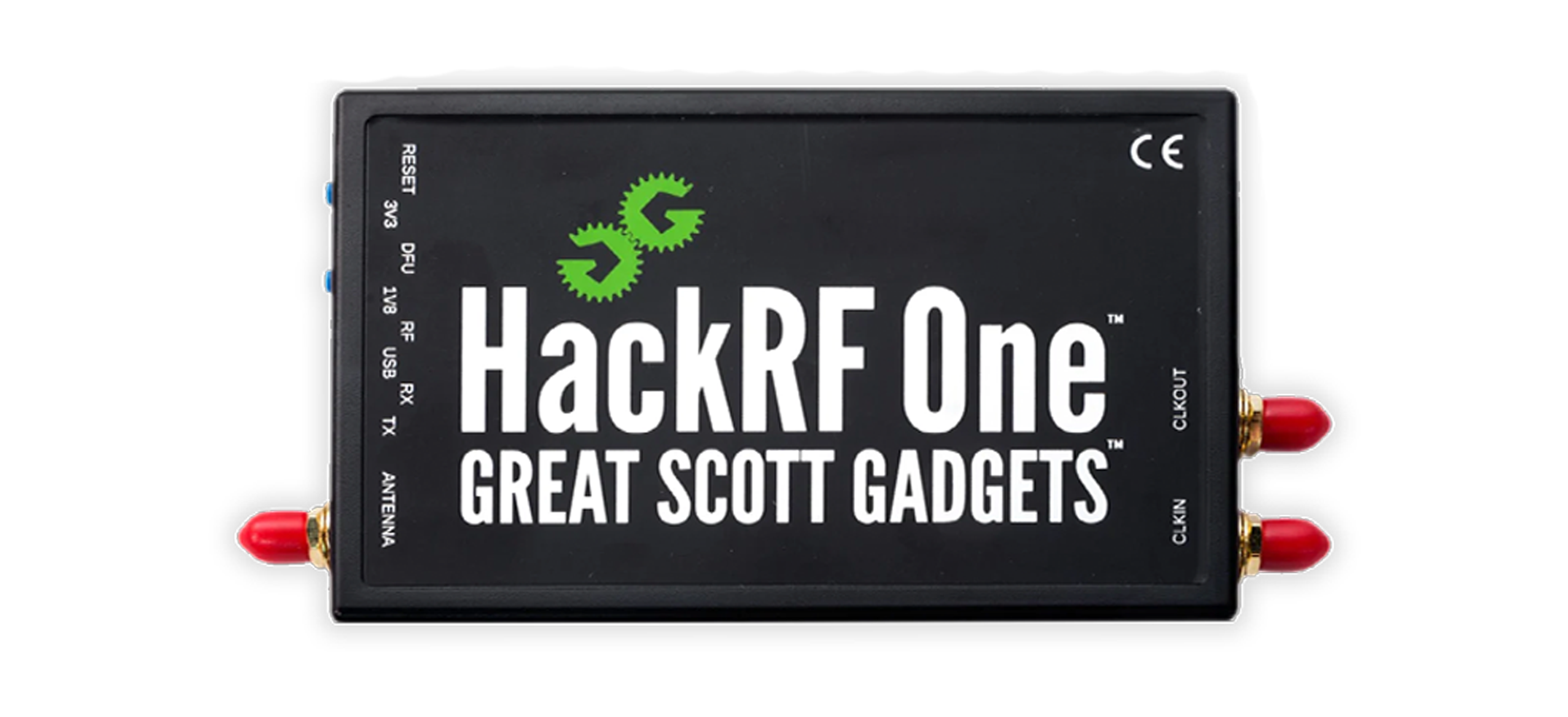
HackRF Pro is useful for wideband RF experiments, signal generation, spectrum exploration, controlled lab transmissions, and RF validation tasks around AI-RAN research.
Choose HackRF Pro when the lab needs:
- Wideband transmit-or-receive experiments
- GNU Radio demonstrations
- RF validation and signal generation
- Portable lab experiments
- Teaching wireless security and RF signal behavior in authorized conditions
Important limitation: HackRF-style devices are half-duplex. They are not the right choice for full-duplex base-station research.
RTL-SDR: Low-cost monitoring and dataset collection
RTL-SDR receivers are not AI-RAN base-station radios, but they are still useful in an AI-RAN lab.
Use RTL-SDR for:
- Independent spectrum monitoring
- OpenWebRX remote receiver stations
- ADS-B, AIS, ACARS, and passive dataset projects
- Student RF awareness labs
- Low-cost RF sensing and logging
- Interference observation during AI-RAN experiments
Compute Hardware for AI-Native RAN
AI-RAN research is compute-heavy. The lab needs to run normal RAN workloads plus AI training, AI inference, telemetry collection, RIC/xApp logic, simulations, digital twins, and data processing.
Starter compute
For a first AI-RAN learning lab, use a strong Linux workstation:
- Modern high-performance CPU
- 32 GB RAM minimum, 64 GB preferred
- NVMe SSD
- Ubuntu LTS or supported Linux distribution
- USB 3.0 for USRP B210 or 10GbE for X310-class SDRs
- Optional NVIDIA GPU for AI/ML experiments
GPU-accelerated AI-RAN compute
For AI-native research, add GPU acceleration when the lab needs neural receivers, AI-based channel estimation, reinforcement-learning scheduling, digital twins, ray tracing, real-time inference, or AI workload sharing.
GPU compute becomes important for:
- Neural receiver inference
- AI-assisted channel estimation
- Beam selection and channel prediction
- Digital-twin training loops
- RAN analytics and anomaly detection
- Real-time model deployment
- Shared AI-and-RAN workload orchestration
Advanced AI-RAN compute
For serious AI-RAN research, plan for a more powerful compute cluster:
- High-core-count x86 server or AI workstation
- NVIDIA GPU or accelerator platform
- 128 GB RAM or more for data-heavy research
- Fast NVMe storage for IQ datasets
- 10GbE/25GbE networking
- Container runtime and orchestration tools
- Real-time Linux tuning where required
- Separate hosts for RAN, 5G Core, RIC, AI training, and monitoring in larger labs
AI-RAN Research Workflows
Workflow 1: Neural receiver research
A neural receiver uses AI/ML models to replace or improve parts of the traditional receiver chain, such as channel estimation, demodulation, equalization, or decoding support.
Hardware direction:
- USRP B210 or X310 for real RF data
- GPU workstation for training and inference
- OpenAirInterface or srsRAN testbed
- Cabled RF path with attenuators for repeatability
- RF power meter and spectrum analyzer for validation
Workflow 2: AI-based RAN optimization
This workflow uses AI to optimize network behavior, such as scheduling, handover decisions, resource allocation, interference management, or energy use.
Hardware direction:
- USRP B210, X310, or higher-end radio
- srsRAN or OpenAirInterface RAN stack
- Open5GS or OAI 5G Core
- near-RT RIC or experimental control layer
- Compute host for xApps, telemetry, and AI models
- Traffic-generation tools and COTS UE devices
Workflow 3: AI-and-RAN shared compute
This workflow studies how RAN processing and AI workloads can share the same edge compute infrastructure without breaking real-time RAN performance.
Hardware direction:
- GPU server or AI workstation
- USRP B210/X310/N310/X410-class SDR
- Containerized RAN and AI workloads
- Monitoring for CPU, GPU, memory, latency, and packet timing
- Dataset and inference workload such as video analytics or edge AI
- Resource orchestration experiments
Workflow 4: O-RAN RIC and AI xApp research
This workflow uses O-RAN control loops to apply AI/ML decisions to network behavior.
Hardware direction:
- SDR-based gNB testbed
- srsRAN or OAI with E2/RIC integration direction
- near-RT RIC host
- xApp development environment
- Telemetry collection pipeline
- Repeatable UE traffic and RF test setup
Workflow 5: AI-on-RAN edge services
This workflow studies AI applications running on infrastructure located near the RAN. Examples include video analytics, industrial AI, XR support, robotics, and low-latency inference.
Hardware direction:
- Edge GPU server or AI workstation
- Private 5G SDR testbed
- 5G Core
- COTS UE or embedded modem
- Application server and inference pipeline
- Latency and throughput measurement tools
RF Test Equipment for AI-RAN Labs
AI-RAN research still depends on RF fundamentals. A neural receiver model trained on bad RF data or tested through an unsafe signal path can produce misleading results.
Minimum RF safety and measurement kit
- Fixed attenuator set
- 50-ohm dummy loads
- Short SMA cables
- DC blocks where required
- RF power meter
- Spectrum analyzer or TinySA Ultra
- NanoVNA for antennas, cables, and filters
- Shielded enclosure where needed
- Band-specific antennas
- Documented RF safety procedure
Recommended SDRstore.eu RF tools
| Tool | Use in AI-RAN research | Link |
|---|---|---|
| TinySA Ultra | Spectrum scanning, interference checks, harmonics, and signal-level inspection | TinySA Ultra |
| NanoVNA-H4 | Antenna, cable, filter, return-loss, and matching checks | NanoVNA-H4 |
| RF power meter | Conducted output checks and safe RF path validation | RF power meters |
| Dummy loads | Safe transmitter testing without unnecessary radiation | RF dummy loads |
| RTL-SDR receiver | Independent monitoring and low-cost RF logging | RTL-SDR receivers |
Timing and Synchronization for AI-RAN
Timing becomes important when the research moves beyond a single basic SDR demo. AI-RAN experiments involving MIMO, TDD, COTS UE, O-RAN fronthaul, multi-radio measurements, or repeatable dataset collection need stable synchronization.
Timing hardware to consider
- 10 MHz reference clock
- 1 PPS reference
- GPSDO
- Clock distribution such as OctoClock-style systems
- PTP grandmaster for O-RAN-style networking
- PTP-capable NICs and switches
- SyncE-capable equipment for advanced fronthaul labs
Starter recommendation
For a USRP B210 private 5G AI-RAN starter lab, begin with a stable external reference if COTS UE attachment, frequency stability, or repeatability becomes a problem.
Advanced recommendation
For O-RAN 7.2x, multi-radio, or distributed AI-RAN testbeds, plan timing from the beginning. Do not treat timing as an accessory to add later.
AI-RAN Lab Packages
Package 1: Starter AI-RAN learning lab
- 1× USRP B210
- 1× strong Linux workstation
- Optional NVIDIA GPU for AI experiments
- Open5GS, srsRAN, or OpenAirInterface
- 1× COTS UE or SDR UE direction
- Programmable SIM tools where required
- Attenuators, dummy loads, SMA cables, and antennas
- TinySA Ultra and NanoVNA for RF checks
Best for: universities starting AI-native 5G learning, private 5G research, neural receiver experiments, and student projects.
Package 2: AI-RAN research lab
- 1–2× USRP B210 or USRP X310
- 1× GPU workstation or AI server
- Separate 5G Core host
- srsRAN or OpenAirInterface testbed
- near-RT RIC/xApp environment where required
- Data collection and model training pipeline
- RF power meter, TinySA Ultra, NanoVNA, attenuators, dummy loads, filters, and antennas
Best for: AI-based RAN optimization, RIC control loops, real RF datasets, channel estimation, scheduling, interference mitigation, and edge AI experiments.
Package 3: Advanced AI-native 6G testbed
- USRP X310, N310/N320/N321, X410-class SDR, or compatible O-RU direction
- High-performance GPU server or accelerated edge platform
- O-CU/O-DU, 5G Core, near-RT RIC, Non-RT RIC, and telemetry hosts
- 10GbE/25GbE networking
- PTP/GNSS/10 MHz/PPS timing architecture
- Container orchestration and AI workload management
- Digital-twin and ray-tracing workflow where required
- Shielded RF environment and professional RF test tools
Best for: 6G research grants, AI-native physical layer, AI-and-RAN workload orchestration, O-RAN fronthaul, RIC/xApp research, and multi-node testbeds.
Common AI-RAN Hardware Mistakes
Buying only the SDR
AI-RAN needs compute, timing, networking, data pipelines, and RF safety tools. The SDR is only one part of the system.
Ignoring GPU and AI workload requirements
If the research includes neural receivers, digital twins, or real-time inference, a basic CPU-only workstation may not be enough.
Confusing private 5G with O-RAN 7.2x
A USRP B210 private 5G testbed is a great start, but it is not the same as a full O-RAN 7.2x fronthaul lab.
Training AI models on poor RF data
Bad antennas, overload, clock drift, and unsafe RF paths can produce misleading datasets. Validate the RF chain first.
Forgetting repeatability
AI research needs repeatable conditions. Document SDR model, firmware, gain, frequency, bandwidth, timing source, channel model, UE type, software versions, RF path, attenuation, and dataset labels.
Using over-the-air transmission too early
Start with cabled RF paths and attenuators. Move to antennas only when the lab is authorized and the experiment requires over-the-air behavior.
Purchase-Order Justification Examples
USRP B210 justification
USRP B210 is required as a UHD-compatible 2×2 MIMO SDR platform for AI-native 5G research, private 5G experiments, OpenAirInterface or srsRAN testbeds, and real RF dataset collection for AI/ML model development.
GPU workstation justification
A GPU workstation is required to train and deploy AI/ML models for AI-RAN research, including neural receiver experiments, RAN optimization, edge inference, digital-twin workflows, and real-time model evaluation against SDR-based wireless signals.
RF test equipment justification
RF test equipment is required to validate the signal chain, protect SDR inputs, measure conducted power, inspect interference, verify antenna performance, and ensure safe, repeatable AI-RAN experiments before over-the-air testing.
Request a Quote for AI-RAN Research Hardware
Universities, telecom labs, cybersecurity firms, RF research groups, 6G projects, engineering departments, and grant-funded teams can request a formal quotation directly from SDRstore.eu.
Use the Add to Quote button on product pages or the document icon on product cards. Add USRP devices, SDR boards, TinySA Ultra, NanoVNA, RF power meters, dummy loads, attenuators, antennas, filters, cables, adapters, and project notes to one quote request.
A quote request is useful when you need:
- USRP B210, X310, or other SDR hardware for AI-RAN research
- A complete private 5G or 6G research testbed
- RF safety accessories included in the same offer
- Hardware options based on grant budget
- Formal pricing for university purchase approval
- A phased AI-RAN lab rollout
- Alternative hardware recommendations by research objective
Read the SDRstore.eu quote-request guide.
Related SDRstore.eu Guides
- O-RAN Research Lab Hardware: USRP, Compute, Networking, Timing, and RF Test Equipment
- USRP B210 for srsRAN and OpenAirInterface
- Best SDR for 5G Research: USRP B210, X310, X410, and Lower-Cost Alternatives
- OpenAirInterface vs srsRAN: Which Open-Source 5G Stack Is Better?
- USRP B210 vs X310: Which SDR Should a Research Lab Buy?
- How to Choose SDR Hardware for a Research Grant or University Purchase Order
- SDR Hardware for RF Product Testing
- RF Cybersecurity Lab Equipment Checklist
Official and Technical Resources
- AI-RAN Alliance official website
- AI-RAN Alliance mission and vision
- AI-RAN Alliance working groups
- AI-RAN Alliance publications
- O-RAN Native AI Architecture Description
- O-RAN architecture and resources
- NVIDIA AI Aerial
- NVIDIA Sionna Research Kit publication
- Sionna Research Kit documentation
- OpenAirInterface RAN overview
- srsRAN Project documentation
- Ettus Research USRP B210 official page
Final Recommendation
For a first AI-RAN research lab, start with a practical private 5G setup: USRP B210, strong Linux workstation, optional NVIDIA GPU, srsRAN or OpenAirInterface, Open5GS, COTS UE or software UE, attenuators, dummy loads, TinySA Ultra, NanoVNA, and proper lab documentation.
For a serious AI-native 6G lab, plan the full architecture: SDR or O-RU hardware, GPU compute, RAN stack, 5G Core, RIC/xApp layer, telemetry pipeline, AI training environment, timing, fronthaul networking, and RF test equipment.
The best AI-RAN lab is not just the most expensive SDR. It is the lab where real RF data, AI models, RAN software, GPU acceleration, timing, and safe RF validation are integrated into one repeatable research workflow.
FAQ
What is AI-RAN?
AI-RAN is the integration of artificial intelligence into radio access networks. It includes AI-for-RAN, AI-and-RAN, and AI-on-RAN, covering AI-based RAN optimization, shared AI/RAN infrastructure, and AI applications running on RAN-edge resources.
What is the difference between AI-RAN and O-RAN?
O-RAN focuses on open, disaggregated, programmable RAN architecture. AI-RAN focuses on making the RAN AI-native through AI models, AI workload orchestration, GPU acceleration, neural receivers, telemetry, and edge AI services.
What SDR is best for AI-RAN research?
USRP B210 is a strong starter SDR for AI-RAN-adjacent private 5G research. USRP X310 and higher-end USRP platforms are better for advanced bandwidth, timing, networked SDR, and multi-node research. bladeRF, PLUTO+, HackRF Pro, and RTL-SDR can support secondary experiments.
Is USRP B210 enough for AI-RAN?
USRP B210 is enough for starter private 5G, neural receiver, OpenAirInterface, srsRAN, Open5GS, and dataset experiments. It is not enough by itself for a full advanced AI-RAN lab because compute, timing, RIC, RF tools, and safe test infrastructure are also required.
Does AI-RAN require a GPU?
Not for every beginner experiment, but GPU acceleration becomes important for neural receivers, AI/ML inference, training, digital twins, ray tracing, AI-and-RAN workload sharing, and real-time AI-native RAN research.
Can OpenAirInterface be used for AI-RAN research?
Yes. OpenAirInterface is widely used in research labs and can support AI-RAN experiments when paired with SDR hardware, GPU compute, data pipelines, and AI/ML model development.
Can srsRAN be used for AI-RAN research?
Yes. srsRAN can be used for private 5G, O-RAN-oriented research, CU/DU experiments, RIC integration direction, and AI-based optimization studies when combined with SDR hardware and suitable compute.
What RF tools are needed for AI-RAN labs?
Useful RF tools include TinySA Ultra or a spectrum analyzer, NanoVNA, RF power meter, dummy loads, fixed attenuators, DC blocks, filters, antennas, SMA cables, and shielded test setups.
Can RTL-SDR be used for AI-RAN?
RTL-SDR is not a base-station SDR for AI-RAN, but it is useful for low-cost monitoring, passive data collection, OpenWebRX stations, RF awareness labs, and interference observation during experiments.
Can SDRstore.eu provide a quote for AI-RAN research hardware?
Yes. Use the Add to Quote button on product pages or the document icon on product cards. Add USRP devices, SDRs, RF tools, antennas, attenuators, dummy loads, and project notes so the full AI-RAN lab setup can be quoted together.
No posts found
Write a review






We support all major card and digital payment options. More local methods are available and shown during checkout.
You enter into a binding sales contract once you have received an 'order confirmation and sales receipt' email from us, in line with our Sales & Delivery conditions. Therefore, sdrstore.eu has the right to cancel your order in the event of technical problems, delivery failure, Fair use policy and other similar situations.






Your payments are protected by advanced encryption and 3-D Secure authentication for safe online shopping.