





RF Fingerprinting Explained: How SDR and Machine Learning Can Identify Transmitters
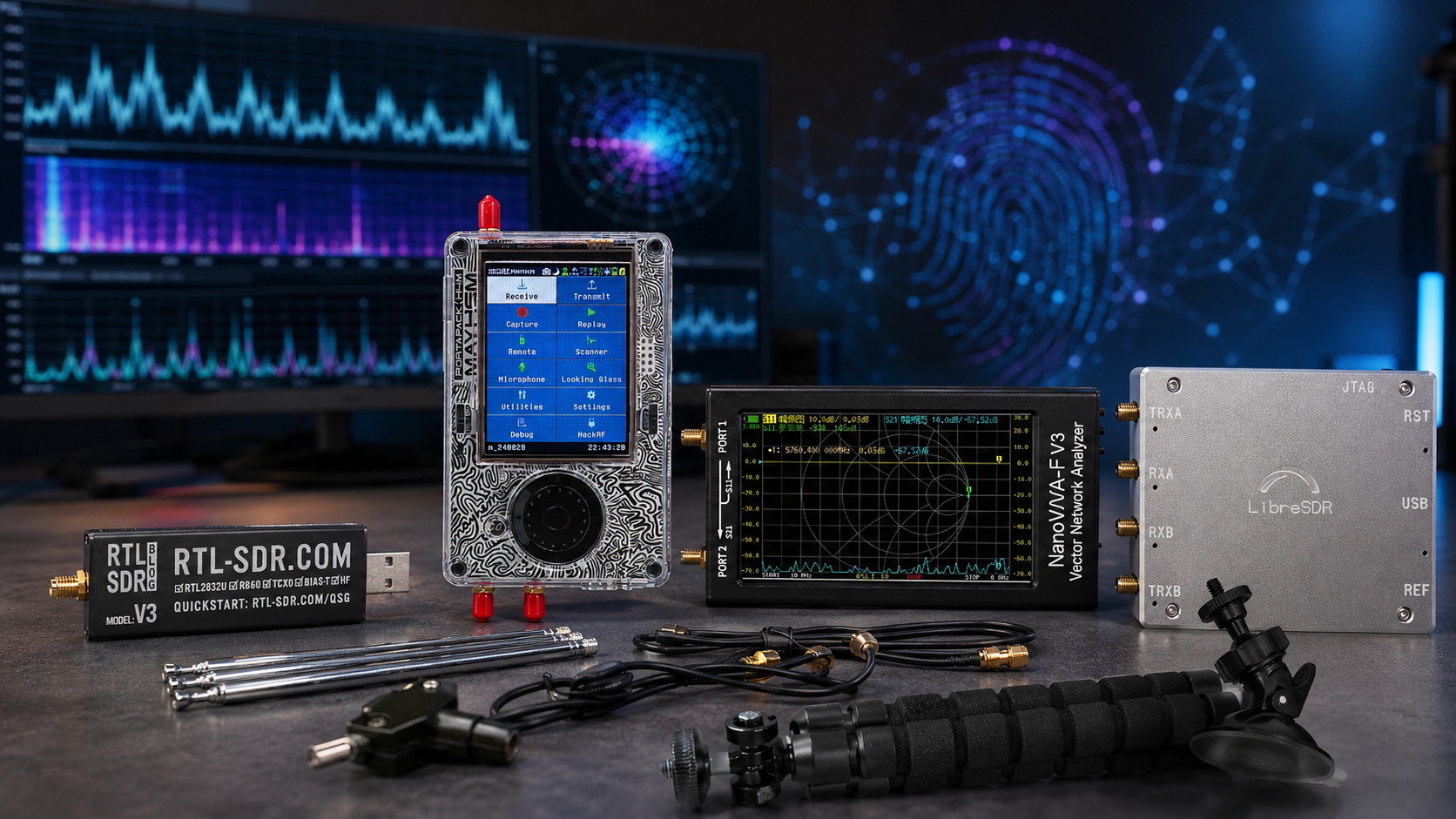
RF fingerprinting is a defensive wireless research technique that tries to identify a radio transmitter from the tiny imperfections in its transmitted signal. Even two devices of the same model can have slightly different RF behavior because of oscillator tolerance, IQ imbalance, DC offset, power-amplifier nonlinearity, phase noise, clock drift, filters, antennas, and manufacturing variation.
With software-defined radio and machine learning, a lab can capture IQ samples from known transmitters, extract useful signal features, train a model, and test whether a new signal looks like one of the known devices. This is useful for IoT security, wireless device authentication research, spectrum monitoring, rogue-device detection, LoRa and Wi-Fi research, drone RF monitoring, private 5G labs, and RF cybersecurity education.
This guide explains RF fingerprinting with SDR from a practical lab perspective: what it can do, what it cannot prove, what hardware is useful, how datasets are built, which machine-learning methods are common, and how to avoid misleading results caused by antennas, channels, receiver settings, or poor experimental design.
Browse software-defined radio hardware, RTL-SDR receivers, HackRF SDR devices, USRP SDR devices, bladeRF SDR devices, and RF test and measurement equipment.
Quick Answer: What Is RF Fingerprinting?
RF fingerprinting is the process of identifying or classifying a transmitter by analyzing physical-layer signal traits instead of only reading protocol identifiers. A normal receiver might identify a device by MAC address, serial number, IMEI, callsign, packet header, or network identity. RF fingerprinting tries to identify the transmitter from how the radio hardware behaves.
| Layer | Normal identification | RF fingerprinting approach |
|---|---|---|
| Protocol layer | MAC address, device ID, packet fields, callsign, network identity | May be spoofed, randomized, hidden, or unavailable |
| Physical RF layer | Signal power, frequency, bandwidth, modulation | Hardware imperfections, IQ imbalance, phase noise, CFO, transient behavior, PA nonlinearity |
| Machine-learning layer | Rule-based classification or manual inspection | Model trained on IQ samples, spectrograms, constellations, or extracted features |
In simple terms: RF fingerprinting asks whether the radio signal contains a repeatable hardware signature that can distinguish one transmitter from another.
Why Transmitters Have RF Fingerprints
No transmitter is perfect. Real RF hardware introduces small distortions into the signal. These imperfections can appear in ways that a sensitive receiver and a well-designed algorithm can measure.
Common RF fingerprint sources
- Carrier frequency offset from oscillator tolerance
- Phase noise from oscillator and synthesizer behavior
- IQ imbalance from imperfect quadrature mixers
- DC offset from receiver or transmitter front-end behavior
- Power-amplifier nonlinearities
- Transient turn-on and turn-off behavior
- Symbol constellation distortion
- Clock drift and sample-rate mismatch
- Filter response and front-end imperfections
- Spurious emissions and harmonic behavior
The challenge is separating the transmitter fingerprint from everything else: channel effects, antenna placement, receiver gain, multipath, temperature, motion, interference, and the SDR receiver’s own imperfections.
RF Fingerprinting vs Signal Classification
RF fingerprinting is often confused with signal classification. They are related, but not the same.
| Task | Question answered | Example |
|---|---|---|
| Signal detection | Is there a signal present? | Detecting activity around 433 MHz, 868 MHz, 915 MHz, 2.4 GHz, or 5.8 GHz. |
| Modulation classification | What type of signal is this? | FSK, LoRa, OFDM, Wi-Fi, Bluetooth, FM, QAM, PSK. |
| Protocol decoding | What does the packet say? | Reading packet headers, IDs, payloads, or network fields where legal and permitted. |
| RF fingerprinting | Which transmitter likely produced this signal? | Distinguishing transmitter A from transmitter B even if both use the same protocol. |
For a practical lab, start with detection and signal classification before attempting RF fingerprinting. If you cannot reliably capture and align the signal, the fingerprinting model will not be trustworthy.
Legal and Ethical Boundary
RF fingerprinting can be useful for defensive security and research, but it also has privacy and compliance implications. Use it only in legal, authorized, and documented environments.
- Use RF fingerprinting on your own devices, lab devices, authorized test equipment, or controlled research datasets.
- Do not use SDR systems to track people or identify personal devices without a lawful basis and clear authorization.
- Do not decode, store, or publish sensitive communications content.
- Follow local radio, privacy, cybersecurity, and data-protection laws.
- Use receive-only monitoring unless a transmit experiment is explicitly legal and controlled.
- Do not use RF fingerprinting results as the only proof in high-stakes decisions.
- For security operations, treat RF fingerprinting as one signal of evidence, not an absolute identity guarantee.
What SDR Hardware Is Useful for RF Fingerprinting?
RTL-SDR: Low-cost receive-only learning and monitoring
The RTL-SDR Blog V3 USB-C is a good starting receiver for basic RF monitoring, low-cost education, and simple dataset experiments in supported frequency ranges.
Use RTL-SDR for:
- Beginner SDR and RF fingerprinting education
- Receive-only spectrum observation
- Simple IoT signal monitoring
- Basic IQ dataset collection at modest bandwidth
- RF cybersecurity lab demonstrations
- Remote monitoring nodes where low cost matters
Limitations: RTL-SDR has limited bandwidth, dynamic range, and frequency coverage. It is useful for learning and low-cost monitoring, but more serious fingerprinting work benefits from SDRs with better clocks, wider bandwidth, calibrated gain behavior, and more stable RF performance.
HackRF Pro: Wideband RF monitoring and dataset capture
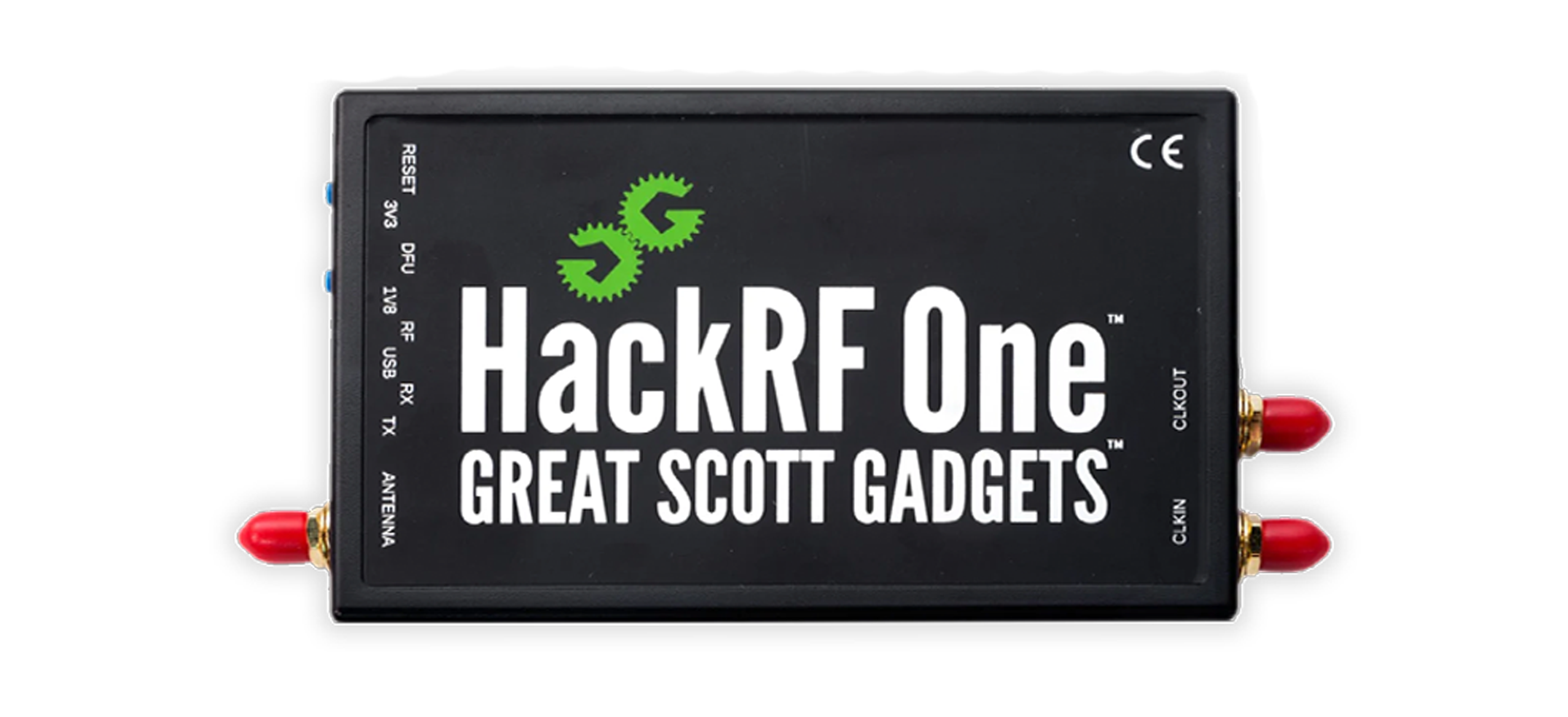
The HackRF Pro is useful for wideband receive-side monitoring, RF lab work, GNU Radio experiments, and collecting signals across many common IoT, ISM, drone, and wireless-device bands.
Use HackRF Pro for:
- Wideband RF fingerprinting experiments
- 2.4 GHz and 5.8 GHz monitoring
- IoT, drone, remote-control, and wireless-device research
- GNU Radio data capture workflows
- Signal classification and RF anomaly detection
- Controlled lab transmitter testing
Important note: HackRF Pro is transmit-capable, but RF fingerprinting datasets should normally be built with authorized transmitters and receive-only monitoring. Do not transmit in bands or conditions where you are not authorized.
USRP B210: Strong research SDR for repeatable RF/ML experiments
The USRP B210 is a strong platform for RF fingerprinting research because it supports UHD, GNU Radio, 2×2 MIMO direction, external workflow integration, and real-time IQ capture over USB 3.0.
Use USRP B210 for:
- University RF fingerprinting research
- IoT device identification datasets
- LoRa, Wi-Fi, BLE, 5G lab, or custom waveform experiments where supported
- MIMO or multi-antenna feature research
- GNU Radio and Python ML pipelines
- Repeatable cabled RF paths
- Private 5G and AI-RAN-adjacent datasets
For many labs, USRP B210 is the practical step up from RTL-SDR and HackRF when repeatability and research credibility matter.
bladeRF 2.0 micro: 2×2 MIMO and FPGA-oriented experimentation
bladeRF 2.0 micro is useful when the research includes 2×2 MIMO, custom waveforms, libbladeRF, SoapySDR, FPGA-related experiments, or compact SDR testbeds.
Choose bladeRF 2.0 micro xA4 for general RF/ML, GNU Radio, and host-side processing. Choose bladeRF 2.0 micro xA9 when the project needs more FPGA capacity.
Use bladeRF for:
- 2×2 MIMO RF fingerprinting research
- Custom transmitter/receiver experiments
- FPGA-assisted preprocessing research
- GNU Radio and SoapySDR workflows
- Wireless communications courses and graduate projects
PLUTO+ SDR: AD9363-based research and teaching
PLUTO+ SDR is useful for AD9363-based learning, transmit/receive experiments, Ethernet SDR workflows, student projects, and lower-cost RF fingerprinting experiments.
Use PLUTO+ for:
- University teaching labs
- AD936x-based RF experiments
- Controlled transmitter datasets
- GNU Radio and SDRangel workflows
- Lower-cost SDR/ML research before moving to USRP-class platforms
RF Measurement Tools for Better Datasets
Machine learning cannot fix a bad RF dataset. If antennas, cables, gain, clocks, and RF paths are uncontrolled, the model may learn the room, cable, receiver, or antenna placement instead of the transmitter.
| Tool | Use in RF fingerprinting lab | SDRstore.eu link |
|---|---|---|
| Spectrum analyzer or TinySA Ultra | Check signal presence, bandwidth, interference, harmonics, and overload | Spectrum analyzers |
| NanoVNA | Validate antennas, cables, filters, return loss, and RF paths | NanoVNA-H4 |
| RF power meter | Measure conducted output power and verify safe signal levels | RF power meters |
| Dummy loads | Safe transmitter testing without unnecessary radiation | RF dummy loads |
| Attenuators | Protect receivers and create repeatable cabled RF paths | RF test and measurement equipment |
| Antennas and filters | Real-world capture, band isolation, and reduced receiver overload | Antennas |
How an RF Fingerprinting Pipeline Works
Step 1: Define the identification problem
Before collecting data, define what the model should identify.
- Known device among known devices?
- Rogue transmitter vs approved transmitter?
- Same model devices with different hardware units?
- Different models or different protocols?
- Open-set detection where unknown devices may appear?
- Lab-only classification or field deployment?
Closed-set classification is easier because every test device is already represented in training. Open-set identification is harder because the system must recognize when a signal does not belong to any known transmitter.
Step 2: Capture IQ samples
IQ samples are the raw material for many RF fingerprinting systems. Capture should be repeatable and documented.
- Use fixed sample rate and bandwidth.
- Use fixed or logged gain settings.
- Record center frequency and clock source.
- Capture enough packets or bursts per transmitter.
- Collect data across time, temperature, distance, and channel conditions.
- Record metadata for every capture.
- Keep training, validation, and test datasets separated properly.
Step 3: Preprocess the signal
Preprocessing can improve consistency and reduce model confusion.
- Frequency correction
- Time alignment
- Packet or burst extraction
- Amplitude normalization
- Noise filtering where appropriate
- Resampling
- Windowing
- Removing obvious non-transmitter artifacts where justified
Be careful: too much preprocessing can remove the fingerprint. Too little preprocessing can make the model learn channel or receiver artifacts.
Step 4: Choose the representation
| Representation | Best use | Trade-off |
|---|---|---|
| Raw IQ samples | Deep learning directly from signal data | Can learn useful features, but may also learn channel artifacts. |
| Spectrograms | CNN image-style classification | Good for time-frequency patterns, but may miss subtle phase details. |
| Constellation features | Modulated signals with stable symbol timing | Requires synchronization and symbol extraction. |
| Transient features | Turn-on/turn-off behavior and bursty devices | Requires precise capture of transients. |
| Engineered RF features | Interpretable ML models | May need RF expertise and careful feature design. |
| Channel-state or MIMO features | Wi-Fi/MIMO research | May mix device identity with environment and movement. |
Step 5: Train the model
Common model types include:
- Support Vector Machines
- Random forests
- k-nearest neighbors
- Convolutional neural networks
- Recurrent neural networks
- Transformers
- Siamese networks
- Autoencoders
- Open-set and anomaly-detection models
The best model depends on dataset size, signal type, compute budget, interpretability requirements, and whether unknown devices must be detected.
Step 6: Validate against realistic conditions
A model that reaches high accuracy in one room on one day may fail in a new environment. Validate across:
- Different days
- Different receiver positions
- Different antenna placements
- Different SNR levels
- Different temperatures
- Different channels and multipath conditions
- Different receiver hardware if deployment requires it
- Unknown transmitters not seen during training
What Can Go Wrong?
| Problem | What happens | Fix direction |
|---|---|---|
| Model learns the channel, not the transmitter | Accuracy is high in one location but poor elsewhere | Collect data across positions, channels, and days. |
| Model learns receiver artifacts | Changing SDR receiver breaks performance | Use multiple receivers or calibrate/normalize receiver effects. |
| Data leakage | Train and test data are too similar | Split by day, device, capture session, and environment where appropriate. |
| Closed-set illusion | Model always picks one known device even when the transmitter is unknown | Add open-set detection and unknown-device testing. |
| Too little data | Model memorizes examples instead of learning stable traits | Collect more captures and more real variation. |
| Class imbalance | Model performs well on common devices and poorly on rare ones | Balance classes and report per-device metrics. |
| Changing firmware or operating mode | Signal characteristics change | Log firmware, modulation, bandwidth, power, and configuration. |
| Privacy or compliance issues | Dataset contains sensitive or unauthorized signals | Use authorized devices and clear data-handling rules. |
Best Use Cases for RF Fingerprinting
IoT device authentication research
RF fingerprinting is useful for studying whether IoT devices can be authenticated at the physical layer, especially when protocol identifiers can be spoofed or cloned.
LoRa and Sub-GHz device identification
LoRa, 433 MHz, 868 MHz, and 915 MHz devices are common in industrial IoT, smart metering, environmental sensing, and low-power networks. RF fingerprinting research can help distinguish known devices in a controlled lab.
Wi-Fi and Bluetooth research
Wi-Fi and Bluetooth devices provide rich RF signals, but they are also challenging because of protocol complexity, mobility, MIMO behavior, and crowded spectrum.
Drone RF monitoring research
RF fingerprinting can support drone RF monitoring research when used legally and defensively. It should be combined with Remote ID, spectrum monitoring, visual confirmation, and lawful escalation.
Private 5G and AI-RAN labs
USRP and SDR-based 5G labs can collect controlled datasets for studying transmitter behavior, neural receivers, RAN authentication ideas, and physical-layer security.
Rogue transmitter detection
In a controlled network, RF fingerprinting can help flag a transmitter that does not match known approved devices. It should be one signal in a broader security system, not the only decision mechanism.
Recommended RF Fingerprinting Lab Packages
Package 1: Beginner RF fingerprinting learning kit
- RTL-SDR Blog V3 USB-C
- Known low-power transmitters or authorized IoT devices
- Band-specific antenna
- Laptop or Raspberry Pi
- GNU Radio or Python capture scripts
- Basic dataset folder structure
Best for: teaching SDR, IQ samples, spectrograms, signal classification, and early RF/ML experiments.
Package 2: Wideband SDR/ML research kit
- HackRF Pro
- Band-specific antennas for the target devices
- TinySA Ultra or spectrum analyzer
- NanoVNA for antenna and cable checks
- RF power meter for controlled transmit tests
- GNU Radio, Python, PyTorch, TensorFlow, or scikit-learn
Best for: wireless security labs, IoT research, drone RF monitoring research, and general RF feature extraction.
Package 3: University research SDR fingerprinting bench
- USRP B210 or USRP X310
- Linux workstation with GPU if deep learning is planned
- External clock or reference source where needed
- Attenuators, dummy loads, cables, and controlled RF path
- Multiple known transmitters of the same model
- Dataset storage and version control
- RF measurement tools for validation
Best for: reproducible RF fingerprinting research, graduate projects, IoT authentication, and machine-learning publications.
Package 4: MIMO and advanced RF fingerprinting testbed
- bladeRF 2.0 micro xA4, bladeRF xA9, USRP B210, or higher-end multi-channel SDR
- Matched antennas
- Equal-length cables
- Clock reference and synchronization where required
- GPU workstation
- Known transmitter set
- Controlled channel and over-the-air test scenarios
Best for: MIMO RF fingerprinting, channel-robust feature research, AI-RAN datasets, and advanced wireless security experiments.
Dataset Checklist
A strong RF fingerprinting dataset should include more than folders named after devices.
- Device model and serial number
- Transmitter firmware and configuration
- Protocol and modulation
- Center frequency and bandwidth
- Sample rate
- SDR model and serial number
- Receiver gain and clock source
- Antenna model and placement
- Cable type and length
- Distance between transmitter and receiver
- Environment description
- Date and time of capture
- Temperature if relevant
- Signal-to-noise estimate
- Train/validation/test split method
- Known legal authorization for the capture
Model Evaluation Checklist
- Report per-device accuracy, not only average accuracy.
- Use a confusion matrix.
- Test on captures from different days.
- Test on different antenna positions.
- Test at different SNR levels.
- Test on unknown devices if the system claims rogue-device detection.
- Test with a different receiver if deployment requires receiver independence.
- Report false positives and false negatives.
- Compare against simple baselines before claiming deep-learning success.
- Keep raw data and preprocessing code versioned.
RF Safety Notes
- Use cabled RF paths with attenuators when possible.
- Use dummy loads for transmitter tests where radiation is unnecessary.
- Do not transmit in licensed bands without authorization.
- Do not connect transmitter output directly to an SDR input without safe attenuation.
- Verify maximum input power for every receiver and instrument.
- Keep lab transmit power low and documented.
- Use shielded setups where required.
- Separate research networks from production networks.
Purchase-Order Justification Examples
USRP B210 RF fingerprinting justification
USRP B210 is required as a UHD-compatible 2×2 MIMO SDR platform for RF fingerprinting research, IQ dataset collection, machine-learning transmitter identification, controlled IoT authentication experiments, and repeatable wireless security laboratory workflows.
HackRF Pro RF monitoring justification
HackRF Pro is required as a wideband SDR platform for receive-side RF monitoring, dataset capture, signal classification, and defensive transmitter-identification research across multiple wireless and IoT bands.
bladeRF MIMO research justification
bladeRF 2.0 micro is required for 2×2 MIMO RF fingerprinting research, custom waveform experiments, libbladeRF workflows, GNU Radio integration, and FPGA-oriented physical-layer security studies.
RF test equipment justification
Spectrum analyzers, NanoVNA, RF power meters, attenuators, dummy loads, antennas, and cables are required to validate the RF capture chain, prevent receiver overload, check antennas, control signal levels, and produce reproducible RF fingerprinting datasets.
Request a Quote for RF Fingerprinting Lab Hardware
Universities, cybersecurity firms, IoT companies, telecom labs, RF research groups, AI/ML teams, and grant-funded projects can request a formal quotation directly from SDRstore.eu.
Use the Add to Quote button on product pages or the document icon on product cards. Add SDR receivers, HackRF Pro, USRP B210, bladeRF, PLUTO+, antennas, cables, filters, attenuators, dummy loads, TinySA Ultra, NanoVNA, RF power meters, and project notes to one quote request.
A quote request is useful when you need:
- RF fingerprinting hardware for a university lab
- SDR and machine-learning dataset capture equipment
- IoT transmitter identification test benches
- Wideband receive-side RF monitoring kits
- MIMO RF fingerprinting research hardware
- RF measurement tools included in one offer
- Formal pricing for a research grant or purchase order
- A phased rollout from beginner to advanced SDR/ML hardware
Read the SDRstore.eu quote-request guide.
Related SDRstore.eu Guides
- RF Cybersecurity Lab Equipment Checklist
- SDR Hardware for RF Product Testing
- Drone RF Detection with SDR
- GNSS Spoofing Detection with SDR
- Best SDR for GNU Radio Projects
- MIMO Testbed Hardware
- SDR Hardware for Wireless Communications Courses
- How to Choose SDR Hardware for a Research Grant or University Purchase Order
- AI-RAN Explained
Official and Technical Resources
- NIST: Robust Measurements for RF Fingerprinting with Constellation Patterns in Radiated Waveforms
- Radio Frequency Fingerprinting via Deep Learning
- Deep Learning-Based LoRa RF Fingerprinting Survey
- Specific Emitter Identification Method for Limited Samples
- ORACLE RF Fingerprinting Dataset
- Adversarial-Driven Experimental Study on Deep Learning for RF Fingerprinting
- GNU Radio official website
- Ettus Research USRP B210 official page
- Nuand bladeRF 2.0 micro official page
Final Recommendation
For a beginner RF fingerprinting lab, start with RTL-SDR or HackRF Pro, known authorized transmitters, a stable antenna setup, and simple IQ or spectrogram classification. For university research, use USRP B210, USRP X310, bladeRF, or PLUTO+ with controlled RF paths, measurement tools, strong metadata, and a carefully designed dataset.
The most important part is not the machine-learning model. It is dataset quality. A good RF fingerprinting project controls antennas, cables, gain, receiver hardware, channel conditions, timing, and train/test splits so the model learns transmitter traits rather than shortcuts.
For real security use, treat RF fingerprinting as one layer of evidence. Combine it with protocol checks, cryptographic authentication, spectrum monitoring, access logs, device inventory, physical security, and human review.
FAQ
What is RF fingerprinting?
RF fingerprinting is a technique for identifying or classifying a transmitter based on physical-layer signal traits caused by hardware imperfections, such as IQ imbalance, phase noise, carrier frequency offset, transient behavior, and power-amplifier nonlinearity.
Can SDR identify a transmitter?
SDR can capture the RF signal needed for transmitter-identification research. Whether it can identify a transmitter reliably depends on hardware quality, dataset design, signal type, channel conditions, model quality, and whether unknown devices are included in testing.
What is the best SDR for RF fingerprinting?
RTL-SDR is good for learning, HackRF Pro is useful for wideband receive-side experiments, USRP B210 is a strong research choice, bladeRF is useful for 2×2 MIMO and FPGA-oriented work, and PLUTO+ is useful for AD9363-based teaching and research.
Does RF fingerprinting need machine learning?
Not always. Some systems use engineered RF features and traditional classifiers. However, many modern RF fingerprinting systems use machine learning or deep learning on IQ samples, spectrograms, constellation features, transient features, or other extracted RF features.
What data is used for RF fingerprinting?
Common data types include raw IQ samples, spectrograms, constellation points, transient captures, packet bursts, carrier frequency offset, phase noise, amplitude behavior, and engineered RF features.
Can RF fingerprinting identify unknown transmitters?
Only if the system is designed for open-set detection or anomaly detection. A normal closed-set classifier will usually force every signal into one of the known classes, even when the transmitter is actually unknown.
What is the biggest problem in RF fingerprinting?
The biggest problem is generalization. A model may work well in one lab but fail when the channel, receiver, antenna position, temperature, SNR, or environment changes. Dataset design and validation are critical.
Is RF fingerprinting legal?
RF fingerprinting research can be legal when performed on authorized devices and datasets, but laws vary by country and use case. Do not use it for unauthorized tracking, interception, surveillance, or high-stakes identification without legal authority and proper safeguards.
Do I need a NanoVNA or spectrum analyzer?
They are strongly recommended. NanoVNA helps validate antennas, cables, and filters. A spectrum analyzer or TinySA Ultra helps check signal power, interference, bandwidth, and receiver overload before building a dataset.
Can SDRstore.eu quote an RF fingerprinting research kit?
Yes. Use the Add to Quote button on product pages or the document icon on product cards. Add SDRs, antennas, cables, RF tools, attenuators, dummy loads, and project notes so the complete RF fingerprinting setup can be quoted together.
No posts found
Write a review






We support all major card and digital payment options. More local methods are available and shown during checkout.
You enter into a binding sales contract once you have received an 'order confirmation and sales receipt' email from us, in line with our Sales & Delivery conditions. Therefore, sdrstore.eu has the right to cancel your order in the event of technical problems, delivery failure, Fair use policy and other similar situations.






Your payments are protected by advanced encryption and 3-D Secure authentication for safe online shopping.